DeepSeek

Search documents
DeepSeek-V3.2-Exp发布,训练推理提效,API成本降50%以上
Sou Hu Cai Jing· 2025-09-29 13:18
Core Insights - DeepSeek has released the DeepSeek-V3.2-Exp model, which is an experimental version aimed at transitioning to a new generation architecture [1] - The new model introduces DeepSeek Sparse Attention, focusing on optimizing training and inference efficiency for long texts [1] - The official app, web version, and mini-program have all been updated to DeepSeek-V3.2-Exp, and the API costs have been significantly reduced by over 50% for developers [1] - The performance of DeepSeek-V3.2-Exp on various public evaluation sets is comparable to that of V3.1-Terminus [1]


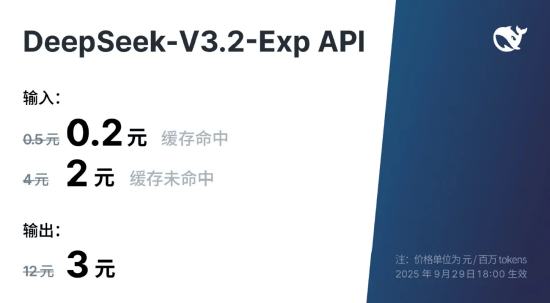
Deepseek API大降价,开发者成本可降超50%
2 1 Shi Ji Jing Ji Bao Dao· 2025-09-29 12:39
Core Insights - DeepSeek has officially released and open-sourced the DeepSeek-V3.2-Exp model on the Hugging Face platform, with updates across its official app, web, and mini-programs [1] - The new model incorporates a sparse Attention architecture, which reduces computational resource consumption and enhances inference efficiency [1] - The introduction of the new model has led to a significant reduction in service costs, with API prices dropping by over 50% [1] Company Developments - On September 22, DeepSeek updated the DeepSeek-V3.1 model to the DeepSeek-V3.1-Terminus version, achieving a maximum single-item performance improvement of over 36% [3] - The API pricing for the previous version remained unchanged, with costs set at 0.5 yuan for 1 million tokens input and 12 yuan for output [3] - The rapid updates and enhancements in model performance are seen as crucial for retaining developers in a competitive open-source model landscape [3] Industry Impact - Analysts from Guosheng Securities highlight that DeepSeek's high performance, low cost, and innovative algorithms position it competitively against global standards, reshaping investor perceptions of Chinese tech companies' innovation capabilities [3] - The growth in AI model training and inference is expected to drive demand for AI computing power, benefiting various segments of the computing industry, including AI chips and servers [4]
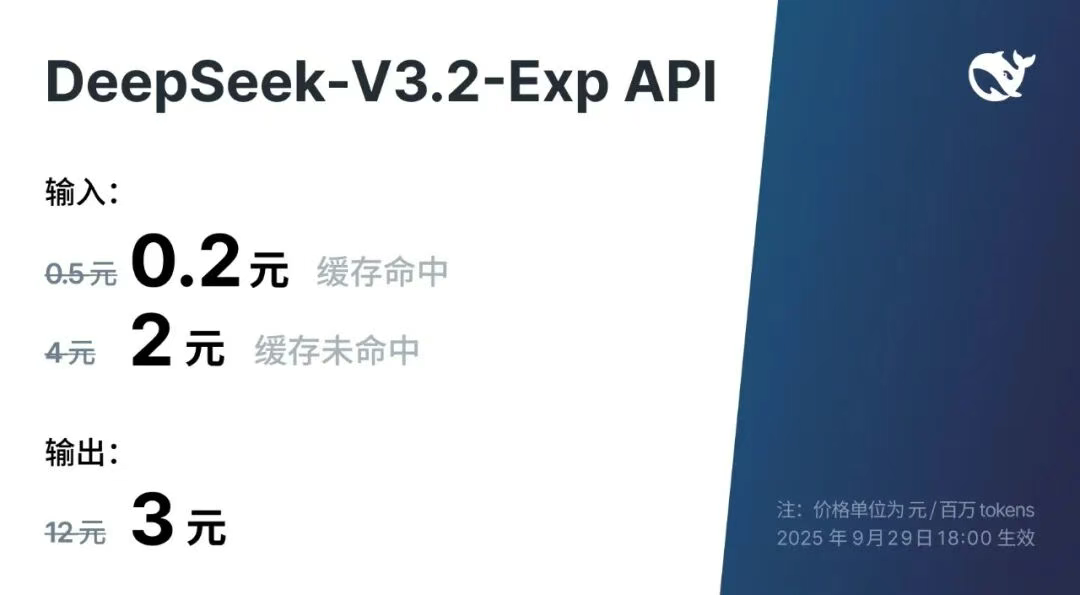
Deepseek API大降价,开发者成本可降超50%
21世纪经济报道· 2025-09-29 12:35
Core Viewpoint - DeepSeek has released its new model DeepSeek-V3.2-Exp, which significantly reduces service costs and enhances model inference efficiency through a sparse Attention architecture [1][5]. Group 1: Model Updates - The DeepSeek-V3.2-Exp model was officially launched on September 29, with updates across its app, web, and mini-program platforms [1]. - The previous version, DeepSeek-V3.1, was updated to DeepSeek-V3.1-Terminus on September 22, showing a performance improvement of over 36% [5]. - The API pricing for DeepSeek has been reduced by over 50% due to the new model's cost efficiency [1]. Group 2: Market Impact - Following the release of DeepSeek-V3.1, there was a notable surge in stock prices for several domestic chip industry companies [5]. - Analysts highlight that the rapid updates and bug fixes in open-source models are crucial for retaining developers in a competitive landscape [5]. Group 3: Industry Insights - The AI computing demand is expected to grow due to large model training and inference, benefiting various segments of the computing industry, including AI chips and servers [6]. - DeepSeek's innovations and performance position it competitively against global leaders, reshaping investor perceptions of Chinese tech companies' capabilities [5].
DeepSeek-V3.2-Exp模型发布并开源,API价格大幅下调
3 6 Ke· 2025-09-29 12:12
Core Insights - DeepSeek-V3.2-Exp model has been officially released and open-sourced, featuring significant updates in architecture and efficiency [1][4] - The introduction of DeepSeek Sparse Attention (DSA) aims to enhance training and inference efficiency for long texts without compromising output quality [1][5] - The API costs for developers have been reduced by over 50% due to the new model's service cost decrease [4] Group 1: Model Features - DeepSeek-V3.2-Exp is an experimental version that builds on V3.1-Terminus, incorporating a sparse attention mechanism [1] - The model achieves fine-grained sparse attention, significantly improving long text training and inference efficiency [1] - The new model's performance is comparable to V3.1-Terminus across various public evaluation datasets [5] Group 2: Development and Implementation - The development of the new model required the design and implementation of numerous new GPU operators, utilizing TileLang for rapid prototyping [2] - The open-sourced operators include both TileLang and CUDA versions, with a recommendation for the community to use the TileLang version for easier debugging [2] Group 3: Previous Versions and Improvements - DeepSeek-V3.1 was released on August 21, featuring a mixed inference architecture and improved efficiency compared to DeepSeek-R1-0528 [4] - The subsequent update to DeepSeek-V3.1-Terminus on September 22 addressed user feedback, enhancing language consistency and agent capabilities [4]
X @Bloomberg
Bloomberg· 2025-09-29 12:08
DeepSeek updated an experimental AI model Monday in what it called a step toward next-generation artificial intelligence https://t.co/jGu6RIkgj9 ...
降价!DeepSeek,大消息!
Zheng Quan Shi Bao Wang· 2025-09-29 12:07
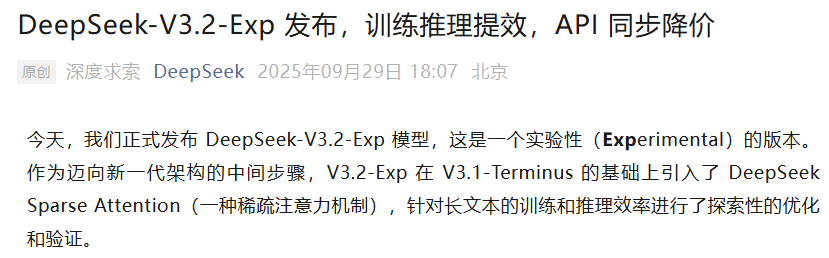
Core Insights - DeepSeek has officially released the DeepSeek-V3.2-Exp model, which introduces the DeepSeek Sparse Attention mechanism to enhance training and inference efficiency for long texts [1][3] - The performance of DeepSeek-V3.2-Exp is comparable to its predecessor, DeepSeek-V3.1-Terminus, across various benchmark datasets [3][4] - The official app, web version, and mini-program have been updated to DeepSeek-V3.2-Exp, with a significant reduction in API costs by over 50% for developers [4] Model Performance - DeepSeek-V3.2-Exp maintains similar performance levels to DeepSeek-V3.1-Terminus in several benchmarks, such as MMLU-Pro (85.0), GPQA-Diamond (79.9), and SimpleQA (97.1) [4] - Notable improvements were observed in the BrowseComp and Codeforces-Div1 benchmarks, with scores of 40.1 and 2121 respectively for V3.2-Exp [4] Recent Developments - DeepSeek has been active recently, with the release of DeepSeek-V3.1 on August 21, which marked a step towards the "Agent era" with enhanced reasoning capabilities and efficiency [8] - A research paper on the DeepSeek-R1 reasoning model was featured on the cover of the prestigious journal Nature, highlighting significant advancements in AI technology from China [8][9] - Nature's editorial praised DeepSeek for breaking the gap in independent peer review for mainstream large models, marking a milestone for Chinese AI research [9]
降价!DeepSeek,大消息!
证券时报· 2025-09-29 11:55
Core Viewpoint - DeepSeek has launched the DeepSeek-V3.2-Exp model, which introduces a Sparse Attention mechanism to enhance training and inference efficiency for long texts, while maintaining output quality similar to its predecessor, V3.1-Terminus [2][4]. Group 1: Model Performance - The DeepSeek-V3.2-Exp model shows comparable performance to the V3.1-Terminus across various benchmark datasets, with specific scores indicating slight variations in certain areas [5]. - In the MMLU-Pro benchmark, both models scored 85.0, while in the General GPQA-Diamond benchmark, V3.1 scored 80.7 and V3.2-Exp scored 79.9 [5]. - The Sparse Attention mechanism has led to significant improvements in training and inference efficiency without compromising model output [4]. Group 2: Recent Developments - DeepSeek has been active recently, with the V3.1-Terminus model being released on August 21, which introduced a hybrid reasoning architecture and improved efficiency and agent capabilities [8]. - A research paper on the DeepSeek-R1 reasoning model was published in the prestigious journal Nature, marking a significant achievement for Chinese AI research [8][9]. - The new pricing policy for the DeepSeek API has reduced costs for developers by over 50%, making it more accessible [4].

“价格屠夫”DeepSeek上线,新模型成本下降超50%
Di Yi Cai Jing· 2025-09-29 11:50
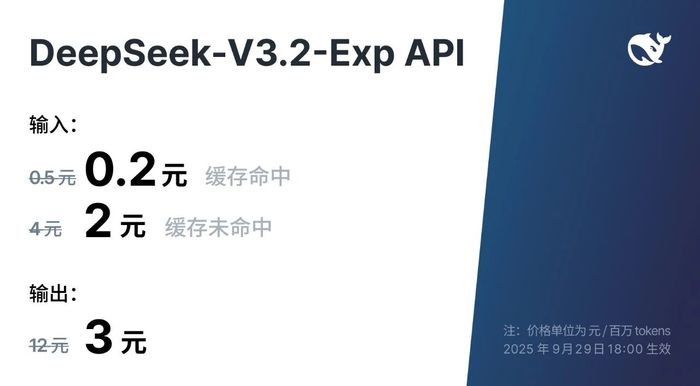
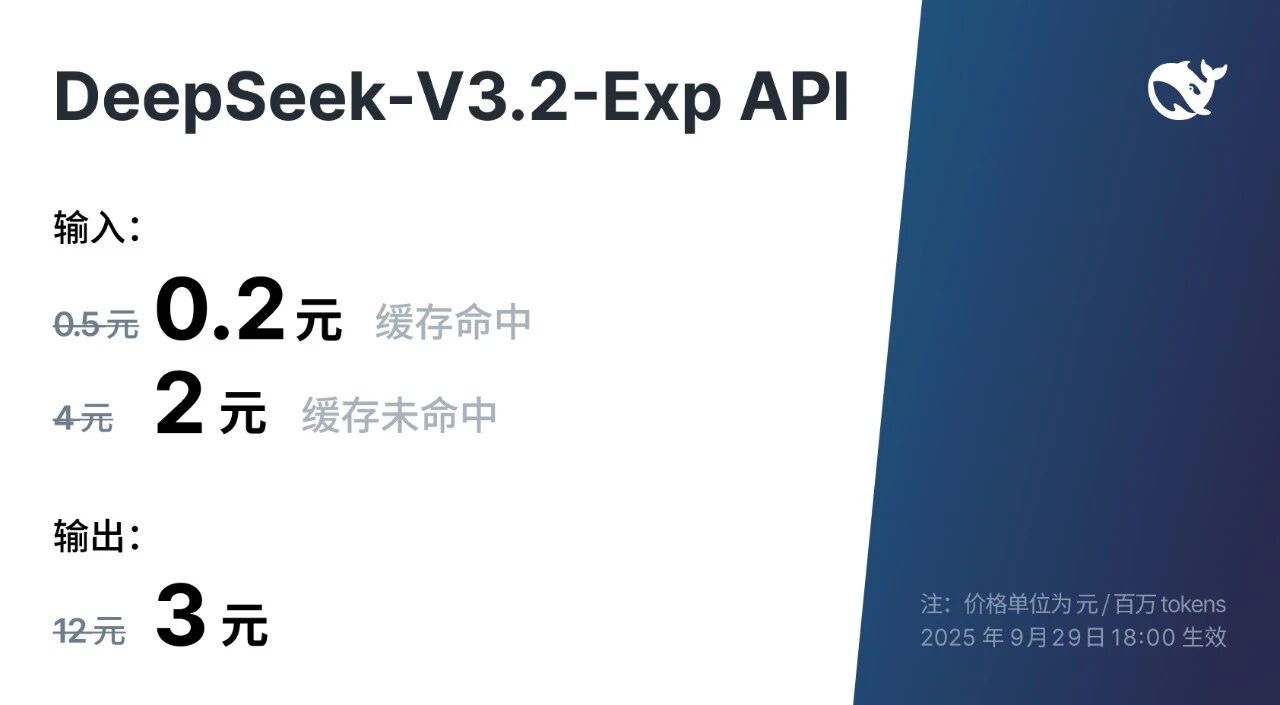
Core Insights - DeepSeek, known as the "price butcher," has significantly reduced its pricing for the newly released DeepSeek-V3.2-Exp model, with output prices dropping by 75% and overall API costs for developers decreasing by over 50% [1][3]. Pricing Changes - Input pricing for DeepSeek-V3.2-Exp has been adjusted: - Cache hit price decreased from 0.5 yuan per million tokens to 0.2 yuan per million tokens - Cache miss price reduced from 4 yuan per million tokens to 2 yuan per million tokens - Output pricing has been slashed from 12 yuan per million tokens to 3 yuan per million tokens [3]. Model Performance and Features - The V3.2-Exp model is an experimental version that introduces DeepSeek Sparse Attention, enhancing training and inference efficiency for long texts without compromising output quality [3][6]. - Performance evaluations show that DeepSeek-V3.2-Exp maintains comparable results to the previous V3.1-Terminus model across various public benchmark datasets [3][4][5]. Community Support and Open Source - DeepSeek has open-sourced GPU operators designed for the new model, including TileLang and CUDA versions, encouraging community research and experimentation [6]. - The model is now available on platforms like Huggingface and has been updated across official applications and APIs [5][6]. Industry Context - Following the recent release of DeepSeek-V3.1-Terminus, there is speculation about the future of the V4 and R2 versions, with industry voices expressing anticipation for major updates [6].
DeepSeek V3.2和智谱GLM-4.6即将发布
Zheng Quan Ri Bao Wang· 2025-09-29 11:46
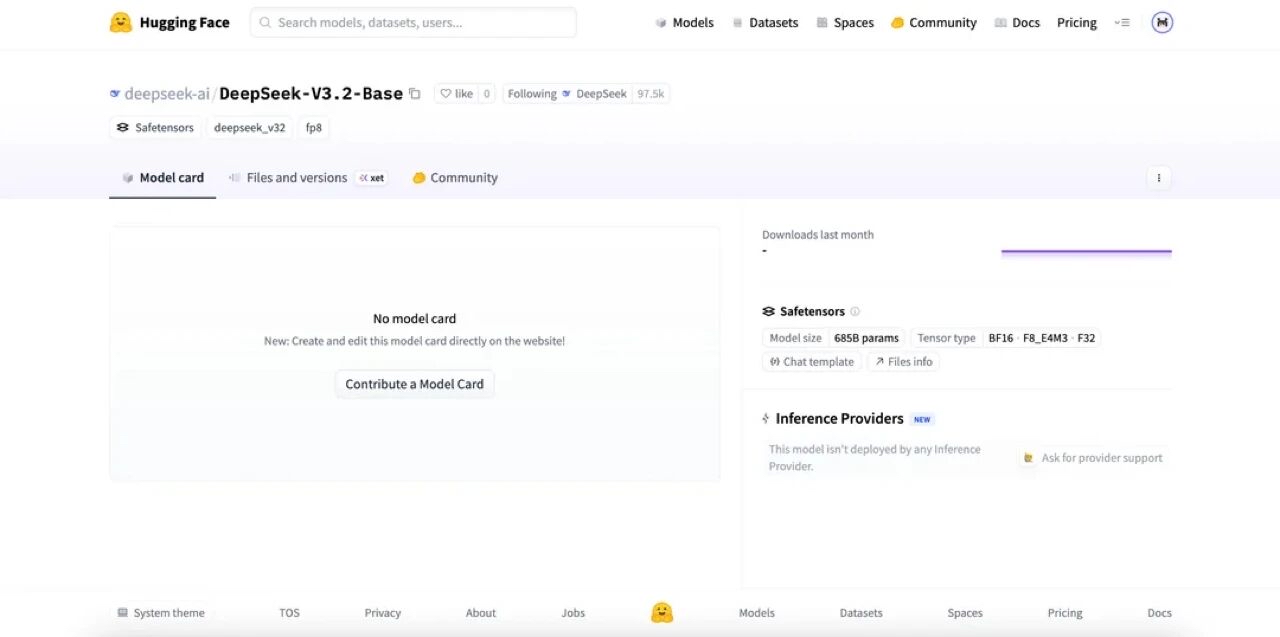
Group 1 - DeepSeek has launched the DeepSeek-V3.2-base model on Huggingface as of September 29 [1] - Zhiyu's next-generation flagship model GLM-4.6 is set to be released soon, with the current flagship model GLM-4.5 available on Z.ai's official website [1]
DeepSeek,重大突发!
券商中国· 2025-09-29 11:16
Core Viewpoint - DeepSeek has launched its updated model DeepSeek-V3.2-Exp, which significantly reduces API costs for developers by over 50% due to lower service costs associated with the new model [1][9]. Model Release and Features - The DeepSeek-V3.2-Exp model was officially released on September 29 and is available on the Hugging Face platform, marking an important step towards the next generation architecture [3]. - This version introduces the DeepSeek Sparse Attention (DSA) mechanism, which optimizes training and inference efficiency for long texts while maintaining model output quality [5][8]. - The model supports a maximum context length of 160K, enhancing its capability for handling extensive data [4]. Cost Structure and API Pricing - The new pricing structure for the DeepSeek API includes a cost of 0.2 yuan per million tokens for cache hits and 2 yuan for cache misses, with output priced at 3 yuan per million tokens, reflecting a significant reduction in costs for developers [9]. Open Source and Community Engagement - DeepSeek has made the DeepSeek-V3.2-Exp model fully open source on platforms like Hugging Face and ModelScope, along with related research papers [11]. - The company has retained API access for the previous version, V3.1-Terminus, to allow developers to compare performance, with the same pricing structure maintained until October 15, 2025 [11]. Upcoming Developments - There are indications that the new model GLM-4.6 from Z.ai will be released soon, which is expected to offer greater context capabilities [15][16].