
BAE Systems

Search documents
X @Bloomberg
Bloomberg· 2025-07-16 21:36
BAE said it is speeding ahead with the development of its next-generation Tempest fighter jet, as a rival European program is hamstrung by Franco-German squabbling https://t.co/SbRvcP0tQN ...
X @Bloomberg
Bloomberg· 2025-07-15 18:12
BAE is confident about securing as many as 150 additional Eurofighter Typhoon jet orders from export markets as conflicts push up demand in the Middle East and Europe https://t.co/XjQt2xGZxT ...
决定性催化剂:解析“大而美法案”对欧美A、D板块的冲击与机遇
Haitong Securities International· 2025-07-09 01:46
Investment Rating - The report indicates a bullish outlook for the US Aerospace and Defense (A&D) sector following the passage of the "One Big, Beautiful Bill" [3][11]. Core Insights - The "One Big, Beautiful Bill" allocates an additional $150 billion to the US Department of Defense, addressing chronic underinvestment in the Defense Industrial Base (DIB) and military modernization needs [1][8]. - This funding is a strategic, front-loaded capital injection aimed at signaling long-term demand to the defense industry, encouraging private sector investments in production capacity and supply chain resilience [2][9]. - The bill is expected to create a growth super-cycle in the A&D industry, providing unprecedented certainty for defense contractors' planning and capital expenditures over the next 3-5 years [2][10]. Summary by Sections US A&D Sector - The funding will lead to higher order-to-delivery ratios and earnings growth in the coming years, with management commentary on the impact of new orders being closely monitored [3][11]. - Labor shortages and supply chain bottlenecks are identified as potential execution risks despite a positive demand outlook [11]. European A&D Sector - The substantial funding for US A&D firms will increase competitive pressures on European counterparts, particularly in export orders [12]. - This situation may catalyze European governments to enhance their defense spending to support local champions, necessitating a selective investment approach in the European A&D sector [12]. Investment Recommendations - The report recommends focusing on companies such as Howmet Aerospace, BAE Systems, Rolls-Royce, Safran, GE Aerospace, and Boeing for potential investment opportunities [5][13].
花旗:金钱与实力 2.0_权衡选择
花旗· 2025-07-07 15:44
Investment Rating - The report maintains a positive outlook on global defense spending, indicating potential growth opportunities for defense contractors through the remainder of the decade [3][7][57]. Core Insights - The report highlights a significant shift in defense spending priorities under President Trump's administration, focusing on bolstering security in the Indo-Pacific and reducing reliance on European security [6][56]. - NATO member countries have set a new defense spending target of 5% of GDP by 2035, with core defense spending rising from 2% to 3.5% of GDP, which could enhance NATO's defense capabilities if achieved [4][22]. - The report emphasizes the increasing importance of technological advancements, particularly in artificial intelligence and unmanned systems, which are expected to drive future defense investments [49][81]. Summary by Sections Global Defense Spending - The U.S. defense budget is projected to increase significantly, with a flat discretionary budget and $119 billion in mandatory spending allocated for fiscal 2026 [10][72]. - The U.S. is currently spending 3.4% of GDP on defense, with a notable increase in defense spending across NATO countries due to geopolitical tensions [28][29]. European Defense - European defense spending has increased by approximately 40% over the past two years, with Germany accounting for a significant portion of this growth [39]. - The EU's ReArm Europe program aims to unlock additional funding for defense, potentially adding €160 billion annually over the next four years [37][40]. Indo-Pacific Defense - Countries in the Indo-Pacific region are enhancing their defense capabilities in response to threats from China and North Korea, with increased cooperation among Western and Eastern allies [9][18]. - The report notes that while some nations have maintained spending levels, others are increasing their budgets to deter regional conflicts [18]. Technological Advancements - The report discusses the role of AI and machine learning in modernizing defense efforts, with a focus on enhancing decision-making and operational capabilities [81]. - The U.S. is investing in autonomous systems and cyber capabilities to improve defense readiness and counter adversarial threats [81][83]. Procurement and Spending Trends - The report anticipates a shift in defense procurement priorities, with an emphasis on attritable systems and advanced technologies to enhance military effectiveness [74][90]. - The U.S. Department of Defense is expected to allocate significant funding towards shipbuilding and missile defense initiatives, reflecting a strategic focus on maritime threats [86][92].
全球LEO抗辐射IC总体规模及主要厂商占有率和排名
QYResearch· 2025-06-30 09:52
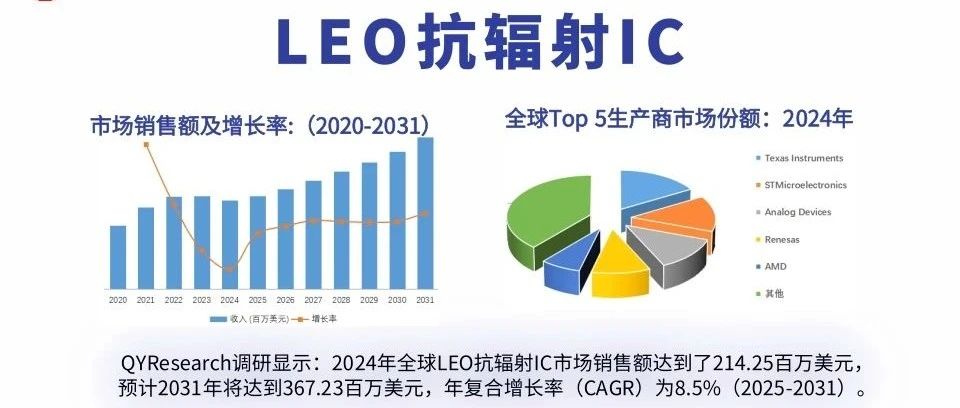
Core Viewpoint - The LEO radiation-resistant IC industry is rapidly emerging due to the growth of commercial space and satellite constellations, focusing on integrated circuits designed to operate reliably in low Earth orbit environments [2][4]. Global LEO Radiation-Resistant IC Market Overview - The global LEO radiation-resistant IC market is projected to reach $367.23 million by 2031, with a compound annual growth rate (CAGR) of 8.5% from 2025 to 2031 [8]. - In 2024, the market size is expected to be $214.25 million, with China accounting for approximately 18.35% of the global market at $39.32 million [9][8]. Market Dynamics - The deployment of satellite constellations is stimulated by lower launch costs, enhancing internet access and Earth observation capabilities [4]. - LEO satellites offer advantages such as low latency, low radiation exposure, and cost-effectiveness, making them suitable for various applications including mobile communications [4]. Key Players and Market Share - Major global players include Texas Instruments, STMicroelectronics, Analog Devices, Renesas, and AMD, with the top five companies holding about 61.19% of the international market share in 2024 [10]. - In the Chinese market, leading companies include航天智装, 航宇微, and 臻镭科技, with the top five firms capturing approximately 64.95% of the domestic market [11]. Product and Application Insights - Ceramic packaging is expected to dominate the market, reaching a share of 74.62% by 2031 [14]. - The satellite application segment is projected to account for about 94.74% of the market in 2024, with a CAGR of 8.58% in the coming years [14]. Industry Trends and Innovations - The industry is focusing on enhancing radiation resistance and optimizing power consumption, with advancements in semiconductor technology improving performance and reducing costs [18][21]. - North America remains a dominant production center, while China is rapidly catching up due to increasing local demand and government support for domestic chip development [19]. Competitive Landscape - The market is characterized by high concentration among leading firms, with significant vertical integration in supply chains to reduce costs and enhance capabilities [20]. - The industry is driven by the increasing demand for LEO satellite communications, technological advancements, and supportive policies aimed at standardizing and promoting the sector [21][22].

甲烷革命:价值向上游转移,重塑太空发射投资版图
Haitong Securities International· 2025-06-27 09:22
Investment Rating - The report suggests a focus on upstream suppliers that provide core technologies and high barriers to entry, rather than direct investment in launch vehicle companies that face significant market and capital expenditure risks [4][50]. Core Insights - The global aerospace launch market is undergoing a profound and irreversible structural expansion driven by a revolution in cost structures, shifting from a government budget-dominated paradigm to a commercially driven era focused on high launch frequency and cost efficiency [1][7]. - The key catalyst for this transformation is SpaceX's disruptive cost reductions achieved through reusable rocket technology, which has set new price benchmarks and operational expectations for the market [1][7]. - Future launch demand will be supported by three solid pillars: the large-scale deployment of commercial broadband constellations (e.g., Starlink and Kuiper), increasing geopolitical competition and national security needs, and the revival of scientific and deep space exploration missions represented by the Artemis program [1][10]. Industry Background and Market Drivers - The report highlights a significant increase in global orbital launches, with a record of 259 launches expected in 2024, up from 223 in 2023, and a forecast of over 300 launches in 2025 [7][10]. - The transition to a commercial-driven market is exemplified by SpaceX's 138 launches in 2024, which accounted for half of the global market, establishing a new operational rhythm [7][10]. Core Technology Path Analysis - The competition in the launch market is fundamentally a competition of underlying propulsion technologies, converging on the "Methalox + Reusability + Additive Manufacturing" combination [2][13]. - Methalox engines are recognized as the future mainstream path due to their clean combustion characteristics and ability to simplify the reuse process, addressing the carbon buildup issues of traditional kerosene fuels [15][19]. Value Chain and Supply Chain Analysis - The report identifies a shift in value and profit concentration towards upstream suppliers of core technologies and high-barrier components, moving away from midstream assembly integration [3][36]. - The "smile curve" analysis indicates that high-value areas are concentrated at the upstream and downstream ends of the value chain, while midstream assembly faces profit margin pressures [36][37]. Investment Recommendations - The report recommends focusing on companies such as Howmet Aerospace, LOAR, VSE Corporation, BAE Systems, Rolls-Royce, Safran, L3Harris Technologies, and Velo3D, which are positioned as key technology enablers in the supply chain [4][50].


General Dynamics' Arm Secures $621M Contract to Aid SGT Stout Program
ZACKS· 2025-06-24 14:25
Group 1: General Dynamics' Contract and Product Overview - General Dynamics' Land Systems unit secured a modification contract worth $621.1 million to support the SGT Stout program, expected to be completed by September 29, 2028 [1][8]. - The SGT Stout is an armored vehicle designed to enhance the U.S. Army's short-range air defense capabilities, built on the advanced Stryker A1 chassis [2][8]. - The vehicle features integrated target-acquisition systems and is compatible with the Army's Integrated Air and Missile Defense command systems, improving operational effectiveness in Multi-Domain Operations [2][3]. Group 2: Market Growth and Demand - Rising geopolitical tensions, defense modernization programs, and increased military spending are driving demand for combat vehicles globally [4]. - The global armored fighting vehicles market is forecasted to grow at a compound annual growth rate of 5% from 2025 to 2030, benefiting General Dynamics as a key contractor in this sector [4][5]. Group 3: Opportunities for Other Defense Companies - RTX Corporation's XM30 Combat Vehicle is positioned to address future battlefield challenges, with a long-term earnings growth rate of 9.3% and a projected 4.2% year-over-year sales growth for 2025 [6][7]. - Textron Inc.'s COMMANDO armored vehicle series combines combat-proven features and has a long-term earnings growth rate of 10%, with a 6.6% year-over-year sales growth forecast for 2025 [7][8]. - BAE Systems has a diverse portfolio of combat vehicles and a long-term earnings growth rate of 13.4%, with an impressive 62.6% year-over-year sales growth estimate for 2025 [9].



Can the UK Afford to Defend Itself?
Bloomberg Originals· 2025-06-20 08:00
UK Defense Spending & Capability - UK government will begin the biggest sustained increase in defense spending since the end of the Cold War [1] - The British army's combat power is much less than it has been [1] - The army is at its smallest size since the Napoleonic era, losing more people than it's recruiting [2] - Security experts believe Britain is incapable of defending itself against a ballistic missile attack [4] - There is a significant gap between Britain's rhetoric/reputation and its actual military capabilities [5] Financial Constraints & Political Challenges - Voters want more security and greater defense spending, but don't necessarily want to pay for it [4] - Since 1955, there's been a correlation between the UK's ballooning health and welfare bill and cuts to defense spending [10] - In the 50s, defense spending was at 7-1/2% of GDP and health spending at around 3% of GDP; those percentages are almost flipped now [11] - Raising defense spending to 5% of GDP will add 350 billion pounds to the level of government debt by 2032 [19] - By 2030, upping the NATO target to 5% would mean an extra 87 billion pounds worth of spending on defense [18] Strategic Considerations & Industry Impact - The current target strength is 72,000 personnel, but available strength is around 55,000 [6][7] - Defense spending will now rise to 2-3/5% of GDP by April 2027, including the contribution of intelligence agencies [17] - Focus expenditure on investments in this country, not importing from the US, to provide a domestic boost to the economy [23] - Military spending focused on research and development could lift UK productivity [23] - Industry needs commitments from the UK government or allied governments to know exactly what they need to make [26]

General Dynamics' Arm Wins a $987M Navy Deal for Submarine Support
ZACKS· 2025-06-19 14:56
Core Viewpoint - General Dynamics Corporation's Electric Boat unit secured a $986.8 million modification contract for Columbia Class submarines, enhancing its position in the defense sector [1][2][8]. Group 1: Contract Details - The contract, valued at $986.8 million, is expected to be completed by December 2031 and includes component development, class lead yard support, and enhancements for the Submarine Industrial Base [2]. - Most of the work will be executed in Groton, Connecticut [2][8]. Group 2: Industry Growth Prospects - Global military conflicts and national security concerns are driving investments in submarine fleets, with a forecasted compound annual growth rate of 7.6% for the global submarine market from 2025 to 2030 [3][4]. - General Dynamics, as a key contractor in the submarine market, is well-positioned to benefit from this growth, particularly through its Electric Boat division [4]. Group 3: Opportunities for Other Defense Players - Huntington Ingalls Industries (HII) is involved in producing Columbia-class and Virginia-class submarines, with a long-term earnings growth rate of 11% and a projected 3.3% sales growth for 2025 [5][6]. - BAE Systems, a primary manufacturer of the Astute-class nuclear submarines, has a long-term earnings growth rate of 13.4% and a projected 62.6% sales growth for 2025 [6][7]. - Northrop Grumman Corporation provides missile launch systems for naval submarines, with a long-term earnings growth rate of 3.3% and a projected 2.8% sales growth for 2025 [7][9]. Group 4: Stock Performance - General Dynamics' stock has decreased by 1.1% over the past month, contrasting with the industry's 1.1% growth [10].

超越表象:发掘以色列冲突中的结构性价值
Haitong Securities International· 2025-06-19 08:18
Investment Rating - The report suggests a "core + satellite" investment strategy focusing on structural investment opportunities in the aerospace and defense industry [1][9]. Core Insights - Structural investment opportunities exist in the chain reaction of orders, particularly in combat-driven ammunition replenishment, upstream supplier value highlighted by production bottlenecks, and direct commercial procurement (DCS) representing future warfare [1][9]. - The most certain short-term demand is for interceptor missile replenishment worth over $1 billion, with significant revenue potential for companies like RTX [2][10]. - Production bottlenecks create investment flexibility for key upstream companies, making them more attractive than prime contractors [3][11]. Summary by Sections Ammunition Replenishment - The consumption of defensive interceptor missiles has the highest certainty and urgency for replenishment, with potential revenue of nearly $1 billion for RTX from ammunition replenishment alone [2][10]. - The report highlights specific ammunition types and their estimated consumption and replenishment values, such as the Iron Dome's Tamir interceptor with a replenishment value of $750 million to $1 billion [3]. Production Bottlenecks - Delivery cycles of 1-2 years for munitions like JDAM indicate a stable revenue stream for defense contractors, enhancing performance visibility [3][11]. - The report outlines production capacities and delivery timelines for various ammunition types, emphasizing the limited capacity and high demand [4]. Direct Commercial Procurement (DCS) - The DCS channel indicates a shift towards more flexible and cost-effective combat capabilities, opening new growth opportunities for companies focused on unmanned systems, AI data analysis, and cybersecurity [5][12]. - Recent DCS orders highlight the strategic intent of the Israeli defense sector to invest in advanced technologies, benefiting companies specializing in these areas [6]. Investment Recommendations - The report recommends focusing on companies such as BAE Systems, Howmet Aerospace, Lockheed Martin, Boeing, RTX, Rheinmetall, and Woodward for potential investment opportunities [13].