Nvidia

Search documents
Sensex, Nifty drag on Nvidia hangover, but IT stocks buck trend
BusinessLine· 2026-02-27 04:33
Markets opened lower on Friday, with the Sensex falling 376.73 points (0.46 per cent) to 81,871.88 by 9.45 AM IST from a previous close of 82,248.61, having opened at 82,220.48. The Nifty 50 slipped 140.85 points (0.55 per cent) to 25,355.70, after closing Thursday at 25,496.55 and opening at 25,459.85. Gift Nifty had signalled the weak start, trading nearly 80 points lower ahead of the bell.The selloff tracked Wall Street, where Nvidia tumbled 5.5 per cent despite strong quarterly results, dragging the Nas ...



英伟达:又一个业绩与展望均极为强劲的季度,增长确定性持续提升
2026-02-27 04:00
NVIDIA Corp. Earnings Call Summary Company Overview - **Company**: NVIDIA Corp. (NVDA.O) - **Industry**: Semiconductors - **Market Cap**: $4.82 billion - **Current Stock Price**: $195.56 - **Price Target**: Increased from $250.00 to $260.00 [1][6][21] Key Financial Highlights - **Revenue**: $68.127 billion for the quarter, up 19.5% quarter-over-quarter (q/q) and 73.5% year-over-year (y/y), exceeding expectations [16][39] - **Gross Margin**: 75.2%, slightly above estimates [16][39] - **Non-GAAP EPS**: $1.62, beating both the Street and internal estimates [16][39] - **Guidance**: Projected revenue of $78 billion for the next quarter, up 14.5% q/q and 77.0% y/y [17][39] Segment Performance - **Data Center Revenue**: $62.314 billion, up 21.7% q/q and 75.1% y/y [16][39] - **Gaming Revenue**: $3.727 billion, down 12.6% q/q but up 46.5% y/y [16][39] - **Professional Visualization**: $1.321 billion, up 73.8% q/q and 158.5% y/y [16][39] - **Automotive Revenue**: $604 million, up 3.0% q/q and 6% y/y [16][39] - **OEM & Other**: $161 million, down 7.5% q/q and 27.8% y/y [16][39] Growth Outlook - **Long-term Growth**: NVIDIA expects continued growth in AI and data center demand, with significant cash flow generation anticipated from AI factories [5][10][11] - **Future Projections**: Revenue growth of 63.85% y/y for FY27 and 27.87% y/y for FY28 [18][19] - **Market Demand**: Strong demand for compute capacity, particularly for large language models (LLMs), is expected to drive future growth [4][10][25] Risks and Challenges - **Cash Flow Concerns**: Hyperscaler cash flows are under pressure, raising questions about sustainability [4][10] - **Market Competition**: Potential competition from AMD and other players could impact market share [38] - **Regulatory Risks**: Minimal contribution from China due to regulatory challenges, despite potential clearance for certain products [12][38] Strategic Initiatives - **Engineering Talent**: Rapid hiring to support growth and new product development [14] - **Stock Compensation**: Inclusion of stock compensation in non-GAAP metrics, impacting EPS estimates positively [15] Analyst Sentiment - **Stock Rating**: Overweight, with a positive outlook on AI investments and market conditions [7][20] - **Investor Sentiment**: Despite strong performance, stock reaction has been muted, indicating potential investor concerns about long-term growth sustainability [3][20] Conclusion - NVIDIA Corp. is positioned for strong growth driven by AI and data center demand, with robust financial performance in the latest quarter. However, challenges such as cash flow sustainability and competitive pressures remain critical factors to monitor. The upward revision of price targets reflects confidence in NVIDIA's growth trajectory and market leadership in the semiconductor industry.
中国工业:人形机器人信号-机器人 “大脑” 将如何演进-China Industrials-The Humanoid Signal - How Will the Robot Brain Evolve
2026-02-27 04:00
February 26, 2026 05:39 AM GMT China Industrials | Asia Pacific The Humanoid Signal - How Will the Robot "Brain" Evolve? The importance of the robot "brain" will rise in 2026 as model capability becomes the key differentiator. Architectures have yet to converge, while data and compute remain bottlenecks. Development is gradual, so deployment will proceed in steps. Key Takeaways In our 2026 outlook, we listed 10 key highlights to monitor. In this series, we will provide further analysis of each. VLA is curre ...

英伟达:GTC 大会前上调目标价至 300 美元,维持买入评级
2026-02-27 04:00
Summary of NVIDIA Corp (NVDA.O) Conference Call Company Overview - **Company**: NVIDIA Corp - **Industry**: Graphics Processing Units (GPUs), Data Centers, Automotive - **Headquarters**: Santa Clara, CA - **Market Cap**: $4,752,108 million [8] Key Financial Metrics - **Current Stock Price**: $195.56 - **Target Price**: Raised to $300, indicating a potential return of 53.4% [8] - **Fiscal Year End**: January 31 - **Sales Revenue Estimates**: - FY2027: $371.87 billion - FY2028: $490.77 billion - FY2029: $565.72 billion [11] Core Insights and Arguments 1. **Sales Growth**: NVIDIA expects sales to grow at a compound annual growth rate (CAGR) of 35% from 2025 to 2028, with FY2029 sales estimated at $566 billion, reflecting a 15% year-over-year increase [2][27]. 2. **Earnings Per Share (EPS)**: FY2027 EPS estimates increased by 2% to $8.02, and FY2028 EPS is projected at $10.20 [2]. 3. **Gross Margins**: Management anticipates gross margins to remain in the mid-70s%, with current estimates at 75% for the upcoming quarter [4][24]. 4. **Data Center Revenue**: Data Center revenue grew 22% sequentially, driven by demand for AI technologies, particularly the Grace Blackwell platform [12][13]. 5. **Product Launches**: The Vera Rubin chip is expected to be a cornerstone for AI inference, with production shipments anticipated in the second half of 2026 [3][13]. 6. **Hyperscaler Revenue Concentration**: The top five hyperscalers account for about 50% of total revenue, but management expects diversification in customer base moving forward [5]. Segment Performance 1. **Gaming Revenue**: Down 13% quarter-over-quarter but up 47% year-over-year, representing approximately 5% of total sales [18]. 2. **Pro Visualization Revenue**: Increased by 74% quarter-over-quarter, crossing the $1 billion sales mark, driven by strong demand for DGX Spark [19]. 3. **Automotive Sales**: Modest growth of 2% quarter-over-quarter, with significant developments in autonomous vehicle technology [20]. Market Dynamics - **AI Demand**: The demand for AI GPUs and networking products is expected to drive significant revenue growth, with NVIDIA's AI GPU sales projected to reach $269 billion by FY2027 [26]. - **China Market**: NVIDIA faced challenges in shipping products to China due to US export controls, with zero sales expected from the H20 product line [17]. Risks and Considerations 1. **Competition**: Potential loss of market share in gaming could negatively impact stock performance [43]. 2. **Adoption Rates**: Slower-than-expected adoption of new platforms may lead to lower sales in data centers and gaming [43]. 3. **Market Volatility**: Fluctuations in the auto and data center markets could add volatility to stock performance [43]. Conclusion NVIDIA Corp is positioned for strong growth driven by AI demand and product innovation, with a favorable outlook for revenue and earnings. However, potential risks from competition and market dynamics should be monitored closely.
英伟达-2026 财年第四季度业绩回顾 —— 你想了解哪些内容?
2026-02-27 04:00
on 26-Feb-2026 U.S. Semiconductors NVIDIA Corp Rating Outperform Price Target NVDA 300.00 USD (275.00 OLD) 26 February 2026 Stacy A. Rasgon, Ph.D. +1 213 559 5917 stacy.rasgon@bernsteinsg.com Alrick Shaw +1 917 344 8454 alrick.shaw@bernsteinsg.com $220 $200 $180 $160 $140 $120 $100 02/25 05/25 08/25 11/25 02/26 5000 5500 6000 6500 7000 7500 NVDA SPX Arpad von Nemes +1 917 344 8461 arpad.vonnemes@bernsteinsg.com NVIDIA (NVDA): FQ426 recap - Tell me what you want to hear... NVIDIA's FQ4 results solidly beat ( ...
半导体:英伟达业绩影响 -lackwell 架构强劲扩张,进入 “Rubin周期”- Semiconductors Nvidia result implications - Blackwell expanding strongly entering the Rubin Cycle
2026-02-27 04:00
Vi e w p o i n t | 25 Feb 2026 19:27:39 ET │ 10 pages Taiwan Semiconductors Nvidia result implications - Blackwell expanding strongly, entering the Rubin Cycle CITI'S TAKE Nvidia just published its Jan Q result (report) and provided a positive outlook for the upcoming Rubin product cycle. While some investors were skeptical on Rubin's schedule and initial yield rate, Nvidia reiterates that the chip already has mass volume production and system rack is to ramp up big volumes in 2H26. Yet we believe the major ...
英伟达:季度业绩与指引强劲;未来数月股价跑赢大盘路径更清晰 —— 建议买入
2026-02-27 04:00
25 February 2026 | 8:34PM EST Equity Research Nvidia Corp. (NVDA): Strong quarter and guidance; we see a clearer path to stock outpeformance in the coming months - Buy Key stock takeaways: We expect the stock to trade higher following a strong quarter and guidance relative to the Street, and relative bullish expectations heading into the quarter. We believe investor expectations were somewhat elevated heading into the quarter, given recent upward CapEx revisions from hyperscalers - but we believe 1Q guidanc ...
亚太股市延续涨势冲刺史上最佳2月,韩国股指月涨18%,但英伟达财报后科技股承压
Hua Er Jie Jian Wen· 2026-02-27 03:55
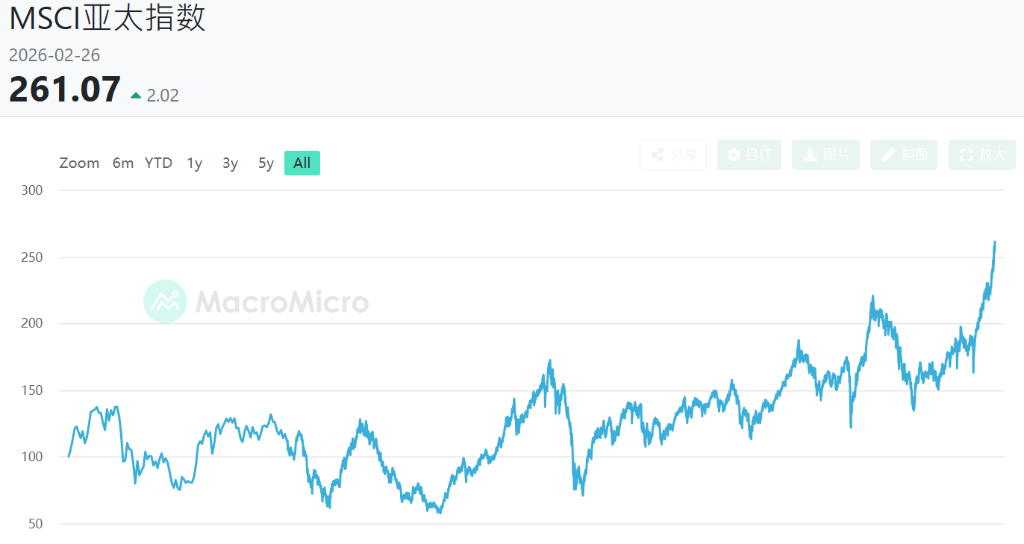
亚洲股市跑赢了欧洲和美国基准指数,因为投资者涌向支撑AI基础设施扩张的公司,将该地区的企业视为供应链中的"卖铲人"。相比之下,这项 新技术的颠覆性潜力数周来一直扰乱着美国各行业的股票,这被称为"AI恐慌交易"。 管理着超过20万亿美元资产的全球资产管理公司对新兴市场股票、货币、国内债券和信贷的看涨情绪日益高涨,这可能为该板块打破纪录的涨势 提供新的动力。 2月27日,亚洲股市正迈向有史以来表现最好的2月。投资者大举买入该地区提供人工智能(AI)基础设施建设的公司,推动了这一创纪录的涨 幅。 MSCI亚太指数尽管今日小幅上涨,本月累计上涨6.3%。这是该指数自1998年创立以来的最佳2月表现。该指标也有望连续第三个月跑赢标普500 指数。周五美国股指期货下跌,预示华尔街基准指数将进一步走低。 韩国作为AI投资的风向标,是亚洲表现最亮眼的市场。韩国综合股价指数(Kospi)本月上涨约18%,今年迄今飙升46%,成为全球表现最好的基 准指数。 花旗集团(Citigroup Inc.)审查了全球一些最大资产管理公司发布的展望,发现基金增加了对亚洲、拉丁美洲以及欧洲、中东和非洲市场的多头 头寸。这一发现出现之际,MSC ...
Infosys, TCS, other IT stocks rise up to 3% as Wall Street's AI rally loses steam
The Economic Times· 2026-02-27 03:48
Wipro, HCL Tech, Tech-heavy Nasdaq ended lower on Thursday, as the world’s most valuable company, Nvidia, saw its share price decline by 5% a day after rising sharply, following its better-than-expected January quarter results and high revenue forecast for the ongoing quarter.Google-parent Additionally, the US labour department’s data showed that the number of Americans filing new applications for jobless benefits increased marginally last week and the unemployment rate appeared to hold steady this month. ...





美股魔幻夜:炸穿业绩的英伟达 照样跌给你看
Sou Hu Cai Jing· 2026-02-27 03:47
Group 1 - Nvidia's earnings report exceeded expectations in terms of revenue and profit, yet the stock fell by 5%, marking its worst single-day performance since April of last year, which negatively impacted the entire semiconductor sector [1] - The market reaction indicates that current stock performance is less about actual earnings and more about exceeding "expected expectations," with Nvidia being viewed as the top player in the AI space [4] - Other companies in the semiconductor sector, such as Broadcom, Lam Research, and AMD, also experienced significant declines, with drops exceeding 5% for Broadcom and Lam Research, and a 3.4% drop for AMD [4] Group 2 - Salesforce, despite providing disappointing revenue guidance for fiscal year 2027, saw its stock rise by 4%, illustrating a market trend where stocks that have fallen significantly are perceived positively, while those that have risen sharply are viewed negatively [4] - The current market sentiment suggests a dichotomy where stocks that are perceived as having hit rock bottom are treated as favorable, while high-flying stocks like Nvidia are under pressure [4]