
Sony

Search documents
2025 年台湾国际半导体展_3.5D 先进封装、共封装光学及更多测试_ SEMICON Taiwan 2025_ 3.5D advanced packaging, co-packaged optics and more testing
2025-09-15 13:17
Summary of Key Points from the Conference Call Industry Overview - The conference focused on the semiconductor industry, particularly advancements in AI chips, heterogeneous integration, advanced packaging, and optical interconnect technologies, reflecting the growing importance of these areas in the market [2][3][20]. Core Findings 1. **TSMC's Capacity Expansion**: TSMC is expected to expand its CoWoS capacity to 100kwpm by the end of 2026, up from 70kwpm at the end of 2025, driven by robust demand for Cloud AI GPUs and ASICs [3]. 2. **AI Computing Demand**: AI computing requirements have surged by 10x in the past year, necessitating advancements in chip scaling, memory, and interconnect technologies [3]. 3. **3.5D Advanced Packaging**: The event highlighted significant discussions around 3.5D advanced packaging, which is anticipated to become mainstream for high-performance computing, improving cost structures and product design speeds [3]. 4. **Heterogeneous Integration**: The trend towards co-packaged optics (CPO) is gaining traction, with expectations for power consumption to be optimized by 2028, allowing for the replacement of copper in AI server integrations [3]. 5. **Testing Innovations**: The complexity of die and package designs is increasing the need for more rigorous testing at the wafer/die level to identify yield issues early [3]. Stock Recommendations - Top stock picks in the Greater China semiconductor sector include TSMC, ASE, MediaTek, Alchip, and Aspeed, all rated as "Buy" due to their structural AI opportunities [4]. Additional Insights - **Optical Interconnects**: Nvidia's advancements in networking infrastructure, particularly with its Spectrum-X CPO solution, promise significant power savings and improved signal integrity [12]. - **AI Data Center Power Consumption**: The power consumption of AI data centers is projected to rise dramatically, with examples like Meta's Hyperion data center expected to consume 2GW by 2030 [16]. - **Challenges in Advanced Packaging**: The industry faces challenges in transitioning to panel-level packaging and CoWoP technologies, which require overcoming technical hurdles related to system design and materials [30][39]. Emerging Technologies - **Silicon Photonics**: TSMC's COUPE platform aims to enhance integration of optics and electrical signaling, addressing bandwidth bottlenecks in computing performance [12]. - **GaN Technology**: GaN is highlighted for its efficiency and potential in powering AI applications, with Texas Instruments and Infineon leading developments in this area [36][38]. Conclusion - The semiconductor industry is at a pivotal point, driven by AI advancements and the need for innovative packaging and integration solutions. Companies like TSMC, Nvidia, and MediaTek are positioned to capitalize on these trends, while challenges in testing and power consumption remain critical areas for development [3][4][16][20].
FIVB Volleyball Men’s World Championship opens with grand ceremony
The Manila Times· 2025-09-12 11:26
MANILA, Philippines — THE Philippines served as a mecca of the sporting world once more, ushering in the biggest FIVB Volleyball Men’s World Championship in history with a bang on Friday night at the Mall of Asia Arena in Pasay City. From cultural performances to world-class acts, a festive atmosphere it was before an even bigger storm featuring 32 teams split in eight groups spiking it out in full-swing action starting Saturday at both the MOA Arena and the Smart-Araneta Coliseum in Quezon City. “We are ...



Amazon demands proof of authenticity from electronics sellers
Ecommerce News· 2025-09-11 13:53
Core Points - Amazon has implemented new verification requirements for electronics sellers to prove their products come from authorized suppliers, effective September 17, 2025 [1][3] - Sellers must submit recent invoices and detailed supplier information, impacting numerous well-known brands and potentially affecting many sellers [2][3] - The new rules have raised concerns among sellers regarding unclear communication and the risk of losing product listings if documentation is not provided [4][5] Seller Requirements - Sellers are required to submit invoices dated within the last 180 days that include at least 100 units, along with full supplier details [2] - Acceptable document formats include PDF, JPG, PNG, or GIF, and the rules apply across several European countries [2] Impact on Brands and Retailers - The requirement affects major brands such as Samsung, Dyson, Canon, Philips, HP, Sony, and Panasonic, with many sellers potentially facing warnings [3] - Retailers unable to provide the necessary documentation risk losing their product listings, which may lead to the return, destruction, or donation of existing inventory [5] Customer Complaints and Company Justification - Amazon's verification requirement aims to ensure the availability of safe and authentic products, responding to customer complaints regarding product authenticity [6] - The company emphasizes the need for sellers to demonstrate a reliable supply chain to meet these new requirements [6]


X @TechCrunch
TechCrunch· 2025-09-10 17:21
While Sony has long offered parental controls, the new app brings all of these tools into one dedicated place for easier access. https://t.co/XoVFZo4cFk ...
Micro LED手表推动,2029年芯片市场规模或突破4.61亿美元
WitsView睿智显示· 2025-09-10 09:08
Core Viewpoint - The article discusses the accelerating penetration of Micro LED technology in consumer electronics, highlighting its potential to transform various sectors, including televisions, smartwatches, and automotive displays, with a projected market value of $461 million by 2029 [2][4]. Group 1: Market Trends and Projections - Micro LED technology is expected to see significant growth, with Samsung launching a 140-inch Micro LED TV in 2023 and Garmin planning to introduce the Fenix 8 Pro smartwatch with Micro LED technology by 2025 [2]. - The market value of Micro LED chips is projected to reach $461 million by 2029, driven by the introduction of key products across various applications [2][4]. Group 2: Competitive Landscape - Current challenges for Micro LED include high power consumption and pricing, making it difficult to compete with more mature OLED technology in the short term [4]. - Despite these challenges, Micro LED's ability to meet the high brightness demands of outdoor environments and its potential for integrating sensing components position it favorably for future innovation [4]. Group 3: Industry Collaboration and Supply Chain - The Garmin Fenix 8 Pro smartwatch will utilize components from AUO, PlayNitride, and Raydium, showcasing the evolving Micro LED supply chain and its readiness for commercialization [4]. - The collaboration among various companies in the Micro LED ecosystem indicates a growing interest and investment in this technology, paving the way for further advancements and cost optimization [4].

X @Bloomberg
Bloomberg· 2025-09-05 13:02
Bose has launched a new-generation version of its popular over-ear headphones aimed at competing with the latest offerings from Apple and Sony https://t.co/wY2l95am2m ...
X @The Block
The Block· 2025-08-28 09:48
RT shαs (@XBT002)Very busy Asia session at @TheBlock__ this morning. Here's everything you may have missed:Ark Invest bought $15.6 million in BitMine shares on Wednesday across three of its ETFs. @timmyhmshenZhou Xiaochuan, the former governor of the People’s Bank of China, warned that stablecoins carry fraud and instability risks to the financial system. @ParkKunwoongAround 74% of YZY investors lost money on Kanye West’s Solana token, while 11 wallets received 30% of the entire profits, according to Bubble ...
电子证件(Digital ID)的全球信任度全景:亚洲、中东与非洲领先,欧美市场滞后
Jin Tou Wang· 2025-08-21 07:41
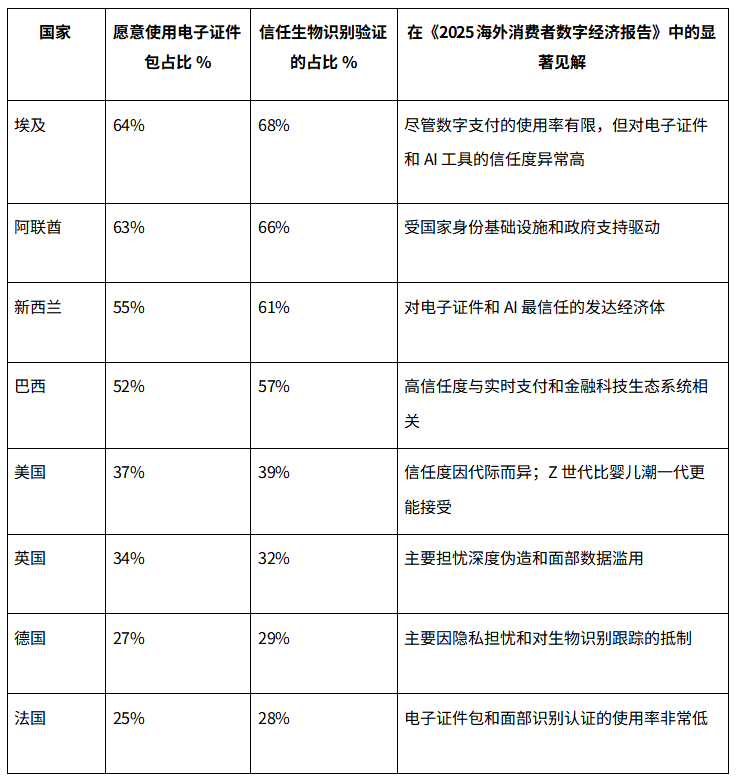
Core Insights - Checkout.com's global survey highlights significant regional differences in the acceptance of digital IDs, emphasizing the need for building trust [1][2] - Consumers in Asia, the Middle East, and Africa show high trust in digital IDs and biometric authentication, while Europe and North America exhibit lower acceptance [1][2] - The rise of AI-driven e-commerce agents underscores the importance of digital identity systems in maintaining transaction trust [1][2] Regional Analysis - In Egypt, 68% of consumers view digital IDs as a secure payment method, with 74% trusting AI-assisted transactions [2][3] - In the UAE, 63% of consumers are willing to use digital ID packages, driven by national identity infrastructure and government support [5] - New Zealand leads developed economies with 55% of consumers open to digital ID packages and 61% trusting biometric technology [3][5] - Brazil shows similar trends with 52% and 57% trust levels, attributed to a thriving fintech ecosystem and a tech-savvy population [3][5] - In contrast, only 32% of UK consumers trust digital IDs, with concerns over deepfakes and facial recognition being major barriers [3][5] - Trust levels in Germany and France remain below 30%, reflecting a cautious attitude towards centralized personal data storage [3][5] Generational Perspectives - 60% of Generation Z consumers believe digital IDs will soon become the primary method for online payments, indicating a more optimistic outlook compared to older generations [3][4]
X @THE HUNTER ✴️
GEM HUNTER 💎· 2025-08-20 17:40
RT unusual_whales (@unusual_whales)Sony hikes PlayStation 5 prices in US due to tariffs, per Reuters ...