monday.com Ltd.

Search documents
monday.com vs. Salesforce: Which Workflow Stock Has More Upside?
ZACKS· 2025-09-05 15:11
Core Insights - The enterprise software market is experiencing significant growth, with a projected increase from $263.8 billion in 2024 to $517.3 billion by 2030, reflecting a 12.1% CAGR [2] - Both monday.com (MNDY) and Salesforce (CRM) are central players in this market shift, with Salesforce having a long-standing dominance in enterprise CRM and monday.com emerging as a flexible Work OS [1][2] Summary of monday.com (MNDY) - monday.com is facing challenges in sustaining growth, particularly in enterprise workflows, which has revealed gaps in depth and efficiency [3] - The monday CRM extension is gaining traction but has modest annual recurring revenue of $100k, with high R&D costs at $59.2 million (20% of revenues) and sales and marketing expenses at $139.2 million (47% of revenues) [4] - The core Work Management product saw a 27% year-over-year revenue increase to $299 million, but customer acquisition costs are high, and net dollar retention has slipped to 111% [5] - AI initiatives are adding costs without proving significant returns, with a non-GAAP operating margin of 15%, down from 16% a year ago [6] - The Zacks Consensus Estimate for 2025 earnings is $3.93 per share, reflecting a 3.7% increase over the past 30 days [7] Summary of Salesforce (CRM) - Salesforce is a leading enterprise software provider with a multi-cloud portfolio that includes sales, service, marketing, integration, and analytics, leveraging AI in newer tools like Data Cloud and Agentforce [8] - Sales and Service Clouds are the largest revenue contributors, but their maturity limits incremental growth; however, AI initiatives like Data Cloud and Agentforce generated $1.2 billion in recurring revenues, up 120% year-over-year [9][11] - Salesforce's total remaining performance obligation reached $59.9 billion, up 10% year-over-year, with a non-GAAP operating margin of 34.3% [12] - The Zacks Consensus Estimate for fiscal 2026 earnings is $11.30 per share, indicating an improvement over the previous year's earnings of $10.2 per share [13] Price Performance and Valuation - In the past three months, monday.com's stock has declined 40.6%, while Salesforce's shares fell 8.9%, reflecting investor concerns over MNDY's high spending and slowing customer expansion [14] - monday.com trades at a forward P/S ratio of 6.66X, higher than Salesforce's 5.65X, but faces execution risks and profitability pressures [17] - Salesforce's lower P/S multiple appears more balanced due to its scale, margin consistency, and visibility from long-term contracts [17] Conclusion - Both companies operate in attractive segments of the enterprise software market, but monday.com is struggling with high spending and slowing customer expansion, limiting its valuation premium [19] - Salesforce benefits from a broader portfolio and stable margins, providing better visibility for investors [19] - The Zacks Rank indicates CRM as a hold and MNDY as a strong sell, suggesting CRM holds a relative edge [20]


新浪财经ESG:MNDY MSCI(明晟)ESG评级调升至AAA
Xin Lang Cai Jing· 2025-09-03 23:09
Core Insights - MNDY (MNDY.US) has had its MSCI ESG rating upgraded from A to AAA as of September 3, 2025 [1] Group 1 - The upgrade reflects an improvement in MNDY's environmental, social, and governance practices [1] - The new AAA rating positions MNDY among the top-rated companies in terms of ESG performance [1] - This change may enhance MNDY's attractiveness to socially responsible investors [1]
软件行业“快时尚化”背后的经济学 | AGIX PM Notes
海外独角兽· 2025-08-18 12:06
Core Viewpoint - The article discusses the transformative impact of Artificial General Intelligence (AGI) on the software industry, suggesting that AGI will redefine the technological landscape over the next two decades, similar to the internet's influence in the past [2]. Group 1: Software Industry Outlook - The software industry is experiencing a shift towards a "fast fashion" model, where AI enables cheaper and faster production processes, leading to a pessimistic sentiment among market participants [2][3]. - The fate of technology is determined not solely by the technology itself but by a combination of factors including market demand, efficiency, and policy, which together define "feasible technology" [3]. - The software industry is expected to undergo a process of elevation, moving from "dead" systems to "living" software that can learn and adapt to user contexts [4][5]. Group 2: Evolution of Software - Traditional software operates as either a system of record or engagement, but the future lies in "living software" that builds competitive advantages based on learning rather than just code [5][6]. - The ability of software companies to self-learn will depend on advanced models like Recursive agents and In Context Learning Agents, which are currently being explored in both academia and industry [6]. - The democratization of front-end UI/UX is causing anxiety in the industry, as many startups are creating environments for AI models to replicate existing software functionalities [7]. Group 3: Pricing Dynamics - AI is leading to a more granular economic landscape, allowing for extreme pricing strategies where software companies can potentially monopolize pricing based on outcomes rather than usage [8][9]. - This new pricing model could fundamentally change the revenue structure for software companies, moving away from traditional seat-based or usage-based pricing [9]. - The infrastructure investments in data centers and model training are likened to banks absorbing savings before lending, indicating a shift towards a new economic model for intelligent systems [9]. Group 4: Market Performance - Recent market performance shows a mixed sentiment, with companies like Atlassian, Monday, and MongoDB experiencing declines, reflecting broader market pessimism [12]. - AGIX has shown resilience with a year-to-date return of 15.62% and a return of 55.02% since 2024, indicating potential strength in the AGI-related investment space [11].


These 3 Artificial Intelligence (AI) Stocks Could Soar 45% or More Over the Next 12 Months, According to Wall Street
The Motley Fool· 2025-08-17 08:32
Group 1: AI Industry Overview - The AI industry is rapidly growing, with major tech firms like Amazon, Meta, Alphabet, and Microsoft planning to spend a cumulative $364 billion on AI-related infrastructure in 2025 [1] - Analysts believe that the spending habits of Big Tech indicate significant gains for lesser-known AI-focused companies, with shares of Salesforce, HubSpot, and monday.com expected to soar by 30% or more over the next 12 months [2] Group 2: Salesforce - Salesforce is a leading CRM software provider, with 42 out of 54 analysts rating the stock as a "buy" or "strong buy" [4] - The consensus price target for Salesforce suggests a potential gain of 45% over the next 12 months, with the most optimistic analyst predicting an 84% increase [5] - Despite a 33% decline from its peak in February, Salesforce's underlying business remains strong, with an 8% year-over-year sales increase and a 120% growth in annual recurring revenue from its Data Cloud and AI segment [6][7] Group 3: HubSpot - HubSpot's AI-powered customer platform has garnered strong support from analysts, with 33 out of 36 recommending it as a "strong buy" or "buy" [8][9] - The consensus price target for HubSpot is $695.80, indicating a potential 59% increase from its price on August 15 [9] - Although the stock is down 47% from its February peak, HubSpot's total customer base grew by 18% year over year, and management anticipates a 17% sales increase in 2025 [10][11] Group 4: monday.com - monday.com, a work management platform, has received strong endorsements from analysts, with 24 out of 25 recommending it as a "strong buy" or "buy" [11][12] - The consensus price target for monday.com implies a 61% gain over the next 12 months [12] - Despite a 46% decline from its peak in February, monday.com expects total sales to rise by 26% this year, reaching $1.2 billion, and has introduced new AI-powered capabilities to enhance customer productivity [13][14]


AI吞噬软件!GPT-5发布后,本周欧美软件股崩了
Hua Er Jie Jian Wen· 2025-08-15 07:01
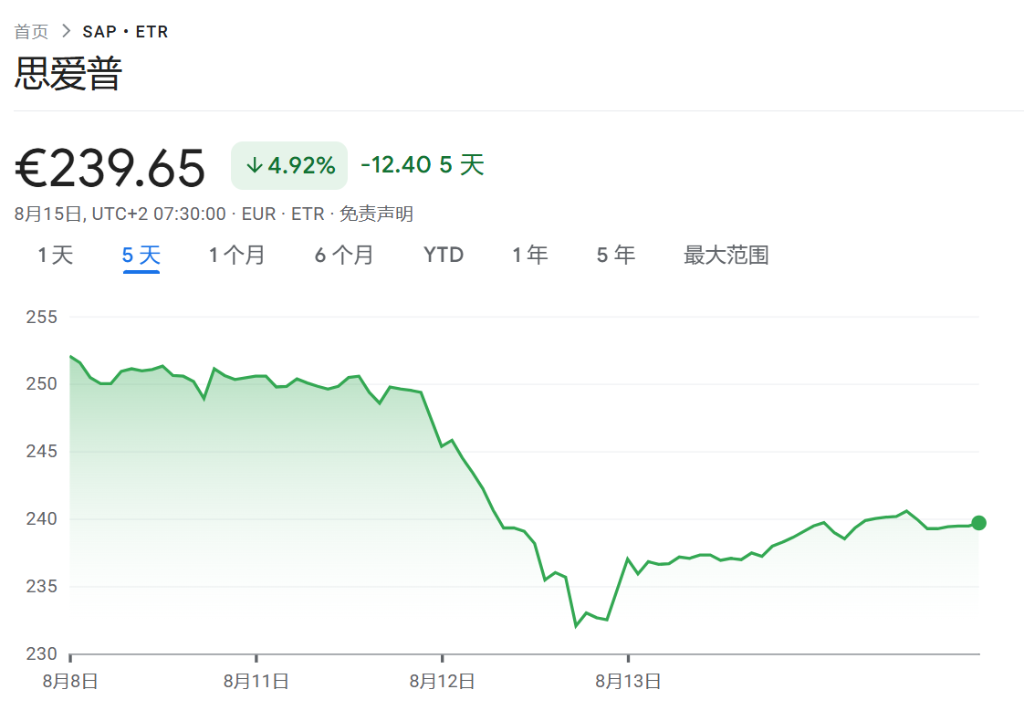
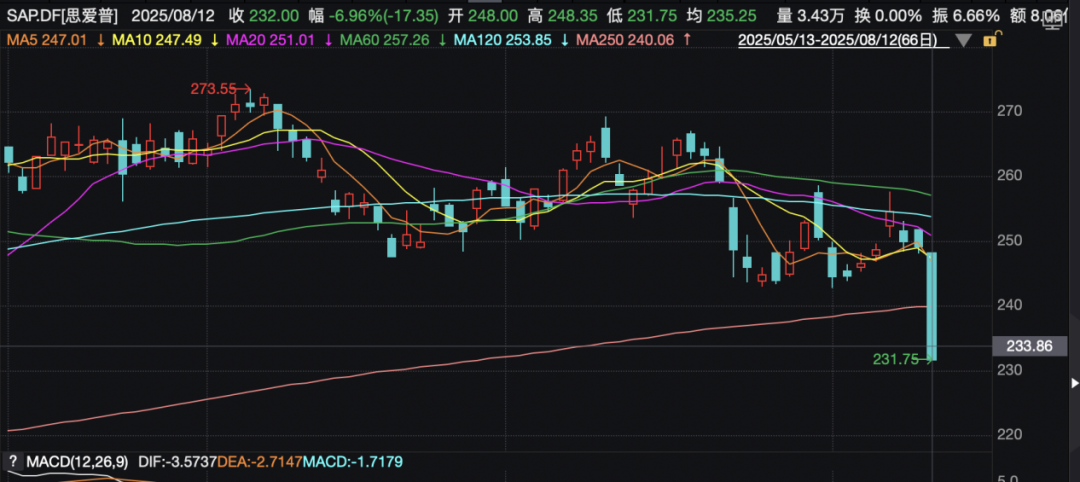
Core Viewpoint - The market is experiencing significant panic selling in the software sector due to concerns that artificial intelligence (AI) will replace traditional software solutions, particularly following the release of advanced AI models like GPT-5 and Claude [1][4][10] Group 1: Market Reaction - European software stocks faced a sharp decline, with SAP's stock dropping 7.1%, resulting in a market value loss of nearly €22 billion, marking the largest single-day drop since late 2020 [1] - Other companies like Dassault Systèmes and Sage Group also saw substantial declines, with many software stocks losing double digits since mid-July [1][4] - In the U.S., Monday.com experienced a 30% drop, while Salesforce and Adobe have seen declines of over 25%-30% this year [5] Group 2: AI Impact - The rapid iteration of AI models is perceived as a direct threat to the core business models of software and data service companies, including financial data providers and data analytics platforms [4][8] - Fund managers are increasingly aware that each new generation of AI models could significantly outperform previous versions, challenging existing business logic [4] Group 3: Valuation Sensitivity - The software sector's high valuations are amplifying the impact of negative sentiment, with the average P/E ratio of STOXX600 around 17 times, while SAP's P/E ratio is close to 45 times [9] - High valuations make these companies particularly sensitive to any potential negative news [9] Group 4: Long-term Outlook - Despite the prevailing narrative that AI will consume software, some analysts believe that not all software will be replaced, especially those deeply integrated into customer workflows and possessing unique proprietary data [9][10] - Companies like Experian, which have unique data and are embedded in financial processes, are seen as having strong competitive advantages [9]

大利空!欧洲软件巨头暴跌
Zhong Guo Ji Jin Bao· 2025-08-13 09:27
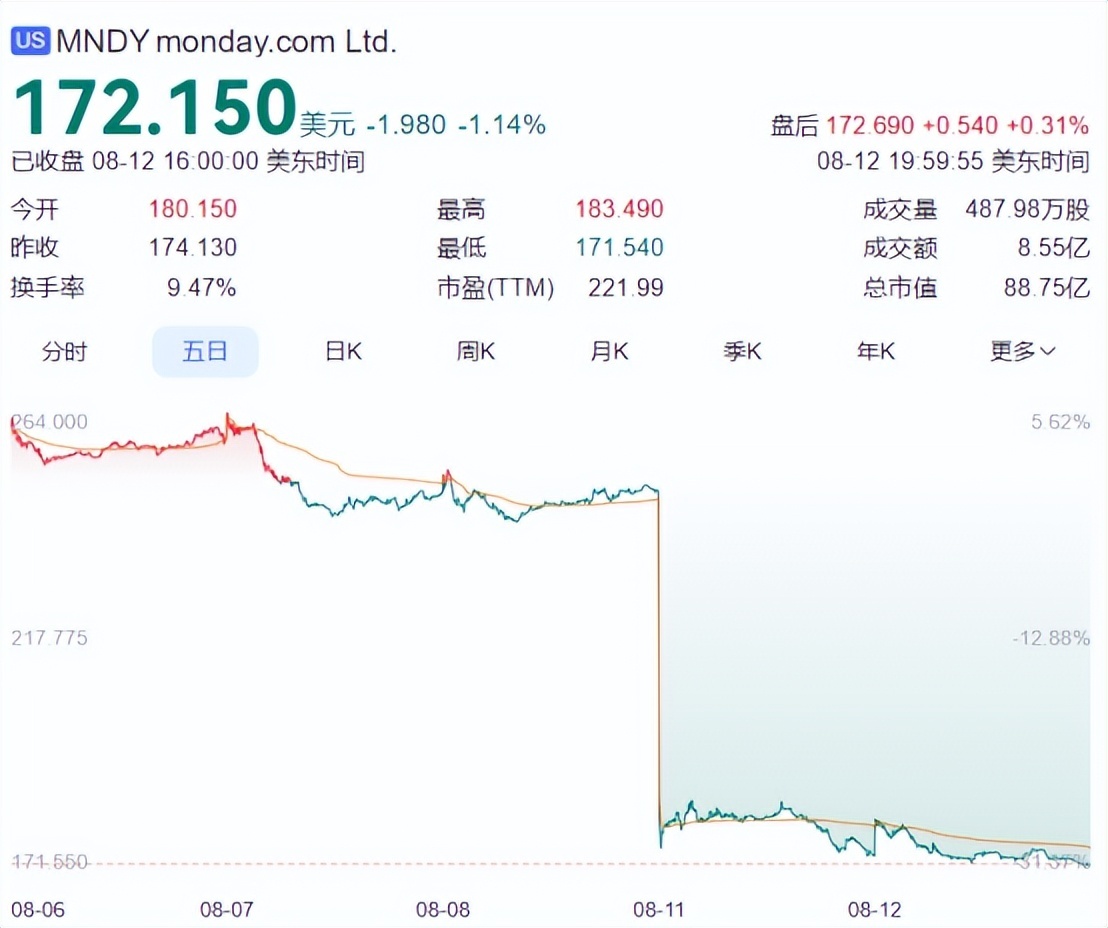
Group 1 - The core point of the article is that Monday.com experienced a significant stock price drop of 29.6%, resulting in a market value loss of over $2 billion, primarily due to disappointing Q3 revenue guidance and the disruptive impact of AI technology on the software industry [1][2][4]. Group 2 - Monday.com reported Q2 revenue of $299 million, a 27% year-over-year increase, and earnings per share of $1.09, surpassing analyst expectations [4]. - The company's Q3 revenue guidance median is projected to be between $306 million and $310 million, which is below the market expectation of $313 million, and the full-year operating margin forecast has been revised down from 15% to a range of 11% to 12% [4]. - The sudden slowdown in growth expectations for a company that previously maintained over 40% annual revenue growth has led to a reevaluation of its valuation model [4]. Group 3 - The underlying issue causing the industry-wide reaction is the disruption of traditional software logic by AI, with OpenAI's CEO stating that AI agents will transform SaaS into a fast-moving consumer good [5]. - Analysts indicate that the software industry is facing a crisis of functional replacement, as AI can now perform core functions like project management and requirement tracking through natural language commands, reducing users' willingness to pay for specialized software [5]. - Despite the challenges, some investment firms see opportunities, with Morgan Stanley upgrading its rating to "overweight" and TD Cowen maintaining a "buy" rating with a target price of $290 per share, highlighting the revenue potential of Monday Magic, an AI product [5].
大利空!欧洲软件巨头暴跌
中国基金报· 2025-08-13 09:21
Core Viewpoint - The significant drop in Monday.com's stock price, nearly 30%, is attributed to disappointing Q3 revenue guidance, highlighting deeper issues related to the disruption of the software industry by AI technology [2][4][6]. Group 1: Stock Performance - Monday.com experienced a stock price decline of 29.8%, marking its largest drop since going public, resulting in a market capitalization loss of over $2 billion [4][6]. - The decline in Monday.com's stock triggered a ripple effect in the SaaS sector, with other companies like SAP also experiencing declines, losing nearly 7% of their market value [4]. Group 2: Financial Performance - In Q2, Monday.com reported revenue of $299 million, a 27% year-over-year increase, and earnings per share of $1.09, surpassing analyst expectations [6]. - The company's Q3 revenue guidance is projected to be between $306 million and $310 million, falling short of market expectations of $313 million, with a downward revision of the full-year operating margin from 15% to a range of 11% to 12% [6]. Group 3: Industry Disruption - The underlying issue causing the stock drop is the disruption of traditional software business models by AI, as noted by industry experts [8]. - AI technology is enabling functionalities that were traditionally provided by specialized software, leading to a decrease in user willingness to pay for dedicated software solutions [8]. - The development costs are rising as software companies increase R&D investments to adapt to the changing landscape, resulting in expanded GAAP operating losses [8]. Group 4: Market Outlook - Despite the challenges, some investment firms see opportunities; Morgan Stanley upgraded its rating to "overweight," suggesting that the current stock price reflects excessive risk [8]. - TD Cowen maintained a "buy" rating with a target price of $290 per share, indicating that the market may be overlooking the revenue potential of Monday Magic, an AI product from Monday.com [8].

欧美软件股遭抛售 AI冲击引发行业估值压力
Huan Qiu Wang· 2025-08-13 05:04
Group 1 - The stock price of Monday.com Ltd. plummeted by 30% after its earnings report, leading to a collective decline in European software stocks as investors sold off related shares [1] - SAP, one of Germany's "Big Seven" and the highest market capitalization company in Europe, saw its stock drop by 6.76%, resulting in a market value loss of nearly €19.5 billion (approximately ¥163.6 billion) [3] - Concerns over competition from AI technologies are driving this downturn, with analysts noting that existing software companies face increasing competitive risks as AI tools develop and become more cost-effective [3] Group 2 - The software sector in the U.S. is experiencing significant challenges, with the Dow component Salesforce down 30% year-to-date and Adobe, labeled as an "AI victim," down 25%, having lost half its value compared to two years ago [3] - Analyst opinions on the software sector's outlook are divided; Morgan Stanley upgraded Monday.com Ltd. to "overweight," suggesting that the stock's decline has largely reflected AI disruption risks [4] - Jefferies analysts indicated that investors are likely to avoid the software sector due to uncertainties surrounding AI's impact, expressing concerns that AI could undermine the software industry and lead to a collapse in price-to-earnings ratios [4]
Final Trade: BSY, GDX, MNDY, GILD
CNBC Television· 2025-08-11 22:25
Yeah, like we talked about Bentley, this is a software name with proprietary data and they're ready for AI. >> Dan, >> the breakout of GDX2 gold unquestioned. I think you stay in the GDX, >> Dan.>> Yeah, monday. com had a bad case of the >> days. You've been waiting an hour.I really have. Um I do not think you buy this >> things you learned in the commercial breaks. Shout out to Sarah Palin.Big fan of the show. >> Huge fan. Stop watching right now.and Rug Gay. Gilead breaking. ...

Investors are worried AI is going to eat software, says Jefferies Brent Thill
CNBC Television· 2025-08-11 22:18
Some of the names leading the losses. For more on the weakness in software. Jefferies.Brant Thill joins us now. Brant, great to have you with us. >> Thanks for having me.>> So we talked about this last week in terms of this whole notion that AI is threatening the software space, and you're seeing names. We mentioned a few of the losers today, but Atlassian CRM, I mean, these are stocks that are down more than 20% year to date. What. What is going on here.>> Investors are fearing that AI is going to eat soft ...