荣耀

Search documents
荣耀前CEO赵明将任千里科技联席董事长
Cai Jing Wang· 2026-02-12 08:33
Group 1 - Former CEO of Honor, Zhao Ming, will join the board of Qianli Technology [1] - Zhao Ming is expected to take on the role of co-chairman at Qianli Technology [1] - Strategic focus for Qianli Technology will involve Zhao Ming advancing the closed-loop strategy for AI business models [1]


荣耀前CEO赵明加盟,担任联席董事长
Xin Lang Cai Jing· 2026-02-12 08:19
Group 1 - Zhao Ming, former CEO of Honor, is set to join the board of Qianli Technology as co-chairman, aiding in the company's "AI+" strategic transformation under Chairman Yin Qi [1][2] - Zhao Ming's previous success in leading Honor out of difficulties and his early focus on AI strategy positions him for a significant career move in the AI sector [2] - The combination of Zhao Ming's market insights and strategic capabilities with Yin Qi's grasp of AI technology direction is expected to create a strong synergy, potentially accelerating Qianli Technology's transition from "technically feasible" to "commercially viable" [2]
荣耀前CEO赵明加盟千里科技 将出任联席董事长
Feng Huang Wang· 2026-02-12 08:07
Group 1 - Qianli Technology has appointed Zhao Ming, former CEO of Honor, as a non-independent director of its sixth board and co-chairman, focusing on AI commercialization [1] - Zhao Ming previously led Honor to become the top smartphone brand in China from 2022 to 2023 and emphasized AI integration in operating systems during his tenure [1] - Qianli Technology is currently in a high-investment phase for its AI business and has not yet achieved scalable profitability [1] Group 2 - The mobile industry is seeing key managers transition into the smart automotive sector, indicating a shift in competition towards chips, operating systems, software ecosystems, and user experience [2] - Zhao Ming's involvement may accelerate Qianli Technology's path to profitability in its AI business and serve as a significant case study for the commercialization of AI technology [2]
荣耀前CEO赵明将于近期加入千里科技董事会
Xin Lang Cai Jing· 2026-02-12 07:53
Core Insights - Former CEO of Honor, Zhao Ming, will join the board of Qianli Technology, potentially taking on the role of co-chairman [1] - Zhao Ming will focus on advancing the closed-loop strategy for AI business models, while the current chairman, Yin Qi, will concentrate on the development strategy of AI technology [1]
荣耀前CEO赵明将出任千里科技联席董事长
Xin Lang Cai Jing· 2026-02-12 07:20
Core Viewpoint - Zhao Ming, former CEO of Honor, will join Qianli Technology's board as co-chairman, focusing on AI business model strategies while the current chairman, Yin Qi, will concentrate on AI technology development strategies [1] Group 1: Leadership Changes - Zhao Ming will take on the role of co-chairman at Qianli Technology, indicating a significant leadership shift within the company [1] - The collaboration between Zhao Ming and Yin Qi has been ongoing, with increased communication since the second half of last year [1] Group 2: Strategic Focus - Zhao Ming aims to advance the closed-loop strategy for AI business models, highlighting a shift towards practical applications of AI in business [1] - Yin Qi will focus on the development strategy of AI technology, suggesting a dual approach to innovation within the company [1] Group 3: Background and Motivation - Zhao Ming has over 20 years of experience in the mobile and communications industry, which positions him well for his new role [1] - His decision to join Qianli Technology is driven by a belief that AI represents the next significant area for investment over the next 20 years [1]
晚点独家丨荣耀前 CEO 赵明将出任千里科技联席董事长
晚点LatePost· 2026-02-12 07:15
Core Viewpoint - The addition of Zhao Ming to Qianli Technology's board is seen as a crucial step towards establishing a complete AI business model, integrating technology with commercial viability [2][3]. Group 1: Zhao Ming's Role and Background - Zhao Ming, former CEO of Honor, is set to join Qianli Technology as co-chairman, focusing on advancing the AI business model while co-founder Inqi will concentrate on AI technology strategy [3]. - After leaving Honor in January 2025, Zhao Ming was rumored to join various tech companies but ultimately chose Qianli Technology, driven by his belief in AI as a long-term investment opportunity [5]. - During his tenure at Honor, Zhao Ming achieved significant milestones, including the survival and market share recovery of Honor and the establishment of its AI strategy, showcasing his strong commercial execution and foresight in technology trends [5]. Group 2: Strategic Challenges and Opportunities - Qianli Technology is undergoing a strategic transformation, facing challenges in resource integration due to its diverse shareholder base, which includes Geely, Mercedes-Benz, and the Chongqing government [5]. - The collaboration between Inqi and Zhao Ming is viewed as a complementary partnership, merging technological expertise with commercial experience to facilitate the scalable implementation of AI solutions [6]. - Qianli Technology reported revenues of 6.95 billion yuan in the first three quarters of 2025, but with a profit margin of less than 1%, indicating that its AI business is still in the investment phase and requires a business model upgrade [6]. Group 3: Future Directions and Market Context - The current period is critical for both Qianli Technology and Zhao Ming, as the company seeks to develop a new business model centered around AI, with Zhao's experience enhancing strategic decision-making in the consumer sector [7]. - The AI industry is at a stage where technological advancements have not yet translated into commercial success, highlighting the need for a balance between technological ideals and tangible business value [7].

华为小米已成新“年货”,后国补时代市场热度几何?
财联社· 2026-02-12 03:25
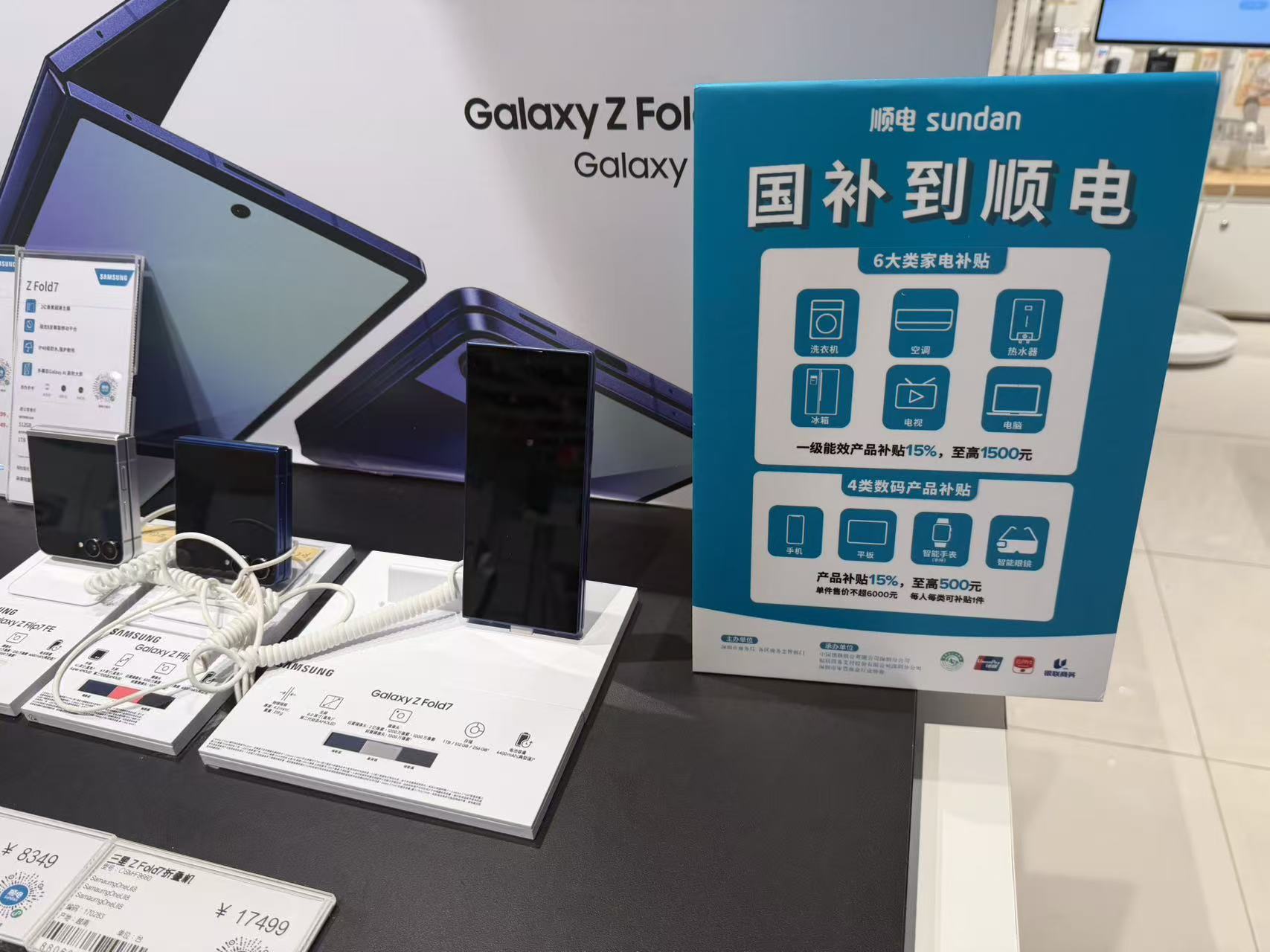
Core Viewpoint - The article discusses the impact of the new round of national subsidies on consumer electronics and home appliances during the upcoming Spring Festival, highlighting increased consumer demand and sales driven by these subsidies [2][15]. Group 1: National Subsidy Implementation - The Ministry of Commerce has allocated the first batch of 62.5 billion yuan in national subsidies, which will be distributed to local commerce departments to ensure consumers can claim these subsidies during the Spring Festival [1]. - Consumers can now apply for subsidies online for digital and smart products, with significant sales increases observed in various electronics stores [2][4]. - The new subsidies are expected to stimulate sales, particularly in the home appliance and 3C product sectors, with sales of air conditioners, refrigerators, washing machines, and televisions seeing over 90% month-on-month growth [2][11]. Group 2: Consumer Trends and Product Preferences - The demand for home appliances and 3C products has surged, with consumers increasingly seeking products that enhance efficiency and create a festive atmosphere [3][10]. - Popular products include smart appliances like automatic washing machines, large-capacity refrigerators, and high-end AI smartphones, reflecting a shift towards premium and technologically advanced items [3][16]. - The sales of energy-efficient appliances have risen significantly, with 92% of sales now comprising first-level energy/water efficiency products, indicating a trend towards greener and smarter home solutions [11][16]. Group 3: Market Dynamics and Manufacturer Strategies - Manufacturers are preparing for the Spring Festival by increasing inventory of energy-efficient products and optimizing supply chains to ensure product availability [12]. - Major brands like Huawei, Xiaomi, and OPPO are offering additional discounts alongside the national subsidies to enhance promotional efforts [12]. - Despite the positive impact of subsidies, rising costs of raw materials are leading to price increases for some products, which may affect overall sales volumes in the consumer electronics sector [13][14]. Group 4: Future Outlook and Challenges - The article notes that while national subsidies have boosted market confidence and consumer demand, the underlying issue of supply-demand mismatch remains a challenge [17]. - The effectiveness of subsidies may diminish as consumers become accustomed to them, necessitating a focus on product innovation and user engagement to sustain growth [17]. - Analysts express caution regarding the marginal benefits of subsidies in 2026, suggesting that manufacturers may prioritize high-margin products over volume sales, potentially impacting overall market performance [17].

一线实探!华为小米已成新“年货” 后国补时代市场热度几何?
Xin Lang Cai Jing· 2026-02-12 01:49
Core Viewpoint - The Chinese government has allocated 62.5 billion yuan in subsidies to stimulate consumer spending during the Spring Festival, with a focus on home appliances and 3C electronic products, leading to increased sales and market activity [1][2][6]. Group 1: Subsidy Implementation and Market Response - The Ministry of Commerce has released the first batch of 62.5 billion yuan in national subsidies, which will be distributed to local commerce departments to ensure consumers can claim these subsidies during the Spring Festival [1]. - Consumers can now apply for subsidies online for digital and smart products, with reports of increased sales activity in stores, particularly for mobile phones and home appliances [2][3]. - The combination of national subsidies, brand discounts, and platform incentives is driving consumer interest and sales, particularly in the home appliance and 3C product sectors [2][6]. Group 2: Sales Performance and Consumer Trends - Sales of major home appliances such as air conditioners, refrigerators, and washing machines have seen a month-on-month increase of over 90%, with high-end smartphones dominating the market [2][7]. - The demand for efficient and technologically advanced home appliances is rising, with products like smart air conditioners and large-screen TVs becoming popular choices for consumers during the festive season [2][7]. - The sales of energy-efficient appliances have surged, with 92% of sales being of first-level energy efficiency products, indicating a shift towards greener and smarter home solutions [7][13]. Group 3: Manufacturer Strategies and Market Dynamics - Manufacturers are preparing for the Spring Festival by increasing inventory of energy-efficient products and optimizing supply chains to ensure availability during peak demand [8][9]. - Major 3C brands are enhancing promotional efforts during the Spring Festival, with additional discounts and marketing campaigns to attract consumers [9]. - Despite the positive impact of subsidies, rising costs of raw materials are leading to price increases for some products, which may affect overall sales volumes in the future [10][11]. Group 4: Future Outlook and Industry Challenges - The effectiveness of subsidies may diminish as consumers become accustomed to them, and the market faces challenges related to supply-demand mismatches [14]. - Industry experts suggest that continuous growth will depend on product innovation and the ability to meet evolving consumer preferences, particularly in the context of AI integration in home appliances [12][14]. - The anticipated decline in smartphone sales in 2026 highlights the need for brands to adapt their strategies in response to changing market conditions and consumer behavior [11].
Omdia:2025年Q4全球智能手机市场同比增长4% 苹果以25%市场份额领跑
智通财经网· 2026-02-12 01:33
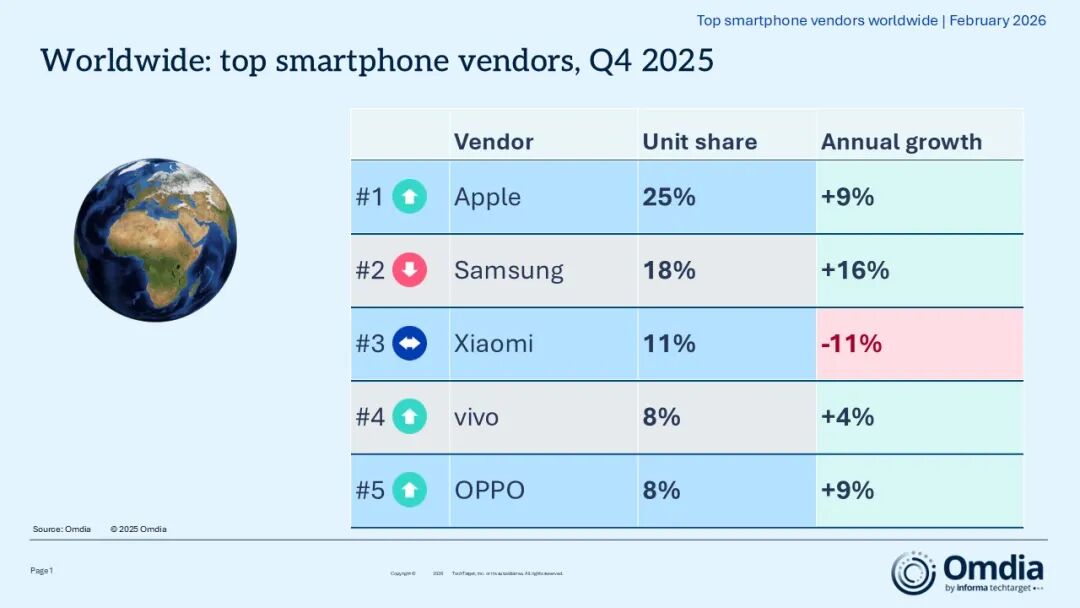
Core Insights - The global smartphone market is expected to grow by 4% year-on-year in Q4 2025, driven by seasonal demand recovery and improved inventory management, despite some manufacturers facing rising component costs [1] - Apple leads the market with a 25% share, benefiting from strong demand for the iPhone 17 series, achieving record quarterly shipments and maintaining its position as the largest smartphone manufacturer for three consecutive years, slightly ahead of Samsung [1] - Samsung holds the second position with an 18% market share, primarily driven by strong sales of models priced below $300, particularly the Galaxy A17 4G and 5G series [1] Global Market Rankings - In Q4 2025, the top smartphone vendors by unit share are: - Apple: 25% (+9% growth) - Samsung: 18% (+16% growth) - Xiaomi: 11% (-11% growth) - Vivo: 8% (+4% growth) - OPPO: 8% (+9% growth) [2] Regional Performance - In the APAC region (excluding Greater China), the top vendors are: - Samsung: 19% (+18% growth) - Apple: 18% (+4% growth) - Vivo: 15% (+11% growth) - OPPO: 11% (+6% growth) - Xiaomi: 10% (-23% growth) [4] - In Latin America, the rankings are: - Samsung: 33% (+21% growth) - Lenovo: 16% (+14% growth) - Xiaomi: 15% (+6% growth) - HONOR: 9% (+64% growth) - Apple: 7% (-8% growth) [4] - In India, the top vendors are: - Vivo: 25% (+16% growth) - OPPO: 16% (+4% growth) - Samsung: 14% (-11% growth) - Xiaomi: 12% (-26% growth) - Apple: 11% (-1% growth) [6] - In the United States, the rankings are: - Apple: 69% (+8% growth) - Samsung: 14% (-3% growth) - Lenovo: 9% (+13% growth) - Google: 3% (-15% growth) - TCL: 2% (-7% growth) [6] - In Brazil, the top vendors are: - Samsung: 39% (-1% growth) - Lenovo: 23% (+12% growth) - Xiaomi: 15% (+12% growth) - Apple: 11% (+10% growth) - realme: 5% (-7% growth) [7]


2025手机活跃存量增2% 苹果三星小米位列前三
Xin Lang Cai Jing· 2026-02-12 01:30
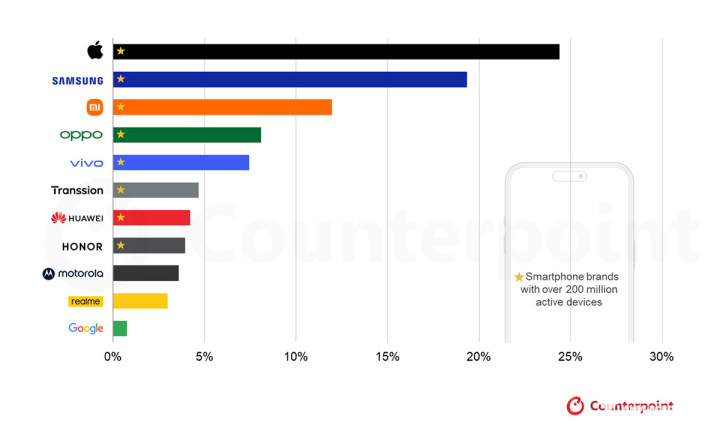
Core Insights - The report by Counterpoint Research indicates that eight smartphone manufacturers have surpassed 200 million active devices globally, collectively accounting for over 80% of the active device market share [1][6][8] - By 2025, the global active smartphone device stock is expected to grow by 2% year-on-year, with the average replacement cycle extending to nearly four years, marking a new phase of competition focused on existing users [1][5] Market Share Distribution - Apple and Samsung demonstrate a significant lead, being the only two brands with active devices exceeding 1 billion, together holding 44% of the global market share, with Apple at approximately 25% and Samsung at around 20% [5][8] - Xiaomi is the only other brand in the "200 million club" with a market share exceeding 10%, holding about 12%, while OPPO and vivo form the second tier [5][8] - The remaining brands, including Transsion, Huawei, and Honor, have closely matched market shares, with Honor making its debut in this club, while Motorola and realme are approaching the 200 million mark, indicating potential growth [5][8] Industry Challenges - The report highlights that due to soaring memory prices and extended replacement cycles, simple hardware upgrades are no longer sufficient to drive frequent device replacements among users [5][8] - The core challenge for smartphone brands moving forward will be to extract value from existing users and expand revenue through software and services [5][8]