
京东方

Search documents
中国产业叙事:晶合集成
新财富· 2025-10-21 08:46
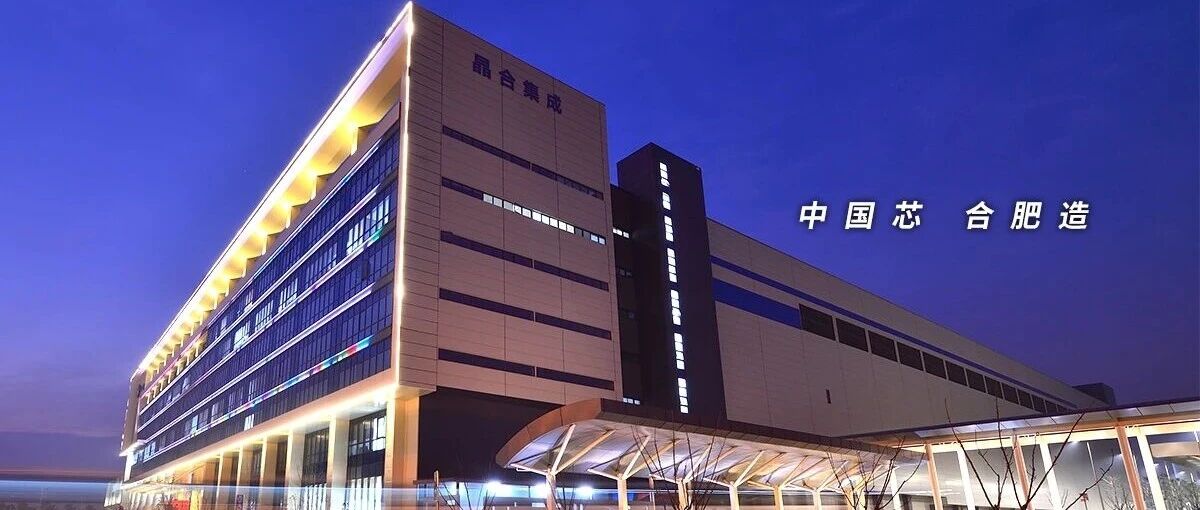
Core Viewpoint - The article highlights the rapid growth and strategic positioning of Hefei Jinghe Integrated Circuit Co., Ltd. (Jinghe Integrated) within the semiconductor industry, emphasizing its successful transition from a startup to a leading player in the display driver chip market, driven by local government support and collaboration with Taiwanese technology teams [2][4][12]. Group 1: Company Development and Achievements - Jinghe Integrated was established in 2015 as a joint venture between Hefei City Government and Taiwan's Lianjing Technology, marking the first 12-inch wafer foundry in Anhui Province [4][5]. - The company has grown to become the third-largest wafer foundry in mainland China and ranks among the top ten globally, achieving a market share of 28% in the display driver chip sector by 2024 [2][12]. - In 2024, Jinghe Integrated is projected to generate nearly 9.3 billion yuan in revenue, reflecting a 28% year-on-year increase, with net profit expected to exceed 530 million yuan, marking a growth of over 150% [2][5]. Group 2: Strategic Positioning and Market Dynamics - The company strategically focuses on niche markets, avoiding direct competition with giants like TSMC and Samsung by specializing in display driver chips and gradually expanding into advanced process nodes [4][6]. - Jinghe Integrated has successfully developed and mass-produced chips at various technology nodes, including 110nm, 55nm, and 40nm, with plans to begin production at the 28nm node in 2025 [5][6][17]. - The company has diversified its product offerings beyond display driver chips to include CMOS image sensors (CIS), power management chips (PMIC), and microcontrollers (MCU), enhancing its revenue resilience [7][17]. Group 3: Regional Ecosystem and Collaboration - Hefei's strategic initiatives, including the establishment of a complete display industry chain, have significantly benefited Jinghe Integrated, allowing for reduced logistics costs and improved supply chain efficiency [12][13]. - The proximity of key partners, such as BOE and Visionox, facilitates rapid collaboration and reduces production lead times, exemplifying the advantages of regional industrial clustering [12][13]. - The article emphasizes the importance of a collaborative ecosystem in Hefei, where companies like Jinghe Integrated, BOE, and Visionox work together to reshape the new display industry landscape in China [16].

杉杉集团重整突变,原中选投资人离奇出局,火速诉讼,更多暗箱操作曝光
21世纪经济报道· 2025-10-21 08:40
Core Viewpoint - The restructuring case of SANSAN Group is facing complications as the investor qualification of one of the bidding consortium members, Saimaike Advanced Materials Co., Ltd., was unexpectedly changed by the management law firm Zhonglun to a TCL subsidiary fund, leading to a request for a delay in the creditor voting process [1][7][8]. Group 1: Restructuring Process - The creditor voting for the restructuring plan is set to take place soon, but Saimaike has raised concerns about being excluded from the investment agreement without consent [1][4]. - Saimaike claims that the management and New Yangzi Trading acted against the agreed terms of the bidding consortium by unilaterally adjusting the restructuring investment plan [2][8]. - The stock price of SANSAN has surged, reaching a peak of 15.65 yuan per share in September 2025, significantly higher than the bidding price of 11 yuan per share, indicating potential substantial profits for the restructuring investors [2][3]. Group 2: Legal Actions and Complaints - Saimaike has filed a lawsuit requesting the court to confirm the invalidity of the restructuring investment agreement, citing violations of the consortium's agreement and the exclusion of a qualified industry investor [8][10]. - The lawsuit outlines that the management's actions not only harmed Saimaike's interests but also those of other potential investors, undermining the principles of fairness and transparency in the selection process [8][10]. - Saimaike emphasizes that the consortium's selection criteria included industry compatibility, and the exclusion of Saimaike, the only suitable industry investor, is deemed invalid [8][12]. Group 3: Financial Implications - The restructuring plan involves a combination of direct acquisitions and partnerships, with the restructuring investors set to acquire 23.36% of SANSAN's voting rights through various means [12]. - The restructuring investors are expected to gain significant market value from their shares, with an estimated unrealized gain of 5.453 billion yuan based on current stock prices [12][13]. - The total secured debt involved in the restructuring amounts to 53.24 billion yuan, while ordinary debts reach 281.19 billion yuan, indicating a low recovery rate for ordinary creditors [13].

TCL华星8.6代印刷OLED产线开工,国内在建产能增多
Di Yi Cai Jing· 2025-10-21 08:35
Core Viewpoint - The Chinese OLED industry is experiencing a trend towards localization, with domestic manufacturers increasing their market share and investing heavily in new production lines, despite an overall decline in the optical display industry's investment. Group 1: Market Trends - Last year, Chinese OLED manufacturers held a market share of 46%, while Korean manufacturers accounted for 54%. In the flexible OLED sector, Chinese manufacturers achieved a market share of 57% [6] - The investment in the optical display industry in China is projected to be approximately 1,035 billion yuan in the first half of 2025, representing a year-on-year decline of 26.7% [5] Group 2: New Production Lines - The TCL Huaxing T8 project, which is the world's first mass production G8.6 generation printed OLED production line, has commenced construction, indicating a shift towards higher generation production lines [1][2] - Other companies, such as BOE and Visionox, are also building high-generation OLED production lines, with significant investments. BOE's G8.6 AMOLED production line has a total investment of 63 billion yuan and a design capacity of 32,000 glass substrates per month [4] Group 3: Investment and Economic Impact - The T8 project is expected to have a total investment of approximately 29.5 billion yuan, with a design capacity of 22,500 glass substrates per month [4] - The investment return period for high-generation display projects is typically between 5 to 7 years, but TCL anticipates a shorter return period for the T8 project, which is expected to start mass production in the second half of 2027 [6] Group 4: Supply Chain and Localization - The upstream supply chain is also concentrating in China, with a significant increase in domestic production capabilities for components such as polarizers. By 2024, Chinese manufacturers are expected to account for 65% of the global polarizer production capacity [8] - The T8 project aims to accelerate the localization of key materials, core equipment, and components, with several global suppliers planning to collaborate with TCL Huaxing [8] Group 5: Challenges and Opportunities - Despite the push for localization, the upstream materials for polarizers still heavily rely on imports, and there are no clear expansion plans from raw material manufacturers [9] - The equipment for panel manufacturing is also moving towards localization, with the T8 project's equipment localization rate expected to reach 50% [9]

韩媒:三星显示将增设8.6代OLED LTPO产线
WitsView睿智显示· 2025-10-21 07:44
Core Viewpoint - Samsung Display is planning to introduce Low-Temperature Polycrystalline Silicon (LTPO) Thin-Film Transistors (TFT) into its 8.6-generation OLED production line, marking a significant shift in its manufacturing strategy to enhance market competitiveness and meet diverse customer demands [2][4]. Group 1: Technology and Production - Samsung Display is currently evaluating the construction of an LTPO TFT production line and is in discussions regarding the introduction of key equipment, specifically Excimer Laser Annealing (ELA), which is essential for achieving LTPO TFT technology [2][4]. - The new production line is expected to have a monthly capacity of 7,500 glass substrates and is currently in the trial operation phase [4]. - LTPO technology is becoming mainstream in the OLED sector due to its combination of low power consumption and high electronic mobility, which is advantageous for high-performance applications [4][5]. Group 2: Market Dynamics and Competition - The decision to adopt LTPO technology is seen as a response to the increasing demands from notebook and display manufacturers, as well as competitive pressures from Chinese display companies like BOE, Visionox, and TCL Huaxing, which have also opted for LTPO solutions [4][5]. - Industry insiders suggest that major clients may have explicitly requested Samsung Display to incorporate LTPO technology into their products [5]. - Samsung Display plans to produce oxide TFT OLED panels for the upcoming Apple MacBook Pro, positioning itself as the sole supplier capable of mass production of such panels [5].
京东方研究新封装方案提升Micro LED光效
WitsView睿智显示· 2025-10-21 07:44
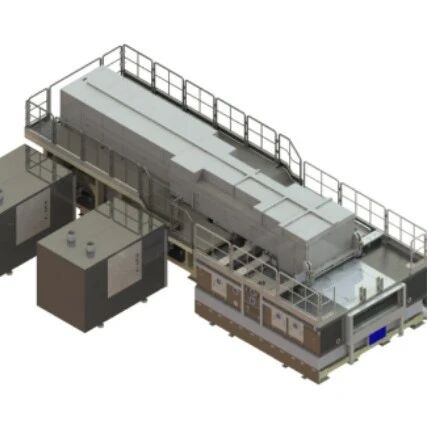
Core Viewpoint - The research team from BOE has developed an innovative Micro LED packaging solution that addresses key technical challenges in the industry, such as high sidewall light emission, low optical efficiency, and color deviation [2][4]. Group 1: Technical Innovations - The new packaging structure consists of high-refractive-index transparent glue, white high-reflective resin, micro-lens arrays, and patterned black matrices, effectively improving light extraction and reducing color deviation [4][5]. - By introducing a gradient refractive index layer on the Micro LED chip, the critical angle for light emission has been increased from 25 degrees to a maximum of 65.9 degrees, significantly enhancing top light extraction efficiency [5]. - The white reflective resin forms an isosceles trapezoidal structure between chips, resulting in a 27% increase in brightness at a 0° viewing angle [5]. Group 2: Performance Metrics - Simulation results indicate that with a lens curvature of 0.03 and a refractive index of 1.85, light intensity can be increased by over 53% [5]. - The introduction of a patterned black matrix in the packaging glass layer has effectively reduced reflectivity to less than 2%, achieving a high contrast ratio of over 20,000:1, thereby significantly enhancing display quality [5][7]. Group 3: Market Applications and Future Directions - The new packaging design not only improves optical efficiency and uniformity but also enhances packaging reliability, making it suitable for mass production in automotive displays, AR/VR headsets, and wearable devices [7]. - BOE continues to advance Mini/Micro LED direct display technology and applications, with a presentation scheduled at the 2025 Self-emissive Display Industry Seminar to share the latest developments in direct display COG technology [7][9].


奥来德(688378):业绩符合预期,关注大客户在设备及材料端的合作赋能:——奥来德(688378.SH)2025年前三季度业绩预告点评
EBSCN· 2025-10-21 07:21
Investment Rating - The report maintains a "Buy" rating for the company [6] Core Views - The company is expected to achieve revenue of 370 to 400 million yuan in the first three quarters of 2025, representing a year-on-year decrease of 13.75% to 20.22%. The net profit attributable to shareholders is projected to be between 29 to 34 million yuan, a decline of 66.42% to 71.36% year-on-year [1] - The materials business is anticipated to grow steadily, with expected revenue of 310 to 330 million yuan, reflecting a year-on-year increase of 2.68% to 9.31%. The equipment business, however, is expected to see a revenue drop of 56.66% to 62.85% [2] - A strategic cooperation framework agreement has been signed with BOE Technology Group, focusing on comprehensive collaboration in equipment and materials, which is expected to enhance the company's performance and growth potential [3] Summary by Sections Revenue and Profit Forecast - For 2025, the company forecasts a net profit of 127 million yuan, with a growth rate of 40.85% in 2026 and 91.30% in 2027 [4][5] - The revenue growth rate is projected to be 31.30% in 2025, 56.49% in 2026, and 35.88% in 2027 [5] Financial Metrics - The company’s earnings per share (EPS) is expected to be 0.51 yuan in 2025, increasing to 0.98 yuan in 2026 and 1.42 yuan in 2027 [5] - The return on equity (ROE) is projected to rise from 7.03% in 2025 to 15.78% in 2027 [12] Valuation Metrics - The price-to-earnings (P/E) ratio is expected to decrease from 47 in 2025 to 17 in 2027, indicating a potential increase in valuation attractiveness [5][13] - The price-to-book (P/B) ratio is projected to be 3.3 in 2025, decreasing to 2.7 by 2027 [5][13]

79股连续5日或5日以上获融资净买入
Zheng Quan Shi Bao Wang· 2025-10-21 03:41
Core Insights - As of October 20, a total of 79 stocks in the Shanghai and Shenzhen markets have experienced net financing inflows for five consecutive days or more [1] Group 1: Stocks with Longest Continuous Net Inflows - The stocks with the longest continuous net inflows are Yongmaotai, Kede CNC, and Fanwei Network, each having recorded net inflows for nine consecutive trading days [1] - Other notable stocks with significant net inflows include Mindray Medical, BOE Technology Group, Xingqi Eye Medicine, Maixinlin, Dongfang Electronics, Cangzhou Mingzhu, Zhongke Software, and Yingke Medical [1]




电子元件板块出现小幅上涨 深南电路、沪电股份涨超1%


Jin Tou Wang· 2025-10-21 02:51
Core Insights - The electronic components sector experienced a slight increase of 1.45% as of the morning of October 21, with several leading stocks showing significant gains [1] Group 1: Stock Performance - Leading stocks in the electronic components sector include Shenghong Technology, Dongshan Precision, and Pengding Holdings, which all rose over 3% [1] - Huagong Technology increased by over 2%, while other stocks like Shenzhen South Circuit and Hude Electric also saw gains exceeding 1% [1] - The top ten electronic component stocks by market capitalization include Shenghong Technology (231.3 billion), Huichuan Technology (212.8 billion), and Shengyi Technology (137.9 billion) [2] Group 2: Capital Flow - The top three stocks with net inflow of main funds are Shannon Chip, Jingwang Electronics, and Pengding Holdings, with inflows of 159 million, 125 million, and 52.216 million respectively [3]
果链爆发,消费电子ETF(561600)盘中涨超2.5%冲击2连涨
Xin Lang Cai Jing· 2025-10-21 02:19
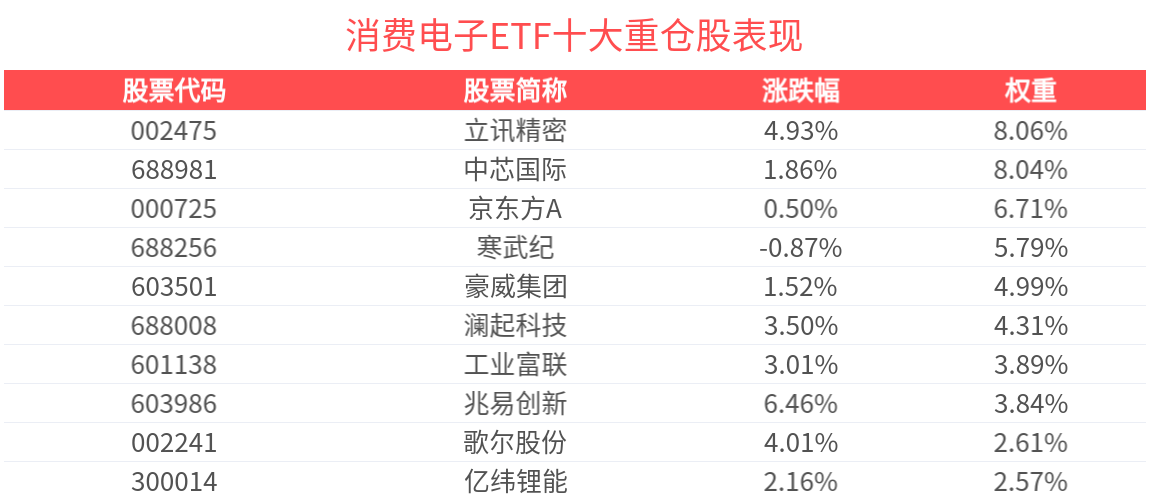
Core Insights - The strong sales growth of the iPhone 17 has led to a significant increase in Apple's stock price, positively impacting the domestic consumer electronics industry chain [1] - As of October 21, 2025, the CSI Consumer Electronics Theme Index (931494) rose by 2.44%, with notable gains in component stocks such as Lixun Precision (10.03%) and Wentai Technology (7.73%) [1] - The Consumer Electronics ETF (561600) increased by 2.53%, reflecting a 39.65% rise over the past three months [1] Summary by Category Market Performance - The CSI Consumer Electronics Theme Index has shown a strong upward trend, with a 2.44% increase as of October 21, 2025 [1] - The Consumer Electronics ETF has reported a significant 39.65% increase over the last three months, indicating robust market performance [1] Key Stocks - Key stocks in the CSI Consumer Electronics Theme Index include: - Lixun Precision (002475) with a weight of 8.06% and a rise of 4.93% [4] - SMIC (688981) with a weight of 8.04% and a rise of 1.86% [4] - BOE Technology Group (000725) with a weight of 6.71% and a rise of 0.50% [4] - The top ten weighted stocks account for 55.93% of the index, highlighting their significance in the overall performance [2]
市场连续缩量 机构对A股风格切换存分歧
Zhong Guo Zheng Quan Bao· 2025-10-20 21:53
Market Overview - On October 20, the A-share market experienced a volume contraction with a trading volume of 1.75 trillion yuan, marking three consecutive trading days below 2 trillion yuan [1][2] - The ChiNext Index rose nearly 2%, with over 4,000 stocks in the A-share market increasing in value, and more than 90 stocks hitting the daily limit [1][2] Sector Performance - Strong performances were noted in sectors such as cultivated diamonds, optical modules, lithium battery electrolytes, and coal, while gold and rare earth sectors faced adjustments [3] - Among the Shenwan first-level industries, telecommunications, coal, and power equipment led the gains, increasing by 3.21%, 3.04%, and 1.54% respectively [3] Fund Flow Analysis - The financing balance in the A-share market decreased by over 12 billion yuan last week, with a net outflow of over 8 billion yuan on October 20 [4][5] - The main funds in the CSI 300 index saw a net inflow of over 700 million yuan, indicating a more optimistic sentiment among major funds [4][5] Individual Stock Movements - On October 20, 60 stocks saw net inflows of over 100 million yuan, with the highest inflows recorded for Zhongji Xuchuang, Shenghong Technology, and Xinyi Communication [6] Long-term Market Logic - As of October 20, the total market capitalization of A-shares was 113.97 trillion yuan, with a rolling P/E ratio of 22.09 for the entire A-share market and 14.22 for the CSI 300 [7] - Analysts believe that the upward trend in the A-share market remains intact, supported by macro liquidity and the positive outlook for AI technology industries, despite recent market fluctuations [7][8]