迈瑞医疗

Search documents
“并购+自研” 迈瑞医疗能打下一个十年
Sou Hu Cai Jing· 2025-09-08 08:01
Core Viewpoint - Despite a significant decline in revenue and net profit for the first half of 2025, investors remain unfazed, focusing instead on the long-term potential of the company's technological advancements and market strategies [1][2]. Financial Performance - The company reported an 18.45% year-on-year decline in revenue and a 32.96% drop in net profit for the first half of 2025 [1]. - The decline in domestic revenue is attributed to extended cycles from public bidding to revenue recognition, reflecting a downturn in last year's bidding [2]. Market Dynamics - China's medical device exports reached $24.1 billion, a 5.0% increase year-on-year, while imports fell to $16.99 billion, a 3.9% decrease, resulting in a trade surplus of $7.11 billion [3]. - The shift from low-value consumables to high-tech medical devices marks a significant transformation in the industry, with diagnostic and therapeutic products now dominating exports [3]. Technological Advancements - The company's Resona series high-end ultrasound systems have achieved international standards in imaging speed and accuracy, with international revenue from the imaging sector rising to 62% [4]. - The integration of AI and advanced technologies into medical solutions is a key focus, exemplified by a new ultrasound endoscope solution that enhances operational efficiency during procedures [4]. Mergers and Acquisitions - The industry is witnessing a trend of mergers and acquisitions aimed at expanding product lines and enhancing technological capabilities, particularly in cardiovascular and AI sectors [6]. - The average valuation for medical device mergers has increased significantly, with 2024's average reaching 18-22 times EBITDA, a 30% rise from five years ago [6]. Research and Development - The company has invested over 20 billion yuan in R&D over the past eight years, with R&D expenditures projected to reach 10.91% of revenue in 2024 [7]. - Key components such as ultrasound probes and diagnostic reagents are developed in-house, establishing a competitive edge in the market [7]. Ecosystem Development - The company is building integrated solutions through its "Smart Ecosystem," which connects devices, data, and users to enhance healthcare delivery [10]. - The "Smart Ecosystem" has been implemented in over 1,000 hospitals domestically and has secured more than 760 projects internationally [11]. Industry Outlook - The medical device industry in China is undergoing a transformation, with a focus on innovation and meeting clinical needs, driven by government policies and increasing healthcare demands [12]. - The company aims to position itself as a leader in technological innovation, moving from a follower to a rule-maker in the global medical device landscape [12].

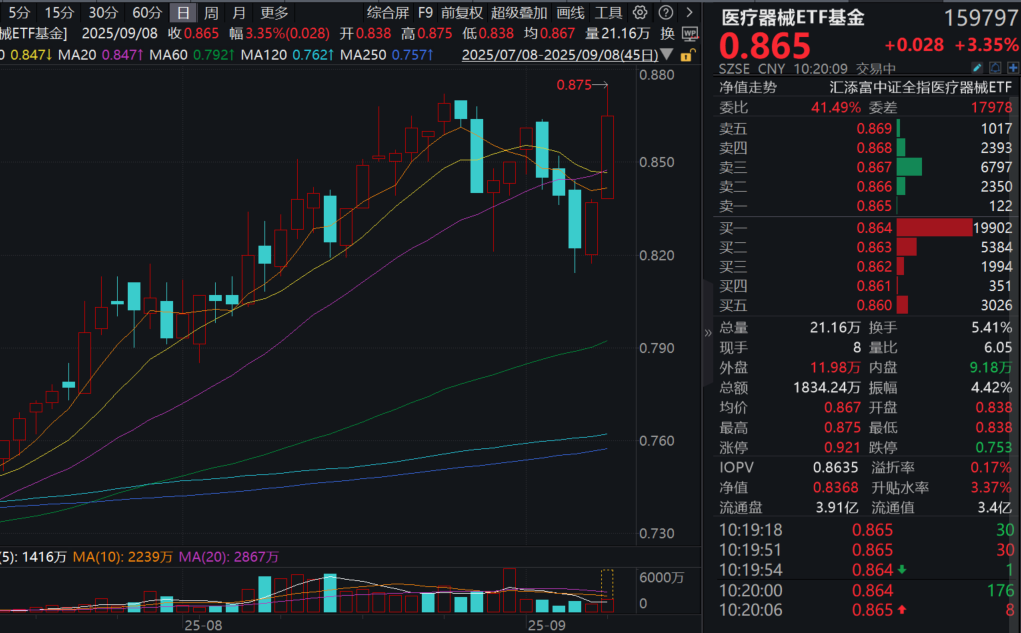
医疗器械再度爆发,联影医疗涨超11%!医疗器械ETF基金(159797)大涨超3%!机构:器械板块拐点来临,估值业绩双修复!
Xin Lang Cai Jing· 2025-09-08 02:44
Group 1 - The core viewpoint of the news highlights a strong performance in the medical device sector, with the medical device ETF (159797) rising by 3.35% and attracting over 140 million yuan in capital in the past 20 days [1][5] - As of 10:20, most constituent stocks of the medical device ETF showed positive performance, with notable gains such as 11.56% for United Imaging, 10.21% for Aikang Medical, and a limit-up for Jimin Health [3][4] - Analysts from CITIC Securities suggest that the medical device sector is at a turning point, experiencing a dual recovery in valuation and performance, and recommend focusing on companies expected to accelerate growth in 2026 compared to 2025 [4][5] Group 2 - The medical device sector is recognized for its innovation and international capabilities, with a focus on "me-too" and "me-better" products benefiting from China's engineering advantages [5] - High-value consumables are expected to recover from policy disruptions, with revenue growth of 3.99% and a net profit increase of 1.97% in the first half of 2025, indicating relative stability within the sector [5] - The medical device ETF (159797) covers key areas such as medical equipment, in vitro diagnostics, and high-value consumables, with the top ten weighted stocks accounting for over 46% of the fund [5][6]


医疗器械概念股走高,多只医疗相关ETF涨超3%
Sou Hu Cai Jing· 2025-09-08 02:36
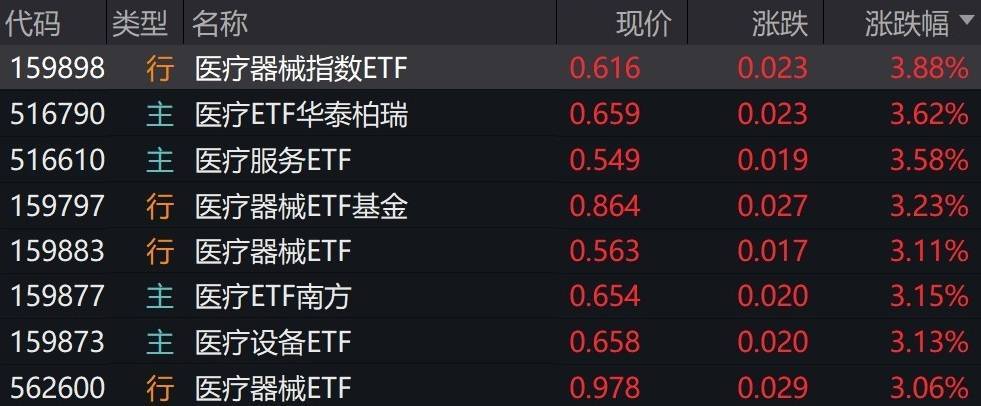
Group 1 - The core viewpoint is that medical device stocks are experiencing significant gains, with companies like United Imaging Healthcare rising over 11%, and others such as Mindray, Aimeike, Yuyue Medical, and BGI Genomics increasing by more than 4% [1] - Multiple medical-related ETFs have also seen an increase of over 3% due to market influences [1] Group 2 - Specific ETF performance includes: - Medical Device Index ETF (code: 159898) at 0.616, up 3.88% - Huatai-PineBridge Medical ETF (code: 516790) at 0.659, up 3.62% - Medical Services ETF (code: 516610) at 0.549, up 3.58% - Medical Device ETF Fund (code: 159797) at 0.864, up 3.23% - Other ETFs also showing positive growth [2] - Analysts indicate that increasing internationalization will provide more investment opportunities in the medical device sector, with several companies expected to see high growth in international business by 2025, leading to a sustained increase in revenue share [2] - The Hong Kong stock market has shown strong performance in medical devices this year, which is expected to reflect positively on the A-share market, suggesting that investment opportunities in both markets will continue to be prominent [2]


医疗器械概念震荡走高,奥精医疗、开立医疗涨超10%
Sou Hu Cai Jing· 2025-09-08 02:25
Group 1 - The medical device sector is experiencing a significant upward trend, with companies such as Aojing Medical, United Imaging, and Kaili Medical seeing stock increases of over 10% [1] - According to a report from Zhongtai Securities, the domestic medical device industry is still in a rapid development phase, with a potential turning point expected in the third quarter of 2025 [1] - Domestic companies are enhancing their competitiveness due to policy support and innovation-driven initiatives [1]


医疗板块爆发,医疗ETF(159828)领涨超4%,器械逻辑支撑行业估值修复
Sou Hu Cai Jing· 2025-09-08 02:25
Group 1 - The medical device industry is experiencing a dual recovery in performance and valuation, driven by optimized procurement policies, corporate strategic transformations, and international business expansion [1] - Several companies are showing signs of performance inflection, with expectations of high growth in the second half of 2025 and 2026 [1] - There is an increasing focus on innovative medical devices, particularly in areas such as brain-computer interfaces, AI healthcare, and surgical robots, which have significant growth potential [1] Group 2 - Internationalization is becoming a key growth logic, with Chinese companies gaining global recognition in both incremental and breakthrough innovations, such as the FDA approval of a cerebral stent by SINO Medical [1] - Companies like United Imaging and Mindray are expected to benefit from improved bidding processes and inventory clearance, with Q3 performance anticipated to accelerate [1] - The optimization of procurement rules, such as price correction mechanisms, is alleviating price reduction pressures, indicating a clear trend of industry valuation recovery [1] Group 3 - The CSI Medical Index, which the medical ETF (159828) tracks, selects listed companies involved in medical devices, medical services, and medical information technology to reflect the overall performance of the medical theme [1] - The CSI Medical Index consists of 50 actively traded and high market capitalization securities from the pharmaceutical and biotechnology sectors, ensuring the representativeness of the index samples through periodic adjustments [1]
医疗器械概念震荡走高 奥精医疗、开立医疗涨超10%
Mei Ri Jing Ji Xin Wen· 2025-09-08 02:13
Group 1 - The medical device sector experienced a significant upward movement on September 8, with companies such as Aojing Medical, United Imaging Medical, and Kaili Medical seeing stock increases of over 10% [1] - Other companies in the sector, including Jimin Health, BGI Genomics, Dabo Medical, and Mindray Medical, also showed positive stock performance [1]



研判2025!中国全自动血细胞分析仪行业产业链、相关政策及市场规模分析:技术革新与政策赋能双轮驱动,行业加速基层渗透[图]
Chan Ye Xin Xi Wang· 2025-09-08 01:05
Industry Overview - The fully automated blood cell analyzer is an essential diagnostic tool in healthcare institutions, playing a crucial role in disease diagnosis, treatment monitoring, and health check-ups. Its rapid detection speed and accurate results meet the growing demand for medical testing, providing strong support for clinical diagnosis [1][7] - The market size of China's fully automated blood cell analyzer industry is projected to reach 2.15 billion yuan in 2024, with a year-on-year growth of 9.69% [1][7] - Recent technological innovations have enhanced the detection parameters, precision, and speed of these devices. High-end models now feature intelligent functions such as automatic sampling, dilution, and retesting, significantly improving testing efficiency and accuracy [1][7] Industry Chain - The upstream of the fully automated blood cell analyzer industry includes electronic components like sensors, integrated circuits, and displays, as well as optical components such as lasers and lenses, mechanical parts, reagents, consumables, and software systems. The midstream involves the manufacturing of the analyzers, while the downstream applications are found in hospitals, clinics, health check centers, and research institutions [3] Market Demand - With rising living standards and increased health awareness, there is a growing willingness among people to undergo health checks. In 2023, the number of outpatient health checks in China reached 525 million, a year-on-year increase of 4.37%. This increase directly drives the demand for blood testing, expanding the market for fully automated blood cell analyzers [4] Relevant Policies - The Chinese medical device industry is experiencing rapid development driven by policy support and technological innovation. The National Health Commission issued a quality standard for clinical blood testing projects in November 2024, providing systematic requirements for fully automated blood cell analyzers in terms of detection accuracy, quality control, and equipment performance [6] Key Enterprises - The industry is dominated by domestic companies, with a high market concentration. Technological iteration and policy support are key competitive factors. Major players include Mindray Medical, which occupies the high-end market with its BC-7500 series, and companies like Dymind and YuliTech that penetrate the grassroots market with cost-effective solutions [7][9] Industry Development Trends 1. **Technological Integration**: The future of fully automated blood cell analyzers will focus on higher precision, faster speeds, and greater intelligence. The integration of AI, big data, and IoT will enhance data analysis and processing capabilities, enabling features like automatic anomaly detection and remote diagnostics [10] 2. **Market Expansion**: The continuous growth of the Chinese medical market and supportive policies will sustain the demand for fully automated blood cell analyzers, particularly in grassroots medical institutions and central-western regions. Domestic products are increasingly replacing imports due to improved performance and cost-effectiveness [11][12] 3. **Intensified Competition**: The industry will face heightened competition, leading to consolidation through mergers and acquisitions. This will optimize resource allocation and promote technological innovation. Additionally, international expansion will become a significant focus as domestic companies enhance their technical capabilities and brand influence [13]


股市必读:惠泰医疗(688617)9月5日主力资金净流入6410.16万元
Sou Hu Cai Jing· 2025-09-07 17:15
Core Viewpoint - Shenzhen Huatai Medical (688617) has seen a recent increase in shareholding by its controlling shareholder, Shenzhen Mindray Technology Holdings Co., Ltd. (Mindray), which has raised its stake to 25.00% through a block trade [3][4][5]. Trading Information Summary - As of September 5, 2025, Huatai Medical's stock closed at 309.44 CNY, up 1.82%, with a turnover rate of 1.25%, trading volume of 17,600 lots, and a transaction value of 548 million CNY [1]. - On the same day, the net inflow of main funds was 64.10 million CNY, while retail and speculative funds saw net outflows of 2.29 million CNY and 61.81 million CNY, respectively [2][6]. Company Announcement Summary - Mindray increased its holdings in Huatai Medical by 655,536 shares, representing 0.46% of the total share capital, at a price of 248.20 CNY per share. Following this transaction, Mindray and its concerted party, Zhuhai Tongsheng Investment Partnership, hold a combined total of 35,253,449 shares, or 25.00% of the total share capital [3][4][5]. - The funding for this acquisition came from Mindray's own or self-raised funds, and it does not involve any funds from the company or its related parties [4][5]. Detailed Equity Change Report - The detailed equity change report indicates that the total transaction value for the shares acquired by Mindray was approximately 162.70 million CNY [5]. - The report confirms that this equity change does not lead to any change in the controlling shareholder or actual controller of the company, maintaining the company's independence and avoiding any adverse effects on related transactions [3][4][5].

迈瑞医疗-2025 年亚洲领导者会议 —— 关键要点_在毛利率承压下聚焦营收,海外业务增速领先
2025-09-07 16:19
Summary of Mindray's Asia Leaders Conference 2025 Company Overview - **Company**: Mindray (300760.SZ) - **Industry**: Medical Technology (Medtech) - **Market Cap**: Rmb289.6 billion / $40.5 billion - **Enterprise Value**: Rmb270.3 billion / $37.8 billion - **Revenue Contribution**: 55% of 2024 revenue from China [5][7] Key Insights from the Conference Revenue and Growth Projections - Mindray maintains guidance for revenue growth to turn positive by 3Q25, but bottom line growth may remain negative due to Gross Profit Margin (GPM) pressure [1][5] - China sales channel destocking is expected to be completed by the end of this year, with no guidance on China growth for 2026 due to policy uncertainties [1][4] - Overseas growth is projected to maintain a double-digit rate, estimated at around 15%-20% CAGR from emerging markets over the next several years [1][4] GPM and Pricing Pressure - The company has experienced a GPM decrease of approximately 5% in China and anticipates further pressure in the second half of 2025 [4][5] - Pricing pressure is expected to persist until 2026 due to the implementation of Value-Based Procurement (VBP) and new hospital testing price guidelines [4][5] Competitive Landscape - Intense price competition is noted within the medical equipment sector, particularly for low-end products [4][5] - Many distributors are currently achieving only single-digit net margins, leading to a faster exit of smaller IVD companies from the market [4][5] Investment Thesis - Mindray is positioned as a leading medtech device manufacturer in China, with strong growth drivers including healthcare infrastructure development and domestic substitution [5][6] - The company is trading below its 5-year average forward P/E, primarily due to policy risks, but is expected to maintain its market leader position [5][6] Price Target and Risks - The 12-month target price is set at Rmb296, indicating an upside potential of 23.9% from the current price of Rmb238.81 [7] - Key downside risks include further impacts from VBP, slower penetration into top-tier hospitals in China, challenges in entering North American and European markets, patent-related lawsuits, and unexpected changes in trade policies [6][7] Additional Considerations - The company is focusing on maintaining market share in hospital procurement rather than historical profitability levels [4][5] - The IVD industry outlook suggests a normalization of volume decreases due to DRG/DIP reforms by 2026, following a low base in 2025 [4][5] This summary encapsulates the critical points discussed during Mindray's Asia Leaders Conference, highlighting the company's strategic focus, market challenges, and growth opportunities within the medtech industry.
海内外多所高校鹏城共话人工智能胜任力培养
Zhong Guo Xin Wen Wang· 2025-09-06 08:05
中新网广东新闻9月5日电 (记者 王坚)2025一带一路高校人工智能胜任力培养学术会议(2025ACTS)近日 在位于广东深圳的清华大学深圳国际研究生院(下称"深圳国际研究生院")开幕。 会议以"人工智能赋能高等教育与跨界对话"为主题,清华大学校务委员会副主任杨斌出席会议并作主旨 报告,深圳国际研究生院院长欧阳证主持大会开幕式并致辞。 活动上,杨斌作题为"智能时代的全球高等教育愿景:清华大学的战略与思考"的主旨报告,强调应塑造 面向未来的高等教育新格局,并提出"XAI"理念,为下一代重新定义卓越的内涵。 欧阳证指出,高校应成为人工智能治理的积极贡献者,坚持人文引领、协同创新与包容卓越,深化AI 与高教融合。 多位海内外高校代表分别分享了人工智能教育领域的创新实践。 此外,会议期间举行了多个合作签约仪式。深圳国际研究生院与马来西亚博特拉大学、印尼建国大学以 及新加坡信托资产管理公司分别签署合作备忘录,将围绕联合培养、学术交流、合作研究等开展合作。 同时,学院与腾讯、美的、迈瑞医疗、中国中煤能源集团、自变量机器人科技、博清科技六家企业达成 产教融合战略合作,共同推进卓越工程师培养与技术创新落地。(完) ...