
渝农商行

Search documents
大竹渝农商村镇银行4项违规被处罚 为渝农商行子公司
Zhong Guo Jing Ji Wang· 2026-01-06 06:36
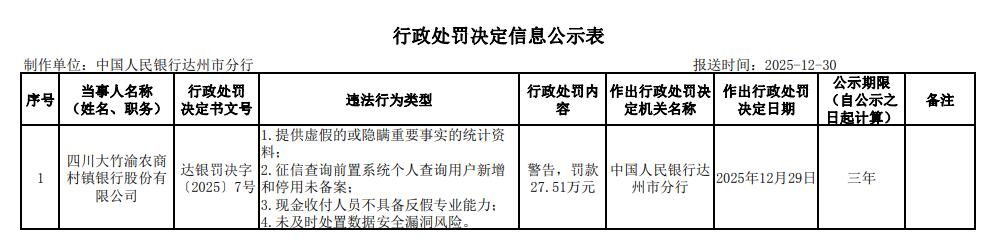
以下为原文: 中国经济网北京1月6日讯 中国人民银行达州市分行近日发布的行政处罚决定信息公示表(达银罚决字〔2025〕7号)显示,四川大竹渝农商 村镇银行股份有限公司存在以下违法行为类型:1.提供虚假的或隐瞒重要事实的统计资料;2.征信查询前置系统个人查询用户新增和停用未 备案;3.现金收付人员不具备反假专业能力;4.未及时处置数据安全漏洞风险。中国人民银行达州市分行对其警告,罚款27.51万元。 渝农商行(601077)2024年年度报告显示,四川大竹渝农商村镇银行股份有限公司是渝农商行的子公司,持股比例91%。 | 明上手段: 十四八尺次 < 川九月 | | | | TRANTH: 20GD 16 00 | | | | | | --- | --- | --- | --- | --- | --- | --- | --- | --- | | | 当事人名称 序号 | 行政处罚 | 违法行为类型 | 行政处罚内 作出行政处罚决 | | 作出行政处罚 | 公示期限 (自公示之 | 备注 | | | (姓名、职务) | 决定书文号 | | 答 | 定机关名称 | 决定日期 | 日起计算) | | | | | | 1 ...

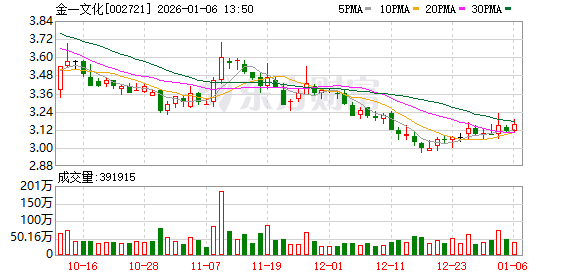
金一文化:开科唯识客户涵盖广西北部湾银行、贵州银行、桂林银行、渝农商行、柳州银行等金融机构
Mei Ri Jing Ji Xin Wen· 2026-01-06 05:49
Core Viewpoint - Jin Yi Culture (002721.SZ) is actively engaged in providing software development, technical services, operation maintenance, and consulting services primarily to financial institutions, focusing on wealth management and financial market solutions [2] Company Overview - The main business of Kai Ke Wei Shi is to offer software development and technical services in the fields of wealth management, financial markets, and payment clearing to banks and financial institutions [2] - Kai Ke Wei Shi's clients include several banks in the western region, such as Guangxi Beibu Gulf Bank, Guizhou Bank, Guilin Bank, Chongqing Rural Commercial Bank, and Liuzhou Bank [2]

银行业须发挥好 “融资”与“结算”双轮驱动作用
Jin Rong Shi Bao· 2026-01-06 01:25
Core Viewpoint - The People's Bank of China and multiple departments have jointly issued the "Opinions on Financial Support for Accelerating the Construction of the Western Land-Sea New Corridor," aiming to inject new momentum into the development of this national strategic initiative [1] Financial Support and Development - The Western Land-Sea New Corridor has achieved significant results, with an import and export volume of 611.5 billion yuan in the first three quarters of 2025, representing a year-on-year growth of 19.3%, contributing 3.4 percentage points to the overall foreign trade growth in the western region [1] - The banking sector has integrated into the construction of the corridor by providing financial support for infrastructure and industry empowerment, facilitating a new pattern of opening up that promotes both land and sea connectivity [1] Financing and Settlement Functions - The dual drive of "financing" and "settlement" will activate the industrial chain and create a financial ecosystem for internal and external circulation, transforming the geographical corridor into a "golden channel" for global resource allocation [2] - Financing should evolve beyond mere capital provision to foster endogenous growth, requiring banks to align their services with the industrial clusters emerging from the corridor [2] - The settlement function aims to enhance the efficiency of cross-border trade by integrating China's payment and settlement systems into broader trade networks [2] Innovation in Cross-Border Financial Services - The Opinions emphasize the need for banks to innovate cross-border financial services, including facilitating cross-border trade settlements and supporting new trade formats [3] - There is a focus on promoting the use of the renminbi in cross-border trade and investment to reduce exchange rate risks for enterprises [3] - The establishment of a multi-layered, cross-regional risk prevention system is essential, leveraging financial technology for real-time monitoring of cross-border capital flows and abnormal transactions [3] Economic Impact and Future Outlook - As the measures outlined in the Opinions are implemented, financial resources will be more precisely directed to various sectors of the Western Land-Sea New Corridor, enhancing its role as a "golden channel" for integrating and allocating global resources [3]
19家上市银行加码财富管理赛道,2026年战略布局将提速
Di Yi Cai Jing· 2026-01-05 12:50
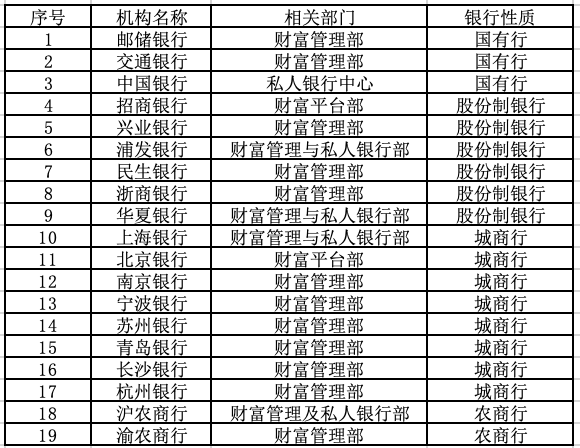
Core Insights - The rapid expansion of high-net-worth client groups is prompting domestic listed banks to accelerate the establishment of dedicated wealth management departments, shifting their retail banking strategy from "product sales" to "full lifecycle asset allocation" [1][2] - By the end of 2025, 19 listed banks are expected to have established or adjusted their wealth management-related departments, including 3 state-owned banks, 6 joint-stock banks, 8 city commercial banks, and 2 rural commercial banks [2][3] Group 1: Wealth Management Department Establishment - State-owned banks like Postal Savings Bank, Bank of China, and Bank of Communications are completing wealth management business integration at the head office level by 2025 [1][4] - Joint-stock banks and city commercial banks are adopting a model that integrates wealth management with private banking, with several banks like Shanghai Bank and Hangzhou Bank establishing new wealth management departments [5][6] Group 2: Strategic Shifts and Market Positioning - The establishment of wealth management departments reflects a strategic shift towards enhancing professional capabilities and resource integration, aiming to upgrade wealth management as a core strategy for banks [7][8] - Compared to state-owned banks, joint-stock banks and city commercial banks focus on precise market positioning, with banks like China Merchants Bank prioritizing wealth management as a core capability [7][8] Group 3: Growth and Performance Metrics - As of Q3 2025, the wealth management AUM of listed banks continues to expand, with Postal Savings Bank reaching 17.89 trillion yuan and significant growth rates reported by other banks [9] - The future of wealth management business is expected to accelerate due to the continuous accumulation of resident wealth and the diversification of high-net-worth client needs, with strategic investments and organizational adjustments being crucial for competitive positioning [9]
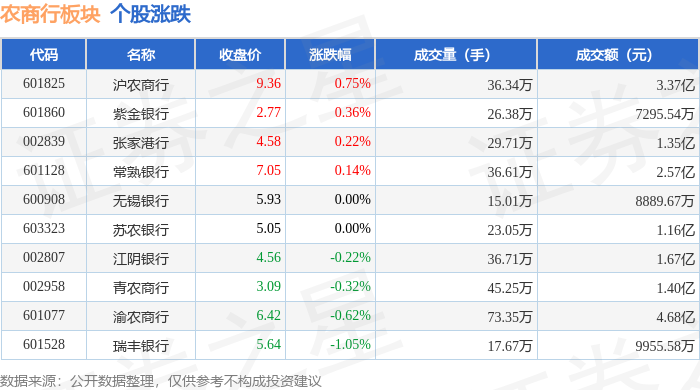
农商行板块1月5日涨0.09%,沪农商行领涨,主力资金净流入7699.1万元
Zheng Xing Xing Ye Ri Bao· 2026-01-05 09:09
Core Insights - The agricultural commercial bank sector experienced a slight increase of 0.09% on January 5, with Shanghai Agricultural Commercial Bank leading the gains [1] - The Shanghai Composite Index closed at 4023.42, up by 1.38%, while the Shenzhen Component Index closed at 13828.63, up by 2.24% [1] Stock Performance - Shanghai Agricultural Commercial Bank (601825) closed at 9.36, with a rise of 0.75% and a trading volume of 363,400 shares, totaling a transaction value of 337 million yuan [1] - Other notable banks include: - Zijin Bank (601860) at 2.77, up 0.36% with a transaction value of 72.96 million yuan [1] - Zhangjiagang Bank (002839) at 4.58, up 0.22% with a transaction value of 135 million yuan [1] - Changshu Bank (601128) at 7.05, up 0.14% with a transaction value of 257 million yuan [1] - Wuxi Bank (600908) remained unchanged at 5.93 with a transaction value of 88.9 million yuan [1] Capital Flow - The agricultural commercial bank sector saw a net inflow of 76.99 million yuan from institutional investors and 84.57 million yuan from retail investors, while individual investors had a net outflow of 162 million yuan [1] - Specific capital flows for key banks include: - Shanghai Agricultural Commercial Bank had a net inflow of 47.24 million yuan from institutional investors, but a net outflow of 54.86 million yuan from individual investors [2] - Changshu Bank saw a net inflow of 32.72 million yuan from institutional investors, with a net outflow of 33.53 million yuan from individual investors [2] - Suzhou Agricultural Bank had a net inflow of 13.51 million yuan from institutional investors, with a net outflow of 12.27 million yuan from individual investors [2]
成都农商银行晋级万亿元:农商行头部阵营扩容至五家 金融资源“极化”趋势凸显
Mei Ri Jing Ji Xin Wen· 2026-01-04 15:24
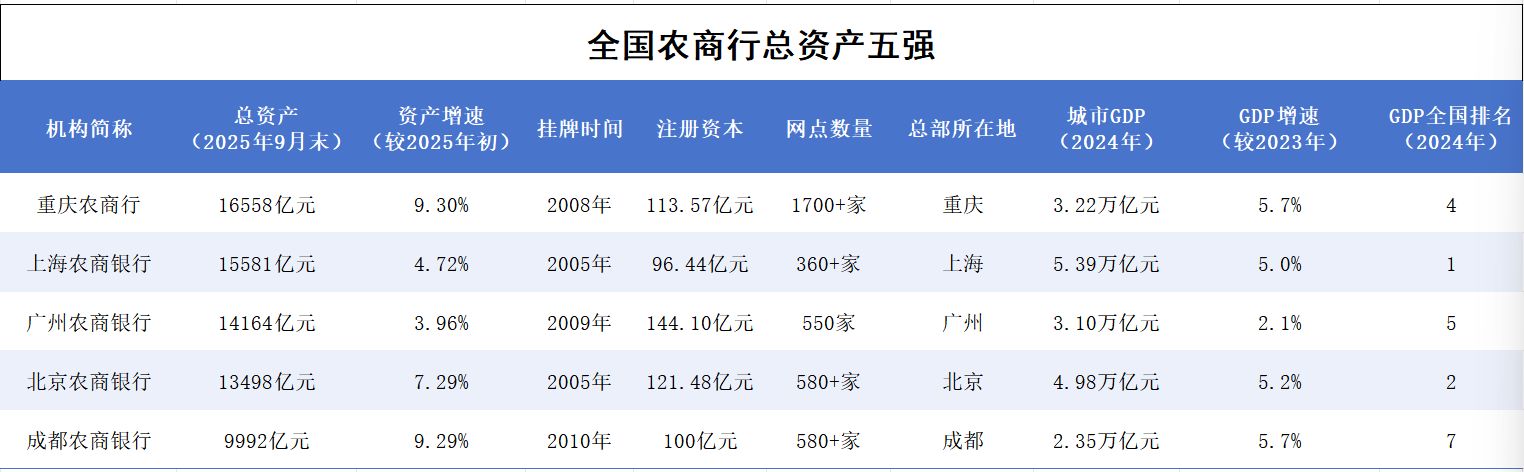
Core Insights - Chengdu Rural Commercial Bank has officially announced that its asset scale has surpassed 1 trillion yuan as of December 31, 2025, joining the "trillion yuan club" alongside four other major rural commercial banks in China [1][3] - The emergence of these banks reflects a trend of financial resource concentration in economically vibrant regions, indicating a shift in China's regional economic development landscape [1][8] Group 1: Overview of the Trillion Yuan Club - The "trillion yuan era" for rural commercial banks began six years ago, with Chongqing Rural Commercial Bank being the first to exceed this threshold in June 2019 [2] - As of September 2025, the total assets of the five major rural commercial banks exceeded 11% of the total assets of all rural financial institutions in China, showcasing significant concentration effects [4] - The five banks—Chongqing, Shanghai, Guangzhou, Beijing, and Chengdu—are primarily located in major cities with strong economic performance, collectively accounting for over 14% of the national GDP [4] Group 2: Individual Bank Performance - As of September 2025, the asset scales of the five banks are as follows: Chongqing Rural Commercial Bank at 1.66 trillion yuan, Shanghai Rural Commercial Bank at 1.56 trillion yuan, Guangzhou Rural Commercial Bank at 1.42 trillion yuan, Beijing Rural Commercial Bank at 1.35 trillion yuan, and Chengdu Rural Commercial Bank at 999.2 billion yuan [6] - Each bank has developed unique strategies based on their regional characteristics, such as Beijing's focus on serving agriculture and small enterprises, and Shanghai's emphasis on wealth management and technology [10][11] Group 3: Strategic Implications - The formation of the "trillion yuan club" among these banks enhances their ability to support local infrastructure projects, providing greater financial autonomy for regional development [15] - The collective strength of these banks facilitates the integration of financial services across administrative boundaries, potentially lowering financing costs for businesses operating in multiple regions [15] - The emergence of this banking cluster is expected to contribute to the establishment of a Western financial center, attracting more financial resources and fostering innovation in financial products tailored to local industries [15]

成都农商银行资产规模突破1万亿元
Jin Rong Jie· 2026-01-04 14:13
公开信息显示,成都农商银行是在原成都市农村信用社基础上改制成立的股份制商业银行,于2010年1 月15日挂牌开业。2011年完成增资扩股,注册资本达到100亿元。2020年6月,完成股权结构调整,回归 国有,市区两级国资合计持股比例77.67%,是成都市国资持股比例最大的银行,系市属国资一级企 业。 银行频道更多独家策划、专家专栏,免费查阅>> 2026年1月1日,成都农商银行在其官方平台宣布,该行资产规模正式突破 1 万亿元,成为全国第五家迈 入 "万亿农商行俱乐部" 的农商行,其余四家分别为重庆农商行、北京农商行、广州农商行和上海农商 行。 责任编辑:小讯 ...
渝农商行(601077) - 渝农商行H股公告
2026-01-04 08:45
FF301 股份發行人及根據《上市規則》第十九B章上市的香港預託證券發行人的證券變動月報表 截至月份: 2025年12月31日 狀態: 新提交 致:香港交易及結算所有限公司 公司名稱: 重慶農村商業銀行股份有限公司 呈交日期: 2026年1月2日 I. 法定/註冊股本變動 | 1. 股份分類 | 普通股 | 股份類別 | H | | | 於香港聯交所上市 (註1) | | 是 | | | --- | --- | --- | --- | --- | --- | --- | --- | --- | --- | | 證券代號 (如上市) | 03618 | 說明 | | | | | | | | | | | 法定/註冊股份數目 | | | 面值 | | | 法定/註冊股本 | | | 上月底結存 | | | 2,513,336,041 | RMB | | | 1 RMB | | 2,513,336,041 | | 增加 / 減少 (-) | | | | | | | RMB | | | | 本月底結存 | | | 2,513,336,041 | RMB | | | 1 RMB | | 2,513,336,041 | | ...
回望“十四五” | 破解“内陆困局” 构筑“价值高地”——“十四五”期间重庆辖区上市公司蝶变观察
Xin Lang Cai Jing· 2025-12-31 16:01
Core Insights - As of September 2025, the number of listed companies in Chongqing reached 78, an increase of 20 from early 2021, with a total market capitalization exceeding 1.25 trillion yuan, representing a growth of 28.87% from the end of 2020 [2][11] - The "14th Five-Year Plan" period has seen Chongqing's securities regulatory authority implement policies to enhance both the quantity and quality of listed companies, contributing to high-quality economic development in the region [2][12] - Chongqing is leveraging capital to drive a structural revolution, with significant increases in core indicators such as revenue, R&D investment, and tax contributions, with R&D investment surging by 127.45% over five years [2][11] Group 1: Structural Changes and Innovations - The transformation of Chongqing's listed companies from quantity to quality is facilitated by institutional innovations, including government-guided funds and bankruptcy restructuring, providing a replicable model for inland cities [4][13] - Notable examples include the integration of resources between China National Pharmaceutical Group and Taiji Group, breaking down barriers in the pharmaceutical industry and fostering deep integration between central enterprise capital and local market networks [4][13] - The shift towards a light-asset model by companies like China Communications Construction Company has improved asset turnover rates by 37%, prompting a transition from land development to urban operations [4][13] Group 2: Bankruptcy Restructuring - For companies facing operational difficulties, Chongqing has adopted a challenging path of market-oriented bankruptcy restructuring to rebuild corporate value, as exemplified by Jinke Group's transformation into a comprehensive real estate operator [5][14] - The regulatory authority emphasizes that bankruptcy restructuring should not be seen as an endpoint but as a process that tests the long-term governance capabilities of the capital market [5][14] Group 3: Innovation Ecosystem - Chongqing's innovation has evolved from a focus on input quantity to an ecosystem approach, integrating "institution + scenario" to embed technological innovation deeply within the industrial landscape [6][15] - Leading companies like Changan Automobile have established significant research facilities, enhancing technology transfer rates to 42%, surpassing the national average of 28% [6][15] - The city is actively developing systemic support for innovation, including the establishment of technology transfer research institutes and specialized technology incubators [6][15] Group 4: Green Transformation - The green transformation of Chongqing's listed companies has integrated ESG (Environmental, Social, and Governance) principles into core competitive advantages, with the number of companies disclosing sustainability reports doubling to 41 since 2021 [7][16] - Companies like Seres have achieved high ESG ratings, which not only attract international capital but also facilitate market entry into the EU, reducing export costs by an average of 8% due to carbon tariffs [7][16] - Innovations in green finance, such as the issuance of green bonds linked to carbon reduction, have transformed financing into a dynamic value creation mechanism [7][16] Group 5: Strategic Positioning - Chongqing's listed companies have found a clearer positioning within national strategies, actively participating in regional development and international trade initiatives, becoming key players in the Chengdu-Chongqing economic circle and the Western Land-Sea New Corridor [8][17] - Financial innovations have significantly reduced the time for enterprise financing approvals, enhancing regional collaboration and serving as a vital link in the national strategy [8][17] - The successful establishment of automotive research and manufacturing bases by companies like Changan and Seres is paving the way for Chongqing's transition from domestic leadership to international competitiveness [8][17] Group 6: Future Outlook - The achievements during the "14th Five-Year Plan" lay a solid foundation for Chongqing's listed companies in the upcoming "15th Five-Year Plan," with ambitions to evolve from an "industrial highland" to an "innovation source" [8][18] - Future plans include the establishment of a Western Science and Technology Innovation Financial Reform Pilot Zone and the creation of a "green technology international certification center" to lower compliance costs for companies entering global markets [8][17][18]

农商行板块12月31日涨0.94%,渝农商行领涨,主力资金净流入1263.96万元
Zheng Xing Xing Ye Ri Bao· 2025-12-31 09:06
Group 1 - The agricultural commercial bank sector increased by 0.94% on December 31, with Chongqing Rural Commercial Bank leading the gains [1] - The Shanghai Composite Index closed at 3968.84, up 0.09%, while the Shenzhen Component Index closed at 13525.02, down 0.58% [1] - The trading volume and turnover for Chongqing Rural Commercial Bank were 791,700 shares and 509 million yuan, respectively, with a price increase of 2.38% [1] Group 2 - The net inflow of main funds into the agricultural commercial bank sector was 12.64 million yuan, while retail investors experienced a net outflow of 39.35 million yuan [1] - The main net inflow for Changshu Bank was 22.32 million yuan, accounting for 13.28% of its trading volume [2] - Zhangjiagang Bank saw a main net inflow of 15.00 million yuan, representing 11.93% of its trading volume [2]
