珀莱雅

Search documents
珀莱雅:首次回购23.08万股
2 1 Shi Ji Jing Ji Bao Dao· 2026-01-15 08:32
21智讯1月15日电,珀莱雅公告,2026年1月15日,公司通过集中竞价交易方式首次回购公司股份23.08 万股,占公司目前总股本的比例为0.06%,回购成交的最高价为69.95元/股,最低价为69.76元/股,支付 的资金总额为1,611.9331万元(不含印花税、佣金等交易费用)。本次回购股份符合法律法规的规定及 公司的回购股份方案。公司将严格按照相关规定,在回购期限内根据市场情况择机做出回购决策并予以 实施,同时根据回购股份事项进展情况及时履行信息披露义务,敬请广大投资者注意投资风险。 ...

珀莱雅(603605.SH):首次回购23.08万股公司股份
Ge Long Hui A P P· 2026-01-15 08:27
格隆汇1月15日丨珀莱雅(603605.SH)公布,2026年1月15日,公司通过集中竞价交易方式首次回购公司 股份23.08万股,占公司目前总股本的比例为0.06%,回购成交的最高价为69.95元/股,最低价为69.76元/ 股,支付的资金总额为人民币16,119,331.00元(不含印花税、佣金等交易费用)。 ...
珀莱雅:首次以集中竞价回购股份1611.93万元
Xin Lang Cai Jing· 2026-01-15 08:27
珀莱雅公告称,公司于2025年12月30日决定以自有资金回购股份,用于股权激励或员工持股计划,回购 金额为8000万元-15000万元,回购期限至2026年12月29日。2026年1月15日,公司首次以集中竞价方式 回购股份23.08万股,占总股本0.06%,回购价格69.76元/股-69.95元/股,支付资金1611.9331万元。 ...
进口美妆品牌在华市场份额持续下滑
3 6 Ke· 2026-01-15 00:28
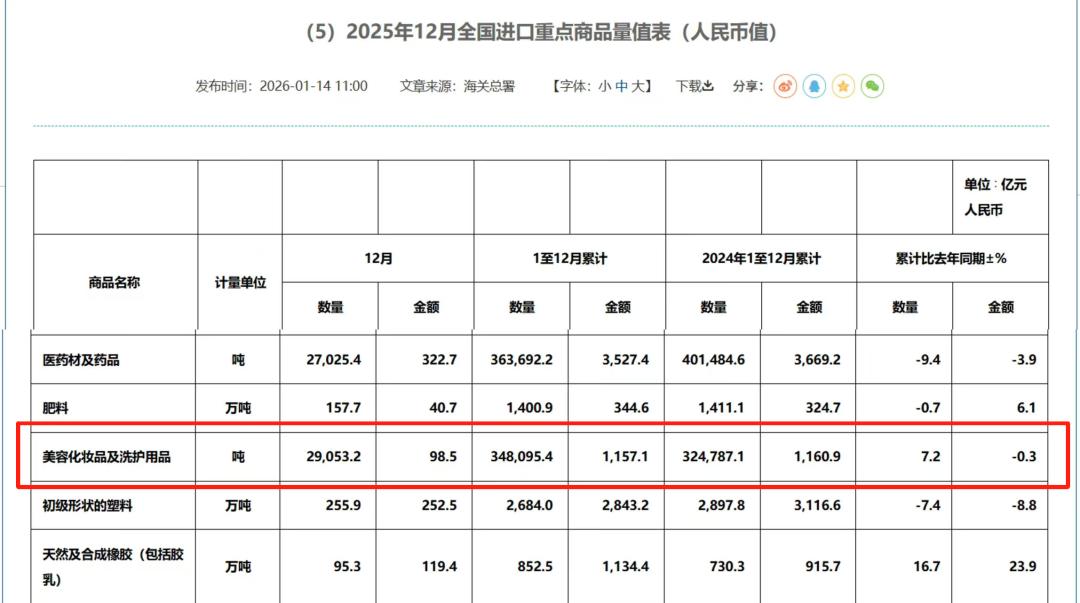
Core Insights - The overall trend of China's import and export market is positive, but the beauty and cosmetics sector shows a contrasting pattern with "cold imports and hot exports" [1][3] - In 2025, the export value of cosmetics increased by 10.4% year-on-year, while the import value slightly decreased by 0.3% [1][2] Import and Export Data - In 2025, the total import quantity of cosmetics reached 348,095.4 tons, a year-on-year increase of 7.2%, while the import value was 115.71 billion yuan, a slight decrease of 0.3% [2][4] - The import quantity of cosmetics has been on a downward trend since 2021, with 2025's figure of 34.8 tons being only slightly higher than 2024's [4][6] - The import value of cosmetics in 2025 was the lowest in nearly six years, indicating a significant decline in international beauty brands' market share in China [8][12] Market Dynamics - The decline in import value contrasts with the continuous growth of domestic cosmetics exports, which have seen a consistent increase for four years [15][31] - The top five countries for China's cosmetics exports in the first half of 2025 were the United States, the United Kingdom, Indonesia, the Netherlands, and Japan, with exports to Indonesia growing by 94.34% [21][24] Competitive Landscape - International beauty brands are facing challenges in the Chinese market, with many brands from Japan and South Korea experiencing significant sales declines [13][14] - Domestic brands are increasingly capturing market share, with some successfully expanding overseas through e-commerce and brand acquisitions [29][30] - The shift in consumer preferences and the competitive pressure from local brands are reshaping the market dynamics, indicating a need for international brands to adapt [12][31] Future Outlook - The ongoing adjustments in the global beauty market suggest that Chinese beauty brands are moving from domestic market competition to international expansion [31][32] - The ability to build global brand influence while leveraging supply chain advantages will be crucial for the future success of the Chinese beauty industry [32][33]

2025年面部护肤电商消费趋势
知行战略咨询· 2026-01-14 14:24
Investment Rating - The report indicates a positive investment outlook for the facial skincare industry, particularly in the e-commerce segment, with a projected growth rate of 19.4% year-on-year [9]. Core Insights - The facial skincare category is leading the beauty and skincare market, with significant sales growth on e-commerce platforms, especially on Douyin, which is expected to surpass 1340.39 billion in sales by 2024 [9][10]. - Tmall's market share is declining, projected to drop to 30.5% by 2024, while Douyin is rapidly gaining market share [9][10]. - The report highlights various product categories within facial skincare, noting that while some categories are experiencing growth, others are facing declines [12][14][16]. E-commerce Market Trends - The overall e-commerce market for facial skincare is expected to grow by 19.4% year-on-year, with Douyin becoming the leading platform [9]. - Tmall's sales are projected to decline, while Douyin's sales are expected to grow significantly, reaching 1340.39 billion by 2024 [9][10]. - The report provides detailed sales figures for major platforms, indicating a shift in consumer preferences towards Douyin [10]. Product Category Performance - The report categorizes facial skincare products into several key segments, including serums, creams, masks, and cleansers, with varying growth rates across these categories [8][12][14][16]. - Specific product categories such as lotions and toners are showing positive growth, while others like facial scrubs and certain masks are declining [12][14][16]. - Douyin shows remarkable growth in categories like facial care sets and liquid serums, with growth rates of 48.6% and 54.0% respectively [16][17]. Brand Performance - The report lists top-performing brands in the facial skincare market, highlighting significant sales figures and growth rates for brands like Proya, L'Oreal, and Estee Lauder [19][20][21]. - Proya is noted for its strong growth, with a sales increase of 103.9%, while other brands like Sk-II and Olay are experiencing declines [19][20][21]. - The competitive landscape is shifting, with emerging brands gaining traction alongside established players [19][20][21].



知行数据观察:化妆水/爽肤水品类
知行战略咨询· 2026-01-14 14:24
Investment Rating - The report does not explicitly state an investment rating for the industry Core Insights - The facial skincare market is expanding, with e-commerce sales projected to grow by 19.4% year-on-year in 2024, while Tmall's market share is expected to decline to 30.5% [9][11] - Douyin has emerged as the leading platform for sales, surpassing 1340.39 billion in sales by 2024, marking a significant increase of 53.6% [9][10] - The market is entering a phase of stock competition, focusing on differentiation rather than scale expansion, as total sales growth is projected to be only 2.8% from 2023 to 2025 [19] Summary by Sections Market Overview - The facial skincare category is a core segment of the beauty industry, with a focus on hydrating and soothing products [8] - The market is characterized by a stable demand for basic hydration, while anti-aging and soothing effects are emerging as key growth trends [12][14] Sales Performance - E-commerce sales for facial skincare products reached 98.1 billion in 2023, with a projected increase to 121.8 billion by 2025, reflecting a modest growth rate [20] - Douyin's sales in the facial skincare category reached 54.27 billion in 2023, showing a year-on-year growth of 16%, while Tmall's sales declined by 11% [21][30] Consumer Trends - Anti-aging and hydration are identified as essential selling points, with a high willingness to pay among consumers [14] - The report highlights a significant opportunity in the sensitive skin and repair segments, which currently have a supply-demand gap [14][15] Brand Analysis - The top brands on Tmall are dominated by international high-end brands, while Douyin features a higher proportion of domestic brands with rapid growth [26][30] - The report notes that brands like La Mer and Lancôme dominate the high-price segment on Tmall, while domestic brands like Rellet and Dr. Wu are gaining traction on Douyin [27][33] Channel Dynamics - Douyin is becoming the primary growth channel, with a sales share increasing from 46% to 55% by 2025, while Tmall's share is declining [17][19] - The report indicates that live streaming is a key driver of sales on Douyin, accounting for 72% of sales in the facial skincare category [23]
知行数据观察:乳液面霜品类
知行战略咨询· 2026-01-14 14:21
Investment Rating - The report does not explicitly state an investment rating for the industry Core Insights - The lotion and cream category is fundamental in skincare, primarily used for moisturizing and nourishing the skin, with a focus on different textures and oil content [8] - Moisturizing remains the core demand in the market, accounting for 31% of the total efficacy share, but its growth rate is only 5%, indicating a mature stage with limited growth potential [10][11] - Nourishing creams, while only 5% of the market, show the highest growth rate at 16%, indicating a rising demand for high-nutrition products [10] - The market is experiencing a shift, with a decline in demand for traditional benefits like hydration and anti-aging, suggesting a saturation of these offerings [10][11] Market Overview - The online sales landscape is shifting, with Douyin's sales share increasing from 44% to 49% and Tmall's decreasing from 56% to 51% between 2023 and 2025 [17][19] - The average price on Tmall has risen significantly, while Douyin has adopted a low-price strategy to capture market share [17][19] - Overall sales growth is slowing, with a projected increase of only 4.3% from 2024 to 2025, indicating a potential market peak [19] Product Demand Analysis - Key selling points such as glycerin and moisturizing are in high demand, but the market is competitive, requiring differentiation to maintain an edge [13][14] - Sensitive skin and repair claims represent a blue ocean opportunity, with significant demand and insufficient supply, making them key areas for growth [13] - The report highlights a notable disparity in supply and demand for various product claims, with high demand for moisturizing and sensitive skin products but lower supply [14] Brand Performance - Top brands in the Tmall platform are dominated by high-end names like SkinCeuticals and Helena Rubinstein, with significant market shares [21][22] - Domestic brands like Proya and Winona are performing well in terms of growth, while established brands like Proya are experiencing declines [21][23] - The report notes that international brands maintain a high-end positioning with lower sales volumes, while domestic brands focus on competitive pricing to capture market share [23] Sales Channel Dynamics - The report indicates that Douyin's sales strategy focuses on low prices to drive volume, while Tmall emphasizes premium products [17][19] - The sales performance of brands varies significantly between platforms, with Douyin showing a higher volume of sales but at lower price points [19][23] - The report suggests that brands need to adapt their strategies to the unique characteristics of each sales channel to optimize performance [19] Consumer Trends - There is a growing consumer preference for products that offer high nutritional value, indicating a shift in consumer priorities towards more effective skincare solutions [10] - The report emphasizes the importance of understanding consumer behavior and adapting product offerings to meet evolving demands [10][13]
知行数据观察:面膜品类
知行战略咨询· 2026-01-14 14:11
Investment Rating - The report provides a positive investment rating for the facial mask industry, highlighting its growth potential and market dynamics [12][18]. Core Insights - The facial mask market in China is expected to grow from 47.8 billion yuan in 2018 to 75 billion yuan by 2025, with a compound annual growth rate (CAGR) of 6.7% [12][13]. - Sheet masks dominate the market, accounting for 72.8% of the market share, while cream masks show higher growth potential [12]. - Regulatory changes are pushing the industry towards transformation, with stricter guidelines enhancing product safety and transparency [14]. - Consumer preferences are shifting towards efficacy, with 23.9% prioritizing product effectiveness in their purchasing decisions [15]. Industry Macro Market Research - The facial mask industry is defined as skincare products applied to the face, designed to enhance skin absorption of nutrients and achieve various skincare benefits [10]. - The market is expanding due to increasing skincare demands and innovations in product technology [12]. Online Industry Trend Overview - The online facial mask market is projected to grow from 20.85 billion yuan in 2023 to 27.24 billion yuan by 2025, with Douyin (TikTok) showing significant sales growth [18]. - Douyin's sales are expected to rise from 11.26 billion yuan to 19.10 billion yuan, capturing 75% of the market share by 2025 [18]. Head Brand Analysis on Douyin - The top brands on Douyin, such as EIIO and Zao Wu Zhe, have shown remarkable growth, with some brands achieving over 200% growth [28]. - The competitive landscape on Douyin is characterized by a mix of established and emerging brands, with a focus on innovative marketing strategies [31]. Consumer Purchase Behavior - The main factors influencing consumer decisions include product efficacy (23.9%), ingredients (21.1%), and skin feel (19.5%) [15][16]. - The market is witnessing a segmentation between convenience-focused sheet masks and more intensive cream masks, reflecting diverse consumer needs [15]. Regulatory Trends - The implementation of stricter regulations, such as the "Cosmetics Supervision and Administration Regulations," is shaping the industry by ensuring product safety and compliance [14]. - Future regulations will focus on sustainable packaging and the introduction of new standards for "pure masks" [14]. Brand Performance on E-commerce Platforms - Taobao's facial mask sales are experiencing a decline, with a 9.2% drop in sales for the first nine months of 2025 [22]. - In contrast, Douyin's facial mask sales are growing at a rate of 23.3%, with cream masks showing exceptional growth [25]. Market Share and Sales Data - The top brands on Taobao include Proya and L'Oreal, while Douyin's leading brands are EIIO and Original Password, showcasing a shift in brand dominance [28][37]. - The report highlights the sales performance of various brands, indicating a competitive market with significant growth opportunities for emerging players [29][37].
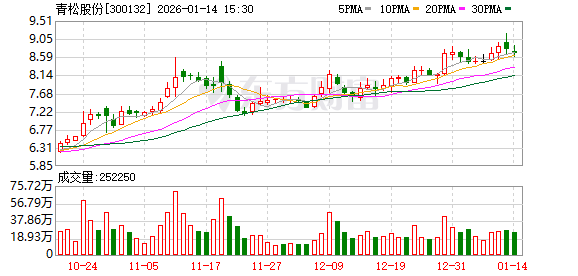
青松股份:公司化妆品业务的主要客户涵盖国际知名品牌、国内知名品牌等
Zheng Quan Ri Bao· 2026-01-14 09:41
Core Viewpoint - Qingsong Co., Ltd. has a diverse customer base in its cosmetics business, including international and domestic well-known brands, channel merchants' private labels, social e-commerce brands, and emerging e-commerce brands [2] Group 1: Customer Base - The main customers of Qingsong Co., Ltd. in the cosmetics sector include international renowned brands such as Unilever, Procter & Gamble, Estée Lauder, Sephora, Watsons, Shiseido, Nivea, Dettol, GAMA, and Muji [2] - Domestic well-known brand customers include Shanghai Jahwa, Plant Doctor, Natural Hall, Proya, Gaozi, Xiyu Bencao, Ibeishi, Veenona, Pechoin, Huaxi Biological, Furuida, and Miniso [2] - Emerging e-commerce brand customers consist of Peilai, Guyu, Half Acre Flower Field, Yiwo, Orange Du, Yixian E-commerce, Huaxi Zi, San Cao Liang Mu, New Zealand Mystery, PMPM, C Coffee, You Shiyan, and Kangaroo Mama [2]

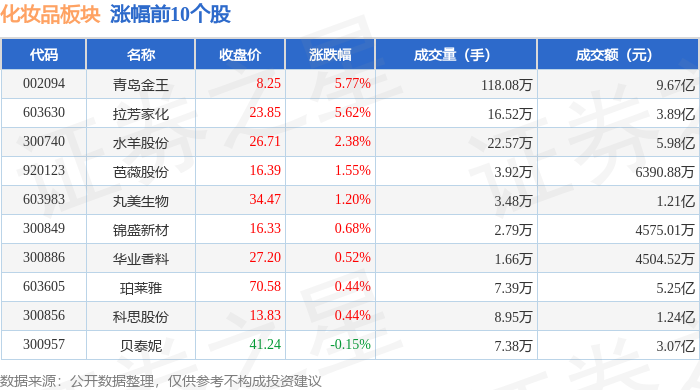
化妆品板块1月14日涨0.58%,青岛金王领涨,主力资金净流出3561.02万元
Zheng Xing Xing Ye Ri Bao· 2026-01-14 08:57
Group 1 - The cosmetics sector experienced a rise of 0.58% on January 14, with Qingdao King leading the gains [1] - The Shanghai Composite Index closed at 4126.09, down 0.31%, while the Shenzhen Component Index closed at 14248.6, up 0.56% [1] - Key stocks in the cosmetics sector showed varied performance, with Qingdao King rising by 5.77% to a closing price of 8.25, and Betaini declining by 0.15% to 41.24 [1][2] Group 2 - The net capital flow in the cosmetics sector showed a net outflow of 35.61 million yuan from main funds, while retail funds saw a net inflow of 49.69 million yuan [2] - The individual stock capital flow indicated that Qingdao King had a main fund net inflow of 45.22 million yuan, while Shanghai Jahwa experienced a net outflow of 39.65 million yuan [3] - Retail investors showed a net outflow from several stocks, including Qingdao King and Shanghai Jahwa, indicating a mixed sentiment among retail investors [3]