
GCL Tech

Search documents
中国光伏行业_多晶硅_2025 年三季度一线企业营业利润因短期利好触底回升;对多晶硅价格前景仍持谨慎态度-China Solar_ Poly_ 3Q25 Tier 1 OP inflection on temporary tailwinds; remain cautious on Poly pricing outlook
2025-10-29 02:52
Summary of Conference Call Notes on China Solar: Poly Industry Overview - The conference call discusses the solar industry, specifically focusing on the Poly (polycrystalline silicon) segment, with key players including GCL Tech, Tongwei, and Daqo. Key Points and Arguments 3Q25 Earnings Performance - The three Poly companies reported stronger than expected earnings recovery in 3Q25 due to temporary tailwinds from policy-induced downstream re-stocking activities, reversing since late September [1][13] - Daqo's Poly sales volume increased by 134% quarter-over-quarter (qoq), while recognized Poly prices rose by 37% qoq [1] Future Price Outlook - GCL and Daqo expect Poly prices to remain between Rmb60-80/kg into 2026, while Tongwei anticipates industry-wide supply cuts to support further price increases [2] - Despite the positive outlook, there is caution regarding the Poly pricing trajectory, with cost reduction and supply-demand factors expected to outweigh policy influences [3] Cost Reduction and Production Guidance - GCL and Daqo reported cash cost declines of 5% and 11% qoq, respectively, with further declines expected [6] - Tongwei is estimated to have an 8% qoq cash cost decline due to seasonal factors [6] - Production cuts are anticipated, with Tongwei and GCL indicating potential cuts starting in early November, while Daqo has increased its utilization target rate (UTR) to 52%-56% for 4Q25 [6] Inventory Levels - Total Poly inventory is estimated at 275GW in October, significantly above the monthly module production demand during 4Q25-1Q26 [7] Company-Specific Financials - GCL achieved approximately 75k tons of Poly shipments with a gross profit of Rmb3/kg based on a Rmb42/kg Poly price [12] - Tongwei recorded around 95k tons of Poly sales, with a gross profit margin of 4% in 3Q25 [12] - Daqo reported 42k tons of shipments but faced a unit loss of Rmb4.55/kg [12] Investment Ratings and Price Targets - Post-results, target prices for Poly companies were raised by an average of 5%, but the market is viewed as overly bullish on the Poly pricing outlook, suggesting an average share price downside of 32% [9] - Investment ratings include "Sell" for Tongwei due to high exposure to the Poly segment and "Neutral" for Daqo due to a weak demand outlook [28][33] Risks and Considerations - Key risks include potential capacity exits by Tier 1 players and stronger-than-expected solar demand, which could shift profitability outlooks [29][31][34] - Downside risks involve weaker-than-expected solar demand and unfavorable changes in raw material prices that may increase production costs [32] Additional Important Information - The strong sales in 3Q25 were primarily driven by policy-induced re-stocking activities, which have since reversed [13] - Analysts express skepticism regarding the sustainability of the recent price increases given the rapid cost reduction progress among Tier 1 players [21] This summary encapsulates the critical insights from the conference call, highlighting the current state and future outlook of the Poly segment within the solar industry.


中国公用事业、可再生能源与电网:专家见解 - “十五五” 规划前瞻;催化因素丰富的环境-China Utilities, Renewables & Power Grid_ Expert insights_ 15-FYP preview; a catalyst-rich environment
2025-10-19 15:58
Summary of Key Points from the Conference Call Industry Overview - **Industry Focus**: China Utilities, Renewables & Power Grid [2][3] - **Key Trends**: Rapid deployment of renewable energy sources, particularly wind and solar, with annual installations projected at 200 to 300 GW [2][4] Core Insights 1. **Renewable Energy Deployment**: - Wind and solar installations are expected to reach 200-300 GW annually, with cumulative installations surpassing 3,000 GW by 2030 [4][2] - Offshore wind is anticipated to have the best growth prospects due to higher utilization hours and government support [4][2] 2. **Energy Storage Systems (ESS)**: - Strong growth in energy storage systems and pumped storage, with a combined CAGR of 20% projected until 2030 [2][8] - The power regulation capacity gap for renewable energy is estimated to reach 700 million kW by 2030, necessitating increased ESS deployment [8][5] 3. **Grid Investments**: - Continued investment in grid infrastructure is essential for integrating renewable energy, with UHV (Ultra High Voltage) capex expected to rise from RMB 380 billion per annum during the 14th FYP to RMB 500-600 billion during the 15th FYP [9][2] - Distribution grid automation is projected to grow at a CAGR of 15% due to increased capacity from distributed renewable projects [9][2] 4. **Thermal Power Outlook**: - Capacity charges for thermal power plants are expected to increase from 30% to 70% of fixed costs by 2030, while their role in peak shaving will diminish [10][2] - Thermal plants will generate more revenue from ancillary services, potentially offsetting lower utilization rates [10][2] 5. **Green Power Trading**: - Anticipated policy reforms may lead to green certificates covering all renewable power by the end of 2025, with prices expected to rise from RMB 5-6 to RMB 50 per certificate [11][2] - Green power trading volume is projected to reach 1.5 trillion kWh by 2030, growing at a CAGR of over 30% [11][2] Investment Recommendations - **Top Picks**: - Daqo (DQ US), GCL Tech (3800 HK), Orient Cable (603606 CH), Nari (600406 CH), and Huaming (002270 CH) are rated Overweight (OW) [2][12] - A long/short pair strategy is recommended with Longyuan (916 HK, OW) and Huaneng (902 HK, Underweight) [12][2] Additional Insights - **Catalyst-Rich Environment**: The period leading up to mid-2026 is expected to be rich in catalysts for policy discussions, which could positively impact the renewable energy sector [3][2] - **Technological Advancements**: Innovations in offshore wind technology, such as larger turbines and flexible DC cable transmission, are expected to enhance project returns [4][2] Conclusion - The renewable energy sector in China is poised for significant growth driven by government support, technological advancements, and increasing demand for energy storage solutions. Investment opportunities are abundant, particularly in companies aligned with these trends.


中国光伏:追踪盈利拐点-9 月多晶硅、玻璃价格超预期,但下游库存积压或致逆转-China Solar_ Tracking profitability inflection_ Sep Poly_Glass price above expectation, but likely to be reversed as downstream inventory piles up
2025-09-29 02:06
Summary of China Solar Profitability Tracker Industry Overview - The report focuses on the solar industry in China, specifically tracking the profitability and pricing dynamics of the solar value chain, including Poly, Glass, Wafer, and Module segments [3][12]. Key Highlights 1. **Price Dynamics**: - In September 2025, the solar value chain experienced a price hike of 5% month-to-date (MTD), up from 2% in August, primarily driven by a 15% increase in Glass prices and an 8% increase in Poly prices [3][6]. - The price increase was attributed to active downstream re-stocking activities rather than a recovery in solar installation demand [3][12]. 2. **Inventory and Demand Outlook**: - There is an expectation of a 20% decline in Poly and Glass prices for the remainder of the year due to a buildup of downstream inventory against weak demand [3][12]. - Estimated inventory levels indicate that 130GW of Poly inventory will suffice for module needs, while Glass shipments are projected to decline by 20% month-over-month due to potential production cuts [3][12]. 3. **Sector View**: - The ongoing anti-involution campaign and new restrictions on below-cost pricing are expected to have a mild positive impact on Poly pricing, but downstream players will still need to reduce selling prices to maintain market share amid demand weakness [3][12]. - Long-term profitability is anticipated to remain low without a reduction in Tier 1 capacity [3][12]. 4. **Profitability Trends**: - Cash gross profit margins (GPM) and EBITDA margins improved for upstream companies but deteriorated for downstream players in September [5][9]. - The average cash GPM for Poly was reported at 36%, while for Glass, it was 16% [12]. 5. **Investment Recommendations**: - Preferred segments include Film (Buy on Hangzhou First), High-efficiency Module (Buy on Longi), and Granular Poly (Neutral on GCL Tech) [4]. - Least preferred segments include Glass (Sell on Flat A/H, Xinyi Solar) and Equipment (Sell on Shenzhen S.C. and Maxwell) [4]. Additional Insights - The report indicates that the production-to-demand ratio for the solar value chain is expected to increase to 110% in September from 109% in August, suggesting a slight oversupply situation [13]. - Producer-side inventory days are likely to decline to 34 days in September from 37 days in August, indicating a tightening of inventory levels [15]. This summary encapsulates the critical insights from the China Solar Profitability Tracker, highlighting the current state of the solar industry, pricing dynamics, inventory levels, and investment recommendations.
中国太阳能行业_反内卷 Ⅲ_多晶硅供应整合的最新举措-China Solar_ Anti-involution III_ Latest move for supply consolidation of polysilicon
2025-09-23 02:34
Summary of Key Points from the Conference Call Industry Overview - **Industry**: Solar Energy, specifically focusing on polysilicon production in China - **Context**: The call discusses the implications of new energy efficiency benchmarks set by the Standardization Administration of China (SAC) as part of the anti-involution campaign aimed at consolidating the polysilicon supply chain [1][2] Core Insights - **New Energy Efficiency Benchmark**: A new mandatory benchmark for energy consumption in polysilicon production was released, which is stricter than previous estimates. This benchmark is expected to lead to the shutdown of approximately 1/3 of existing polysilicon production capacity in China, equating to about 1.1 million tons [1][6][8] - **Government's Tactical Move**: The new benchmark is seen as a significant step in the anti-involution process, aimed at removing outdated production capacity and accelerating consolidation within the industry. This is expected to facilitate a quicker commitment from lower-tier players to the capacity buyout plan [2][6] - **Impact on Non-Compliant Producers**: Producers failing to meet at least the level 3 standard will be required to upgrade their production technology within one year or face factory closures [6][8] Company-Specific Insights - **GCL Technology (3800 HK)**: Preferred as it meets the level 1 standard for energy usage. The company recently launched an equity placement at a 9% discount, which was positively received by the market. GCL is expected to be the first to recover during the sector downcycle due to its effective cost reduction and lower power usage [3][6][14] - **Daqo New Energy (DQ US)**: Valued at an undemanding level, with a market cap comparable to its net cash. The company has a USD 100 million share buyback plan, which is seen as a positive catalyst for future performance [3][14] - **Xinte Energy (1799 HK)**: Attractive due to its low price-to-book (PB) valuation. The company is positioned between level 2 and 3 standards [3][6][14] Market Dynamics - **Supply and Demand Rebalance**: The new benchmark is expected to lead to a meaningful rebalancing of supply and demand in the polysilicon market. The anticipated reduction in capacity is viewed as a necessary step to stabilize prices and improve market conditions [6][8] - **Polysilicon Price Trends**: Prices have been increasing since July, indicating a potential recovery in the market as the new regulations take effect [12] Risks and Valuation - **Valuation Risks**: Key risks include a significant drop in polysilicon prices, reduced demand from global buyers due to trade disputes, and rising upstream raw material costs. These factors could adversely affect the valuations of GCL Tech, Daqo, and Xinte [14][14] - **Target Prices**: - GCL Tech: Target price of HKD 1.80, implying a 29.5% upside [14] - Daqo New Energy: Target price of USD 31.00, implying a 13.8% upside [14] - Xinte Energy: Target price of HKD 11.00, implying a 33.5% upside [14] Conclusion - The new energy efficiency benchmarks represent a pivotal moment for the polysilicon industry in China, with significant implications for production capacity, market dynamics, and individual company valuations. The focus on compliance and consolidation is expected to reshape the competitive landscape in the coming quarters [2][6][8]

中国太阳能:市场对定价过度乐观-China Solar_ Market overly bullish on pricing; downgrading Daqo A and Shenzhen SC to Sell
2025-09-19 03:15
Summary of Conference Call Notes on China Solar Industry Industry Overview - The conference call focuses on the China solar industry, particularly the pricing dynamics and financial outlook for key players in the sector, including Poly and Module manufacturers [1][2][3]. Key Points and Arguments 1. **Market Sentiment and Pricing Trends** - Share prices for covered stocks have risen by an average of 40% since July 1, compared to +15% for CSI300 and +10% for HSI [1]. - Upstream price hikes, particularly a ~40% increase in Poly prices during July-August, are attributed to the ongoing Anti-involution campaign aimed at curbing excessive pricing competition [1]. 2. **Demand Forecast and Pricing Adjustments** - The demand outlook for China’s Module market is weak, with a forecasted decline of 40-45% year-over-year in 2H25E-1H26E [1]. - A bottom-up analysis suggests a likely 20% decline in Poly prices to Rmb42/kg and stable Module prices at Rmb0.67/W due to high-efficiency upgrades [2]. 3. **Cost Reduction and Market Dynamics** - Rapid cost reductions by Tier 1 players are expected to continue, with a projected 10% cash cost reduction to Rmb25/kg by 2Q25-2026E [1][2]. - The need for Tier 1 players to cut prices alongside cost reductions to maintain market share amid softening demand is emphasized [2][22]. 4. **Revised Pricing Models and Forecasts** - The pricing model has shifted to a cost-based approach, leading to an average 4% increase in Poly prices for 2025E-2027E and a 12% decrease in downstream prices for 2025E-2030E [3][37]. - The revised forecasts imply a ~20% downside for upstream segments (Poly/Wafer) and ~3% for downstream segments (Cell/Module) [3]. 5. **Capital Expenditure Adjustments** - Solar capex is raised by 15% for 2025E-2026E but cut by an average of 20% for 2027E-2030E due to higher Topcon upgrade capex and stricter investment standards [7][44]. 6. **Earnings Revisions and Target Prices** - EBITDA forecasts for Poly players are raised by an average of 28% for 2025E-2027E, while downstream players see a 15% cut due to lower shipments [8]. - Target prices for coverage stocks are revised down by 11% to 26%, with GCL Tech's target price raised by 26% due to improved volume and profitability outlook [8]. 7. **Downgrades of Specific Companies** - Daqo A and Shenzhen S.C. are downgraded to Sell due to overly optimistic market valuations and weaker order outlooks amid the anti-involution campaign [9][10]. 8. **Investment Preferences** - Preference is given to Film (Buy on Hangzhou First), High-efficiency Module (Buy on Longi), and Granular Poly (Neutral on GCL Tech) over Glass and Rod Poly due to better cost dynamics and product-level supply/demand [11]. Additional Important Insights - The ongoing anti-involution campaign is expected to have a long-term impact on pricing and demand, with a focus on maintaining fair competition and preventing below-cost pricing [1][36]. - The market may be underestimating the rapid cost reduction potential of Tier 1 players, which could lead to significant shifts in market dynamics and profitability [53][67]. - Historical trends indicate that cost reduction, rather than price hikes, has been the primary driver for margin expansion in the solar industry [67]. This summary encapsulates the critical insights and forecasts regarding the China solar industry, highlighting the interplay between pricing, demand, and cost dynamics.
瑞银: 中国股票策略:反内卷-目前选择性参与-UBS-China Equity Strategy Anti-involution-selectively participate for now
瑞银· 2025-08-05 03:15
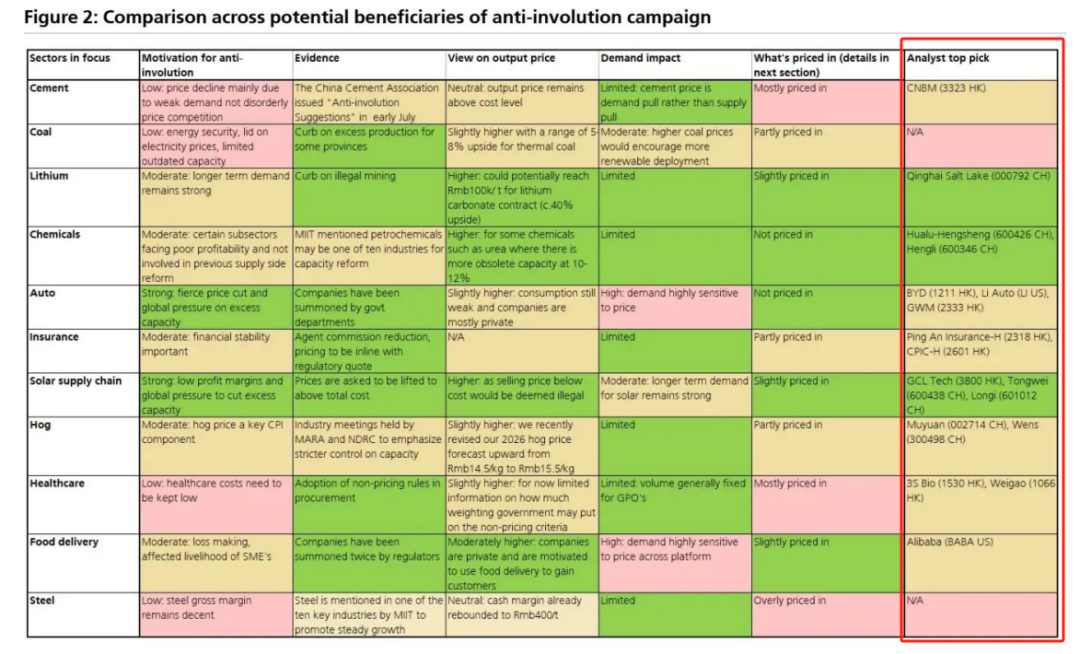
Investment Rating - The report suggests a selective participation strategy in sectors with attractive risk-reward profiles, specifically highlighting solar, chemicals, and lithium as top picks [1][6]. Core Insights - The anti-involution campaign is broadening into various sectors, including healthcare and financial services, with mixed feedback from analysts regarding its potential impact [1][2]. - Despite skepticism in the market about the effectiveness of the anti-involution initiatives, the motivations behind these initiatives are considered valid, leading to an upside skew in share price risks [3]. - The report emphasizes that the relevant sectors have not significantly outperformed the broader market, and investor expectations are generally low, indicating potential for positive surprises in future policies [3]. Sector Summaries Solar - The solar sector is characterized by very low profitability compared to other sectors, with significant long-term growth potential and external pressures to reduce excess capacity [6][8]. Chemicals - The chemicals sector faces low profitability and is close to historical troughs in valuation, with potential for cutting outdated capacities [6][8]. Lithium - The lithium sector is noted for its strong long-term growth potential and asymmetric risk-return profile, making it an attractive investment opportunity [6][8]. Auto - The auto sector is under pressure from fierce price competition and global excess capacity, with regulatory scrutiny aimed at promoting rational competition [2][8]. Healthcare - In healthcare, the focus is shifting towards non-price conditions in procurement, which may impact pricing strategies in the sector [2][8]. Food Delivery - The food delivery sector is experiencing regulatory pressure to rectify aggressive promotional practices, which may affect demand sensitivity [2][8]. Coal - The coal sector is facing production limits in certain provinces, which could lead to slight price increases [2][8]. Hog - The hog sector is under scrutiny for production capacity controls, with recent upward revisions in price forecasts [2][8].
瑞银中国股票策略:太阳能、化工和锂行业是“反内卷”主题最佳投资板块
Zhi Tong Cai Jing· 2025-08-04 14:56
Core Viewpoint - UBS analysts express mixed feedback on the anti-involution measures, indicating that the market remains skeptical about their potential impact on stock prices [1][4]. Industry Analysis - **Cement**: Price decline mainly due to weak demand, with output prices remaining above cost levels. The sector is mostly priced in, with CNBM (3323 HK) as a top pick [2]. - **Coal**: Limited outdated capacity and energy security concerns lead to a slight price increase, with moderate demand impact. The sector is partly priced in [2]. - **Lithium**: Long-term demand remains strong, with potential price increases for lithium carbonate contracts. The sector is slightly priced in, with Qinghai Salt Lake (000792 CH) as a top pick [2]. - **Chemicals**: Certain subsectors face poor profitability, with potential for capacity reform. The sector is not priced in, with Hualu-Hengsheng (600426 CH) and Hengli (600346 CH) as top picks [2]. - **Auto**: Strong price cuts and global pressure on excess capacity lead to slightly higher consumption. The sector is not priced in, with BYD (1211 HK), Li Auto (LI US), and GWM (2333 HK) as top picks [2]. - **Insurance**: Financial stability is important, with limited demand impact. The sector is partly priced in, with Ping An Insurance-H (2318 HK) and CPIC-H (2601 HK) as top picks [2]. - **Solar Supply Chain**: Low profit margins and global pressure to cut excess capacity lead to higher prices. The sector is slightly priced in, with GCL Tech (3800 HK), Tongwei (600438 CH), and Longi (601012 CH) as top picks [2]. - **Hog**: Hog prices are a key component of CPI, with limited demand impact. The sector is partly priced in, with Muyuan (002714 CH) and Wens (300498 CH) as top picks [2]. - **Healthcare**: Healthcare costs need to be kept low, with limited demand impact. The sector is mostly priced in, with 3S Bio (1530 HK) and Weigao (1066 HK) as top picks [2]. - **Food Delivery**: Companies face loss-making conditions, with high demand sensitivity. The sector is slightly priced in, with Alibaba (BABA US) as a top pick [2]. - **Steel**: Steel gross margins remain decent, with limited demand impact. The sector is overly priced in [2]. Investment Opportunities - UBS identifies solar, chemicals, and lithium industries as the most attractive for selective investment based on their low profitability, growth potential, and valuation risks [4][12].

中国太阳能_关于反内卷的关键问答-China Solar_ Key Q&As on Anti-Involution
2025-07-23 02:42
Summary of China Solar Conference Call Industry Overview - The conference focused on the solar industry in China, particularly the polysilicon segment, in light of recent government policies aimed at regulating competition and addressing overcapacity [1][2][3]. Key Points and Arguments 1. **Market Reaction to Policy Changes**: Following the Central Commission for Financial and Economic Affairs meeting on July 1, share prices for polysilicon companies (Tongwei, GCL, Daqo) increased by an average of 32%, indicating positive market sentiment towards potential regulatory changes [1]. 2. **Price Increases**: Polysilicon asking prices rose from Rmb35 per kg to Rmb49 per kg, a 40% increase within two weeks, reflecting expectations of improved pricing power in the industry [1][14]. 3. **Anti-Involution Campaign**: The campaign aims to discourage local protectionism and excessive competition, with a focus on establishing a legal framework to ensure fair competition and prevent below-cost pricing [12][13]. 4. **Potential Capacity Buyout Fund**: Discussions are ongoing regarding a tail polysilicon capacity buyout fund, which could involve Rmb40-80 billion to acquire excess capacity, with preliminary government support noted [13][15]. 5. **Profitability Outlook**: While there is optimism about price recovery, normalized profitability is expected to remain low due to a slowdown in demand growth in China [3][24]. Implementation Details 1. **Regulatory Framework**: The revised Anti-Unfair Competition Law is set to take effect on October 15, 2025, enhancing enforcement against below-cost competition [12]. 2. **Production Control**: Future policies will focus on controlling production and preventing new capacity expansion, with specific details still under discussion [19]. 3. **Demand-Side Policies**: The introduction of demand-side policies is crucial to ensure a stable demand outlook, which remains uncertain [19][20]. Beneficiaries of Anti-Involution 1. **Liquidity-Constrained Companies**: Companies like GCL Tech, Tongwei, and Xinyi Solar are expected to benefit from improved cash flows due to regulatory changes [11][38]. 2. **Upstream Integrated Players**: Tier 1 module manufacturers, such as Tongwei and Longi, are likely to see significant benefits from a steeper industry cost curve [11][38]. 3. **High-Efficiency Module Producers**: Companies producing high-efficiency modules may benefit from price hikes in mainstream products [11][38]. Risks and Challenges 1. **Execution Challenges**: The ability to pass through module price hikes to downstream operators is uncertain, especially given the current oversupply situation [20]. 2. **Dependence on Policy Enforcement**: The success of the Anti-Unfair Competition Law and its impact on profitability will depend on effective enforcement and potential penalties for violations [24]. Conclusion - The solar industry in China is at a critical juncture with the potential for significant regulatory changes aimed at stabilizing prices and improving profitability. However, the successful implementation of these policies and their impact on market dynamics remain to be seen [3][15].