
Roborock

Search documents
The maker of the Roomba is running out of cash and options. After its failed Amazon deal, iRobot could face bankruptcy.
Business Insider· 2025-11-06 10:18
Core Viewpoint - iRobot, once a leader in the robotic vacuum market, is facing severe financial difficulties and is on the brink of bankruptcy due to failed acquisitions and increasing competition [1][2][3]. Financial Strain - iRobot has been under financial pressure, worsened by the collapse of Amazon's $1.4 billion acquisition plan in early 2024 [2]. - The company reported that its last potential buyer withdrew after exclusive negotiations, offering a price significantly lower than its recent stock trading price [2][3]. - iRobot warned that without new funding, it may have to significantly reduce or cease operations and could seek bankruptcy protection [3][16]. Product and Market Position - iRobot has sold over 50 million Roomba models since its launch, but competition has intensified from brands like Dreame, Roborock, and Ecovacs [8][13]. - The company launched a new fleet of Roomba vacuums and mops in March 2023, aiming to reinforce its market leadership [4][8]. - iRobot's annual revenue peaked at $1.56 billion in 2021 but has been declining since, with shares dropping about 65% year-to-date, currently priced at $2.70 [13][16]. Historical Context - Founded in 1990 by MIT roboticists, iRobot initially focused on military and space-related robots before achieving consumer success with the Roomba in 2002 [9][11]. - The company sold its defense and security business in 2016 for up to $45 million, shifting its focus entirely to consumer robotics [12]. Strategic Challenges - iRobot acknowledged increased competition in the robotic floorcare segment, leading to a loss of market share [14]. - The failed acquisition by Amazon, initially agreed upon at $61 per share, was a significant setback, resulting in layoffs of 350 employees, or about 31% of its workforce [14][15].



中国消费行业 _ 2025 年上半年、2025 年第二季度业绩回顾及下半年展望 _ 企业间每股收益修正分歧扩大-China Consumer Sector_ H125_Q225 results review and H2 outlook_ EPS revision divergence among companies widened
2025-09-11 12:11
Summary of Key Points from the Conference Call Industry Overview - **Industry**: Greater China Consumer Sector - **Period Covered**: H125/Q225 results and H2 outlook - **Key Findings**: - Weighted average revenue and net profit grew by 11% and 12% YoY in H125, respectively, compared to 7% and 16% YoY in Q125, indicating a deceleration in net profit over Q2 [2][3] - 37 companies had positive EPS revisions while 36 had negative revisions, with the percentage of companies with positive revisions declining from 60% in Q125 to 51% in H125, although this still marks a YoY improvement from 41% in H124 [2][3] Earnings Performance - **New Consumer Names**: Companies like Younghui Superstores, Laopu, Pop Mart, Guming, and Arashi Vision are leading positive EPS revisions, with Yonghui Superstores showing the largest EPS revision for the next 12 months due to a potential turnaround in 2026 [2][3] - **Consumer Staples and Home Appliances**: Most companies in these sectors underperformed due to slowing demand recovery, intensifying competition, and phasing-out subsidies. However, established leaders like Nongfu, CR Beer, and Weilong showed positive EPS revisions [2][3] Market Performance - **MSCI China**: Delivered a 30% return YTD, with the Consumer Discretionary sector posting a 22% return, supported by resilient demand among new consumer names. The Consumer Staples sector lagged with a 19% return due to soft overall demand [2][3] Economic Indicators - **Retail Sales Growth**: China's retail sales grew by 4.0% YoY in July 2025, up from 2.7% YoY in July 2024. Restaurant sales rose by 1.1% YoY, down from 3.0% YoY a year ago, reflecting the impact of delivery subsidies [3][4] - **Government Policies**: Supportive policies introduced by the Chinese government, including childcare subsidies and interest subsidies on personal consumption loans, are expected to boost consumption in H2 [3][4] Stock Recommendations - **Preferred Stocks**: - Stocks benefiting from domestic consumption policies (e.g., Yum China, DPC Dash) - Value plays with decent shareholder returns (e.g., WH Group) - Structural growth opportunities (e.g., Pop Mart, China Pet Food) - Home appliance makers with overseas earnings potential (e.g., Roborock, Midea) [4][5] Sector-Specific Insights - **Agriculture**: Hog prices stable YoY in H125, with Muyuan increasing its dividend payout ratio to 47.5% [7] - **Baijiu Sector**: Notable revenue and NP declines in Q225, with Kweichow Moutai showing resilience [8] - **Beer Sector**: Yanjing Brewery and CR Beer reported revenue/NP growth, attributed to premium product growth [9] - **Beverages**: Freshly-made beverage chains reported strong revenue growth, driven by store expansion [10] - **Condiments and Frozen Food**: Sluggish sales in Q225, with Yihai expected to accelerate growth in H225 [11] - **Dairy**: Liquid milk sales under pressure, while infant milk formula showed recovery signs [12] - **Pet Food**: Strong domestic growth, with both China Pet Foods and Gambol reporting 40% YoY growth [14] - **Next-Generation Tobacco**: RLX and Smoore saw strong revenue growth, with RLX benefiting from regulatory tailwinds [15] Conclusion - The Greater China consumer sector is experiencing a mixed performance with notable divergences among companies. While some new consumer names are thriving, traditional sectors like consumer staples and home appliances are facing challenges. Government policies aimed at boosting consumption may provide a tailwind for the sector in the second half of the year.
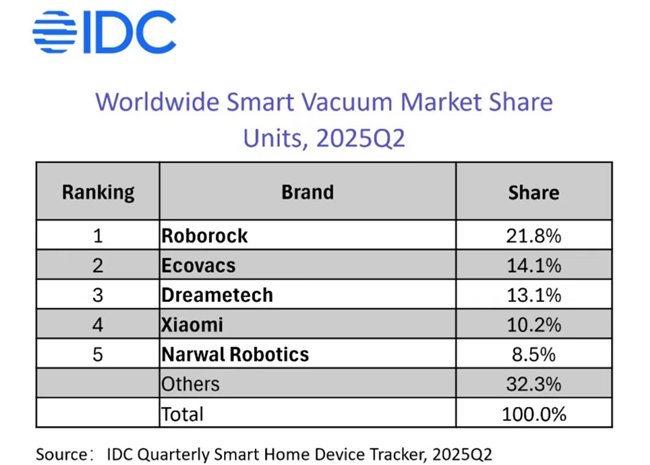
云鲸二季度全球市场表现强劲,跻身2025年Q2全球扫地机器人市占TOP5
Cai Fu Zai Xian· 2025-09-10 07:52
Group 1 - The core point of the article highlights that Cloud Whale (NARWAL) has achieved significant growth in the global smart home cleaning robot market, ranking fifth with a market share of 8.5% and a shipment volume of 524,200 units in Q2 2025 [1][3]. - The global smart vacuum robot market reached a shipment volume of 6.17 million units in Q2 2025, reflecting a year-on-year growth of 20.5% [3]. - Chinese brands dominate the top five positions in global vacuum robot sales, collectively holding 67.7% of the market share, indicating a trend towards increased market concentration among leading brands [3]. Group 2 - At the IFA 2025, Cloud Whale showcased a full range of cleaning products, including the flagship Narwal Flow robot, which features innovative carpet cleaning technology, enhancing its competitive edge in the market [4]. - Cloud Whale has adopted a differentiated market strategy focusing on regions with lower market penetration, achieving a 50% growth in Europe and over 200% growth in emerging markets like Southeast Asia and Latin America in the first half of 2025 [6]. - The company plans to expand into over 70 new markets globally, anticipating a 3-4 times growth in its overseas business, further solidifying its position in the international market [6].

中国新兴前沿领域-入境旅游零售:中国已做好准备-China's Emerging Frontiers-Inbound Travel Retail China Is Ready
2025-09-06 07:23
Summary of Inbound Travel Retail in China Industry Overview - The inbound travel retail market in China is projected to grow from **US$14 billion in 2024 to US$60 billion by 2034**, representing a **15% CAGR** [1][10][27] - By 2034, inbound travel retail is expected to account for **25% of China's total travel retail market**, up from **10%** in previous years [10][27] Key Drivers of Growth - **Globally Known Brands**: The presence of well-known brands and competitive pricing is attracting international tourists [4][10] - **Improved Shopping Experience**: The introduction of tax-free shopping (TFS) and instant tax refunds is enhancing the shopping experience for inbound tourists [5][10][31] - **Policy Support**: Recent policy changes are aimed at expanding tax-free shopping and improving infrastructure to support inbound tourism [26][48] Tax-Free Shopping Impact - The tax-free shopping market is expected to grow from **<US$0.5 billion in 2024 to US$20 billion by 2035** [94] - The **instant tax refund system** was expanded nationwide in April 2025, significantly increasing the number of malls offering this service from **2 to 17** among the top 20 malls in China [5][34][98] - Retail sales with tax refunds in cities like Shenzhen and Shanghai have shown remarkable growth, with increases of **160% and 75% YoY**, respectively, in the first half of 2025 [35][103] Competitive Pricing - Chinese brands offer products at **20-50% lower prices** compared to international markets, making them attractive to tourists [4][29] - Imported luxury goods in China are competitively priced, often similar to or lower than prices in key Asian markets [29][74] Market Segmentation - The inbound travel retail market is primarily driven by international tourists, excluding visitors from Hong Kong, Macau, and Taiwan, who are expected to contribute significantly to growth [27][45] - The duty-free market is also gaining traction, with projections of **US$5 billion in spending by inbound tourists by 2035** [36] Implications for Retailers - Retailers, malls, and duty-free operators in China are expected to benefit the most from the growth in inbound tourism [6][40] - Companies like **CR Land, Hang Lung Properties, and CTG Duty Free** are identified as key beneficiaries [43] Risks and Challenges - Potential dilution of the Hong Kong retail market due to increased competition from mainland China [6][40] - The need for improved tax refund services and training for sales staff to facilitate the shopping experience for tourists [39] Conclusion - The inbound travel retail market in China is at a pivotal point, with significant growth potential driven by favorable policies, competitive pricing, and an enhanced shopping experience. Retailers and duty-free operators are well-positioned to capitalize on this trend, although challenges remain in execution and market competition.
瑞银:A股2025年下半年展望-五类资金流向与五种宏观情景配置
瑞银· 2025-06-18 00:54
Investment Rating - The report maintains a "Buy" rating for several A-share stocks, including PetroChina, Yangtze Power, and NAURA Technology, among others, indicating a positive outlook for these companies [5]. Core Insights - The report anticipates a 6% year-over-year growth in CSI 300 A-share EPS for 2025, driven by a low base effect and potential policy easing, despite deflationary pressures limiting upward revisions [2][27]. - A-share valuations are expected to remain range-bound in the near term due to uncertainties surrounding US-China trade relations, but medium-term catalysts could arise from stronger policy easing and structural reforms [2][40]. - The "national team" (Central Huijin) has played a significant role in stabilizing the A-share market, particularly during periods of market correction, with substantial investments in CSI 300 ETFs [3][60]. Fund Flows and Market Styles - The report identifies five types of fund flows impacting market styles amid macro uncertainties, including significant inflows from the "national team," medium/long-term investors favoring high-dividend stocks, and retail investors driving small-cap outperformance [3][60]. - The report notes that high-dividend stocks have attracted long-term investors, particularly insurers, as they seek to mitigate risks associated with falling risk-free rates [65][66]. Sector Preferences and Investment Themes - The report outlines sector preferences based on different macro scenarios, suggesting that export-oriented sectors may benefit from trade friction de-escalation, while defensive sectors could be favored in adverse conditions [4]. - It highlights that consumption and property sectors may see the most benefit from stronger policy stimulus, while AI and services sectors could attract inflows under modest easing conditions [4]. Top A-share Picks - The report lists top A-share picks within UBS-S coverage, including PetroChina, Yangtze Power, and NAURA Technology, with respective price targets and expected upside percentages [5].
高盛:中国消费品-2025 年第一季度总结 - 延续四季度财报季趋势,复苏进程中波动犹存
Goldman Sachs· 2025-05-14 02:38
Investment Rating - The report maintains a consistent sector preference, favoring sports brands, diversified retailers, dairy, beverages, and restaurants, while being less favorable towards apparel/footwear OEM, furniture, projectors, discretionary small kitchen appliances, jewelry, and non-super-premium spirits [11]. Core Insights - Consumption in China has shown signs of recovery, with retail sales growth improving to +4.6% year-over-year in 1Q25, and companies in the coverage reporting an average growth of 14% compared to 12% in 4Q24 [1]. - Despite the positive growth, companies remain cautious about the outlook due to ongoing volatility and external factors such as US-China tariff developments impacting consumer confidence [2][1]. - Margin performance in 1Q25 was mixed, with some companies benefiting from favorable raw material prices and cost control, while others faced risks from marketing investments and competition [1]. - Companies are generally maintaining disciplined pricing strategies and healthier inventory levels, although some categories like spirits and sportswear are experiencing challenges due to demand pressures [1]. - The impact of tariffs on earnings and consumer sentiment is significant, with companies cautious about the second half of 2025 amid uncertainties [2]. Summary by Sections Key Findings from 1Q25 Results - Retail sales growth improved to +4.6% year-over-year, with coverage companies reporting an average growth of 14% [1]. - Labor Day consumption growth accelerated, indicating a potential rebound in consumer spending [1]. Expectations for 2Q25 - Companies are cautious about the outlook for 2H25 due to tariff uncertainties, although those with market share gain opportunities may be more resilient [2]. Sector/Stock Preferences - Preferred sectors include sports brands, diversified retailers, dairy, beverages, and restaurants, while least preferred sectors include apparel/footwear OEM and furniture [11]. Macro Data Points - The report notes that macroeconomic data points are solid, but ongoing tariff developments and policy support need to be monitored [11]. Valuation Methodology - The report emphasizes the importance of understanding the valuation methodology and the potential risks associated with it [11].