Schaeffler

Search documents
行业聚焦:全球单向离合器市场头部企业份额调研(附Top 10 厂商名单)
QYResearch· 2025-10-13 05:31
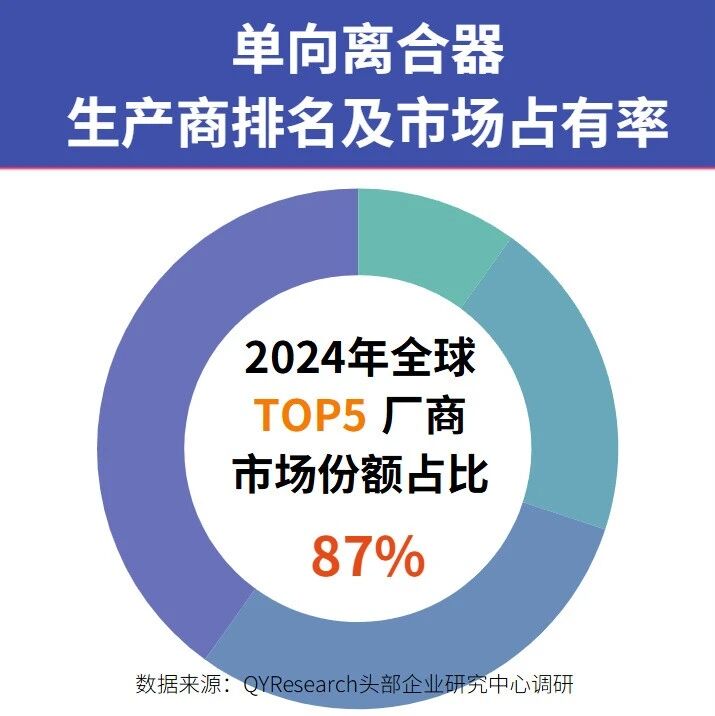
Core Insights - The article discusses the single-direction clutch market, highlighting its expected growth and key drivers, including the rise of electric vehicles and advancements in industrial automation [1][15][16]. Market Overview - The global single-direction clutch market is projected to reach $822 million by 2031, with a compound annual growth rate (CAGR) of 3.76% over the coming years [1]. - The leading manufacturers in the single-direction clutch market include NTN, NSK-Warner, Schaeffler, SKF, and Jiangsu Nanfang Precision, which collectively hold approximately 87% of the market share [5][20]. Product Segmentation - Roller-type single-direction clutches dominate the market, accounting for about 51% of the total market share [7]. - In terms of application, the transportation sector is the largest downstream market, representing approximately 42% of the demand [9]. Regional Insights - Major production regions for single-direction clutches are primarily located in North America and Europe, while key consumption areas include Japan and Europe [12][15]. Growth Drivers - The explosion of the electric vehicle market is increasing demand for high-performance, low-noise, and long-life clutches, particularly in electric drive systems and energy recovery systems [15]. - The advancement of industrial automation and smart manufacturing is driving the need for precision, reliability, and durability in transmission components, leading to stable growth in demand for single-direction clutches [16]. - Technological advancements and product innovations, such as the use of new materials and smart control systems, are enhancing the performance and applicability of single-direction clutches [17]. - Policy support for high-end manufacturing and the expansion into emerging markets are creating favorable conditions for the growth of the single-direction clutch industry [18].

Porsche’s Sliding Sales Deepen German Automotive Malaise
Yahoo Finance· 2025-10-09 14:34
Core Insights - Germany's auto industry is facing a rapid decline due to weak demand, trade tensions, and increasing competition from Chinese manufacturers [1][2] - Major German automakers like Porsche, BMW, and Mercedes-Benz are reporting weaker sales in China, where local competitors are gaining market share with affordable electric vehicles [1][2] - The German automotive sector has lost approximately 55,000 jobs over the past two years, with projections indicating tens of thousands more will be lost by 2030 [4] Industry Challenges - The decline in market share in China is exacerbated by US tariff costs and stagnant sales in Europe, putting pressure on German carmakers across their primary markets [2] - Despite significant investments in battery technology, the initial wave of electric vehicles (EVs) has not performed well, with next-generation models not expected until next year [2][3] - High energy costs and regulatory burdens are prompting automakers to reduce production and cut jobs [3] Company Responses - Volkswagen AG is reducing production and laying off staff, while Robert Bosch GmbH plans to cut 18,500 jobs, primarily in Germany [5] - Other companies like Continental, Schaeffler, and ZF Friedrichshafen are also implementing workforce reductions, alongside Ford Motor Co. [5]
On Semiconductor Expands Portfolio With Strategic Acquisitions
ZACKS· 2025-10-01 15:35
Core Insights - On Semiconductor (ON) is experiencing significant growth driven by strategic acquisitions and increasing demand for AI data center solutions, with AI data center revenues more than doubling year over year in Q2 2025 [1][10] - The acquisition of Aura Semiconductor's Vcore power technologies and Qorvo's Silicon Carbide Junction Field Effect Transistor business enhances ON's power management portfolio and positions the company to meet the power requirements of AI infrastructure [2][4][10] Acquisitions and Technology - ON's acquisition of Aura Semiconductor strengthens its capabilities in providing comprehensive power solutions for AI data centers, leveraging advanced silicon carbide (SiC) technology [2][10] - The $115 million acquisition of Qorvo's SiC JFET business enhances ON's EliteSiC power portfolio, improving energy efficiency in AI data centers and supporting electric vehicle (EV) applications [4][10] Partnerships and Collaborations - ON's partnerships with major companies like NVIDIA, Schaeffler, and BorgWarner are pivotal for expanding its market reach and enhancing its silicon carbide technology offerings [5][6][8][10] - The collaboration with NVIDIA focuses on advancing 800 VDC power architectures for next-generation AI data centers, positioning both companies at the forefront of high-performance power delivery [6][10] - The expanded collaboration with Schaeffler involves the use of ON's EliteSiC MOSFETs in traction inverters for advanced plug-in hybrid electric vehicles [7][10] Financial Outlook - For Q3 2025, ON expects revenues to be between $1.465 billion and $1.565 billion, reflecting the positive impact of its expanding portfolio and strong partnerships [9][10] - Non-GAAP earnings are projected to be between 54 cents per share and 64 cents per share, indicating robust financial performance [11]

中国工业:CIIF Trip 调研收获-智能人形机器人 -各阶段快速发展-China Industrials -CIIF Trip Takeaways IntelligentHumanoid Robots – Fast Pace Throughout Different Stages
2025-09-29 02:06
Summary of CIIF Trip Takeaways: Intelligent/Humanoid Robots Industry Overview - The report focuses on the **intelligent and humanoid robotics industry** in China, highlighting rapid commercialization and penetration of intelligent robots, while humanoid robots are still addressing product development challenges [1][2]. Key Insights 1. **Increased Participation at CIIF**: The CIIF event saw a significant rise in participation, with over **450 supply chain companies** attending, compared to **350 in 2024**. A dedicated humanoid value chain zone featured **30 integrators and component suppliers** [2][3]. 2. **Shift in Robot Focus**: Intelligent robots, particularly collaborative robots (cobots), showcased improved speed, precision, and payload capabilities, leading to strong adoption growth. Cobot shipments surged **47% YoY** in the first half of 2025, outpacing the industry's **16% YoY growth** [3][13]. 3. **Composite Robots**: Composite robots, which combine mobility and manipulation, are emerging as key solutions for various applications, significantly improving automation and reducing labor costs [14][20]. 4. **Humanoid Robots Development**: Humanoid robots are still in the early stages of integration into workflows, with clearer pain points and solutions emerging. However, real integration into manufacturing processes is expected to take time [4][10]. 5. **Supply Chain Expansion**: The number of component suppliers is rapidly increasing, with larger companies launching standard products. Leading players like **Inovance** and **Schaeffler** are expected to emerge in the next few years [5][24]. Additional Observations - **Corporate Collaboration**: There is a trend towards collaboration beyond vertical supply chains, with expectations for partnerships among robot integrators [3]. - **Technological Innovations**: Companies are exploring new materials and structures, but verification of new technologies will take time. For instance, **Inovance** is addressing joint heating issues through design and algorithm optimization [23]. - **Future Industry Outlook**: The industry is transitioning from showcasing new models to real adoption, with **ToB orders totaling close to Rmb1bn (US$140mn)**. However, integration with industrial workflows will require time due to efficiency and ROI considerations [20]. Conclusion The intelligent and humanoid robotics industry in China is experiencing rapid growth and innovation, with significant advancements in technology and supply chain dynamics. While humanoid robots are still developing, the overall trend indicates a positive outlook for the industry as it moves towards greater integration and adoption in various sectors [1][10][20].

人形机器人供应链最新情况:实地走访舍弗勒中国-Capital Goods-Humanoid supply chain update Visiting Schaeffler on the ground in China.
2025-09-26 02:29
Summary of the Conference Call on Schaeffler and the Humanoid Robotics Industry Industry Overview - **Industry**: Capital Goods, specifically focusing on Humanoid Robotics in Europe - **Company**: Schaeffler, a key supplier in the humanoid robotics supply chain Key Points and Arguments 1. **Schaeffler's Market Position**: - Schaeffler is a critical component supplier in the humanoid robotics sector, with an expanding addressable market [2][9] - The company generated €4.7 billion in revenue from its China operations in 2024, accounting for approximately 26% of total group sales [7] 2. **Local-for-Local Business Model**: - Celebrating its 30th anniversary in China, Schaeffler has established a highly localized business model with six R&D centers and 17 manufacturing plants [7] - This localization strategy enhances its competitiveness in the Chinese market [7] 3. **Market Share Objectives**: - Schaeffler aims to increase its market share in E-mobility and humanoid robotics, targeting further gains against domestic competitors [7] 4. **Humanoid Robotics Exposure**: - Schaeffler's components, such as ball screws and planetary roller screws, represent about 20% of humanoid hardware costs, with potential to increase its addressable content to over 50% [7][9] - The company emphasizes its role as a "trusted supplier" to OEMs rather than an integrator [8] 5. **Technological Differentiation**: - Schaeffler's products are positioned to meet high standards for long-term functionality, with a focus on precision and payload advantages [12] - The company has a first-mover advantage in the humanoid hardware supply chain, ready for mass production without significant capacity build-outs [10] 6. **Future Development in Humanoids**: - Management is optimistic about the global humanoid opportunity, emphasizing the need for clear use cases and scalable applications in industrial settings [12] 7. **Global Humanoid Market Forecast**: - Morgan Stanley's model estimates a total addressable market of 1 billion humanoids and $5 trillion in annual revenue by 2050, with a cumulative adoption forecast of 134 million units by 2040 [14] 8. **Recent Developments**: - Key integrators in China have announced orders totaling close to RMB 1 billion (approximately $140 million) as of September 2025 [13] - Tesla's Optimus V3 project is highlighted as a significant challenge requiring a new supply chain for its components [13] Additional Important Insights - **Schaeffler's Competitive Edge**: - The company differentiates itself through technology and scale, which will be crucial as humanoids transition into mass production [12] - The management team expressed confidence in improving competitiveness against local suppliers once domestic volume production is established [12] - **Valuation Trends**: - Recent funding rounds have seen significant valuations for humanoid developers, with Figure valued at $39 billion and Unitree at $1.7 billion [13][14] - **Cost Breakdown in Humanoid Robotics**: - A breakdown of costs indicates that screws account for approximately 20.2% of the total costs, with reducers and motors also contributing significantly [15][16] This summary encapsulates the critical insights from the conference call regarding Schaeffler's role in the humanoid robotics industry and the broader market dynamics.
Schaeffler Issues Mid-Term Targets 2028; Plans To Double EBIT Before Special Items
RTTNews· 2025-09-16 14:01
Group 1 - Schaeffler has set new medium-term targets for 2028, aiming for an adjusted EBIT margin of 6-8% and revenue between 27-29 billion euros [1] - The E-Mobility division is expected to achieve significant revenue growth, targeting 8.25 to 9 billion euros and breakeven EBIT margin before special items by 2028 [1] - The company plans to double its EBIT before special items and improve free cash flow significantly by 2028 [2] Group 2 - By 2035, Schaeffler aims to generate approximately 10% of its revenue from new high-potential activities, including humanoids, defense, and eAviation [2]

ROHM’s SiC MOSFETs Adopted in Schaeffler’s New Inverter Brick – Now in Mass Production
Globenewswire· 2025-09-04 21:30
Core Insights - ROHM Semiconductor and Schaeffler have commenced mass production of a new high-voltage inverter brick utilizing ROHM's SiC MOSFET bare chips, aimed at a major Chinese automaker [1][8] - The inverter brick enhances performance by supporting battery voltages exceeding 800V and managing RMS currents up to 650A, making it a compact power solution [2][4] - The strategic partnership between ROHM and Schaeffler, established in 2020 and reinforced in June 2023, focuses on innovation and sustainability in the automotive sector [6][11] Company Developments - Schaeffler's inverter brick is designed for scalability and modularity, facilitating integration into various inverter systems [3][4] - The brick includes essential components such as a power module for PWM, DC link capacitor, and an integrated DC boost function, allowing compatibility with 400V charging stations while maintaining 800V charging speeds [5][4] - Schaeffler has over 75 years of experience in motion technology and is recognized as one of Germany's most innovative companies, employing around 120,000 people globally [7]

DXC Advances AI Innovation in Automotive and Manufacturing through Startup Collaboration
Prnewswire· 2025-09-03 04:01
Core Insights - DXC Technology has announced collaborations with startups Acumino, CAMB.AI, and GreenMatterAI to develop AI solutions for the automotive and manufacturing sectors [1][2] - The partnerships are part of DXC's ongoing collaboration with STARTUP AUTOBAHN, which connects early-stage innovators with large enterprises [1][3] Group 1: AI Innovations in Manufacturing - Acumino is working with DXC to implement general robotic intelligence for scalable automation in complex production environments, addressing the limitations of traditional robotic solutions [4] - Acumino's collaboration with Schaeffler has led to a proof-of-concept study that enhances packaging automation through AI-powered training systems, enabling robots to learn tasks with human-like dexterity [5][6] - GreenMatterAI is partnering with DXC to improve automatic weld inspection using synthetic data generation, which enhances defect detection accuracy and reduces rework costs by 25%, potentially saving manufacturers millions annually [9][10] Group 2: AI Solutions in Automotive Mobility - CAMB.AI is collaborating with DXC to create an AI-powered real-time speech translation solution aimed at improving traffic interpretation for international drivers [7][8] - The solution enhances driving experiences by providing live conversation translation, multilingual street sign recognition, and traffic rule explanations within the vehicle's digital cockpit [8] Group 3: Strategic Partnerships and Impact - DXC has selected over 100 emerging technology companies and launched over 25 pilots and customer projects through its partnership with STARTUP AUTOBAHN, demonstrating a commitment to transforming innovation into real-world impact [2][11] - The collaboration with startups reflects DXC's open innovation strategy, which aims to accelerate AI adoption and deliver tangible results in manufacturing and automotive sectors [11]


2025-2031全球及中国机器人运动控制轴承行业深度评估及前景预测分析报告
Sou Hu Cai Jing· 2025-08-13 01:48
Group 1 - The report provides a comprehensive overview of the global robot motion control bearing market, including market size, growth trends, and forecasts from 2020 to 2031 [2][3][4] - The market is segmented by product type, including rolling bearings, sliding bearings, and others, with growth trends analyzed for each category [2][3] - The application segments include service robots, industrial robots, and others, with projected growth trends for each application type [2][3] Group 2 - The current state of the robot motion control bearing industry is analyzed, highlighting overall development, key characteristics, and influencing factors [3][4] - The report discusses the supply and demand dynamics in the global market, including production capacity, output, and utilization rates from 2020 to 2031 [3][4] - A specific focus is placed on the Chinese market, detailing production capacity, output, and market demand trends [3][4] Group 3 - The competitive landscape of the robot motion control bearing market is examined, including market share analysis of key global manufacturers [4][5] - The report outlines the market concentration and competition levels, identifying the top manufacturers and their respective market shares [5][6] - Detailed profiles of major manufacturers, including their production bases, sales regions, and market positions, are provided [6][7] Group 4 - The report includes a detailed analysis of different product types and applications, with sales volume and revenue forecasts for both global and Chinese markets [5][6] - It also covers the pricing trends for various types of robot motion control bearings from 2020 to 2031 [5][6] - The supply chain dynamics of the industry are discussed, including procurement and production models [6][7] Group 5 - The report concludes with insights into the future trends of the robot motion control bearing industry, including driving factors and potential challenges [6][7] - It emphasizes the importance of understanding the regulatory environment and industry policies affecting market dynamics [6][7] - The analysis includes a SWOT assessment of Chinese enterprises within the industry [6][7]
onsemi and Schaeffler Expand Collaboration with New EliteSiC-based PHEV Platform
Globenewswire· 2025-07-24 12:00
Core Insights - onsemi has announced an expanded collaboration with Schaeffler to utilize its next-generation EliteSiC technology in a traction inverter for a leading global automaker's plug-in hybrid electric vehicle (PHEV) platform [1][4] Group 1: Technology and Performance - onsemi's EliteSiC technology significantly reduces conduction losses and enhances short-circuit robustness, leading to a compact and thermally efficient inverter design that improves overall system performance [2] - The silicon carbide-based solution offers the lowest on-state resistance, providing the highest peak power compared to other SiC solutions in its class, which allows for measurable benefits to end customers [2] Group 2: Industry Trends - The automotive industry is increasingly focusing on energy efficiency and performance, transitioning to advanced hybrid architectures even in cost-sensitive EV platforms, traditionally dominated by insulated-gate bipolar transistors (IGBTs) [3] - onsemi's leadership in silicon carbide technology positions it at the forefront of this transition, enabling Schaeffler to meet stringent performance and packaging requirements for EV systems [3] Group 3: Strategic Positioning - As the exclusive silicon carbide supplier for this program, onsemi strengthens its position as a trusted innovation partner for leading global automotive players, emphasizing its commitment to high-efficiency electric mobility solutions [4] - This collaboration builds on a long-term partnership between onsemi and Schaeffler, reinforcing their shared commitment to delivering innovative electric powertrain systems for both battery electric vehicles and plug-in hybrid platforms [4]