读客文化

Search documents
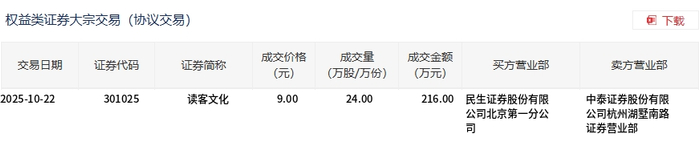
读客文化今日大宗交易折价成交24万股,成交额216万元
Xin Lang Cai Jing· 2025-10-22 09:10
Group 1 - On October 22, 2023, Duku Culture executed a block trade of 240,000 shares, with a transaction amount of 2.16 million yuan, accounting for 5.12% of the total trading volume for the day [1][2] - The transaction price was set at 9 yuan per share, representing a discount of 6.35% compared to the market closing price of 9.61 yuan [1][2] - The buyer was Minsheng Securities Co., Ltd., while the seller was Zhongtai Securities Co., Ltd. [2]

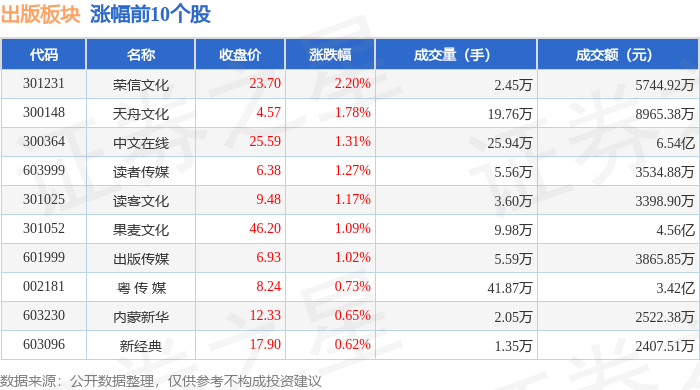
出版板块10月15日涨0.01%,荣信文化领涨,主力资金净流出4186.83万元
Zheng Xing Xing Ye Ri Bao· 2025-10-15 08:37
Market Overview - The publishing sector increased by 0.01% compared to the previous trading day, with Rongxin Culture leading the gains [1] - The Shanghai Composite Index closed at 3912.21, up by 1.22%, while the Shenzhen Component Index closed at 13118.75, up by 1.73% [1] Individual Stock Performance - Rongxin Culture (301231) closed at 23.70, with a rise of 2.20% and a trading volume of 24,500 lots, amounting to a transaction value of 57.44 million [1] - Tianzhou Culture (300148) closed at 4.57, up by 1.78%, with a trading volume of 197,600 lots and a transaction value of 89.65 million [1] - Zhongwen Online (300364) closed at 25.59, increasing by 1.31%, with a trading volume of 259,400 lots and a transaction value of 654 million [1] - Other notable stocks include Guomai Culture (301052) at 46.20 (+1.09%) and Yuedu Media (002181) at 8.24 (+0.73%) [1] Capital Flow Analysis - The publishing sector experienced a net outflow of 41.87 million from institutional investors, while retail investors saw a net inflow of 23.18 million [2] - The net inflow from speculative funds was 18.69 million [2] Detailed Capital Flow for Selected Stocks - Zhongyuan Media (000719) had a net outflow of 12.14 million from institutional investors, with a retail net outflow of 17.89 million [3] - Zhongwen Online (300364) saw a net inflow of 10.05 million from institutional investors, but a net outflow of 7.53 million from retail investors [3] - Publishing Media (601999) had a net inflow of 5.02 million from institutional investors, while retail investors experienced a net outflow of 2.55 million [3]


读客文化10月9日获融资买入651.54万元,融资余额1.07亿元
Xin Lang Cai Jing· 2025-10-10 01:28
Group 1 - The core viewpoint of the news is that Reader Culture's stock experienced a decline of 1.65% on October 9, with a trading volume of 45.62 million yuan, indicating a potential concern in market sentiment [1] - On October 9, Reader Culture had a financing buy-in amount of 6.52 million yuan and a net financing buy-in of 3.18 million yuan, with a total financing and securities balance of 107 million yuan, which is 2.79% of its market capitalization [1] - The company’s main business revenue composition includes 82.16% from physical books, 17.69% from digital content, and minimal contributions from copyright operations and promotional services [1] Group 2 - As of July 18, Reader Culture had 17,300 shareholders, an increase of 2.84%, while the average circulating shares per person decreased by 2.77% to 16,002 shares [2] - For the first half of 2025, Reader Culture reported a revenue of 168 million yuan, a year-on-year decrease of 15.38%, and a net profit attributable to the parent company of 6.13 million yuan, down 46.90% year-on-year [2] - Since its A-share listing, Reader Culture has distributed a total of 88.84 million yuan in dividends, with 55.24 million yuan distributed over the past three years [3]
见一面600万,企业抢着给这对贵州兄弟送钱
盐财经· 2025-09-26 11:07
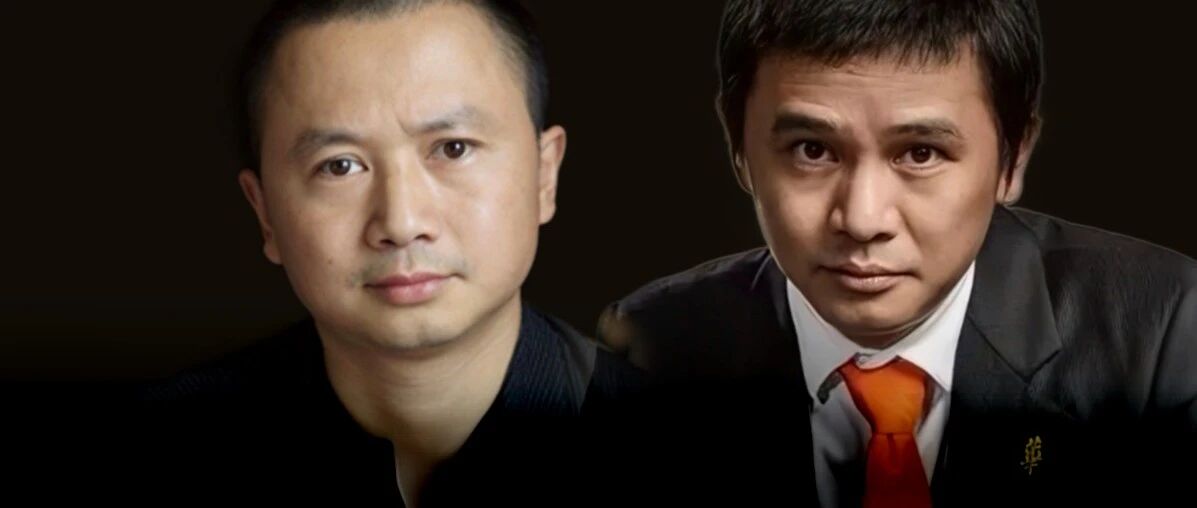
Core Viewpoint - The article discusses the unique business model and success of Huayuhua, a marketing consulting company in China, which charges a high consulting fee starting at 6 million and has gained significant attention and controversy in the industry [3][30]. Company Overview - Huayuhua is described as "China's most mysterious marketing company," known for its high consulting fees and controversial design aesthetics [3][32]. - The company has fewer than 200 employees and generates over 300 million in annual revenue, which is more than three times the industry average per employee [5][6]. - Founded by brothers Huashan and Huanan, Huayuhua has developed a unique "super symbol" theory that has contributed to its success [8][16]. Business Model and Strategy - Huayuhua's pricing strategy is a point of contention, with a flat fee of 6 million regardless of client size, which Huashan believes signals transparency and value [33]. - The company emphasizes that its design philosophy prioritizes sales and marketing effectiveness over traditional aesthetic considerations, leading to criticism of its design as "low" or lacking in sophistication [31][36]. - Huayuhua invests 10% of its revenue in advertising, believing that consistent advertising is crucial for brand recognition [30]. Key Theories and Methodologies - The "super symbol" theory posits that effective brand marketing involves extracting recognizable cultural symbols from a shared cultural heritage rather than creating entirely new concepts [21][28]. - The company applies this theory through practical methods, such as the "fill-in-the-blank" approach in advertising slogans, exemplified by the successful campaign for Hanting Hotels [22][24]. - Huayuhua's collaboration with brands like Mixue Ice City demonstrates the effectiveness of the "super symbol" theory in transforming brand identity and market reach [26][27]. Controversies and Criticisms - The company has faced ongoing criticism regarding its design style, with detractors labeling it as simplistic and lacking artistic merit [32][36]. - Recent controversies include accusations of design similarities between Huayuhua's logos and those of established international brands, raising questions about originality [38]. - Despite the criticisms, Huashan maintains a strong belief in the company's methodologies and the effectiveness of its branding strategies [36].
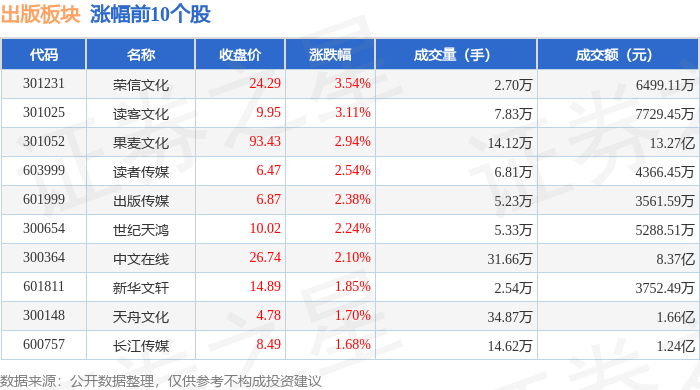
出版板块9月24日涨0.46%,荣信文化领涨,主力资金净流出4388.08万元
Zheng Xing Xing Ye Ri Bao· 2025-09-24 08:46
Market Overview - The publishing sector increased by 0.46% on September 24, with Rongxin Culture leading the gains [1] - The Shanghai Composite Index closed at 3853.64, up 0.83%, while the Shenzhen Component Index closed at 13356.14, up 1.8% [1] Individual Stock Performance - Rongxin Culture (301231) closed at 24.29, up 3.54% with a trading volume of 27,000 hands and a transaction value of 64.99 million [1] - Reader Culture (301025) closed at 9.95, up 3.11% with a trading volume of 78,300 hands and a transaction value of 77.29 million [1] - Guomai Culture (301052) closed at 93.43, up 2.94% with a trading volume of 141,200 hands and a transaction value of 132.7 million [1] - Other notable stocks include Zhongwen Online (300364) which closed at 26.74, up 2.10% with a transaction value of 837 million [1] Capital Flow Analysis - The publishing sector experienced a net outflow of 43.88 million from institutional investors and 65.03 million from speculative funds, while retail investors saw a net inflow of 109 million [2] - Major stocks with significant net inflows from retail investors include Zhongnan Media (601098) with 17.93 million and Nanfang Media (601900) with 11.13 million [3] Summary of Key Stocks - Zhongnan Media (601098) had a net inflow of 17.93 million from institutional investors, while it faced a net outflow of 4.27 million from speculative funds [3] - Longjiang Media (600757) saw a net inflow of 11.09 million from institutional investors, with a net outflow of 3.26 million from speculative funds [3] - ST Huawen (000793) had a net inflow of 3.94 million from retail investors despite a net outflow from institutional and speculative funds [3]

财说| 华与华兄弟的读客文化,为何掉队?
Xin Lang Cai Jing· 2025-09-23 23:36
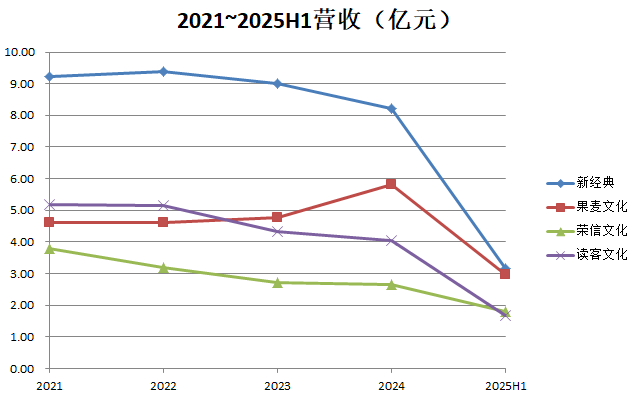
Core Viewpoint - The recent performance of Reader Culture (读客文化) has been disappointing, with significant declines in revenue and profit, raising concerns about its business model and market strategy [1][2][6]. Group 1: Financial Performance - In the first half of 2025, Reader Culture reported revenue of 168 million yuan, a year-on-year decline of 15.38%, and a net profit of only 3.18 million yuan, down 57.76% [2]. - The company's market position has deteriorated, dropping from the second largest in 2021 to the lowest among its peers by mid-2025 [2][4]. - Reader Culture's gross margin fell to 32.4% in the first half of 2025, the lowest among its competitors [10][12]. Group 2: Market Challenges - The overall book retail market saw a slight growth of 0.73% in pricing but a decline of 0.31% in actual sales, indicating a challenging environment for all players [6]. - Reader Culture's sales of physical books decreased by 27.28% in terms of pricing and 19.33% in revenue [6]. Group 3: Strategic Issues - The company attributed its performance issues to "declining channel traffic," a claim that has been met with skepticism from industry analysts who argue that all companies face similar challenges [7]. - Despite increasing its sales expenses by 24% to 22.58 million yuan in the first half of 2025, including a near doubling of e-commerce promotion costs, Reader Culture failed to halt its revenue decline, suggesting deeper issues with its marketing strategy [7]. Group 4: Product Development - Reader Culture's "creative assembly line" approach, which previously yielded success, has seen a significant drop in new book releases, with only 55 new titles launched in the first half of 2025, a nearly 40% decrease from the previous year [9]. - The lack of appealing new titles has been identified as a critical factor in the company's struggles, indicating a potential "content anxiety" rather than merely a "traffic anxiety" [9]. Group 5: Management Changes - Recent management changes, including the resignation of the general manager while retaining the chairman position, may impact the company's strategic direction [13].
华与华,曾多次被罚
Nan Fang Du Shi Bao· 2025-09-20 01:25
Core Viewpoint - The recent controversy surrounding the pre-made dishes at Xibei has escalated, involving the marketing consulting company "Hua Yu Hua" and its founder Hua Shan, who publicly supported Xibei's founder Jia Guolong while criticizing Luo Yonghao as a "network black mouth" [1][2]. Group 1: Incident Overview - The "pre-made dishes controversy" began on September 10 when Luo Yonghao claimed on social media that his meal at Xibei consisted mostly of pre-made dishes [2]. - Jia Guolong responded the next day, asserting that Xibei does not serve any pre-made dishes and announced plans to sue Luo Yonghao, leading to a series of exchanges between the two [2]. - Hua Shan, the founder of Hua Yu Hua, defended Xibei and criticized Luo Yonghao, stating that Xibei is a company dedicated to quality and that Jia Guolong would not tolerate such slander [2][3]. Group 2: Hua Yu Hua's Background - Hua Yu Hua, founded in 2002 by brothers Hua Shan and Hua Nan, provides marketing consulting services and has been working with Xibei since 2013, making it their first client in the restaurant sector [4]. - The average annual consulting fee for their services to Xibei is over 6 million yuan, totaling more than 60 million yuan over ten years [5]. - Hua Yu Hua has worked with various well-known brands across different sectors, including internet, food and beverage, and seasoning industries, creating popular advertising campaigns [5]. Group 3: Legal and Financial Issues - Hua Yu Hua has faced multiple penalties for advertising violations, including a fine of 1 million yuan in 2017 for an ad that damaged national dignity and interests [6][7]. - The company was also penalized in 2021 for misleading advertising related to a food product, resulting in a fine of 20,000 yuan [7]. - Additionally, Hua Yu Hua has been accused of design plagiarism in 2020, leading to public backlash [7]. Group 4: Related Business Ventures - Besides managing Hua Yu Hua, the founders also hold significant shares in Du Ke Culture, which was established in 2006 and went public in 2021 [8]. - Du Ke Culture has experienced declining performance since its IPO, with revenue dropping from 519 million yuan in its first year to an estimated 406 million yuan in 2024, reflecting a 6.61% year-on-year decline [8]. - The net profit of Du Ke Culture peaked at 67.36 million yuan in 2021 but has since turned into losses, with a reported loss of 3.28 million yuan in 2023 [10].
从华与华风波,看读客文化的转型之困
市值风云· 2025-09-18 10:09
Core Viewpoint - The article discusses the challenges faced by DuKe Culture, a company that once thrived on a "production line" strategy for book publishing, which is now failing to adapt to changing market dynamics and consumer preferences [4][14][19]. Group 1: Company Overview - DuKe Culture was founded in 2009 and is known for its unique approach to book publishing, which includes a "production line" strategy inspired by the marketing firm Hua Yu Hua [6][9]. - The company gained recognition with bestsellers like "The Bloodied Official Career" and "The Secret of the Tibetan Land," with the latter selling 5.8 million copies by the end of 2020 [8][19]. Group 2: Financial Performance - Since its IPO in 2021, DuKe Culture has experienced a continuous decline in revenue, with a reported revenue of 170 million yuan and a net profit of 6.126 million yuan in the first half of 2025, both showing year-on-year declines [15][20]. - The company's reliance on physical book sales, which accounted for over 80% of its revenue, has proven vulnerable, with a nearly 20% decline in this segment [20][22]. Group 3: Market Challenges - The overall book retail market has seen a significant contraction, with a 27.28% year-on-year decline in the first half of 2025 [22]. - DuKe Culture's market share is relatively low, with a 0.77% share in terms of code volume and 0.85% in actual sales volume as of 2024 [24]. Group 4: Competitive Landscape - The publishing industry is highly fragmented, with numerous competitors, including large publishing houses and agile marketing-focused companies like Guomai Culture and MoTie Group [22][25]. - DuKe Culture has struggled to keep pace with competitors who have successfully leveraged new marketing strategies, such as live-streaming sales, which have significantly outperformed DuKe's efforts [20][22]. Group 5: Future Outlook - The company is exploring new avenues, including digital content, but faces challenges in monetization and scaling, as its digital revenue remains low at under 30 million yuan [20][22]. - DuKe Culture's stock price has plummeted over 70% from its peak at the time of listing, leading to a market capitalization loss exceeding 10 billion yuan, indicating a loss of investor confidence [28].

让西贝花6000万的男人,服软了
商业洞察· 2025-09-17 09:25
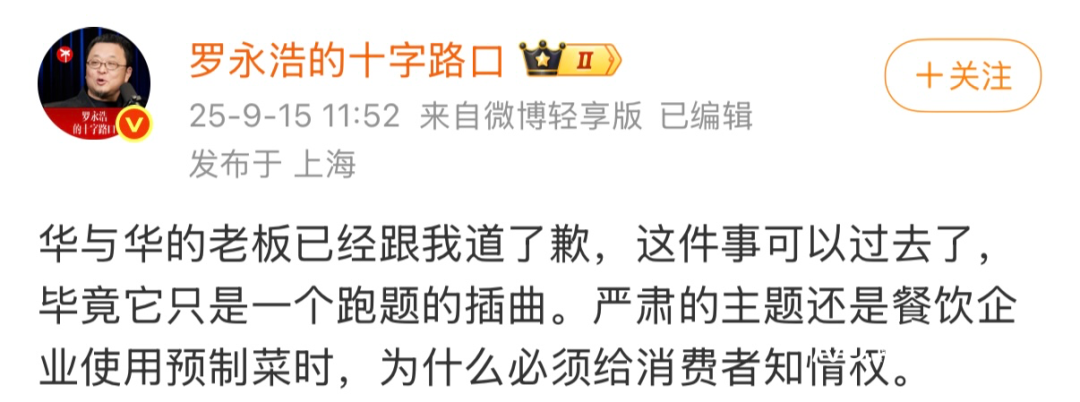
Core Viewpoint - The article discusses the ongoing conflict between Xibei and Luo Yonghao, highlighting a surprising turn of events where Hua Yu Hua, previously supportive of Xibei, has apologized to Luo Yonghao, raising questions about the credibility of Hua Yu Hua's marketing strategies and their impact on the industry [2][4][6]. Group 1: Company Background and Business Model - Hua Yu Hua was founded in 2002 by brothers Hua Shan and Hua Nan, who transitioned from various unsuccessful ventures to the advertising industry, eventually creating a unique business model that combines strategic consulting with advertising creativity [7][8]. - The company is known for its "super symbol" methodology, which emphasizes simple, memorable slogans to reduce communication costs for brands, successfully creating iconic marketing campaigns for clients like Xibei, Haidilao, and others [9][11]. - Unlike traditional advertising firms, Hua Yu Hua does not engage in competitive bidding for projects and charges high service fees, earning the reputation of being the "most expensive marketing company" [12][14]. Group 2: Performance and Controversies - Hua Yu Hua's strategic consulting has significantly benefited clients, with Xibei's revenue increasing from 1.6 billion yuan to 6.2 billion yuan between 2013 and 2019, and the number of stores expanding to nearly 500 [16]. - Despite its successes, Hua Yu Hua has faced criticism for its aesthetic choices, with some designs labeled as "too crude" and "brainwashing," leading to public backlash [17][21]. - The company has also been involved in legal issues, including a significant fine for advertising violations, which raises concerns about its operational integrity [23]. Group 3: Financial Performance of Related Companies - The article notes that the performance of Reader Culture, another company controlled by the Hua brothers, has been declining since its IPO in 2021, with revenues dropping from 519 million yuan in its first year to an estimated 168 million yuan in the first half of 2025 [25][26]. - The decline in Reader Culture's performance coincides with significant stock sell-offs by executives, raising questions about the company's future and the Hua brothers' management capabilities [28]. Group 4: Future Outlook - The recent apology from Hua Yu Hua to Xibei reflects a need for the consulting firm to reassess its role in managing corporate crises and public relations [29]. - The ability of Hua Yu Hua to maintain market trust through its "super symbol" approach remains uncertain and will require time and genuine effort to prove its effectiveness [29].

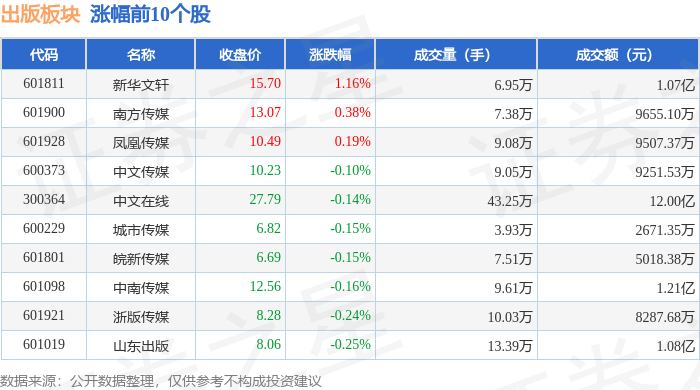
出版板块9月17日跌0.6%,粤 传 媒领跌,主力资金净流出2.39亿元
Zheng Xing Xing Ye Ri Bao· 2025-09-17 08:52
Core Viewpoint - The publishing sector experienced a decline of 0.6% on September 17, with significant losses in the Guangdong media segment, while the Shanghai Composite Index rose by 0.37% and the Shenzhen Component Index increased by 1.16% [1] Group 1: Market Performance - The Shanghai Composite Index closed at 3876.34, up 0.37% [1] - The Shenzhen Component Index closed at 13215.46, up 1.16% [1] - The publishing sector's individual stocks showed mixed performance, with notable declines in several companies [1] Group 2: Stock Performance - Major stocks in the publishing sector included: - Xinhua Wenhui (601811) closed at 15.70, up 1.16% with a trading volume of 69,500 shares and a turnover of 107 million yuan [1] - Southern Media (601900) closed at 13.07, up 0.38% with a trading volume of 73,800 shares [1] - Guangdong Media (002181) closed at 8.23, down 3.63% with a trading volume of 955,700 shares and a turnover of 788 million yuan [2] Group 3: Capital Flow - The publishing sector saw a net outflow of 239 million yuan from institutional investors, while retail investors contributed a net inflow of 200 million yuan [2] - The capital flow for individual stocks indicated varying levels of interest from different investor types, with some stocks experiencing significant net inflows from retail investors [3]