
重庆银行

Search documents
城商行板块1月13日涨1.55%,宁波银行领涨,主力资金净流入2.38亿元
Zheng Xing Xing Ye Ri Bao· 2026-01-13 09:06
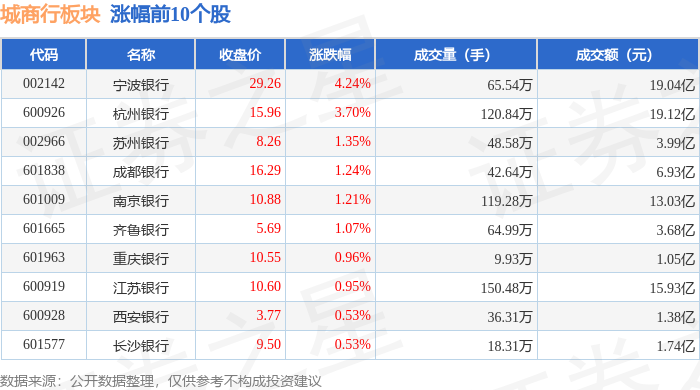
Core Insights - The city commercial bank sector experienced a rise of 1.55% on January 13, with Ningbo Bank leading the gains [1] - The Shanghai Composite Index closed at 4138.76, down 0.64%, while the Shenzhen Component Index closed at 14169.4, down 1.37% [1] Stock Performance - Ningbo Bank (002142) closed at 29.26, up 4.24%, with a trading volume of 655,400 shares and a transaction value of 1.904 billion [1] - Hangzhou Bank (600926) closed at 15.96, up 3.70%, with a trading volume of 1,208,400 shares and a transaction value of 1.912 billion [1] - Suzhou Bank (002966) closed at 8.26, up 1.35%, with a trading volume of 485,800 shares [1] - Chengdu Bank (601838) closed at 16.29, up 1.24%, with a trading volume of 426,400 shares and a transaction value of 693 million [1] - Nanjing Bank (600109) closed at 10.88, up 1.21%, with a trading volume of 1,192,800 shares and a transaction value of 1.303 billion [1] - Qilu Bank (601665) closed at 5.69, up 1.07%, with a trading volume of 649,900 shares and a transaction value of 368 million [1] - Chongqing Bank (601963) closed at 10.55, up 0.96%, with a trading volume of 99,300 shares and a transaction value of 10.5 million [1] - Jiangsu Bank (616009) closed at 10.60, up 0.95%, with a trading volume of 1,504,800 shares and a transaction value of 1.593 billion [1] - Xi'an Bank (600928) closed at 3.77, up 0.53%, with a trading volume of 363,100 shares and a transaction value of 13.8 million [1] - Changsha Bank (601577) closed at 9.50, up 0.53%, with a trading volume of 183,100 shares and a transaction value of 174 million [1] Capital Flow - The city commercial bank sector saw a net inflow of 238 million from institutional investors, while retail investors contributed a net inflow of 199 million [2] - The sector experienced a net outflow of 437 million from speculative funds [2] Individual Stock Capital Flow - Hangzhou Bank (600926) had a net inflow of 70.42 million from institutional investors, while it faced a net outflow of 12.4 million from speculative funds [3] - Shanghai Bank (601229) saw a net inflow of 66.71 million from institutional investors, with a net outflow of 33.15 million from speculative funds [3] - Ningbo Bank (002142) had a net inflow of 37.18 million from institutional investors, with a net outflow of 1.4 million from speculative funds [3] - Suzhou Bank (002966) experienced a net inflow of 34.87 million from institutional investors, while facing a net outflow of 24.25 million from speculative funds [3] - Jiangsu Bank (601577) had a net inflow of 20.83 million from institutional investors, with a net outflow of 15.24 million from speculative funds [3]





生态价值转化绿色引擎
Jin Rong Shi Bao· 2026-01-13 04:41
Group 1 - The People's Bank of China Qianjiang Branch focuses on green finance, utilizing "equity financing" as a breakthrough to create a service system that integrates policy guidance, product innovation, and precise outreach [1] - As of the end of Q3 2025, the green finance loan balance in the jurisdiction reached 40.697 billion yuan, representing a year-on-year growth of 62.5% [1] Group 2 - The Qianjiang District Guohui Asset Management Group faced funding shortages for a river dredging project due to high investment and long recovery periods [2] - The People's Bank of China Qianjiang Branch coordinated with local authorities and financial institutions to develop a new financing model that allowed ecological governance rights to be used as collateral, resulting in an approval of 890 million yuan in loans within half a month [2] - This model achieved a dual win in ecological economy by combining "guarantee collateral" with "dredging sand comprehensive utilization operating rights pledge" [2] Group 3 - The Qianjiang Branch is addressing challenges in the forestry industry, where high forest coverage has not translated into financial value due to issues with collateral [3] - A new financing model was introduced in Youyang County, utilizing a "forest rights transfer transaction certificate" and satellite vector maps to create a dual security system for financing [3] - This innovation led to the successful issuance of a 530 million yuan loan, marking the first "forest rights transaction certificate mortgage loan" in Chongqing [3] Group 4 - In Xiushan County, four aging reservoirs struggled to secure financial support due to outdated facilities and unclear ownership [4] - The People's Bank of China Qianjiang Branch facilitated the completion of water extraction permits and clarified ecological resource ownership, enabling a loan of 160 million yuan for reservoir renovation [4] - This financial innovation transformed ecological resources into economic benefits, demonstrating the importance of converting ecological value into measurable economic value [4]
A股银行股普涨,宁波银行、杭州银行涨超3%
Ge Long Hui A P P· 2026-01-13 03:43
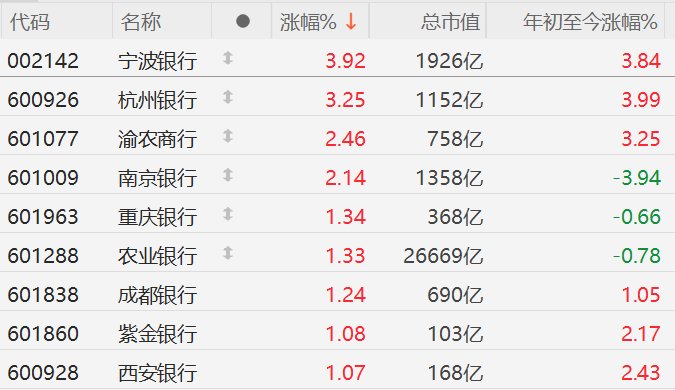
Group 1 - The A-share market saw a general rise in bank stocks, with notable increases in Ningbo Bank and Hangzhou Bank, both rising over 3% [1] - Other banks such as Chongqing Bank, Agricultural Bank, and Xian Bank also experienced gains of over 1% [1] Group 2 - Ningbo Bank's stock increased by 3.92%, with a total market capitalization of 192.6 billion [2] - Hangzhou Bank's stock rose by 3.25%, with a market cap of 115.2 billion [2] - Chongqing Bank and Agricultural Bank saw increases of 1.34% and 1.33% respectively, with market caps of 36.8 billion and 26,669 billion [2] - The year-to-date performance shows that Ningbo Bank and Hangzhou Bank have increased by 3.84% and 3.99% respectively, while Nanjing Bank has decreased by 3.94% [2]



银行股普涨,宁波银行、杭州银行涨超3%
Ge Long Hui· 2026-01-13 03:41
Core Viewpoint - The A-share market saw a significant increase in bank stocks on January 13, with notable gains from several banks, indicating a positive trend in the banking sector [1]. Group 1: Stock Performance - Ningbo Bank (002142) experienced a rise of 3.92%, with a total market capitalization of 192.6 billion [2]. - Hangzhou Bank (600926) increased by 3.25%, with a market cap of 115.2 billion [2]. - Chongqing Rural Commercial Bank (601077) saw a gain of 2.46%, with a market value of 75.8 billion [2]. - Nanjing Bank (601009) rose by 2.14%, but has a year-to-date decline of 3.94%, with a market cap of 135.8 billion [2]. - Agricultural Bank of China (601288) increased by 1.33%, with a substantial market capitalization of 2,666.9 billion [2]. - Other banks such as Chengdu Bank (601838), Zijin Bank (601860), and Xi'an Bank (600928) also reported gains of 1.24%, 1.08%, and 1.07% respectively [2].
“双贴息”政策优化在即,贷款经办机构有望扩围
券商中国· 2026-01-13 01:51
Core Viewpoint - The State Council's recent meeting has outlined a comprehensive policy package aimed at promoting domestic demand through financial and fiscal collaboration, focusing on enhancing consumer spending capabilities by optimizing personal consumption loan interest subsidy policies [1] Group 1: Policy Implementation - The "double subsidy" policy for personal consumption loans will be optimized, including expanding the range of institutions eligible for subsidies and simplifying the approval process by breaking down data barriers between government departments and financial institutions [1][6] - The initial implementation of the subsidy policy has seen significant engagement from major banks, with Industrial and Commercial Bank of China issuing nearly 400 billion yuan in personal consumption loans by the end of November 2025, and Agricultural Bank of China reporting a balance of 1.46 trillion yuan in personal consumption loans, with a growth rate of 9.4% [2] Group 2: Expansion of Eligible Institutions - The current subsidy policy covers 18 national commercial banks and several leading consumer finance companies, with expectations for further expansion to include more regional banks, enhancing the policy's reach [3][4] - Local governments, such as those in Chongqing and Sichuan, have already begun to integrate regional banks into the subsidy framework, demonstrating a trend towards a "national and local subsidy" model that could be adopted by more provinces [4] Group 3: Financial Impact and Recommendations - The consumer finance sector is expected to benefit significantly from the subsidy policy, particularly for smaller banks that serve clients more affected by economic downturns, thus increasing the marginal utility of the subsidies [5] - Recommendations for optimizing the subsidy policy include establishing differentiated subsidy strategies based on regional development levels and specific consumer needs, as well as integrating digital technologies to enhance monitoring and efficiency in fund allocation [6][7]

“双贴息”政策优化在即,贷款经办机构有望扩围
证券时报· 2026-01-13 01:49
Core Viewpoint - The State Council's recent meeting has outlined a comprehensive policy package aimed at promoting domestic demand through financial and fiscal collaboration, particularly focusing on enhancing consumer spending capacity through optimized loan subsidy policies [1] Group 1: Policy Implementation - The "double subsidy" policy will optimize the implementation of loans for service industry entities and personal consumption loans, aiming to increase the supply of quality services and enhance consumer spending ability [1] - The policy includes a 1% interest subsidy for personal consumption loans under certain conditions, with a maximum subsidy of 3,000 yuan per borrower for loans above 50,000 yuan [3] Group 2: Financial Institution Participation - The initial batch of institutions eligible for the subsidy includes 18 national commercial banks and several leading consumer finance companies, with expectations for the expansion of eligible institutions in future policy adjustments [4] - Financial institutions have increased credit issuance in the consumer sector, with significant loan disbursements reported by major state-owned banks [3] Group 3: Regional Policy Adaptation - Several provinces, including Chongqing, Sichuan, and Guizhou, have already included local banks in the subsidy policy, demonstrating a trend towards regional adaptation of the national policy [6] - The "national subsidy + local subsidy" model is expected to be adopted by more provinces, enhancing policy coverage and efficiency in reaching consumers [6] Group 4: Future Policy Optimization - Future policy evaluations may lead to the extension of the subsidy period and adjustments in the range of supported institutions, with a focus on managing financial risks and ensuring effective policy execution [9] - Recommendations for optimizing the subsidy policy include establishing differentiated subsidy strategies based on regional development levels and specific consumer needs, as well as improving data sharing between government and financial institutions to streamline loan approval processes [10][11]

“双贴息”政策优化在即,贷款经办机构有望扩围
Zheng Quan Shi Bao· 2026-01-12 14:46
Group 1 - The core viewpoint of the news is the implementation of a comprehensive policy package by the State Council to promote domestic demand through financial and fiscal collaboration, focusing on enhancing consumer spending capabilities [1] - The "double subsidy" policy aims to optimize personal consumption loan interest subsidies and service industry loans, with suggestions for expanding the range of institutions involved and simplifying approval processes [1][3] - The first phase of the personal consumption loan subsidy policy includes 18 national commercial banks and several leading consumer finance companies, with expectations for further expansion of participating institutions [3] Group 2 - The policy has already seen regional banks in cities like Chongqing, Sichuan, and Guizhou included in the subsidy framework, indicating a trend towards a "national subsidy + local subsidy" model [4] - Financial institutions have increased credit issuance in the consumer sector, with significant loan amounts reported by major state-owned banks [2] - The effectiveness of the subsidy policy is expected to be evaluated post-implementation, with potential adjustments to the support range and participating institutions [6] Group 3 - The policy's marginal utility is particularly significant for customers of city commercial banks and rural commercial banks, who are more affected by economic downturns [5] - Recommendations for optimizing the "double subsidy" policy include using digital currency technology for fund management and establishing differentiated subsidy strategies based on regional needs [7][8] - Long-term strategies should align the subsidy policy with income support and employment measures to enhance consumer capacity and confidence [8]
节气雅韵遇知音 300余件艺术佳作亮相武汉
Xin Lang Cai Jing· 2026-01-12 09:46
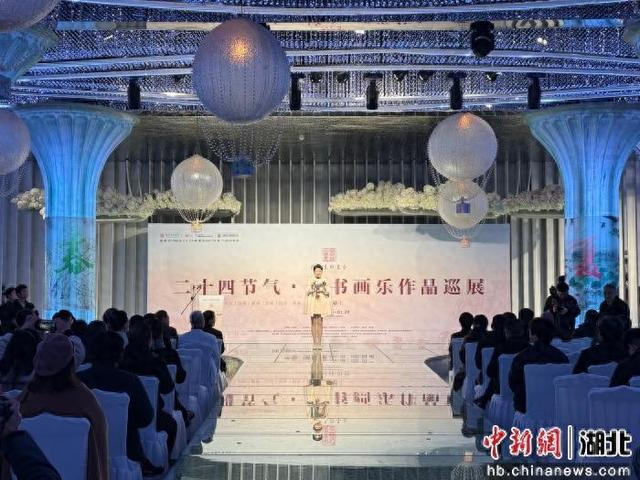
Core Viewpoint - The "Twenty-Four Solar Terms: Poetry, Calligraphy, Painting, and Music Exhibition" has officially opened in Wuhan, showcasing the integration of traditional Chinese culture through various art forms [1][3]. Group 1: Exhibition Overview - The exhibition is organized by China Digital Culture Group and supported by various cultural and tourism authorities, marking its eighth stop in a nationwide tour [3]. - The event features over 300 artworks from nearly 100 renowned artists, highlighting the cultural significance of the twenty-four solar terms [5]. Group 2: Cultural Significance - The exhibition emphasizes the wisdom of ancient Chinese astronomy and agricultural civilization, reflecting the cultural essence of the solar terms [3][7]. - The integration of the solar terms with the unique "Zhiyin" culture of the Jingchu region enhances the cultural experience for visitors [7]. Group 3: Innovative Presentation - Digital audio-visual works are a highlight, utilizing "culture + digital + technology" to create an immersive experience that transcends traditional static displays [9]. - The dynamic presentation of traditional art forms aims to promote the deep-rooted traditional culture to a broader audience [9][12]. Group 4: Visitor Experience - Visitors can experience the changing light and shadow of the solar terms while enjoying traditional music and poetry, providing a multi-sensory understanding of natural rhythms [11]. - The exhibition runs until January 20, allowing free access for the public to explore the cultural richness of the Zhiyin cultural tourism area [12].
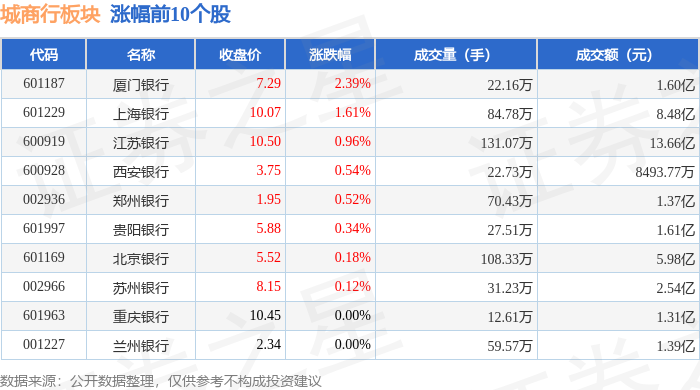
城商行板块1月12日涨0.25%,厦门银行领涨,主力资金净流出6140.56万元
Zheng Xing Xing Ye Ri Bao· 2026-01-12 09:10
Market Performance - The city commercial bank sector increased by 0.25% compared to the previous trading day, with Xiamen Bank leading the gains [1] - The Shanghai Composite Index closed at 4165.29, up 1.09%, while the Shenzhen Component Index closed at 14366.91, up 1.75% [1] Individual Bank Performance - Xiamen Bank (601187) closed at 7.29, up 2.39% with a trading volume of 221,600 shares and a transaction value of 160 million yuan [1] - Shanghai Bank (601229) closed at 10.07, up 1.61% with a trading volume of 847,800 shares and a transaction value of 848 million yuan [1] - Jiangsu Bank (616009) closed at 10.50, up 0.96% with a trading volume of 1,310,700 shares and a transaction value of 1.366 billion yuan [1] - Other banks such as Xi'an Bank, Zhengzhou Bank, and Beijing Bank also showed minor increases in their stock prices [1] Capital Flow Analysis - The city commercial bank sector experienced a net outflow of 61.41 million yuan from institutional investors, while retail investors saw a net inflow of 66.54 million yuan [2] - The individual capital flow for Jiangsu Bank showed a net inflow of 47.88 million yuan from institutional investors, while retail investors had a net outflow of 51.39 million yuan [3] - Xiamen Bank had a net inflow of 17.18 million yuan from institutional investors, but retail investors experienced a net outflow of 8.30 million yuan [3]

银行业周度追踪2026年第1周:如何理解银行股开年调整?-20260112
Changjiang Securities· 2026-01-12 04:41
Investment Rating - The investment rating for the banking sector is "Positive" and is maintained [12]. Core Insights - In the first week of 2026, the banking sector continued to adjust, with a cumulative decline of 1.9% in the banking index, significantly underperforming the CSI 300 and ChiNext indices by -4.7% and -5.8% respectively. Despite this, the fundamental expectations for the sector remain unchanged, and the market's risk appetite has notably increased [2][6][19]. - The main banks are expected to maintain stable growth in performance throughout 2026. Following recent adjustments, the PB-ROE valuation attractiveness of bank stocks has further increased, suggesting a favorable timing for allocation [2][6][19]. Summary by Sections Market Performance - The banking sector's performance in the first week of 2026 showed a cumulative decline of 1.9%, with significant negative excess returns compared to the CSI 300 and ChiNext indices [6][19]. - Individual stocks such as Chongqing Rural Commercial Bank saw price recovery after management uncertainties were resolved, while stable performers like Hangzhou Bank led the city commercial bank sector [2][6][19]. Fundamental Analysis - The banking sector's performance has been influenced by structural concerns, particularly regarding real estate and retail asset quality. Despite these concerns, overall performance remains stable with steady growth [8][37]. - The LTV (Loan-to-Value) ratios for major banks are stable at 40%-50%, providing a safety margin despite rising asset quality pressures in mortgage loans [8][37]. Trading Dynamics - The increase in market risk appetite has continued to suppress bank stock valuations. Historically, January has seen excess returns for bank stocks, but this year, the rapid recovery in market sentiment has led to underperformance [9][38]. - The report recommends focusing on high-quality city commercial banks such as Hangzhou Bank, Nanjing Bank, and Jiangsu Bank, as well as dividend-oriented assets like Bank of Communications and China Merchants Bank [9][38]. Convertible Bonds - The prices of convertible bonds linked to bank stocks have generally followed the sector's adjustment, with the distance to mandatory conversion prices widening. The report highlights potential trading opportunities in convertible bonds for banks like Changshu Bank and Shanghai Bank, which have stable fundamental performance expectations [7][32].

