服务业经营主体贷款

Search documents
北京银行关于落实财政金融促内需一揽子政策工作的公告
Xin Lang Cai Jing· 2026-02-04 10:01
Core Viewpoint - The company is actively implementing policies to support consumer loans, credit card installment plans, and financing for small and micro enterprises, in line with government directives to boost consumption and reduce financing costs [1][2][3] Group 1: Policy Implementation - The company is advancing the implementation of personal consumption loans, credit card installment plans, loans for service industry entities, small and micro enterprises, and equipment upgrade loans [1][2] - The implementation is based on several government notifications aimed at optimizing fiscal subsidy policies for personal consumption and business loans [1][2] Group 2: Operational Guidelines - The company will adhere to market-oriented and legal principles, optimizing business processes and simplifying procedures to expedite policy rollout [1][2] - Specific channels and operational guidelines for these policies will be published through the company's official website, WeChat account, and local branches [1][2] Group 3: Customer Advisory - The company will not charge any service fees for the aforementioned loans and has not partnered with any loan intermediaries or individuals [3] - Customers are advised to remain vigilant against potential scams [3]

招商银行关于中小微企业及服务业经营主体贷款贴息工作的公告
招商银行App· 2026-01-29 03:11
Core Viewpoint - The announcement by China Merchants Bank outlines the implementation of interest subsidies for loans to small and micro enterprises and service industry operators, in line with national policies aimed at boosting the private economy and domestic demand [1][2]. Group 1: Loan Subsidy Implementation - Starting from January 1, 2026, the bank will provide interest subsidies for fixed asset loans to eligible small and micro private enterprises and service industry operators [1]. - Loans issued between March 16, 2025, and December 31, 2025, will continue to be processed under the existing subsidy policies [1]. - The bank aims to streamline the application process and simplify procedures to ensure the prompt implementation of these policies [1]. Group 2: Customer Advisory - The bank emphasizes that there will be no additional fees for processing these loan subsidies and warns customers to be cautious of potential scams [1]. - Customers are encouraged to reach out to bank branches or the customer service hotline for any inquiries [1].



21评论丨贴息政策升级,促消费稳投资意义深远
2 1 Shi Ji Jing Ji Bao Dao· 2026-01-22 03:28
Core Viewpoint - The recent fiscal and financial policies aim to stimulate domestic demand by optimizing interest subsidy policies for various loan types, thereby enhancing consumer spending and private investment [1][2][5]. Group 1: Policy Overview - Five fiscal and financial policies have been released, focusing on personal consumption loans, equipment upgrade loans, loans for small and micro enterprises, loans for service industry entities, and a special guarantee plan for private investment [1][2]. - The personal consumption loan subsidy has been expanded to include credit card installment payments, with an annual subsidy rate of 1% and no upper limit on single consumption subsidy amounts [1][2]. - A new subsidy policy for small and micro enterprise loans has been introduced, offering a 1.5% annual subsidy for fixed asset loans directed at specified key industries, with a maximum limit of 50 million yuan per borrower [2]. Group 2: Implementation and Impact - The policies are designed to enhance the precision of financial support, making it easier for more enterprises to access subsidies, thus increasing the overall effectiveness of the policies [3][5]. - Financial institutions play a crucial role in the implementation of these policies, as they are encouraged to monitor fund flows and improve risk control while expanding their loan offerings [4]. - The combination of these policies is expected to create a synergistic effect, promoting a virtuous cycle of production and consumption, ultimately leading to increased economic growth [5].
【银行】“一揽子”贷款财政贴息政策影响几何?——1月20日贷款财政贴息四项政策点评(王一峰/赵晨阳)
光大证券研究· 2026-01-21 23:07
Core Viewpoint - The article discusses a series of financial subsidy policies aimed at promoting consumption and investment, particularly focusing on small and micro enterprises, personal consumption loans, and service industry loans [4][5]. Group 1: Policy Overview - On January 20, the Ministry of Finance, in collaboration with other departments, released a comprehensive set of financial subsidy policies to support small and micro enterprises, optimize personal consumption loans, and enhance service industry loans [4]. - The policies are designed to be "convenient and efficient," "precise and effective," and "standardized and efficient," with a focus on increasing subsidy amounts, broadening support areas, extending subsidy periods, and simplifying processes [5]. Group 2: Impact on Investment and Consumption - The new subsidy policies are expected to significantly enhance the scale of financial support compared to previous measures, thereby stimulating loan demand in relevant sectors and promoting effective investment and consumption [5][6]. - Specific measures include reducing financial burdens on small and micro enterprises, extending loan terms for service industry operators, and optimizing personal consumption loan subsidies to alleviate residents' interest payment pressures [6][7]. Group 3: Financial Projections - The estimated scale of the new subsidy policies is projected to be between 100 billion to 200 billion by 2026, with a significant portion allocated to small and micro enterprise loans and optimized personal consumption loans [8]. - The actual disbursement of subsidies may vary due to factors such as the scope of supported industries, the structure of client bases, and the willingness of the private sector to expand [8]. Group 4: Implications for the Banking Sector - The coordinated policies are expected to positively influence the banking sector's performance, particularly in small and micro finance and retail sectors, potentially catalyzing a favorable market environment for banks [9]. - As of January 20, A-share banks have seen a cumulative decline of 4.3%, underperforming the HS300 index by approximately 6.2 percentage points, indicating a potential opportunity for recovery in the banking sector due to these new policies [9].
划重点!2026年将更多财政资金用在这些方面
Sou Hu Cai Jing· 2026-01-21 03:25
Group 1: Fiscal Policy and Economic Support - The Chinese government plans to issue 1.3 trillion yuan in ultra-long-term special bonds in 2025 to support "two new" and "two heavy" initiatives, indicating a more proactive fiscal policy aimed at stabilizing the economy [1][2] - The fiscal deficit rate is set at around 4%, with new government debt totaling 11.86 trillion yuan, significantly higher than previous years, to enhance counter-cyclical adjustments [1][2] - The government aims to boost consumption by allocating 300 billion yuan for a trade-in program, expected to generate over 2.6 trillion yuan in related sales [1] Group 2: Support for Employment and Social Welfare - The central government has allocated 66.74 billion yuan for employment subsidies and increased funding for social insurance and public health services, enhancing residents' consumption capacity [1][3] - The government is committed to maintaining necessary levels of fiscal deficit and total debt to ensure sustained support for key areas, focusing on boosting consumption and social welfare [3] Group 3: Policies to Encourage Private Investment - New policies include a loan interest subsidy for small and micro enterprises in key industries, with a subsidy rate of 1.5% for loans up to 50 million yuan [4] - A special guarantee plan for private enterprises will provide support for medium to long-term loans needed for business expansion and upgrades, with a maximum guarantee of 20 million yuan per enterprise [4] - A risk-sharing mechanism for private enterprise bonds will help reduce financing barriers, supported by central government funds [4][8] Group 4: Optimizing Consumption Support Policies - The consumer loan interest subsidy policy has been enhanced, allowing for higher subsidy amounts and broader coverage, including credit card installment payments and new consumption sectors [7] - The implementation period for these consumer loan subsidies has been extended to the end of 2026, increasing accessibility for a wider range of financial institutions [7] Group 5: Government Procurement and Market Regulation - The government aims to optimize procurement processes by establishing a comprehensive legal framework and ensuring fair treatment of all market participants [9] - Continuous efforts will be made to regulate fiscal subsidies and improve the management of government procurement to foster a more competitive market environment [9]
中小微企业贷款贴息、民间投资专项担保……财政部连发五项重要政策
Sou Hu Cai Jing· 2026-01-21 03:12
Group 1 - The Ministry of Finance and other departments have released five policy documents aimed at optimizing financial support for personal consumption loans, equipment updates, private investment guarantees, service industry loans, and small and micro enterprise loans [1][9][29] - The personal consumption loan subsidy policy has been extended until December 31, 2026, with adjustments to the subsidy standards and an expanded range of supported financial institutions [4][5][6] - The equipment update loan subsidy policy includes a 1.5% subsidy on fixed asset loans for equipment updates, applicable for up to two years, and has been expanded to include various sectors such as construction, aviation, and digital technology [10][11][12] Group 2 - The private investment guarantee plan has a total quota of 500 billion yuan, to be implemented over two years, focusing on supporting small and micro enterprises in various sectors including technology upgrades and service industry enhancements [17][18] - The plan includes a risk-sharing mechanism where banks will bear at least 20% of the loan risk, while the government guarantee fund will cover up to 80% [19] - The government will also reduce guarantee fees and increase the compensation limit for the guarantee fund to enhance support for private investments [20] Group 3 - The service industry loan subsidy policy has been extended to December 31, 2026, with an increased subsidy cap of 10 million yuan per loan and a 1% annual subsidy rate [23][24] - The policy now includes additional sectors such as digital, green, and retail industries, expanding the scope of financial support [24][25] - The implementation of these policies will involve streamlined processes for fund allocation and enhanced collaboration among financial institutions and regulatory bodies [26][28]





信用卡账单分期纳入贴息!多家大行新政落地,这些红利可享
2 1 Shi Ji Jing Ji Bao Dao· 2026-01-20 15:06
Core Insights - The Chinese government is implementing a series of fiscal policies aimed at boosting domestic demand and promoting high-quality economic development, with a focus on six new policies, particularly two interest subsidy policies for the service sector and personal consumption loans [2][4]. Group 1: Policy Duration and Implementation - The personal consumption loan interest subsidy policy will be uniformly executed by Agricultural Bank of China, Bank of China, and Postal Savings Bank from September 1, 2025, to December 31, 2026 [5]. - The service sector loan interest subsidy policy, currently announced by Agricultural Bank of China, will also extend to December 31, 2026, with existing loans issued between March 16, 2025, and December 31, 2025, continuing under previous regulations [5]. Group 2: Optimized Subsidy Scope - The new policy includes credit card bill installment payments as part of the subsidy scope, effective from January 1, 2026, to December 31, 2026, with a subsidy rate of 1% per annum, capped at 50% of the agreed annualized interest rate [6]. - Adjustments in personal consumption loan subsidies include the removal of a 500 yuan cap on single transaction subsidies, elimination of a 1,000 yuan cap for cumulative transactions under 50,000 yuan, while maintaining a 3,000 yuan annual cap for all personal consumption loans [7]. - The service sector loan subsidy now includes three new categories: digital, green, and retail consumption, and increases the maximum subsidy per loan from 1 million yuan to 10 million yuan, significantly reducing financing costs for large loans [7]. Group 3: Important Considerations - Fraudulent activities to obtain funds will be legally addressed, with banks retaining the right to recover subsidies if fraudulent behavior is detected [8]. - Banks will not charge any fees for processing loans or subsidies and will not engage third parties for these services, emphasizing the prohibition of fraudulent practices [9]. - Overdue loans will not qualify for interest subsidies, and borrowers must settle all outstanding debts before being eligible for subsidies [9].


信用卡分期纳入贴息,多家国有大行火速公布细则
2 1 Shi Ji Jing Ji Bao Dao· 2026-01-20 14:44
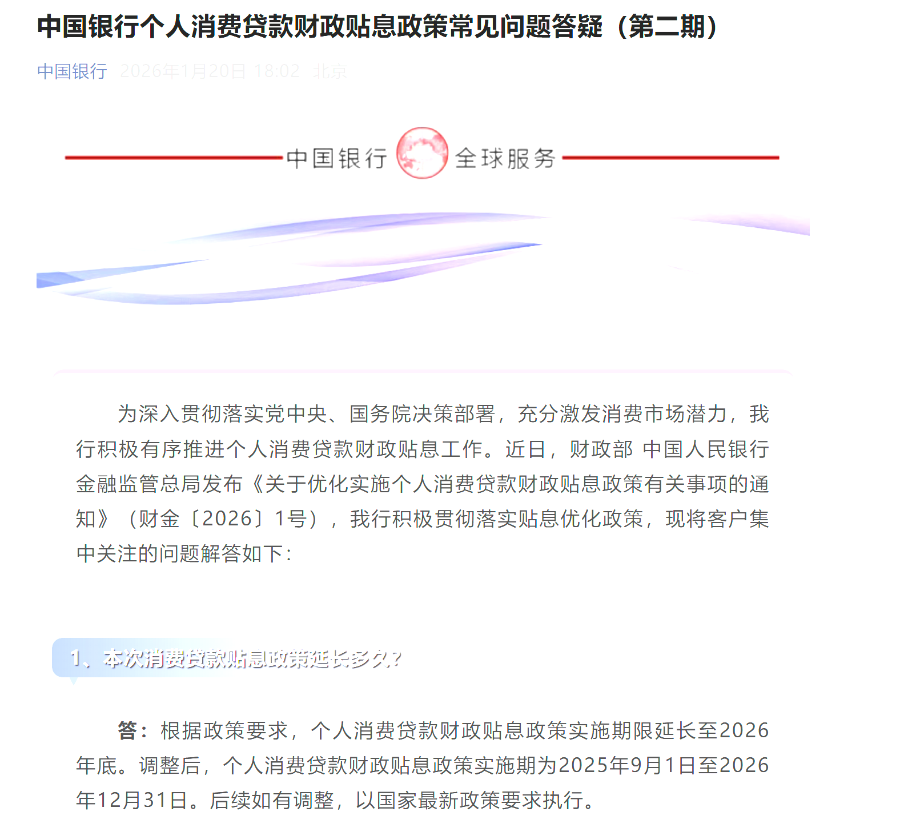
Core Viewpoint - The Chinese government is implementing a series of fiscal policies aimed at boosting domestic demand and promoting high-quality economic development, with a focus on optimizing interest subsidy policies for the service industry and personal consumption loans [1][3]. Group 1: Policy Implementation - The personal consumption loan interest subsidy policy will be uniformly executed by Agricultural Bank, Bank of China, and Postal Savings Bank from September 1, 2025, to December 31, 2026 [4]. - The service industry loan interest subsidy policy, currently announced by Agricultural Bank, will also extend to December 31, 2026, with existing loans issued between March 16, 2025, and December 31, 2025, continuing under previous regulations [4]. Group 2: Subsidy Scope Optimization - Credit card bill installment payments have been added to the subsidy scope, with the subsidy applicable for new transactions from January 1, 2026, to December 31, 2026, subject to bank verification [5]. - The personal consumption loan subsidy standards have been adjusted by removing the previous limits on single transaction amounts and cumulative amounts for smaller loans, while maintaining an annual cap of 3,000 yuan for all personal consumption loans [6]. - The service industry loan subsidy has expanded to include three new sectors: digital, green, and retail, with the maximum subsidy amount for new loans increased from 1 million yuan to 10 million yuan [6]. Group 3: Important Considerations - Fraudulent activities to obtain subsidies will be strictly penalized, with banks retaining the right to recover subsidies if fraud is detected [7]. - No fees will be charged for processing loans or subsidies, and banks will not engage third parties for these services [7]. - Overdue loans will not qualify for interest subsidies, and borrowers must return all outstanding principal and interest before becoming eligible [7]. Group 4: Inquiry Channels - Customers can check subsidy details through bank SMS, mobile banking apps, physical branches, or customer service hotlines [8].
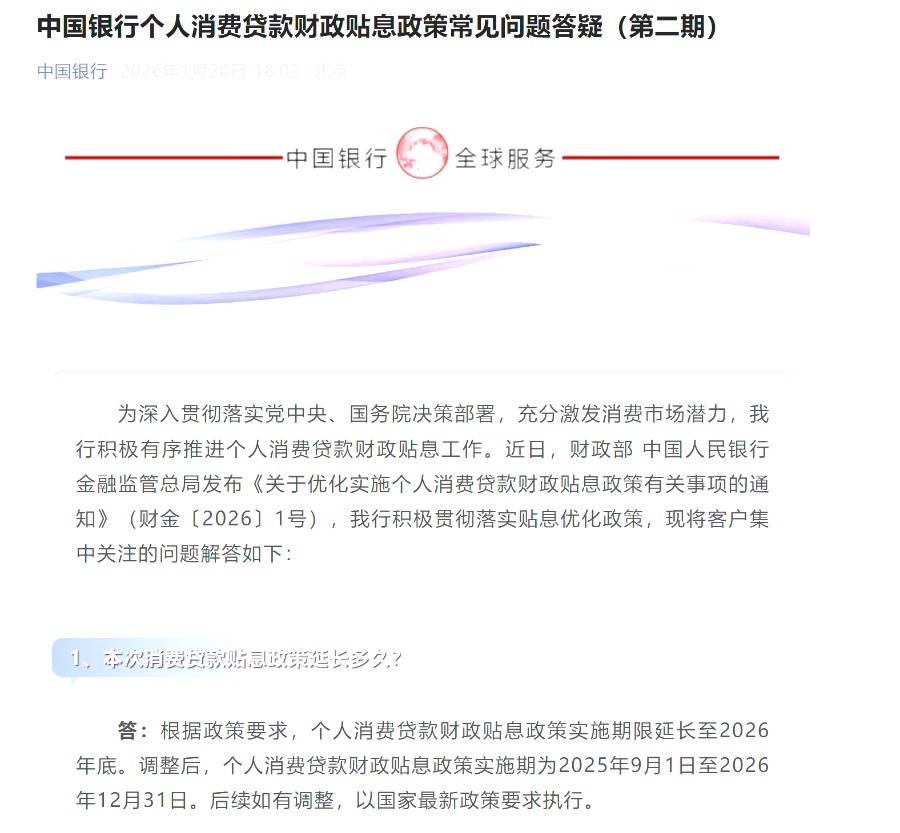
信用卡分期纳入贴息支持范围,年贴息比例1%
21世纪经济报道· 2026-01-20 11:55
Core Viewpoint - The article discusses the recent upgrades to multiple loan interest subsidy policies aimed at stimulating consumer spending and supporting small and micro enterprises, indicating a shift in government strategy from large-scale infrastructure investment to more targeted financial support [1][3]. Summary by Sections Personal Consumption Loan Subsidy Policy - The optimization of the personal consumption loan subsidy policy includes extending the policy period to the end of 2026, incorporating credit card installment payments into the subsidy scope, and increasing the annual subsidy rate to 1% [3][4]. - The previous limits on subsidy amounts have been removed, allowing for a cumulative annual subsidy cap of 3,000 yuan per borrower at a single institution [3]. Service Industry Loan Subsidy Policy - The subsidy cap for individual service industry loans has been raised from 1 million yuan to 10 million yuan, with new support areas including digital, green, and retail sectors [7][9]. - The expansion of eligible banks for these subsidies now includes city commercial banks and foreign banks with a regulatory rating of 3A or above [8]. Equipment Update Loan Subsidy Policy - The subsidy rate for equipment update loans has been increased to 1.5%, with a focus on high-end, intelligent, green, and digital equipment updates [10][11]. - The policy now includes a wider range of sectors such as construction, aviation, and artificial intelligence, with a streamlined subsidy process [11]. New Subsidy Policy for Small and Micro Enterprises - A new subsidy policy for small and micro enterprises has been introduced, targeting key industry chains and their upstream and downstream sectors, with a subsidy rate of 1.5% for eligible loans [13][14]. - The policy aims to support various sectors including new energy vehicles, medical equipment, and agricultural machinery, with a loan cap of 50 million yuan per borrower [14].

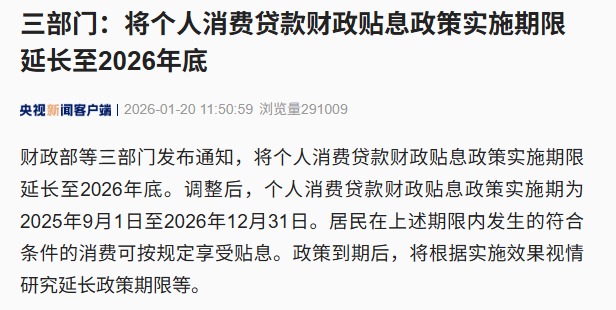
个人消费贷款财政贴息政策实施期限将延长至2026年底
Sou Hu Cai Jing· 2026-01-20 09:03
Group 1 - The core point of the news is the extension of the personal consumption loan interest subsidy policy until the end of 2026, aimed at boosting consumer spending and reducing the cost of personal consumption credit [1][4] - The policy will now be effective from September 1, 2025, to December 31, 2026, allowing residents to enjoy interest subsidies on eligible consumption during this period [4][5] - The subsidy rate for credit card installment payments has been set at 1 percentage point [5] Group 2 - The policy has removed the previous cap of 500 yuan on single transaction interest subsidies and the cumulative cap of 1,000 yuan for each borrower at one financial institution [6] - The policy will include more financial institutions, expanding the coverage to include city commercial banks, rural cooperative financial institutions, foreign banks, and consumer finance companies [6][7] - The central and provincial finances will bear 90% and 10% of the subsidy funds, respectively [6] Group 3 - The funding allocation will follow a "pre-allocation + settlement" method, with financial institutions required to submit their subsidy fund needs by January 31, 2026 [6][7] - The Ministry of Finance will conduct joint inspections to ensure compliance with the policy and will hold institutions accountable for any violations [7][8] - Financial institutions must report their policy execution status monthly, including loan issuance and subsidy amounts [7][8]