
可转债强赎

Search documents
连续大跌!又见转债大幅“杀溢价”
证券时报· 2026-04-01 04:36
Core Viewpoint - The recent sharp decline in the prices of convertible bonds, particularly Yiwai Convertible Bond, is primarily due to the company's decision to implement early redemption, leading to a significant drop in the premium and valuation of these bonds [1][3][5]. Group 1: Yiwai Convertible Bond Performance - On March 31, Yiwai Convertible Bond's price dropped 20% at the opening after the announcement of early redemption, maintaining this decline until the close [3]. - On April 1, the bond continued to fall, reaching a price of 119.508 yuan per share, with a total decline of nearly 30% over two trading days [2][3]. - The early redemption announcement has led to a rapid "killing of the premium" in the market, affecting not only Yiwai but also other newly issued convertible bonds like Jinhong Convertible Bond [5][7]. Group 2: Early Redemption Details - Yiwai Lithium Energy announced the early redemption of the Yiwai Convertible Bond at a price of 100.034 yuan per share, with the redemption date set for April 24, 2026 [4]. - The bondholders must convert their bonds into shares or face forced redemption, which has led to a decrease in the option value of the bonds [4][5]. - The early redemption mechanism is designed to encourage bondholders to convert their bonds into shares, but once announced, it typically results in a rapid alignment of bond prices to their conversion value, compressing the premium to near zero [7][8]. Group 3: Market Impact and Trends - The convertible bond market has experienced increased volatility, with a notable divergence in performance among different bonds [10]. - The overall premium rate in the market has decreased by approximately 2 percentage points to around 33%, returning to early 2026 levels [10]. - Analysts suggest that focusing on low-price, low-premium convertible bonds may enhance investment strategies in the current market environment, which is characterized by high volatility and uncertainty [10].

如何看待强赎压制下的高价券?
GOLDEN SUN SECURITIES· 2026-03-16 12:28
Report Industry Investment Rating No information provided in the content. Core Viewpoints - The number and probability of forced redemptions have been increasing year by year, and the arbitrage opportunities and risks have attracted attention. In the bull market, more convertible bonds trigger and choose forced redemptions, and investors and institutions focus on whether there are arbitrage opportunities and how to time the market [1]. - The valuation adjustment of convertible bonds shows an obvious forward - moving feature. The main pricing process of forced redemption risk is completed at an earlier stage before the announcement, and the valuation compression is basically completed when approaching the announcement [1]. - In 2026, the forced redemption of convertible bonds may be more frequent, and the forced redemption game opportunities will increase. The operation idea of "entering the market close to the announcement and exiting opportunistically after the announcement" is more suitable [3]. Summary by Directory I. Strong Redemption Case Review - From 2018 - 2025, there were 1,178 cases of forced redemption triggers in the market, and the proportion of those finally choosing to implement forced redemptions was about 29.5%. In 2025, the number of forced redemption cases reached 132, and 47.3% of the issuers chose forced redemptions, with the probability hitting a record high [1][9]. - The trend of the stock market dominates the occurrence of convertible bond forced redemption events. Since 2024, the monthly trading volume of the Shanghai - Shenzhen All - A Index has significantly increased, and the number of forced redemptions has risen synchronously. The change in the convertible bond stock structure is closely related to the forced redemption probability. The median remaining term of convertible bonds has been decreasing, and the proportion of old bonds in the market has increased significantly [14]. - In 2026, 190 convertible bonds will mature, and if the stock market remains strong, the number of convertible bonds meeting the forced redemption conditions may increase, and the proportion of forced redemption cases may rise [18]. II. How Does the Valuation of Convertible Bonds Converge Before the Forced Redemption Announcement? 2.1 Typical Convergence Path of Valuation - The identification of forced redemption risk promotes the early compression of the conversion premium rate. The conversion premium rate starts to compress unilaterally from T - 20 and gradually converges to around 0%. The compression mainly occurs in the early stage before the forced redemption announcement. From T - 20 to T - 15, the median conversion premium rate drops from 2.33% to 0.98%, accounting for about 56.7% of the overall compression [19]. 2.2 The Forced Redemption Game Continues to "Involve", and the Valuation Convergence Rhythm Advances - The time rhythm of the forced redemption game shows a forward - moving trend. The compression of the conversion premium rate has advanced to an earlier time window before the announcement. Different stages have different convergence rhythms, and the main compression stage has gradually advanced [23]. 2.3 The Valuation Compression of High - Par Convertible Bonds is More Obvious - High - par convertible bonds have more obvious premium compression. The high - par and high - premium convertible bonds are more likely to experience a rapid decline in the conversion premium rate when the forced redemption condition approaches. At T - 20, the premium rate of high - par convertible bonds is 45.96%, about 54 percentage points higher than that of low - par convertible bonds, and both converge to near 0 at T - 1 [27]. 2.4 Before the Announcement, the Market has Formed a Significant Differentiated Expectation for Convertible Bonds with and without Forced Redemption - Before the announcement, the conversion premium rate of non - forced - redemption convertible bonds remains in the positive premium range, about 4% around T - 1. In contrast, the premium rate of forced - redemption convertible bonds converges to 0. Investors need to be vigilant about the price adjustment risk caused by the change in forced redemption expectations [33][34]. III. Is There Still an Opportunity to Participate After the Forced Redemption Announcement? 3.1 After the Forced Redemption Announcement, the Convertible Bond Price Performance and Its Characteristics: "Rapid Compression, Partial Rebound" - After the forced redemption announcement, the conversion premium rate of convertible bonds quickly compresses and turns negative. In some strong stock market stages, the valuation of individual bonds may rebound from T + 10 to T + 30. The stronger the stock market, the more obvious the rebound feature [36][41]. 3.2 After the Non - Redemption Announcement, the Conversion Premium Rate Gradually Returns to Normal - After the non - redemption announcement, the conversion premium rate of non - redeemed convertible bonds shows obvious repair, rising from about 7% to about 10%, and the market pricing gradually returns to the normal valuation range [46]. 3.3 After the Non - Redemption Announcement, is There a Difference in the Valuation Repair of Convertible Bonds with Different Par Values? - Before the non - forced - redemption announcement, the compression paths of the conversion premium rates of convertible bonds with different par values are similar in the early stage, but they gradually diverge later. After T + 15, the conversion premium rate of high - par convertible bonds is significantly lower than that of low - par convertible bonds [48][49]. 3.4 The Investment Win - Rate of Non - Redeemed Convertible Bonds is Higher - In the forced redemption announcement game, it is better to enter the market close to the announcement and exit opportunistically after the announcement. The game space of non - redeemed convertible bonds is more prominent, and different buy - sell window combinations can obtain positive returns. In the case of a redemption announcement, the short - term trading value is relatively limited [53][54]. IV. In 2026, the Game Opportunities Increase Further, and the Participation Strategy Needs Key Attention 4.1 In 2026, the Forced Redemption of Convertible Bonds May be More Frequent, and the Forced Redemption Game Opportunities Increase - In 2026, the environment for forced redemptions is more mature. Some convertible bonds are more likely to meet the forced redemption conditions, and the issuer's willingness to implement forced redemptions is higher. There are already some convertible bonds approaching the forced redemption trigger conditions, and the forced redemption trigger may enter a concentrated stage [57][58]. 4.2 2026 Forced Redemption Game Trading Window and Operation Suggestions - Based on the 2025 trading window sensitivity analysis, the operation idea of "entering the market close to the announcement and exiting opportunistically after the announcement" is still more suitable in 2026. The appropriate participation interval is T - 3 to T - 1 before the announcement, and the exit strategy around T + 10 after the announcement performs better. Pay attention to high - β stocks and non - redeemed convertible bonds in the valuation repair process [61][63].
13日投资提示:塞力转债,永22转债,光力转债,伟测转债强赎
集思录· 2026-03-12 13:46
Group 1 - The article provides a list of convertible bonds with their respective redemption statuses, indicating which bonds are subject to strong redemption and which are not [2] - It highlights specific convertible bonds along with their current prices, redemption prices, last trading dates, last conversion dates, conversion values, remaining scales, and the proportion of convertible bonds to the underlying stocks [4][6] - The data includes various convertible bonds such as "力诺转债" with a current price of 117.605 and a strong redemption price of 100.550, and "宏柏转债" with a current price of 191.475 and a strong redemption price of 100.373 [4] Group 2 - The article mentions that "伟测转债" and "光力转债" are subject to strong redemption, indicating potential investment risks for holders of these bonds [2] - It also lists convertible bonds with significant market values, such as "百川转2" with a remaining scale of 7.746 billion and a conversion value of 214.61 [4] - The article emphasizes the importance of monitoring the last trading and conversion dates for these bonds, as they can impact investment decisions [4][6]

转债市场,“杀溢价”行情再次上演
证券时报· 2026-03-03 13:42
Core Viewpoint - The convertible bond market is experiencing significant price declines due to increased market volatility and companies' early redemption of convertible bonds, leading to a rapid decrease in the time value and conversion premium of these bonds [1][5]. Group 1: Market Performance - Anji Convertible Bond dropped nearly 20%, significantly outpacing the decline of its underlying stock, Anji Technology, which fell by 5.56% [1][2]. - Other convertible bonds, such as Baichuan Convertible Bond 2, also saw declines exceeding 15%, with multiple bonds falling more than their respective underlying stocks [1][5]. Group 2: Early Redemption Impact - The price drop of Anji Convertible Bond was primarily due to the company's announcement of early redemption, which decreased the option value of the bond [3][5]. - Following the announcement, the conversion premium of Anji Convertible Bond fell to -0.69%, indicating a rapid "killing of the premium" in the market [5][8]. - Baichuan Convertible Bond 2 also experienced a similar situation, with a closing drop of 15.32% and a conversion premium of -3.86% [5][7]. Group 3: Investor Considerations - Investors need to analyze the terms of convertible bonds carefully and adjust their positions to avoid unnecessary losses, especially in light of early redemption announcements [1][5]. - The expectation of early redemption can lead to a significant compression of the conversion premium, often resulting in a rapid alignment of bond prices with their conversion values [8]. Group 4: Market Trends and Valuation - The recent performance of the China Convertible Bond Index has been weaker than the Shanghai Index, with notable adjustments in the conversion premiums of high-priced convertible bonds [10]. - Factors such as poor expectations for the technology sector and increased supply of convertible bonds are contributing to the valuation compression in the market [10]. - Analysts suggest that while short-term pressures exist, the overall risk of significant valuation declines in the convertible bond market remains low, supported by ongoing demand for fixed-income products [10].
强赎后转债是否还有续命机会——可转债市场周度跟踪-20260126
Huafu Securities· 2026-01-26 12:49
1. Report's Industry Investment Rating - No industry investment rating is provided in the report. 2. Core Viewpoints of the Report - The CSI Convertible Bond Index rose 2.92% last week. Despite some equity broad - based indices experiencing fluctuations due to ETF fund outflows, convertible bonds showed strong optimism as they were not affected by such factors. Key asset characteristic indicators in the convertible bond market rapidly increased [3][11]. - The short - term overheating indicators have not been triggered yet, but if the market remains strong in the first half of this week, these indicators may appear in the second half [12][18]. - The call provision remains the main short - term valuation game point. It has a disturbing impact on the pricing of equity - like convertible bonds. Historically, call provisions have generally put pressure on the subsequent trends of convertible bonds [20]. - For the underlying stocks, the call is not just an event - based shock. Converting bonds to stocks for "extending the life" of call - announced convertible bonds does not significantly increase returns. The price recovery of underlying stocks is not a high - probability event after conversion and extended holding [21]. - A set of screening criteria for convertible bond conversion investment to achieve effective "extension of life" has been established. From 2019 to now, convertible bonds meeting these criteria have an arithmetic average return of 3.56%, a median return of 2.13%, and a positive return probability of 72%. For convertible bonds meeting these criteria, it is recommended to actively convert at a negative premium rate at the end of the bond's life and hold for 10 trading days [24]. 3. Summary According to the Table of Contents Section 1: Is There a "Second Chance" for Convertible Bonds after Forced Redemption? - **Market Performance**: The CSI Convertible Bond Index rose 2.92% last week. The weighted average price of the entire market's convertible bonds reached 146 yuan, a record high. The number of convertible bond issues with a price > 130 yuan and a conversion premium rate > 20% reached 222, accounting for 58.58% of the entire market. The conversion premium rate of convertible bonds with a parity between 110 - 130 yuan increased rapidly [11]. - **Overheating Indicators**: The short - term trading signal indicators mainly include the implied 3 - month yield and the moving - average overheating indicator. As of January 23, neither had been triggered, but if the market remains strong in the first half of this week, overheating indicators may appear in the second half [12][18]. - **Impact of Call Provisions**: Call provisions are the main short - term valuation game point, disturbing the pricing of equity - like convertible bonds. From 2019 to now, the arithmetic average return of 441 call - redeemed convertible bonds from the call announcement date to the last trading day was - 4.78%, the median return was - 4.88%, and the positive return probability was only 32.2% [20]. - **Effect of Conversion and Extended Holding**: For underlying stocks, converting call - announced convertible bonds to stocks and extending the holding period does not significantly increase returns. From 2019 to now, the arithmetic average return during the test period was - 0.50%, the median return was - 1.31%, and the positive return probability was 44.93% [21]. - **Screening Criteria for Conversion Investment**: The screening criteria are: on the trading day before the call announcement, the conversion value is between 120 yuan and 135 yuan; the remaining term of the convertible bond is between 1.5 and 4.5 years; the convertible bond's price change from the call announcement date to the last trading day is between - 5% and 10%. From 2019 to now, 25 convertible bonds meet these criteria, with an arithmetic average return of 3.56%, a median return of 2.13%, and a positive return probability of 72% [24].
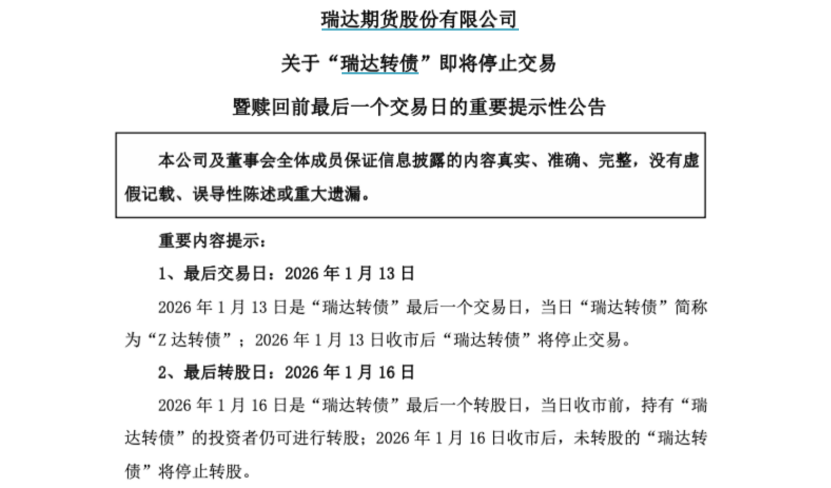
注意!多只可转债,将迎最后交易日
Zhong Guo Zheng Quan Bao· 2026-01-13 04:31
Core Viewpoint - The last trading day for Ruida Convertible Bonds is January 13, with significant price differences leading to potential losses for investors who do not act in time [1][2][4]. Group 1: Ruida Convertible Bonds - Ruida Convertible Bonds will stop trading after January 13, and the last conversion day is January 16, after which unconverted bonds will be redeemed at 101.12 yuan per bond [2][4]. - As of January 13, the market price of Ruida Convertible Bonds is 127.7 yuan, indicating a potential loss of 20.81% for investors who fail to convert or sell [1][4]. - The unconverted proportion of Ruida Convertible Bonds is 22.15%, with a remaining balance of 179 million yuan [4]. Group 2: Other Convertible Bonds - Other convertible bonds such as Jinzong, Zai22, Bo23, and HuGong are also facing forced redemption, with last trading days ranging from January 14 to January 16 and redemption prices varying [5]. - Investors holding these convertible bonds may face losses of 38.16%, 66.59%, 35.31%, and 32.02% respectively if they do not act promptly [5]. - The market for convertible bonds is experiencing a contraction, with predictions indicating a potential reduction in the market size to approximately 160 billion yuan by 2026 under neutral conditions [6].

银行业周度追踪2026年第1周:如何理解银行股开年调整?-20260112
Changjiang Securities· 2026-01-12 04:41
Investment Rating - The investment rating for the banking sector is "Positive" and is maintained [12]. Core Insights - In the first week of 2026, the banking sector continued to adjust, with a cumulative decline of 1.9% in the banking index, significantly underperforming the CSI 300 and ChiNext indices by -4.7% and -5.8% respectively. Despite this, the fundamental expectations for the sector remain unchanged, and the market's risk appetite has notably increased [2][6][19]. - The main banks are expected to maintain stable growth in performance throughout 2026. Following recent adjustments, the PB-ROE valuation attractiveness of bank stocks has further increased, suggesting a favorable timing for allocation [2][6][19]. Summary by Sections Market Performance - The banking sector's performance in the first week of 2026 showed a cumulative decline of 1.9%, with significant negative excess returns compared to the CSI 300 and ChiNext indices [6][19]. - Individual stocks such as Chongqing Rural Commercial Bank saw price recovery after management uncertainties were resolved, while stable performers like Hangzhou Bank led the city commercial bank sector [2][6][19]. Fundamental Analysis - The banking sector's performance has been influenced by structural concerns, particularly regarding real estate and retail asset quality. Despite these concerns, overall performance remains stable with steady growth [8][37]. - The LTV (Loan-to-Value) ratios for major banks are stable at 40%-50%, providing a safety margin despite rising asset quality pressures in mortgage loans [8][37]. Trading Dynamics - The increase in market risk appetite has continued to suppress bank stock valuations. Historically, January has seen excess returns for bank stocks, but this year, the rapid recovery in market sentiment has led to underperformance [9][38]. - The report recommends focusing on high-quality city commercial banks such as Hangzhou Bank, Nanjing Bank, and Jiangsu Bank, as well as dividend-oriented assets like Bank of Communications and China Merchants Bank [9][38]. Convertible Bonds - The prices of convertible bonds linked to bank stocks have generally followed the sector's adjustment, with the distance to mandatory conversion prices widening. The report highlights potential trading opportunities in convertible bonds for banks like Changshu Bank and Shanghai Bank, which have stable fundamental performance expectations [7][32].



转债月报 20260105:历史上转债强赎前后有哪些事实与变化?-20260105
Huachuang Securities· 2026-01-05 15:27
1. Report Industry Investment Rating No information about the industry investment rating is provided in the report. 2. Core Viewpoints of the Report - 2026 Q1 may see an increase in convertible bond calls, but high - parity convertible bond valuations are at historical highs. High valuations do not guarantee post - call valuation maintenance, and the pressure on convertible bond prices before and after the call is relatively large. It is recommended to take profit before the call or stop loss in a timely manner after the call based on market conditions [3][7]. - The overall trend of convertible bond valuations is likely to be high - level oscillations, with a possibility of short - term foaming. In January 2026, institutional demand for configuration will support valuations, and if the equity market performs better than expected, valuations may foam [28]. - In December 2025, the convertible bond market oscillated upward, with both convertible bonds and underlying stocks performing strongly, and valuations oscillated and increased. The trading volume of the convertible bond and equity markets decreased, but margin trading funds showed a strengthening trend [48][56]. - The issuance of new convertible bonds slightly increased in December 2025, and the number of new issuance plans continued to rise. The overall scale of holders in the Shanghai and Shenzhen Stock Exchanges decreased, with obvious reductions by insurance funds [3][62]. 3. Summary According to Relevant Catalogs 3.1 Historical Facts and Changes before and after Convertible Bond Calls - **Before the Call Announcement** - High market valuations do not guarantee post - call valuation maintenance. After the call, the valuation compresses to near 0%, and the compression process is basically completed before the call announcement [3][8]. - The strength of the underlying stock before the call can partially offset the compression of convertible bond valuations, but when valuations are high, the pressure on convertible bond prices before the call is still relatively large [3]. - The decline before the call mainly occurs within T - 10 days, and the day of the highest price is advancing [3][16]. - **After the Call Announcement** - In most months, convertible bond prices continue to decline after the call announcement, but in some months with a strong equity market, prices rebound [3][20]. - There is generally a decline of varying degrees on T - day, and the months with price rebounds mainly show strength from T + 1 to T + 15 days [3][21]. - The stronger the equity market, the more delayed the appearance of the highest price [3][25]. 3.2 Valuation Outlook - The overall trend is high - level oscillations, with a possibility of short - term foaming. In December 2025, valuations oscillated upward. As of December 31, 2025, the 100 - yuan par - value fitted conversion premium rate was 34.04%, up 2.50 pct from the end of November, reaching the highest level since 2019 [28]. 3.3 Key Focused Convertible Bonds - From December 1 to December 31, 2025, the convertible bond portfolio rose 3.84%, outperforming the benchmark index by 1.70 pct. Huayi and Xingqiu had obvious increases [41]. - The "Huachuang Convertible Bond" January key - focused portfolio is adjusted to include Xingqiu, Mingli, Yirui, Huachen, Huayi, Yifeng, Ziyin, Qingnong, Zhongyin, and Xingye [43]. 3.4 Market Review - **Market Performance** - In December 2025, the convertible bond market oscillated upward, with a strong performance in the second half of the month. Most sectors of the convertible bond market rose, and technology - related concepts declined. The science and technology and manufacturing sectors showed significant increases, and the cyclical sector also performed well [48][50]. - **Fund Performance** - The trading volume of the convertible bond and equity markets decreased slightly. From December 1 to December 31, 2025, the average daily trading volume of CSI Convertible Bonds was 63.803 billion yuan, a 1.27% decrease from November, and the average daily trading volume of Wind All - A was 1.880842 trillion yuan, a 1.76% decrease from November [56]. - Margin trading funds oscillated and strengthened. As of December 31, 2025, the balance of margin trading in the Shanghai and Shenzhen Stock Exchanges was approximately 2.53 trillion yuan, an increase of 66.664 billion yuan from the end of November. Most industries received net margin purchases [60]. 3.5 Supply and Demand Situation - **New Bond Issuance and Listing** - In December 2025, 7 convertible bonds were issued, with a total scale of 5.494 billion yuan, and 5 new convertible bonds were listed, with a total scale of 3.005 billion yuan. The online new - bond issuance subscription scale increased, with an average effective subscription amount of 8.85 trillion yuan, a 2.61% increase month - on - month [62]. - **Expected Issuance Scale and New Plans** - The total expected issuance scale is approximately 122.663 billion yuan. As of December 31, 2025, 7 listed companies obtained convertible bond issuance approvals, with a planned issuance scale of 8.583 billion yuan; 6 companies' convertible bond issuances passed the review committee, waiting for approvals, with a total scale of 3.361 billion yuan. In December, 6 new board plans were added, with a total scale of approximately 77.9 billion yuan [65]. - **Holder Scale Changes** - The overall scale of holders in the Shanghai and Shenzhen Stock Exchanges decreased. In December 2025, the total par value of convertible bonds held by the two exchanges was 552.692 billion yuan, a decrease of 6.144 billion yuan from November, a 1.10% decline. The scale of public funds increased, while the scale of enterprise annuities decreased [83][87].
又一批!最后交易日,请注意转股
Zheng Quan Shi Bao· 2025-12-08 23:07
Core Viewpoint - A significant number of convertible bonds are approaching their last trading day, with over 10 expected in December, leading to potential price suppression and risks related to forced redemption for investors [1][2][4]. Group 1: Convertible Bonds Overview - Multiple convertible bonds are set to reach their last trading day, including Hongfa Convertible Bond, Mingdian Convertible Bond 02, and Guocheng Convertible Bond on December 8, followed by others like Ying 19 Convertible Bond and Ceihui Convertible Bond on December 9 [2]. - As of December, the total number of convertible bonds entering their last trading day has increased significantly, with more than 10 expected [2]. - After the last trading day, there are several days available for conversion; unconverted bonds will be forcibly redeemed at a specified price [2][3]. Group 2: Redemption and Market Performance - Convertible bonds are categorized into two scenarios: early redemption due to conditional redemption clauses and maturity for repayment and delisting [3]. - Many convertible bonds have experienced price declines as they approach their last trading day, with some, like Guocheng Convertible Bond and Limin Convertible Bond, seeing cumulative declines exceeding 10% in December [4]. - The average price change for the convertible bonds entering their last trading day in December is -0.12%, with a median change of -0.65%, underperforming the overall market represented by the Zhongzheng Convertible Bond Index, which rose by 0.48% during the same period [4]. Group 3: Investor Considerations - Forced redemption remains a primary exit strategy for convertible bonds, relieving companies from interest and principal repayment pressures [4]. - Investors must be cautious as failure to convert or sell before the deadline can lead to significant losses, particularly for those who purchased bonds at a high premium [4][5]. - For instance, the current price of Guocheng Convertible Bond is 180.151 yuan per share, with a redemption price of 100.82 yuan per share, indicating a potential loss exceeding 40% for investors who do not convert before the deadline [5].
又一批!最后交易日!请注意,转股!
Zheng Quan Shi Bao· 2025-12-08 15:30
Core Viewpoint - A significant number of convertible bonds are approaching their last trading day, with over 10 bonds expected to reach this milestone in December, leading to potential price suppression and risks related to forced redemption for investors [1][2][4]. Group 1: Convertible Bonds Overview - Multiple convertible bonds are entering their last trading day, including Hongfa Convertible Bond, Mingdian Convertible Bond 02, and Guocheng Convertible Bond on December 8, followed by others like Ying 19 Convertible Bond and Ceihui Convertible Bond on December 9 [2]. - The increase in convertible bonds reaching their last trading day is notable, with over 10 bonds expected to be affected in December [2]. Group 2: Redemption and Trading Dynamics - Convertible bonds may experience price suppression as they approach their last trading day, with many showing declines; for instance, Guocheng Convertible Bond and Limin Convertible Bond have seen cumulative declines exceeding 10% in December [4]. - The average price change for the convertible bonds entering their last trading day in December is -0.12%, with a median change of -0.65%, underperforming the overall market represented by the Zhongzheng Convertible Bond Index, which rose by 0.48% during the same period [4]. Group 3: Forced Redemption Risks - Forced redemption remains a primary exit strategy for convertible bonds, allowing companies to alleviate the burden of interest and principal repayment by encouraging bondholders to convert their bonds into shares [4]. - Investors must be cautious, as failure to convert or sell their bonds before the designated deadline may result in forced redemption at a price significantly lower than the market value, leading to potential losses exceeding 40% for those who purchased at a high premium [5].