
邮储银行

Search documents
银行批量上调代销基金风险等级 投资者如何应对?
Guo Ji Jin Rong Bao· 2025-11-28 12:52
Core Viewpoint - Banks are increasingly adjusting the risk levels of mutual fund products they distribute, with several banks, including China Construction Bank and Minsheng Bank, making multiple adjustments this year to align with market conditions and regulatory requirements [1][3][4]. Group 1: Bank Adjustments - China Construction Bank has announced a batch increase in the risk levels of 87 mutual fund products, marking the fourth adjustment this year [1][3]. - Minsheng Bank has also made four similar adjustments since October, with the latest announcement on November 18 regarding eight lower-risk fund products being raised to medium risk [1][3]. - Postal Savings Bank has adjusted the risk levels of 86 mutual fund products in two recent announcements [1][4]. Group 2: Reasons for Adjustments - The adjustments are attributed to a combination of mutual fund product characteristics, market conditions, and regulatory guidance, which aim to reduce the risk mismatch between investors and products [1][4]. - Changes in investment strategies and asset allocations of certain funds have increased their net value volatility, prompting institutions to reassess the risk-return alignment [4]. - Regulatory frameworks, such as the Asset Management New Regulations, are reinforcing the core requirement of "risk matching," compelling institutions to establish dynamic risk rating mechanisms [4][5]. Group 3: Future Implications - The adjustments may become a regular practice as banks are required to dynamically assess product risks to fulfill their suitability obligations and protect investor interests [5]. - Short-term impacts may lead conservative investors to redeem their investments due to increased risk levels, while long-term benefits include enhanced risk transparency and reduced risk mismatch [5][6]. - This shift is expected to drive the wealth management industry towards a service-oriented model, encouraging fund companies to improve their research and investment capabilities [5][6].
银行批量上调代销基金风险等级,投资者如何应对?
Guo Ji Jin Rong Bao· 2025-11-28 12:49
Group 1 - The core viewpoint of the article highlights the increasing normalization of banks adjusting the risk levels of mutual fund products they distribute, with several banks, including China Construction Bank, Minsheng Bank, and Postal Savings Bank, making multiple adjustments this year [1][2][3] - China Construction Bank announced a batch increase in risk levels for 87 mutual fund products, marking its fourth adjustment this year, with 32 products raised from R2 (medium-low risk) to R3 (medium risk) and 55 from R3 to R4 (medium-high risk) [2][3] - Minsheng Bank and Postal Savings Bank have also made similar adjustments, with Minsheng Bank raising the risk levels of eight low-risk fund products to medium risk, and Postal Savings Bank adjusting 86 mutual fund products in two recent announcements [2][3] Group 2 - The adjustments are attributed to a combination of factors including the characteristics of mutual fund products, market conditions, and regulatory guidance, which aim to reduce the risk mismatch between investors and products [2][3] - Regulatory frameworks, such as the Asset Management New Regulations, emphasize the importance of risk matching, compelling institutions to establish dynamic risk rating mechanisms to prevent ratings from lagging behind actual product risks [3][4] - The changes are expected to become a routine practice, as banks need to dynamically assess product risks to fulfill their suitability obligations and protect investor interests [3][4] Group 3 - The impact of these changes on investors is twofold; short-term, conservative investors may choose to redeem their investments due to increased risk levels, while long-term, dynamic rating mechanisms can enhance risk transparency and reduce mismatches [4][5] - The industry may shift from a product-selling approach to a service-oriented model, prompting fund companies to improve their research and investment capabilities, thereby fostering a healthier market ecosystem [4]


多家银行上调代销公募基金风险等级
Zhong Guo Jing Ying Bao· 2025-11-28 10:51
Group 1 - Several banks, including China Construction Bank and Minsheng Bank, have announced adjustments to the risk ratings of certain mutual fund products, with a total of 87 products adjusted by China Construction Bank alone [1][2] - China Construction Bank has raised the risk ratings of 32 products from R2 (medium-low risk) to R3 (medium risk) and 55 products from R3 (medium risk) to R4 (medium-high risk) [1] - Minsheng Bank is adjusting the risk ratings of 8 mutual fund products, including 7 bond funds and 1 mixed fund, from lower risk to medium risk, effective November 19 [2] Group 2 - The adjustments are in line with regulatory requirements, specifically the "higher of" principle, which mandates that if the potential risk of a fund increases due to market conditions, a higher risk rating should be applied [2] - The banks are responding to dynamic market changes, particularly in the equity and bond markets, to protect investors by prompting them to reassess their risk tolerance in light of the new ratings [2] - Additionally, banks are offering fee reductions on mutual fund transactions, with some institutions providing discounts of up to 50% on front-end subscription fees, driven by competitive market conditions and regulatory reforms [3] Group 3 - The fee reductions are a direct result of the China Securities Regulatory Commission's reforms aimed at lowering the maximum subscription fee rates for various funds, which will take effect by September 2025 [3] - Despite the prevalence of low fees, sustainability is a concern as regulations prevent selling funds below cost, and banks must cover operational costs associated with fund distribution [3] - The industry is expected to shift from a price war to value competition, focusing on enhancing service quality, product selection, and asset allocation capabilities to create real value for investors [3]


银行行业资金流出榜:中国银行、邮储银行等净流出资金居前
Zheng Quan Shi Bao Wang· 2025-11-28 10:08
Market Overview - The Shanghai Composite Index rose by 0.34% on November 28, with 29 out of the 31 sectors experiencing gains, led by the steel and agriculture sectors, both up by 1.59% [1] - The banking sector was the biggest loser, declining by 0.83%, followed by coal, which fell by 0.14% [1] Capital Flow - The net inflow of capital in the two markets was 10.84 billion yuan, with 19 sectors seeing net inflows [1] - The electronics sector had the highest net inflow, amounting to 3.423 billion yuan, with a daily increase of 1.30% [1] - The non-ferrous metals sector also performed well, with a daily increase of 1.44% and a net inflow of 3.051 billion yuan [1] Banking Sector Analysis - The banking sector saw a net outflow of 1.287 billion yuan, with 42 stocks in the sector, of which only 4 rose while 36 fell [2] - Among the banks, China Merchants Bank had the highest net inflow of 206 million yuan, followed by Jiangyin Bank and Hangzhou Bank with net inflows of 20.155 million yuan and 15.338 million yuan, respectively [2] - Major banks with significant net outflows included Bank of China (net outflow of 264 million yuan), Postal Savings Bank (222 million yuan), and Agricultural Bank (160 million yuan) [2] Individual Bank Performance - The following banks experienced notable declines in stock price and net capital outflow: - Bank of China: -1.62% with a net outflow of 263.56 million yuan [3] - Postal Savings Bank: -1.90% with a net outflow of 222.33 million yuan [3] - Agricultural Bank: -0.74% with a net outflow of 160.14 million yuan [3] - Other banks with significant declines included China Construction Bank (-0.51%), Bank of Communications (-1.56%), and Industrial and Commercial Bank (-0.61%) [3]



从华与华“宣战”罗永浩,到首富“硬刚”金龙鱼……财经一周重要新闻速览
Feng Huang Wang Cai Jing· 2025-11-28 10:00
Group 1 - The public relations battle between Hua Yu Hua and Luo Yonghao has intensified, with Hua Yu Hua's founder making bold statements and refusing to apologize [3] - Zong Fuli has officially stepped down as the chairman and general manager of Wahaha, with Xu Simin taking over the roles while Zong retains a 29.40% stake in the company [2] - Evergrande's liquidators have achieved a significant victory by freezing $220 million in assets belonging to Xu Jiayin's ex-wife, which aids in recovering debts owed to creditors [4] Group 2 - The conflict between former Hubei billionaire Lan Shili and Golden Dragon Fish has escalated, stemming from a video that led to a defamation lawsuit, resulting in a court ruling against Lan [5] - The sudden announcement of a company-wide shutdown at Mohe Technology, a subsidiary of Great Wall Motors, has raised concerns about potential dissolution, with employees left uncertain about their future [6][7] - Vanke's bonds have experienced a significant drop, with some bonds falling over 20%, leading to speculation about the reasons behind this decline, including potential information leaks regarding bond extensions [9] Group 3 - Mandi International has submitted its IPO application, revealing a dominant market position in the hair loss treatment sector with a 57% market share, but faces concerns over high marketing costs and product controversies [10] - Qingyue Technology is under investigation for suspected financial fraud, facing the risk of forced delisting, which has led to a significant drop in its stock price [11] - Major state-owned banks have collectively stopped offering five-year large-denomination time deposits, indicating a trend of withdrawal from long-term deposit products in the banking sector [12]



上调!多家银行公告!
Zhong Guo Jing Ying Bao· 2025-11-28 10:00
Group 1 - Several banks, including China Construction Bank and Minsheng Bank, have announced adjustments to the risk ratings of certain mutual fund products, with a total of 87 products being affected by Construction Bank's recent changes [1][2] - Construction Bank adjusted 32 products from R2 (medium-low risk) to R3 (medium risk) and 55 products from R3 (medium risk) to R4 (medium-high risk), indicating a significant shift in risk assessment [1] - Minsheng Bank's adjustments include 7 bond funds and 1 mixed fund, all upgraded from lower risk to medium risk, emphasizing the need for investors to reassess their risk tolerance [2] Group 2 - The adjustments are in line with regulatory requirements, specifically the "higher principle," which mandates that financial institutions must adopt higher risk ratings when market conditions indicate increased potential risks [2] - The dynamic assessment of fund risks is crucial for protecting investors, especially in a volatile market environment, as it prompts investors to reconsider whether their investments align with their risk tolerance [2] - In addition to risk adjustments, banks are also reducing fund transaction fees, with some offering discounts of up to 50% on front-end subscription fees, driven by competitive market conditions and regulatory reforms [3] Group 3 - The reduction in fees is a response to intense market competition, particularly among smaller banks, aiming to attract more customers [3] - Regulatory changes set to take effect by September 2025 will lower the maximum subscription fees for various funds, further influencing fee structures in the industry [3] - Despite the prevalence of low fees, sustainability is a concern as banks must balance cost reductions with operational expenses and the need for profitability in their intermediary business [3]
邮储银行今日大宗交易平价成交40万股,成交额227.2万元
Xin Lang Cai Jing· 2025-11-28 09:37
Group 1 - Postal Savings Bank conducted a block trade of 400,000 shares on November 28, with a transaction value of 2.272 million yuan, accounting for 0.16% of the total trading volume for the day [1] - The transaction price was 5.68 yuan, which was in line with the market closing price of 5.68 yuan [1]

邮储银行(601658) - H股公告
2025-11-28 09:15
香港交易及結算所有限公司及香港聯合交易所有限公司對本公告的內容概不負責,對其準確性 或完整性亦不發表任何聲明,並明確表示,概不對因本公告全部或任何部份內容而產生或因倚 賴該等內容而引致的任何損失承擔任何責任。 POSTAL SAVINGS BANK OF CHINA CO., LTD. 1658 暫停辦理股份過戶登記 承董事會命 中國郵政儲蓄銀行股份有限公司 杜春野 聯席公司秘書 中國,北京 2025年11月28日 於本公告日期,本行董事會包括董事長及非執行董事鄭國雨先生;執行董事劉建軍先生及 姚紅女士;非執行董事劉新安先生、張宣波先生、劉瑞鋼先生、胡宇霆先生、丁向明先生 及余明雄先生;獨立非執行董事溫鐵軍先生、鍾瑞明先生、潘英麗女士、唐志宏先生、 洪小源先生及楊勇先生。 * 中國郵政儲蓄銀行股份有限公司並非一家根據銀行業條例(香港法例第155章)之認可 機構,並不受限於香港金融管理局的監督,亦不獲授權在香港經營銀行及╱或接受存 款業務。 中國郵政儲蓄銀行股份有限公司(「本行」)董事會(「董事會」)宣佈,本行擬於 2025年1 2月1 9日(星期五)舉行2025年第三次臨時股東大會(「臨時股東大 會」)。 為 ...
国有大型银行板块11月28日跌0.96%,邮储银行领跌,主力资金净流出8.49亿元
Zheng Xing Xing Ye Ri Bao· 2025-11-28 09:05
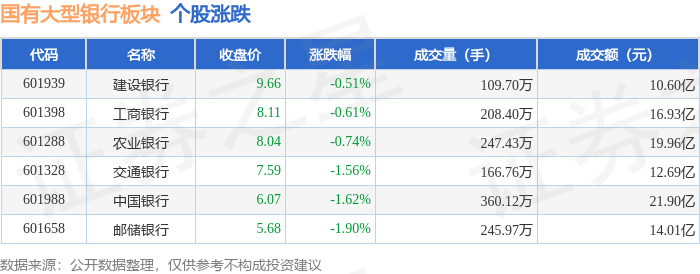
Core Insights - The state-owned large bank sector experienced a decline of 0.96% on November 28, with Postal Savings Bank leading the drop [1] - The Shanghai Composite Index closed at 3888.6, up 0.34%, while the Shenzhen Component Index closed at 12984.08, up 0.85% [1] Bank Performance Summary - Construction Bank: Closed at 9.66, down 0.51%, with a trading volume of 1.097 million shares [1] - Industrial and Commercial Bank: Closed at 8.11, down 0.61%, with a trading volume of 2.084 million shares [1] - Agricultural Bank: Closed at 8.04, down 0.74%, with a trading volume of 2.474 million shares [1] - Transportation Bank: Closed at 7.59, down 1.56%, with a trading volume of 1.668 million shares [1] - Bank of China: Closed at 6.07, down 1.62%, with a trading volume of 3.601 million shares [1] - Postal Savings Bank: Closed at 5.68, down 1.90%, with a trading volume of 2.460 million shares [1] Capital Flow Analysis - The state-owned large bank sector saw a net outflow of 849 million yuan from institutional investors, while retail investors contributed a net inflow of 153 million yuan [1] - The detailed capital flow for individual banks shows significant net outflows for major banks, with the Industrial and Commercial Bank experiencing a net outflow of 69.01 million yuan from institutional investors [2] - Postal Savings Bank had a net outflow of 165 million yuan from institutional investors, while retail investors contributed a net inflow of 41.32 million yuan [2]


邮储银行(01658) - 暂停办理股份过户登记
2025-11-28 08:36
香港交易及結算所有限公司及香港聯合交易所有限公司對本公告的內容概不負責,對其準確性 或完整性亦不發表任何聲明,並明確表示,概不對因本公告全部或任何部份內容而產生或因倚 賴該等內容而引致的任何損失承擔任何責任。 POSTAL SAVINGS BANK OF CHINA CO., LTD. 中國郵政儲蓄銀行股份有限公司 杜春野 聯席公司秘書 中國,北京 2025年11月28日 暫停辦理股份過戶登記 中國郵政儲蓄銀行股份有限公司(「本行」)董事會(「董事會」)宣佈,本行擬於 2025年1 2月1 9日(星期五)舉行2025年第三次臨時股東大會(「臨時股東大 會」)。 為確定有權出席臨時股東大會的H股股東名單,本行將於2025年12月16日(星 期二)至2025年12月19日(星期五)(首尾兩天包括在內)期間暫停辦理H股股份 過戶登記手續。H股股東如欲出席臨時股東大會,須於2025年12月15日(星期 一)下午4時30分前,將股票連同股份過戶文件一併送交本行H股股份過戶登記 處香港中央證券登記有限公司,地址為香港灣仔皇后大道東183號合和中心17 樓1712-1716號舖。 本行將適時發佈載有將於臨時股東大會上提呈的 ...