基金风险等级调整

Search documents
中庚基金管理有限公司关于调整旗下基金风险等级的公告
Xin Lang Cai Jing· 2026-01-06 18:32
Group 1 - The company will adjust the risk levels of its funds starting from January 14, 2026, in accordance with relevant regulations and internal guidelines [1] - Investors are advised to pay attention to the changes in fund risk levels and their potential impact on investment decisions [1] - The company emphasizes that different sales institutions may have varying methods for evaluating fund risk levels, leading to different risk ratings for the same fund [1] Group 2 - The company will lower the minimum initial subscription amount for its open-end funds from RMB 10 to RMB 1 starting January 7, 2026 [3] - The minimum redemption amount and minimum holding amount will be adjusted to 0.1 shares, meaning that each redemption request must not be less than 0.1 shares [4] - The adjustments will also apply to fund conversions, where the minimum transfer out amount will be 0.1 shares, while transfers in will not be subject to the minimum subscription amount [4]
国投瑞银基金管理有限公司关于调整旗下部分公募基金风险等级的公告
Xin Lang Cai Jing· 2025-12-23 19:08
Group 1 - The company, Guotou Ruijin Fund Management Co., Ltd., will adjust the risk levels of certain public funds starting from January 1, 2026, based on the suitability risk assessment results from Galaxy Securities [1] - The risk level changes are important for investors to consider as they may impact investment decisions [1] - Different sales institutions may have varying assessment methods for the same fund, leading to different risk level evaluations [1] Group 2 - Investors are advised to carefully read legal documents such as fund contracts and prospectuses before making investment decisions [2] - The fund management company emphasizes the principle of "buyer bears the risk," indicating that investors are responsible for the risks associated with fund performance and net value changes [2] - The company provides contact information for investors to inquire about related matters [2]
诺德基金管理有限公司关于调整旗下部分基金风险等级的公告
Xin Lang Cai Jing· 2025-12-22 19:21
Group 1 - The company will adjust the risk levels of certain funds starting from January 1, 2026, in accordance with relevant laws and regulations [1] - The adjustments are based on the latest changes in the suitability rating by the Galaxy Securities Fund Research Center [1] - Different sales institutions may evaluate the risk levels of funds differently, but they cannot assign a risk level lower than that determined by the fund manager [1] Group 2 - The fund manager commits to managing and utilizing fund assets with honesty and diligence, but does not guarantee profits or minimum returns [2] - Investors are advised to read legal documents such as the fund contract and prospectus to fully understand the risk-return characteristics of the fund products [2] - Investors should make independent decisions based on their risk tolerance, investment horizon, and investment goals [2]
银行批量上调代销基金风险等级 投资者如何应对?
Guo Ji Jin Rong Bao· 2025-11-28 12:52
Core Viewpoint - Banks are increasingly adjusting the risk levels of mutual fund products they distribute, with several banks, including China Construction Bank and Minsheng Bank, making multiple adjustments this year to align with market conditions and regulatory requirements [1][3][4]. Group 1: Bank Adjustments - China Construction Bank has announced a batch increase in the risk levels of 87 mutual fund products, marking the fourth adjustment this year [1][3]. - Minsheng Bank has also made four similar adjustments since October, with the latest announcement on November 18 regarding eight lower-risk fund products being raised to medium risk [1][3]. - Postal Savings Bank has adjusted the risk levels of 86 mutual fund products in two recent announcements [1][4]. Group 2: Reasons for Adjustments - The adjustments are attributed to a combination of mutual fund product characteristics, market conditions, and regulatory guidance, which aim to reduce the risk mismatch between investors and products [1][4]. - Changes in investment strategies and asset allocations of certain funds have increased their net value volatility, prompting institutions to reassess the risk-return alignment [4]. - Regulatory frameworks, such as the Asset Management New Regulations, are reinforcing the core requirement of "risk matching," compelling institutions to establish dynamic risk rating mechanisms [4][5]. Group 3: Future Implications - The adjustments may become a regular practice as banks are required to dynamically assess product risks to fulfill their suitability obligations and protect investor interests [5]. - Short-term impacts may lead conservative investors to redeem their investments due to increased risk levels, while long-term benefits include enhanced risk transparency and reduced risk mismatch [5][6]. - This shift is expected to drive the wealth management industry towards a service-oriented model, encouraging fund companies to improve their research and investment capabilities [5][6].

银行批量上调代销基金风险等级,投资者如何应对?
Guo Ji Jin Rong Bao· 2025-11-28 12:49
Group 1 - The core viewpoint of the article highlights the increasing normalization of banks adjusting the risk levels of mutual fund products they distribute, with several banks, including China Construction Bank, Minsheng Bank, and Postal Savings Bank, making multiple adjustments this year [1][2][3] - China Construction Bank announced a batch increase in risk levels for 87 mutual fund products, marking its fourth adjustment this year, with 32 products raised from R2 (medium-low risk) to R3 (medium risk) and 55 from R3 to R4 (medium-high risk) [2][3] - Minsheng Bank and Postal Savings Bank have also made similar adjustments, with Minsheng Bank raising the risk levels of eight low-risk fund products to medium risk, and Postal Savings Bank adjusting 86 mutual fund products in two recent announcements [2][3] Group 2 - The adjustments are attributed to a combination of factors including the characteristics of mutual fund products, market conditions, and regulatory guidance, which aim to reduce the risk mismatch between investors and products [2][3] - Regulatory frameworks, such as the Asset Management New Regulations, emphasize the importance of risk matching, compelling institutions to establish dynamic risk rating mechanisms to prevent ratings from lagging behind actual product risks [3][4] - The changes are expected to become a routine practice, as banks need to dynamically assess product risks to fulfill their suitability obligations and protect investor interests [3][4] Group 3 - The impact of these changes on investors is twofold; short-term, conservative investors may choose to redeem their investments due to increased risk levels, while long-term, dynamic rating mechanisms can enhance risk transparency and reduce mismatches [4][5] - The industry may shift from a product-selling approach to a service-oriented model, prompting fund companies to improve their research and investment capabilities, thereby fostering a healthier market ecosystem [4]



【财富周刊】保险资管规模33.3万亿元,跨境ETF密集发布溢价提示
Sou Hu Cai Jing· 2025-11-23 10:33
Group 1 - The total scale of insurance asset management in China reached 33.3 trillion yuan in 2024, with a year-on-year growth of 10.6% [2] - The total investment assets managed by insurance asset management companies amounted to 32.68 trillion yuan, reflecting a significant year-on-year increase of 25% [2] - Among the major asset categories, stocks showed the highest growth rate at 36%, followed by financial products at 31% and bonds at 28% [2] Group 2 - The total scale of ETFs in China increased by nearly 2 trillion yuan since the beginning of the year, reaching 5.69 trillion yuan as of November 21 [3] - Stock ETFs experienced the highest growth in scale, with several broad-based ETFs increasing by over 50 billion yuan [3] Group 3 - Several cross-border ETFs have recently shown varying degrees of premium in the secondary market, with notable products including the E Fund MSCI US 50 ETF and the Southern S&P 500 ETF [4] - The exchanges have issued premium alerts for multiple cross-border ETFs, indicating increased investor interest [4] Group 4 - The Shanghai Stock Exchange has revised its self-regulatory rules for index funds, streamlining the process and eliminating preliminary steps while maintaining core admission standards [5] - The new guidelines reflect improvements over previous versions, particularly in the submission logic for materials prior to index fund listings [5] Group 5 - A total of 48 growth-oriented funds have distributed over 3.56 billion yuan in dividends this year, with 25 of these funds implementing dividends for the first time in three years [6] - The dividends from growth-style funds primarily stem from capital gains through stock sales rather than income from high-dividend stocks [6] Group 6 - Several public fund companies have announced adjustments to the risk levels of their products, with most funds experiencing an increase in risk ratings [7] - Notable fund companies making these adjustments include Shenwan Hongyuan Fund, Great Wall Fund, and Huatai-PineBridge Fund [7]


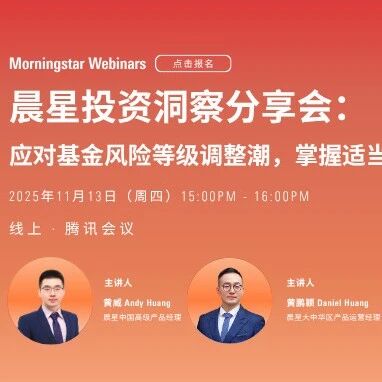
活动邀请 | 晨星投资洞察分享会:应对基金风险等级调整潮,掌握适当性管理实战指南
Morningstar晨星· 2025-11-06 01:04
Core Insights - The article discusses the recent wave of "risk level adjustments" in the domestic fund market, where numerous fund companies have raised the risk levels of hundreds of funds, posing challenges for institutional investors in terms of suitability management [1][3]. Group 1: Fund Risk Level Adjustments - A significant number of fund companies have adjusted the risk levels of their funds, primarily increasing them, which presents a direct challenge for institutional investors regarding how to interpret these adjustments and communicate risk information effectively [1]. - Morningstar has introduced a "suitability" solution to assist institutional clients in the full process of fund risk assessment and investor matching, enhancing compliance and service quality [1]. Group 2: Event Details - The upcoming online event will focus on the challenges posed by the recent fund risk level adjustments and will delve into the underlying logic of Morningstar's fund risk assessment [3]. - The event aims to provide practical strategies for addressing common issues in investor communication and suitability matching [6][7]. Group 3: Expert Insights - The event will feature insights from experts on the motivations and trends behind the recent concentrated adjustments in fund risk levels [6]. - Participants will learn about third-party risk assessment frameworks to improve product selection and suitability management capabilities [6].

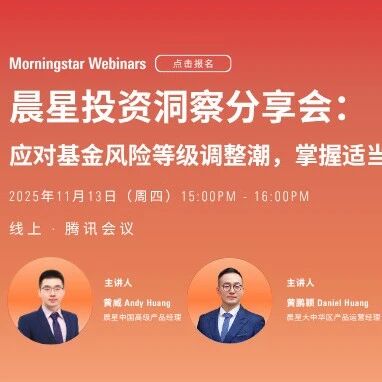
活动邀请 | 晨星投资洞察分享会:应对基金风险等级调整潮,掌握适当性管理实战指南
Morningstar晨星· 2025-10-30 01:04
Core Insights - The article discusses the recent wave of "risk level adjustments" in the domestic fund market, where numerous fund companies have raised the risk levels of hundreds of funds, posing challenges for institutional investors in terms of suitability management [1][3]. Group 1: Fund Risk Level Adjustments - A significant number of fund companies have adjusted the risk levels of their funds, primarily increasing them, which presents a direct challenge for institutional investors regarding how to interpret these adjustments and communicate risk information effectively [1]. - Morningstar has introduced a "suitability" solution to assist institutional clients in the full process of fund risk assessment and investor matching, enhancing compliance and service quality [1]. Group 2: Event Details - The upcoming online event will focus on the challenges posed by the recent fund risk level adjustments and will delve into the underlying logic of Morningstar's fund risk assessment [3]. - The event aims to provide practical strategies for addressing common issues in investor communication and suitability matching [6][7]. Group 3: Expert Insights - The event will feature insights from experts on the motivations and trends behind the recent concentrated adjustments in fund risk levels [6]. - Participants will learn about third-party risk assessment frameworks to improve product selection and suitability management capabilities [6].
长城基金管理有限公司关于旗下部分公募基金产品风险等级变动的公告
Shang Hai Zheng Quan Bao· 2025-10-26 18:30
Core Points - Changcheng Fund Management Co., Ltd. has engaged China Galaxy Securities Co., Ltd. to evaluate the risk levels of its public fund products, with changes effective from October 31, 2025 [1] - The company will raise the risk levels of certain public funds, and investors are encouraged to pay attention to these changes and their potential impact on investment decisions [1] - Different sales institutions may have varying methods for evaluating fund risk levels, leading to discrepancies in risk ratings across institutions [1] Summary by Category - **Risk Level Adjustment** - Changcheng Fund will increase the risk levels of some public funds starting October 31, 2025 [1] - Investors are advised to monitor changes in risk ratings and consider their own risk tolerance when making investment decisions [2] - **Investor Guidance** - Investors should be aware that the risk level of purchased funds may change due to market conditions or operational factors, potentially exceeding their risk tolerance [2] - The company emphasizes the importance of understanding the risk-return characteristics of funds before investing [2]

【财富周刊】多家银行上调积存金门槛,9月以来数百只公募基金调整风险等级
Sou Hu Cai Jing· 2025-10-26 11:53
Group 1: Gold Accumulation Business - Several banks have raised the minimum investment threshold for gold accumulation business to between 950 to 1200 yuan, an increase of 300 to 550 yuan compared to the beginning of the year [1] Group 2: Deposit Rate Adjustments - Multiple small and medium-sized banks have lowered deposit rates, leading to a phenomenon where long-term deposit rates are lower than short-term rates, with some banks showing that "three-year deposits yield less than one-year deposits" [2] - On October 20, Pingyang Pudong Development Bank announced adjustments to various deposit rates effective from October 21 [2] - Fujian Huatuo Bank and Shanghai Huarui Bank also announced reductions in their deposit rates, with the three-year fixed deposit rate dropping from 2.3% to 2.15% [2] Group 3: Capital Increase by Cambrian - Cambrian announced the completion of a capital increase, with 3,334,946 new shares registered on October 16 [4] - The largest allocation went to GF Fund, which received 1,010,900 shares, amounting to 1.208 billion yuan [4] - Other institutions, including Huatai-PineBridge Fund and Bosera Fund, received allocations ranging from 100,400 to 364,000 shares [4] Group 4: Investment Activity in Pharmaceutical Sector - Guo Lan's fund management has increased its stake in Yaokang Biotechnology, becoming the ninth largest shareholder with 5,162,200 shares as of the end of Q3 [5] - The fund managed by Guo Lan and Zhao Lei also appears among the top ten shareholders, holding 12,860,600 shares, an increase of 4,877,600 shares compared to the previous quarter [5] Group 5: Fund Risk Level Adjustments - Since September, nearly 20 fund companies have issued over 20 announcements regarding risk level adjustments for public funds, significantly higher than the previous monthly average [6][7] Group 6: Cross-Border ETF Premium Risks - Several fund companies, including Huaxia Fund and Hua'an Fund, have issued urgent risk warnings regarding high premium rates for cross-border ETFs, indicating potential significant losses for investors [8]