
众安在线

Search documents
67家财险公司车均保费均值超2000元 新能源车险成决定价格 走势关键变量
Jin Rong Shi Bao· 2025-11-19 03:23
Core Insights - The average car insurance premium among 67 companies for the first three quarters is 2079 yuan, with a median of 1836.89 yuan, indicating significant structural differentiation in pricing strategies across different types of insurers [2][4] - The highest car insurance premium reported is 5700 yuan by Modern Insurance, while the lowest is 850 yuan by Dubang Insurance, reflecting a competitive market with a concentration of premiums between 1000 yuan and 3000 yuan, which accounts for 74.7% of the total [1][2] - The future of car insurance pricing is expected to be influenced significantly by the growth of the new energy vehicle (NEV) insurance market, driven by policy optimization, reduced repair costs, and advancements in risk control technology [1][4] Industry Overview - The car insurance market shows a notable structural balance under competitive conditions, with 28 companies reporting premiums above the industry average [2] - 25 companies experienced a year-on-year increase in car insurance premiums, while 36 companies saw a decline, indicating varied performance across the sector [2] - The NEV insurance market is becoming a core driver for premium growth, with the number of NEVs in China reaching 36.89 million by mid-2025, accounting for 10.27% of the total vehicle population [4][6] New Energy Vehicle Insurance - NEV insurance premiums are currently high due to the elevated costs of core components and repair expenses compared to traditional fuel vehicles, leading to increased claims rates [4][6] - The insurance industry is facing challenges with underwriting losses in NEV insurance, with a reported loss of 5.7 billion yuan in 2024, necessitating higher premiums to balance costs [4][6] - Recent regulatory changes aim to enhance the quality and efficiency of NEV insurance, promoting collaboration between car manufacturers and insurers to improve risk pricing [5][6]



百保君高额返利暴雷,涉案或超亿元,实控人被警方调查
Guan Cha Zhe Wang· 2025-11-18 10:06
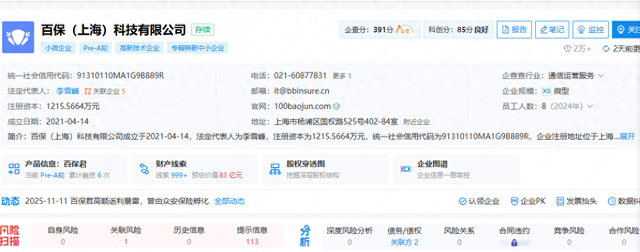
Core Viewpoint - The health service platform Baibaojun, incubated by ZhongAn Technology, has suddenly faced a payment crisis, with numerous users reporting that the promised returns in JD gift cards for purchased rights products from July to September could not be fulfilled [1][6] Company Overview - Baibaojun was established in October 2020 by ZhongAn Technology, initially positioned as a health service vertical search engine [1][6] - The company’s legal representative and actual controller is Li Xuefeng, who previously served as the CTO of ZhongAn Technology [1][6] Business Model - Baibaojun's business model involved purchasing low-cost rights, offering excessive returns in JD gift cards, and providing high reward points, which attracted a large number of investors [1][5] - Users could purchase rights products at prices such as 89 yuan, with a return of 100 yuan in JD gift cards, alongside a points system that incentivized referrals [5][6] Financial Implications - The total amount involved in the Baibaojun crisis may exceed 100 million yuan, although the exact scale has not been officially confirmed [1][6] - A user reported a return of approximately 16% on an investment of 18,000 yuan within two months, indicating an annualized return rate close to 100%, which is unsustainable in a normal business environment [5][6] Regulatory Concerns - The incident highlights significant risks associated with high-reward models in the internet finance sector, resembling characteristics of a Ponzi scheme [1][5] - The lack of timely intervention by ZhongAn Technology raises questions about shareholder responsibility and potential legal implications [6][8] Market Context - The Baibaojun incident is part of a broader trend of risk events in the internet finance sector, where innovative financial products often mask illegal fundraising activities [9] - The case underscores the need for regulatory frameworks to address the gaps that allow such high-risk activities to flourish under the guise of financial innovation [9]

25Q3险资提升核心权益资产配置:保险行业周报(20251110-20251114)-20251118
Huachuang Securities· 2025-11-18 04:03
Investment Rating - The industry investment rating is "Recommended," indicating an expected increase in the industry index exceeding the benchmark index by more than 5% in the next 3-6 months [22]. Core Insights - The insurance index rose by 2.62%, outperforming the market by 3.71 percentage points, with significant individual stock performance variations [1]. - As of Q3 2025, the total balance of insurance funds reached 37.5 trillion, with life insurance companies holding 33.73 trillion and property insurance companies holding 2.39 trillion [2]. - The solvency adequacy ratio for insurance companies was reported at 186.3% for comprehensive and 134.3% for core solvency, with property insurance companies showing a strong solvency position [2]. - The report highlights a shift in asset allocation, with a decrease in bond allocation and an increase in equity and fund holdings, suggesting a more aggressive investment strategy in the current market environment [5]. Summary by Sections Market Performance - The insurance sector showed a positive performance with a 2.62% increase in the index, outperforming the broader market [1]. - Individual stock performances varied, with notable increases in stocks like Taiping (+10.96%) and PICC (+3.16%) [1]. Fund Allocation - As of Q3 2025, the allocation of insurance funds was as follows: bonds 50.3%, stocks 10%, and funds 5.5%, with a slight increase in stock and fund allocations [4]. - Life insurance companies had a bond allocation of 51% and a stock allocation of 10.1%, while property insurance companies had a bond allocation of 40.6% and a stock allocation of 8.7% [4]. Company Performance - New China Life reported a cumulative premium income of 181.973 billion, a 17% year-on-year increase [2]. - China Pacific Life's cumulative premium income was 241.322 billion, reflecting a 9.9% increase, while its property insurance segment saw a modest 0.4% growth [2][3]. - ZhongAn Online reported a cumulative premium income of 29.822 billion [3]. Investment Recommendations - The report suggests a strong beta attribute for the sector in the short term, with a focus on asset performance as a key driver [5]. - Long-term recommendations include companies like China Pacific, China Life, and New China Life based on fundamental performance and valuation [10].



89元买100元京东E卡还白送保险?百保君兑付危机发酵
Zheng Quan Shi Bao Wang· 2025-11-18 01:23
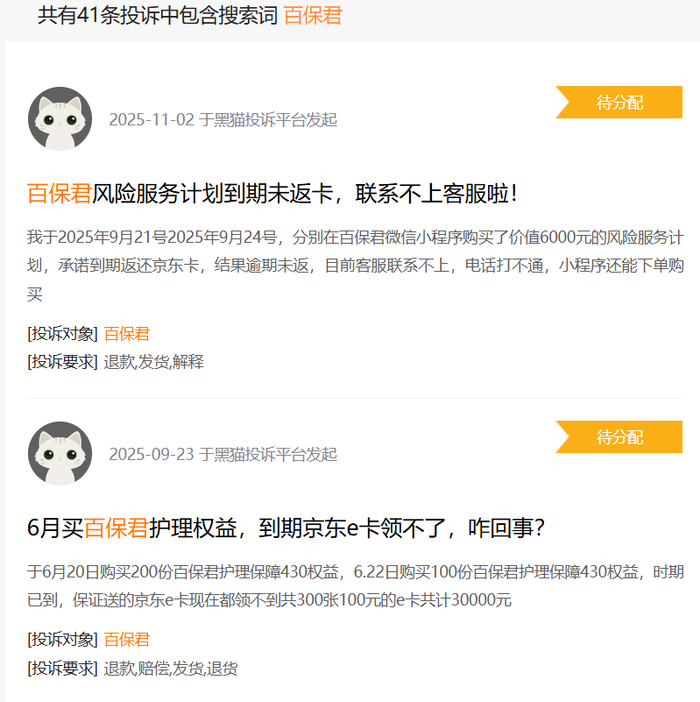
Core Insights - The health service platform "Baibaokun" is facing a redemption crisis, with numerous users reporting that promised JD E-cards and points are not being honored, and the company's Shanghai office is vacant [1] - The business model of Baibaokun is fundamentally based on "purchasing insurance rights + high returns in JD cards + redeemable points," with annualized returns significantly exceeding reasonable limits [1] Group 1: Business Model and Operations - Baibaokun offers products such as "Flexible Employment Travel Accident Insurance Rights," priced at 89 yuan, which includes a maximum compensation of 100 yuan and a JD E-card worth 100 yuan after 60-65 days [1] - The model allows consumers to purchase a 100 yuan JD E-card for 89 yuan, effectively yielding an 11% profit per card, along with a free insurance product valued at 100 yuan, resulting in a total return of 111% [1] - The platform also features a "Pet Treatment Subsidy Rights" product priced at 1840 yuan, which offers a 2000 yuan JD card, with the card issued 45-47 days post-purchase [1] Group 2: Legal and Regulatory Concerns - Legal experts suggest that Baibaokun's operations may fall outside the normal insurance value-added services, potentially constituting illegal fundraising or investment fraud [1] - Since September, discussions regarding Baibaokun's redemption crisis have proliferated on social media, with users claiming that previously purchased rights have not resulted in the promised JD E-cards [1] - As of November 17, there were 41 complaints filed against Baibaokun on the Black Cat Complaint platform, primarily concerning the non-issuance of JD E-cards and delays in the WeChat mini-program [1] Group 3: Company Background - Baibaokun is operated by Baibao (Shanghai) Technology Co., Ltd., with its only clear institutional background being Zhong An Information Technology Service Co., Ltd., a wholly-owned subsidiary of Zhong An Insurance [2] - Zhong An Insurance has stated that its subsidiary Zhong An Technology has transferred all shares of Baibao Technology, indicating that they are also victims in this situation and are monitoring the investigation [2]
知名平台人去楼空,涉案金额或超亿元,CEO被带走
2 1 Shi Ji Jing Ji Bao Dao· 2025-11-18 01:01
Core Viewpoint - The article highlights the issues faced by the Baibaokun platform, particularly regarding its failure to fulfill promised rebates and refunds, leading to multiple consumer complaints and potential legal troubles for the company [1][2][11]. Group 1: Consumer Complaints - A consumer reported on a complaint platform that they purchased 20 home care rights from Baibaokun for a total of 8,600 yuan, expecting to receive 100 JD gift cards worth 100 yuan each by September 18, 2025, but the company failed to deliver by the promised date [1][11]. - As of November 18, 2025, over 40 complaints related to Baibaokun have been recorded, with amounts ranging from thousands to tens of thousands of yuan [2]. Group 2: Company Operations and Legal Issues - Baibaokun's parent company, Baibao (Shanghai) Technology Co., Ltd., has reportedly moved from its registered office and its contact number is no longer in service. The CEO, Li Xuefeng, has been taken into police custody for investigation, with the involved amount potentially exceeding 100 million yuan [6]. - The company's business model, which initially aimed to connect consumers with health products and services, has shifted towards a rebate-driven model that has led to its current operational failures [17][21]. Group 3: Business Model and Marketing Strategy - Baibaokun's reliance on a "subsidy for traffic" customer acquisition strategy has been identified as a key factor in its operational issues, moving away from its original insurance sales commission model [17][21]. - The platform's promotional strategy included offering consumers the chance to purchase rights products with the promise of receiving equal or greater value in gift cards, creating a "no-risk" perception [11][20]. Group 4: Company Background and Funding - Baibaokun was established in October 2020, backed by a team with dual expertise in insurance and technology, and has undergone several rounds of funding, including angel rounds and a Pre-A round [23][28]. - The company was initially positioned as a data-driven algorithmic insurance platform, aiming to leverage technology to meet health needs, but has faced challenges in aligning its operational practices with its stated goals [23][28].
89元买100元京东E卡还白送保险? 百保君兑付危机发酵
Shen Zhen Shang Bao· 2025-11-17 23:33
Core Insights - The health service platform "Baibaokun" is facing a redemption crisis, with numerous users reporting that promised JD E-cards and points cannot be redeemed, and the company's Shanghai office is vacant [1] - The business model of Baibaokun is fundamentally based on "purchasing insurance rights + high returns in JD cards + redeemable points," with annualized returns significantly exceeding reasonable limits [1] - Legal experts suggest that the operations of Baibaokun may constitute illegal fundraising or fraud, as the offerings have deviated from normal insurance value-added services [1] Company Overview - Baibaokun is operated by Baibao (Shanghai) Technology Co., Ltd., with its only clear institutional background being Zhong'an Information Technology Service Co., Ltd. (Zhong'an Technology), a wholly-owned subsidiary of Zhong'an Insurance [2] - Zhong'an Insurance has stated that its subsidiary Zhong'an Technology has transferred all shares of Baibaokun's operating entity, Baibao Technology, and claims to be a victim in the ongoing investigation [2] User Complaints - Since September, discussions regarding the "Baibaokun redemption crisis" have proliferated on social media, with many users claiming that previously purchased rights have not resulted in the promised JD E-card returns [1] - As of November 17, there were 41 complaints about Baibaokun on the Black Cat Complaint platform, primarily concerning the failure to return JD E-cards upon expiration and delays in issuing JD E-cards through the Baibaokun WeChat mini-program [1]
算法理想折戟兑付承诺 百保君高额返利成泡影
2 1 Shi Ji Jing Ji Bao Dao· 2025-11-17 13:24
Core Insights - The article highlights the issues faced by the Baibaokun platform, particularly regarding delayed payouts and unfulfilled promises to consumers [1][2][3] Group 1: Consumer Complaints - Multiple consumers have reported that Baibaokun failed to deliver promised rewards and refunds, leading to numerous complaints on social media and complaint platforms [2][3] - As of November 17, 2025, complaints related to Baibaokun have reached dozens, with amounts ranging from thousands to tens of thousands of yuan [2] - The platform's promise of returning value through rewards has not been met, causing dissatisfaction among users [3][9] Group 2: Business Model and Operations - Baibaokun's business model relies heavily on a "rebate" system, where consumers purchase rights to receive higher-value rewards, creating a "no-loss" scenario [3][4] - The platform's operational strategy involves user acquisition through subsidies, which has led to a shift from its original insurance sales model to a reliance on "rights products + rebates" [7][9] - The company has faced legal scrutiny, with investigations initiated by law enforcement due to the scale of complaints and potential financial misconduct [2][6] Group 3: Company Background and Development - Baibaokun was established in October 2020, incubated by ZhongAn Technology, with a focus on data-driven algorithmic insurance [10][12] - The company has undergone several rounds of financing, raising millions in angel and pre-A rounds, indicating initial investor confidence [13][14] - Despite its technological aspirations, the recent payout failures reveal significant operational flaws and a deviation from its intended business model [12][14]
知名平台爆雷了,人去屋空
Zhong Guo Jing Ying Bao· 2025-11-17 01:00
Core Viewpoint - The "Bai Bao Jun redemption crisis" has gained significant attention on social media, with users expressing concerns about the inability to redeem previously purchased benefits for JD.com gift cards [1] Company Overview - Bai Bao Jun is a platform under Bai Bao (Shanghai) Technology Co., Ltd., functioning as a health service search engine that primarily sells rights products and offers JD.com gift cards as returns [3][4] Recent Developments - The company has faced operational issues, with reports indicating that its office was vacated by September, leading to speculation about potential fraud or the company running away [5][6][7] - Users have reported difficulties in redeeming their gift cards, with some claiming they have not received the full amount promised [5][10] Business Model - Bai Bao Jun's business model involves selling rights products with high return promises, such as offering JD.com gift cards in exchange for purchasing insurance products [8][9] - For example, a user could pay 2,690 yuan for a six-period insurance plan, receiving 500 yuan in JD.com gift cards for each period, effectively making the insurance free while providing additional value [8] User Engagement and Incentives - The platform also promotes user engagement through a points system, where users can earn points by purchasing products or referring friends, which can be redeemed for other benefits [11] - Many users have accumulated significant amounts of JD.com gift cards, raising concerns about the sustainability of the business model [10] Legal and Regulatory Concerns - Legal experts have raised alarms about the platform's operations, suggesting that the model resembles illegal fundraising or Ponzi schemes due to its reliance on user deposits and promises of high returns [12] - The involvement of Zhong An Insurance, which previously held a stake in Bai Bao Jun, has come under scrutiny, with claims that the company has distanced itself from the platform following the crisis [13][14]

知名平台爆雷了!人去屋空
Zhong Guo Jing Ying Bao· 2025-11-16 23:53
Core Viewpoint - The "Baibaokun redemption crisis" has gained significant attention on social media, with users expressing concerns about the inability to redeem their purchased benefits for JD.com gift cards [1][4]. Company Overview - Baibaokun is a health service search engine under Baibao (Shanghai) Technology Co., Ltd., primarily focused on advertising and customer acquisition [1]. - The company has been operational for five years but has recently encountered serious issues [2]. Operational Issues - The original office location was vacated by September, indicating potential operational shutdown [3][5]. - Users in various online groups are reporting difficulties in redeeming their gift cards, with some claiming they have not received the full amount promised [4]. Business Model - Baibaokun's business model involves selling benefit products with high return rates in the form of JD.com gift cards, which has attracted users seeking financial incentives [7][8]. - For example, a product priced at 2,690 yuan offers a return of 500 yuan in gift cards for each of the six installments, effectively providing a free insurance policy along with additional value [7]. User Engagement and Incentives - The platform also offers a points system where users can earn points through purchases and referrals, further incentivizing engagement [10][11]. - Many users have accumulated significant numbers of gift cards, leading to concerns about the platform's ability to fulfill these promises [8]. Legal and Regulatory Concerns - Legal experts suggest that Baibaokun's operations may constitute illegal fundraising or investment fraud due to the characteristics of its business model, which resembles a Ponzi scheme [12]. - The platform's promise of high returns and the structure of its financial operations raise red flags regarding compliance with financial regulations [12]. Corporate Response - Zhong An Insurance, which initially backed Baibaokun, has reportedly transferred all shares of the operating company and claims to be a victim in this situation [14][15]. - The legal implications of this transfer and the responsibilities of Zhong An Insurance in relation to Baibaokun's operations are still under scrutiny [15].
百保君“权益产品+返卡+积分兑换”模式现兑付危机
Mei Ri Jing Ji Xin Wen· 2025-11-16 13:43
Core Viewpoint - Baibaokun, a health service (insurance) vertical search engine, is facing a public relations crisis due to its failure to deliver promised rewards, leading to speculation about the company's potential exit from the market [1][3][4] Business Model - Baibaokun operates on a model that combines "rights products + JD.com card rewards + points redemption," which has contributed to its current predicament [2][5] - The platform's promotional strategy involved selling insurance-like products with high promised returns in the form of JD.com gift cards, creating a perception of free insurance [5][6] User Complaints - Users have reported that they are no longer receiving the promised JD.com cards after purchasing rights products, leading to widespread dissatisfaction and speculation about the company's stability [3][4][6] - A significant number of users in various online groups are expressing concerns about their inability to redeem the promised rewards, with some suggesting that the platform may have ceased operations [3][6] Company Operations - Investigations revealed that Baibaokun's office had vacated its premises in September, and attempts to contact the company were unsuccessful due to a disconnected phone line [4][6] - The company has not provided updates on its operations since mid-2023, raising further concerns about its viability [10] Legal Implications - Legal experts have indicated that Baibaokun's business model may constitute illegal fundraising or investment fraud due to its characteristics of a Ponzi scheme and the promise of high returns without a legitimate revenue source [8][11] - The platform's practices have raised alarms regarding compliance with financial regulations, particularly concerning the provision of benefits outside of standard insurance contracts [12][13]