华能国际

Search documents
华能国际:2025年第四季度按合并报表口径完成上网电量同比下降5.00%
Ge Long Hui· 2026-01-16 10:22
Core Viewpoint - Huaneng International reported a decline in electricity generation and pricing for the fourth quarter of 2025, indicating potential challenges in the domestic power market [1] Group 1: Electricity Generation - In the fourth quarter of 2025, the total electricity generation from Huaneng International's operating power plants in China was 106.112 billion kilowatt-hours, representing a year-on-year decrease of 5.00% [1] - For the entire year of 2025, the cumulative electricity generation was 437.563 billion kilowatt-hours, down 3.39% compared to the previous year [1] Group 2: Pricing and Market Dynamics - The average on-grid settlement price for electricity in 2025 was 477.08 yuan per megawatt-hour, which is a decrease of 3.48% year-on-year [1] - The proportion of market-based trading electricity volume for the year was 85.43%, reflecting a decline of 1.92 percentage points from the same period last year [1]
华能国际(600011) - 华能国际关于第一期超短期融资券发行的公告
2026-01-15 09:47
证券代码: 600011 证券简称: 华能国际 公告编号:2026-001 华能国际电力股份有限公司 关于超短期融资券发行的公告 本公司董事会及全体董事保证本公告内容不存在任何虚假记载、误导性陈述或者重大遗 漏,并对其内容的真实性、准确性和完整性承担个别及连带责任。 特此公告。 华能国际电力股份有限公司董事会 2026 年 1 月 16 日 公司已于近日完成了华能国际电力股份有限公司2026年度第一期超短期融 资券("本期债券")的发行。本期债券发行额为30亿元人民币,期限为27天,单 位面值为100元人民币,发行利率为1.42%。 本期债券由中信银行股份有限公司和中国民生银行股份有限公司为主承销 商组织承销团,通过簿记建档、集中配售的方式在全国银行间债券市场公开发行。 本期债券募集资金将用于补充公司营运资金、调整债务结构、偿还银行借款及即 将到期的债券。 本期债券发行的有关文件已在中国货币网和上海清算所网站上公告,网址分 别为www.chinamoney.com.cn和www.shclearing.com.cn。 华能国际电力股份有限公司("公司")2024年年度股东大会于2025年6月24 日通过决议,同 ...
一年成立392家新公司,国家电网、华能、中核等“国家队”疯狂扩编储能,能源江湖要变天?
3 6 Ke· 2026-01-15 09:42
Core Insights - The energy storage sector in China is experiencing a significant transformation, driven by major state-owned enterprises investing heavily to establish a dominant industry presence [1][2] - In just one year, 392 new energy storage companies have been registered, with a total registered capital exceeding 50 billion, indicating a strategic push to reshape China's energy landscape [1][3] Group 1: Industry Dynamics - Major state-owned enterprises, referred to as the "national team," are rapidly entering the energy storage market, with the State Grid alone establishing 54 subsidiaries within a year [2] - The integration of energy storage with existing energy sources, such as coal, wind, and solar, is becoming a key strategy for companies like China Energy Group and China General Nuclear Power Group [2] - The collaboration between traditional energy giants like China National Petroleum Corporation and battery leader CATL signifies a shift towards energy storage as a core competency for all energy companies [2] Group 2: Investment Trends - The geographical distribution of the newly registered companies reveals a strategic focus on regions with high energy demand and renewable energy potential, such as Hebei, Xinjiang, and Shandong [3] - Companies are employing different capital strategies, with some investing heavily (e.g., China Coal Group's nearly 840 million registered capital) while others opt for lighter, quicker setups with only 1 million registered capital to establish local operations [4][5] - The rapid establishment of these companies reflects a tactical approach to secure market positions and build local partnerships, indicating a shift towards large-scale commercialization of energy storage [5]




华能国际(600011.SH):完成30亿超短期融资券发行
Ge Long Hui A P P· 2026-01-15 09:40
Core Viewpoint - Huaneng International has successfully completed the issuance of its first phase of ultra-short-term financing bonds for the year 2026, raising a total of 3 billion RMB with a maturity of 27 days and an interest rate of 1.42% [1] Group 1: Bond Issuance Details - The total amount of bonds issued is 3 billion RMB [1] - The bonds have a maturity period of 27 days [1] - The face value of each bond is 100 RMB [1] - The interest rate for this bond issuance is set at 1.42% [1] Group 2: Underwriting and Distribution - The bonds were underwritten by CITIC Bank and China Minsheng Bank as the lead underwriters [1] - The issuance was conducted through a book-building and centralized placement method in the national interbank bond market [1] Group 3: Use of Proceeds - The funds raised from this bond issuance will be used to supplement the company's working capital, adjust its debt structure, repay bank loans, and settle upcoming bond maturities [1]
华能国际:完成30亿超短期融资券发行
Ge Long Hui· 2026-01-15 09:39
Core Viewpoint - Huaneng International has successfully completed the issuance of its first phase of ultra-short-term financing bonds for the year 2026, amounting to 3 billion RMB with a maturity of 27 days and an interest rate of 1.42% [1] Group 1: Bond Issuance Details - The total issuance amount for this bond is 3 billion RMB [1] - The bonds have a maturity period of 27 days and a face value of 100 RMB each [1] - The issuance interest rate is set at 1.42% [1] Group 2: Underwriters and Issuance Method - The bond issuance was organized by CITIC Bank and China Minsheng Bank as the lead underwriters [1] - The bonds were publicly issued in the national interbank bond market through a book-building and centralized placement method [1] Group 3: Use of Proceeds - The funds raised from this bond issuance will be used to supplement the company's working capital, adjust its debt structure, repay bank loans, and settle upcoming bond maturities [1]
“新能源入市”“煤电改造升级”等入选2026年中国发电企业发展关键词
Zhong Guo Xin Wen Wang· 2026-01-15 06:17
Group 1 - The core viewpoint of the report emphasizes that in 2026, keywords for the development of Chinese power generation companies will include energy powerhouse, new energy market entry, coal power transformation and upgrading, new industrial scenarios, and "Artificial Intelligence+" [1] - The report indicates that Chinese power generation companies will enhance power security capabilities, maintain a multi-energy approach including wind, solar, water, and nuclear, and solidify the foundation for clean power supply driven by both non-fossil and traditional energy sources [1] - It highlights the goal of building world-class enterprises by setting 18 benchmarking indicators across dimensions such as product excellence and innovation leadership, analyzing 24 representative energy companies domestically and internationally to help improve the core competitiveness of Chinese power generation companies [1] Group 2 - The report states that by the end of 2024, domestic benchmark companies will have a power generation capacity of 1.86 billion kilowatts, which is 2.3 times that of foreign benchmark companies, with a non-fossil energy installed capacity ratio increasing by 3.8 percentage points to 54.3%, surpassing foreign counterparts by 1.8 percentage points [2] - It notes that while domestic companies are expanding their asset scale advantage, foreign benchmark companies are experiencing a higher growth rate in non-fossil energy generation volume, leading to an increasing gap in installed capacity [2] - The profit levels and cash flows of both domestic and foreign benchmark companies are improving, indicating a positive trend in financial performance [2]
中国发电企业和世界同类能源企业对标分析报告2025(摘要版)
Zhong Guo Dian Li Bao· 2026-01-15 00:29
Core Insights - The report titled "2025 Benchmark Analysis of Chinese Power Generation Enterprises and Global Energy Companies" aims to provide insights for Chinese power companies to accelerate their development into world-class energy enterprises [3][5]. Group 1: Benchmarking Framework - The report utilizes a benchmarking indicator system that includes four dimensions: product excellence, brand prestige, innovation leadership, and modern governance, comprising 18 quantitative indicators [7][8]. - A total of 24 representative companies, 12 from China and 12 from abroad, are selected for benchmarking [9]. Group 2: Performance Overview - By the end of 2024, the benchmark companies achieved a total installed capacity of 2.68 billion kilowatts and generated 9.08 trillion kilowatt-hours of electricity, representing a year-on-year growth of 7.8% and 4.0% respectively [12]. - The EBITDA of benchmark companies was approximately $312.6 billion, with operating revenue reaching about $964.4 billion, reflecting a year-on-year increase of 9.0% and 5.8% respectively [13]. Group 3: Comparative Analysis - Domestic benchmark companies have a significant advantage in installed capacity, with a total of 1.86 billion kilowatts, which is 2.3 times that of foreign counterparts [32]. - The proportion of non-fossil energy installed capacity for domestic companies reached 56.8%, surpassing foreign companies by 7.8 percentage points [32]. Group 4: Key Findings - Eight companies, including EDF, State Energy Group, China Three Gorges, and China Huaneng, ranked in the top tier based on comprehensive scores across various indicators [18]. - The report highlights that while domestic companies are expanding their production capabilities, foreign companies are experiencing challenges in integrating renewable energy into existing grids [30][76]. Group 5: Future Outlook - The report identifies key development themes for Chinese power companies in 2026, emphasizing the need for energy security and modernization [6][76]. - It also notes that the growth in electricity demand is expected to boost the global nuclear power industry, with countries like France and the U.S. advancing their nuclear power strategies [79].





《中国发电企业与世界同类能源企业对标分析报告2025》解读:5/8!国家能源集团等中国央企上榜第一方阵
Zhong Guo Dian Li Bao· 2026-01-15 00:19
Core Insights - The report titled "Analysis Report on Benchmarking Chinese Power Generation Enterprises with Global Energy Companies 2025" indicates that eight companies, including five Chinese state-owned enterprises, are ranked in the top tier for 2024, with China Energy Group leading among Chinese firms [1] - The report aims to enhance the core functions and competitiveness of Chinese power generation companies by comparing them with 12 representative global energy enterprises across four dimensions: product excellence, brand prestige, innovation leadership, and modern governance [1] Group 1: Product Excellence - Domestic benchmark companies have significantly increased their power generation asset scale, with a total installed capacity of 1.86 billion kilowatts, which is 2.3 times that of foreign counterparts [1] - The proportion of non-fossil energy installed capacity in domestic benchmark companies has risen by 3.8 percentage points year-on-year to 54.3%, surpassing foreign benchmark companies by 1.8 percentage points [1] Group 2: Non-Fossil Energy Generation - Foreign benchmark companies have shown a higher growth rate in the proportion of non-fossil energy generation, reaching 56.8% in 2024, an increase of 3.3 percentage points year-on-year, which is 0.5 percentage points higher than domestic companies [2] - The overseas installed capacity increased by 7.38 million kilowatts, with a year-on-year growth rate that is 4.4 times that of domestic companies [2] Group 3: Modern Governance - Both domestic and foreign benchmark companies have seen improvements in profit levels, with EBITDA reaching $145.7 billion for domestic companies and $166.9 billion for foreign companies, reflecting year-on-year growth of 7.0% and 4.8%, respectively [2] - The operating cash flow ratio for domestic and foreign benchmark companies stands at 26.1% and 21.3%, with foreign companies improving by 4.0 percentage points year-on-year, narrowing the gap with domestic firms by 2.1 percentage points [2] Group 4: Financial Metrics - The return on equity for domestic and foreign benchmark companies is 8.1% and 13.2%, respectively, with foreign companies increasing by 5.1 percentage points year-on-year, outpacing domestic firms by 4.7 percentage points [3] - Labor productivity for domestic and foreign benchmark companies is $220,000 per person and $350,000 per person, with foreign companies experiencing a year-on-year growth of 15.7%, exceeding domestic growth by 9.3 percentage points [3] - The debt-to-asset ratio for foreign benchmark companies is 73.7%, down 1.8 percentage points from the previous year, while domestic companies maintain a stable ratio of 64.8% over the past three years [3]

【2025回顾·经济大事记】“双千跨越”,滨州能源结构与产业能级实现质跃
Xin Lang Cai Jing· 2026-01-14 15:33
Core Viewpoint - The article highlights the significant achievements of Binzhou in the renewable energy sector, marking a historic milestone with the installed capacity of renewable energy exceeding 10 million kilowatts and the revenue of the new energy and materials industry surpassing 100 billion yuan by the end of 2025, showcasing the city's transition towards green, low-carbon, and high-quality development [1][12]. Group 1: Renewable Energy Capacity and Economic Impact - By the end of 2025, Binzhou's renewable energy installed capacity will exceed 10 million kilowatts, representing nearly a threefold increase from 3.54 million kilowatts at the beginning of the 14th Five-Year Plan [1]. - The new energy and materials industry cluster has reached a revenue level of over 100 billion yuan, becoming the sixth major industry in the city to achieve this milestone [1]. - The transition from traditional energy sources to renewable energy has fundamentally transformed the energy supply structure in Binzhou, establishing its significant position in the provincial and national renewable energy landscape [1]. Group 2: Development of Renewable Energy Projects - The development of renewable energy is supported by the natural advantages of Binzhou's saline-alkali land, which has been transformed into a clean energy base with projects like the 8.6 million kilowatt wind-solar-storage project [2]. - The city has initiated 16 new energy storage projects with a total capacity of 4.3 million kilowatts, addressing the intermittency issues of renewable energy [2]. - A complete ecosystem has been established, integrating raw material supply, equipment manufacturing, and application scenarios, with over 30 lithium battery material companies forming a robust supply chain [2]. Group 3: Energy Consumption and Efficiency Improvements - Over the past five years, the proportion of non-fossil energy consumption in Binzhou has increased by approximately 5 percentage points, while coal consumption has continuously declined [3]. - The energy intensity per unit of GDP has decreased by over 30% compared to 2020, achieving energy-saving targets ahead of schedule [3]. - The city has implemented several large-scale clean energy projects, including a 850,000-kilowatt photovoltaic project, contributing to the growth of clean electricity generation [3]. Group 4: Infrastructure and Community Benefits - Binzhou has significantly upgraded its power grid, completing 58 projects and increasing the capacity and reliability of the grid to support renewable energy integration [6]. - The city has built 1,237 public charging stations and 8,624 charging piles, with plans to increase these numbers to 1,308 and 9,259 respectively by the end of 2025, facilitating the use of electric vehicles [6]. - Community projects, such as geothermal heating and photovoltaic initiatives, have improved the quality of life for residents, demonstrating the tangible benefits of the energy transition [7]. Group 5: Strategic Development and Future Goals - Binzhou is focused on creating a comprehensive policy framework to guide the high-quality development of the new energy and materials industry cluster [10]. - The establishment of a "six-in-one" mechanism aims to enhance coordination and support for the development of the renewable energy sector [11]. - By 2030, Binzhou aims to increase the proportion of non-fossil energy consumption to over 12%, while expanding community projects to ensure that green development benefits both industry and residents [11].
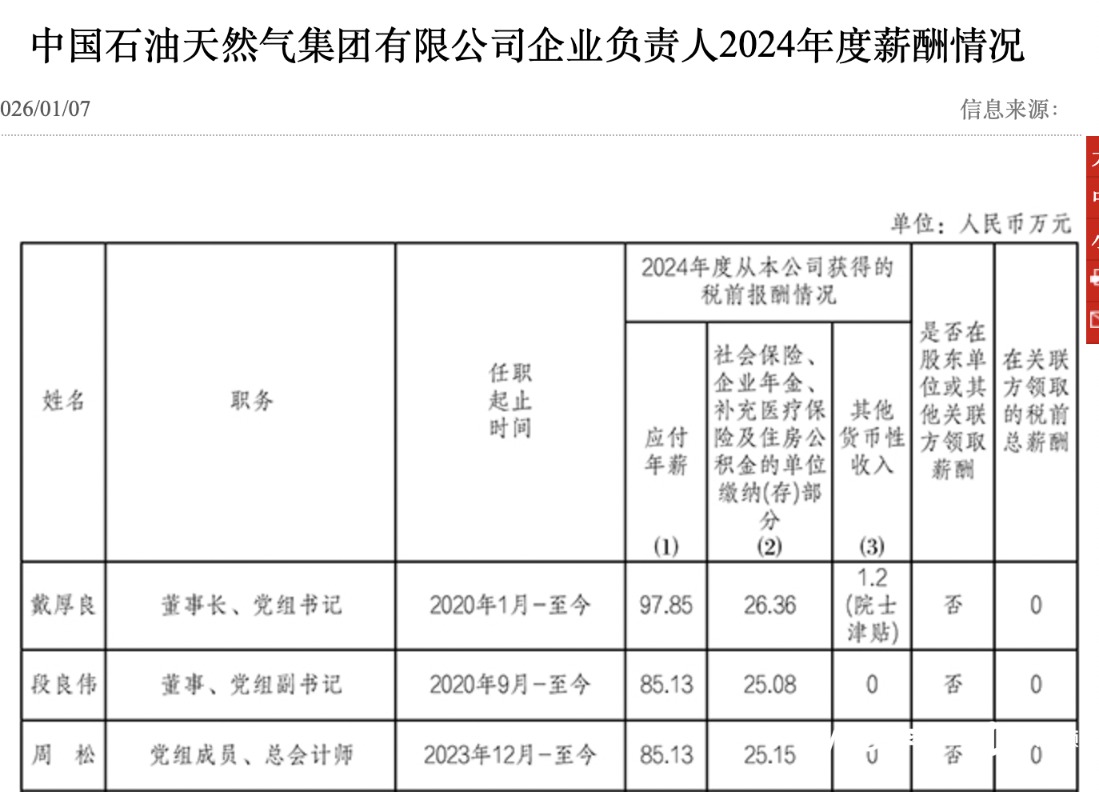
中石油、中石化等央企负责人能领多少钱?国资委披露
Nan Fang Du Shi Bao· 2026-01-14 15:10
Core Insights - The State-owned Assets Supervision and Administration Commission (SASAC) disclosed the 2024 salary information for over 80 central enterprises, indicating a stable salary range for executives, characterized by "top-tier leadership, concentrated median, and compliant lower-tier" without extreme high salaries [1] Group 1: Salary Distribution - The top tier of executive salaries is dominated by telecommunications and energy central enterprises, with China Mobile's former chairman Yang Jie leading at a pre-tax salary of 1.2582 million yuan, followed by China Telecom's chairman Ke Ruiwen and China Unicom's chairman Chen Zhongyue with pre-tax salaries of 1.2160 million yuan and 1.2101 million yuan respectively [1] - In the energy sector, PetroChina's chairman Dai Houliang and general manager Hou Qijun both have an annual salary of 978,500 yuan, ranking first among energy central enterprises, while China National Offshore Oil Corporation's chairman Wang Dongjin follows with an annual salary of 966,900 yuan [2] - Comprehensive central enterprises like China Merchants Group and China Resources Group also maintain high salaries, with China Merchants' chairman Miao Jianmin earning an annual salary of 946,400 yuan and China Resources' chairman Wang Xiangming earning 951,200 yuan [3] Group 2: Salary Tiers - The second tier includes core central enterprises in electricity, construction, and automotive industries, with State Grid's chairman Zhang Zhigang earning an annual salary of 735,000 yuan, and China General Nuclear Power Group's chairman Yang Changli earning 930,000 yuan [4] - The automotive sector features China FAW's chairman Qiu Xiandong with an annual salary of 909,700 yuan, and China National Automotive Industry Corporation's chairman Yang Qing with 868,600 yuan [4] - The third tier consists of public welfare-oriented central enterprises, with China Forestry Group's chairman Shan Zhongli and Overseas Chinese Town Group's chairman Zhang Zhenga both earning 438,500 yuan, which is below the average salary level for central enterprises [4] Group 3: Salary Disparities - Within the same industry, the salary differences among executives of central enterprises are manageable, with the highest annual salary in the energy sector (PetroChina at 978,500 yuan) and the lowest (National Pipeline at 872,900 yuan) showing a gap of approximately 100,000 yuan [5] - The salary disparity among the three major telecommunications operators' chairmen is less than 50,000 yuan, while the five major power generation group chairmen's salaries are concentrated in the range of 880,000 to 960,000 yuan, indicating a relatively balanced ranking [5]