成都银行

Search documents
成都银行稳居2025中国银行业竞争力百强榜中西部首位
21世纪经济报道· 2025-12-02 11:18
近日,21世纪金融研究院发布了《2025中国银行业竞争力研究报告》,备受瞩目的中国银行业竞争 力100强榜单也同步正式揭晓。成都银行凭借综合实力在城商行阵营中持续领跑,更以深厚的区域服 务能力与创新的金融实践,稳居中西部城商行竞争力首位。 报告指出,本次榜单以商业银行年报数据为核心依据,构建规模、盈利、成长、稳健四大 核心指标体系,形成多维度榜单矩阵。该榜单以科学评估体系全面呈现行业发展态势,为 行业转型与创新提供重要参考。 养老金融与数字金融的突破同样亮眼。面对"银发浪潮",成都银行以系统化推进养老金融 服务、打造区域特色养老金融品牌为抓手,建立健全老年客户"优先、优惠、优待"制度, 通过完善网点爱心窗口、提供智能机具"一对一"指导、畅通助老绿色通道、迭代手机银行 老年版等举措,切实解决老年客户线下办事与线上操作难题。同时,该行在账户开立、产 品配套等方面优化全链条服务,推动网点服务向社区延伸,助力零售业务持续增长。截至 2 0 2 5 年6月末,成都银行个人存款规模超5 0 7 8亿元、较年初增长 1 5 . 8 4%,占总存款比例 提升至 5 1 . 6 4%,彰显了特色养老金融服务与"市民银行"定位协 ...

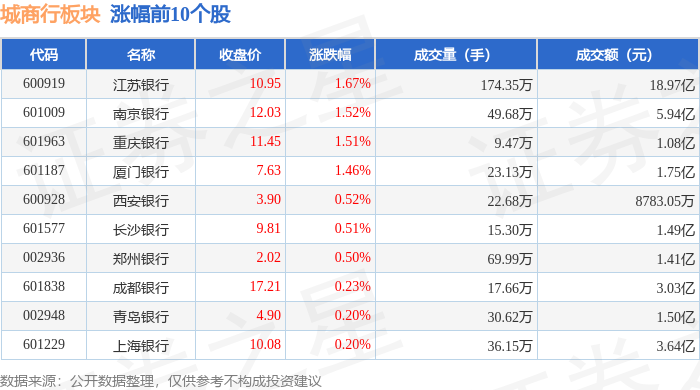
城商行板块12月2日涨0.43%,江苏银行领涨,主力资金净流出3.16亿元
Zheng Xing Xing Ye Ri Bao· 2025-12-02 09:05
Group 1 - The city commercial bank sector increased by 0.43% on December 2, with Jiangsu Bank leading the gains [1] - The Shanghai Composite Index closed at 3897.71, down 0.42%, while the Shenzhen Component Index closed at 13056.7, down 0.68% [1] - Jiangsu Bank's closing price was 10.95, reflecting a 1.67% increase, with a trading volume of 1.7435 million shares and a transaction value of 1.897 billion [1] Group 2 - The city commercial bank sector experienced a net outflow of 316 million from institutional funds, while retail investors saw a net inflow of 421 million [2][3] - The trading data for various banks showed mixed performance, with Ningbo Bank declining by 0.69% and Guizhou Bank remaining unchanged [2] - Shanghai Bank had a net outflow of 46.6477 million from institutional funds, while retail investors contributed a net inflow of 2.33839 million [3]




金工定期报告20251202:预期高股息组合跟踪
Soochow Securities· 2025-12-02 06:35
Quantitative Models and Construction Methods 1. **Model Name: Expected High Dividend Portfolio** - **Model Construction Idea**: The model is constructed using a two-stage process to create an expected dividend yield indicator. The first stage calculates the dividend yield based on annual report profit distribution, and the second stage predicts and calculates the dividend yield using historical dividends and fundamental indicators. Additionally, two short-term factors affecting dividend yield—reversal factor and profitability factor—are used to assist in screening. The model selects stocks from the CSI 300 constituents to construct the expected high dividend portfolio, which holds 30 stocks and rebalances monthly[3][8]. - **Model Construction Process**: 1. Exclude suspended and limit-up stocks from the CSI 300 constituents to form the candidate stock pool[9]. 2. Exclude the top 20% of stocks with the highest short-term momentum (21-day cumulative increase)[13]. 3. Exclude stocks with declining profitability (quarterly net profit growth rate less than 0)[13]. 4. Rank the remaining stocks in the pool by expected dividend yield and select the top 30 stocks to construct the portfolio with equal weight[9]. - **Model Evaluation**: The model's historical performance is impressive, with a cumulative return of 358.90% and a cumulative excess return of 107.44% relative to the CSI 300 Total Return Index. The annualized excess return is 8.87%, with a maximum rolling one-year drawdown of only 12.26% and a monthly excess win rate of 60.19%[11]. Model Backtest Results 1. **Expected High Dividend Portfolio** - **Average Return (November 2025)**: 0.70%[14] - **Excess Return Relative to CSI 300 Index**: 3.08%[14] - **Excess Return Relative to CSI Dividend Index**: 2.31%[14] - **Cumulative Return (2009-2017)**: 358.90%[11] - **Cumulative Excess Return (2009-2017)**: 107.44%[11] - **Annualized Excess Return (2009-2017)**: 8.87%[11] - **Maximum Rolling One-Year Drawdown**: 12.26%[11] - **Monthly Excess Win Rate**: 60.19%[11] Quantitative Factors and Construction Methods 1. **Factor Name: Expected Dividend Yield Factor** - **Factor Construction Idea**: The factor is constructed using a two-stage process. The first stage calculates the dividend yield based on annual report profit distribution, and the second stage predicts and calculates the dividend yield using historical dividends and fundamental indicators. Two short-term factors—reversal factor and profitability factor—are used to assist in screening[3][8]. - **Factor Construction Process**: 1. Calculate the dividend yield based on annual report profit distribution[8]. 2. Predict and calculate the dividend yield using historical dividends and fundamental indicators[8]. 3. Use the reversal factor and profitability factor to assist in screening[8]. - **Factor Evaluation**: The factor effectively identifies high dividend yield stocks, contributing to the construction of a high-performing portfolio[3][8]. Factor Backtest Results 1. **Expected Dividend Yield Factor** - **Average Return (November 2025)**: 0.70%[14] - **Excess Return Relative to CSI 300 Index**: 3.08%[14] - **Excess Return Relative to CSI Dividend Index**: 2.31%[14] - **Cumulative Return (2009-2017)**: 358.90%[11] - **Cumulative Excess Return (2009-2017)**: 107.44%[11] - **Annualized Excess Return (2009-2017)**: 8.87%[11] - **Maximum Rolling One-Year Drawdown**: 12.26%[11] - **Monthly Excess Win Rate**: 60.19%[11]


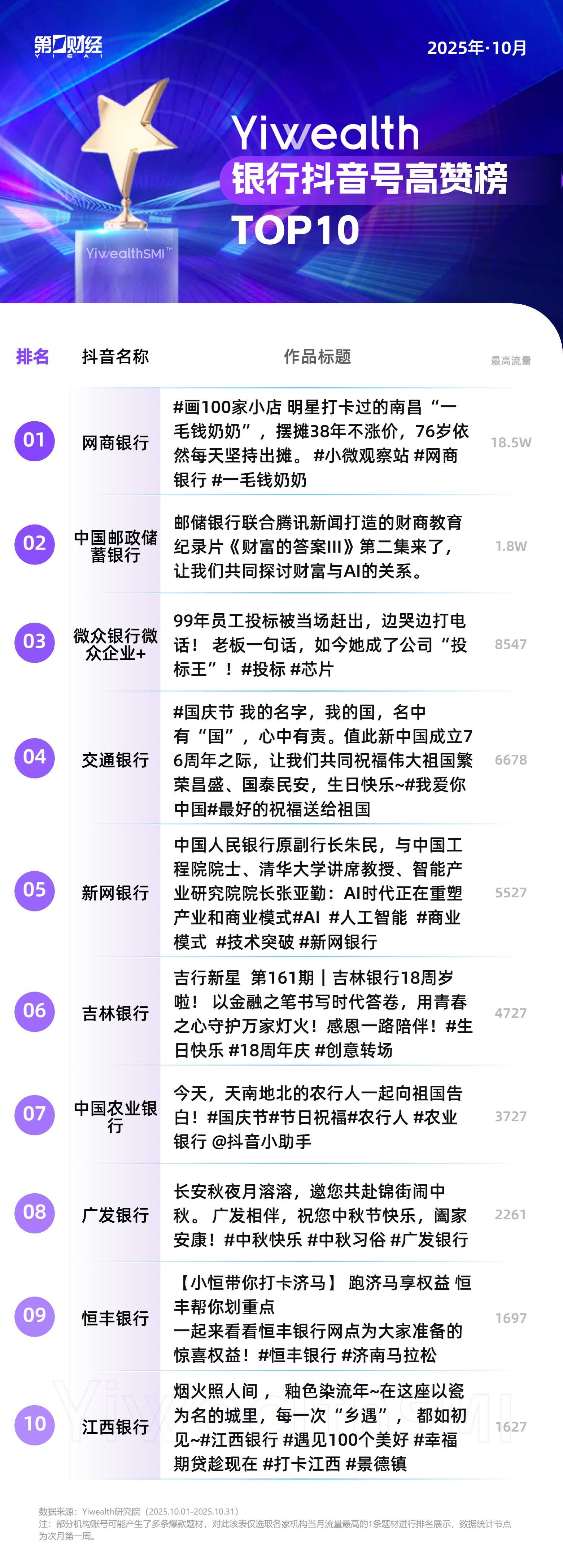
YiwealthSMI|AI与节日成10月创作热点,情感共鸣仍是抖音“流量密码”
Di Yi Cai Jing· 2025-12-02 02:59
Group 1 - The October Bank Social Media Index (SMI) shows slight changes, with several banks dropping out of the top rankings, including Industrial Bank and WeBank, while new entrants include Jilin Bank and Tianjin Bank [2] - The content that gained high engagement on Douyin in October focused on emotional resonance, AI trends, and holiday themes, with WeBank leading with over 185,000 likes for a story about a grandmother selling goods for 38 years without raising prices [2][7] - The holiday themes around National Day and Mid-Autumn Festival were popular, with banks like Agricultural Bank and Guangfa Bank creating content centered on festive greetings and family reunions [2][8] Group 2 - The top-performing videos primarily emphasized brand promotion and holiday greetings, while the articles on public accounts focused on welfare and benefits [3] - The top video content included a documentary by Postal Savings Bank in collaboration with Tencent News, discussing the relationship between wealth and AI [7] - The top public account content featured promotional activities, such as free tickets for the League of Legends World Championship by China Merchants Bank and limited edition sales by the Palace Museum [17][19]
中国金融板块-追踪工业风险:制造业固定资产投资增速显著放缓,助力更快管控风险-China Financials-Tracking industrial risks further notable slowdown in manufacturing FAI growth to help contain risks more quickly
2025-12-02 02:08
Summary of Key Points from the Conference Call Industry Overview - **Industry**: China Financials, specifically focusing on manufacturing and infrastructure investments in China [1][5][7] Core Insights and Arguments - **Manufacturing FAI Growth**: There has been a notable slowdown in manufacturing Fixed Asset Investment (FAI) growth, dropping to 2.7% year-over-year (yoy) from 4.0% yoy in the previous month, indicating steady progress on capital expenditure (capex) slowdown [7] - **Liability Growth**: Total liability growth for industrial firms moderated to 5.0% yoy, while manufacturing firms saw a slight increase to 5.9% yoy. This moderation is expected to lead to more rational capacity expansion [2][7] - **Revenue Decline**: Manufacturing revenue declined by 4.3% yoy, attributed to lower production levels due to overcapacity control efforts. The Value-Added Industrial (VAI) growth also slowed to 4.9% yoy from 6.5% yoy in September [3][10] - **Profit Growth**: Manufacturing profit growth moderated to 7.7% yoy from 9.9% yoy in September, influenced by higher financing costs and lower production [10] Future Outlook - **Infrastructure Investment**: A potential increase in infrastructure investments, supported by a new RMB 500 billion fund from the China Development Bank, is expected to bolster demand in 2026 and aid in the digestion of overcapacity risks [8][3] - **Sector Performance**: 77.1% of sectors experienced a slowdown in capex in October 2025 compared to the first half of 2025, while 39.3% of sectors showed profit improvement [9][7] Additional Important Information - **PPI Trends**: The Producer Price Index (PPI) rebounded month-over-month for the first time since December 2024, with the year-over-year decline narrowing to 2.1% [7] - **Investment Sentiment**: The overall sentiment towards the China Financials sector remains attractive, with ongoing efforts in financial tightening contributing to anti-involution measures [5][4] This summary encapsulates the critical insights from the conference call, highlighting the current state and future expectations of the manufacturing and financial sectors in China.





宁波杉杉股份有限公司关于2025年11月份提供担保的公告
Shang Hai Zheng Quan Bao· 2025-12-01 19:16
Summary of Key Points Core Viewpoint - The company, Ningbo Shanshan Co., Ltd., has announced its decision to provide guarantees for its subsidiary, Sichuan Shanshan New Materials Co., Ltd., to support its financing needs for daily operations [1][2]. Group 1: Guarantee Details - The company will provide a joint liability guarantee for loans amounting to 100 million RMB and 20 million RMB from Chengdu Bank for its subsidiary [1]. - As of October 31, 2025, the total amount of guarantees provided by the company and its subsidiaries is 1,806,033.36 million RMB, which represents 83.68% of the net assets attributable to the shareholders of the listed company [7]. Group 2: Internal Decision-Making Process - The decision to provide guarantees was approved at the annual shareholders' meeting held on May 16, 2025, allowing the company to provide guarantees within a specified limit until the next annual shareholders' meeting [2]. - The board of directors unanimously agreed on April 24, 2025, to provide the guarantees, considering the controllable risk and the operational needs of the subsidiary [7]. Group 3: Financial Health of the Guaranteed Entity - The company is confident in the financial health and creditworthiness of the subsidiary, which is currently performing well and has the ability to repay its debts [4].

城商行板块12月1日涨1.5%,厦门银行领涨,主力资金净流出2.78亿元
Zheng Xing Xing Ye Ri Bao· 2025-12-01 09:10
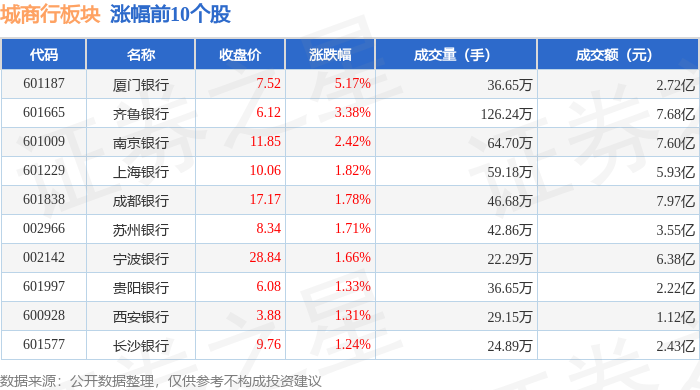
Market Performance - The city commercial bank sector increased by 1.5% on December 1, with Xiamen Bank leading the gains [1] - The Shanghai Composite Index closed at 3914.01, up 0.65%, while the Shenzhen Component Index closed at 13146.72, up 1.25% [1] Individual Bank Performance - Xiamen Bank's closing price was 7.52, with a rise of 5.17% and a trading volume of 366,500 shares, amounting to 272 million yuan [1] - Qilu Bank closed at 6.12, up 3.38%, with a trading volume of 1.26 million shares, totaling 768 million yuan [1] - Nanjing Bank's closing price was 11.85, increasing by 2.42%, with a trading volume of 647,000 shares, amounting to 760 million yuan [1] - Shanghai Bank closed at 10.06, up 1.82%, with a trading volume of 591,800 shares, totaling 593 million yuan [1] - Chengdu Bank's closing price was 17.17, increasing by 1.78%, with a trading volume of 466,800 shares, amounting to 797 million yuan [1] Fund Flow Analysis - The city commercial bank sector experienced a net outflow of 278 million yuan from institutional investors, while retail investors saw a net inflow of 240 million yuan [1] - The table shows various banks' net fund flows, indicating mixed results among different institutions [2]

A股银行股普涨,张家港行涨5%,厦门银行涨超4%
Ge Long Hui A P P· 2025-12-01 03:10
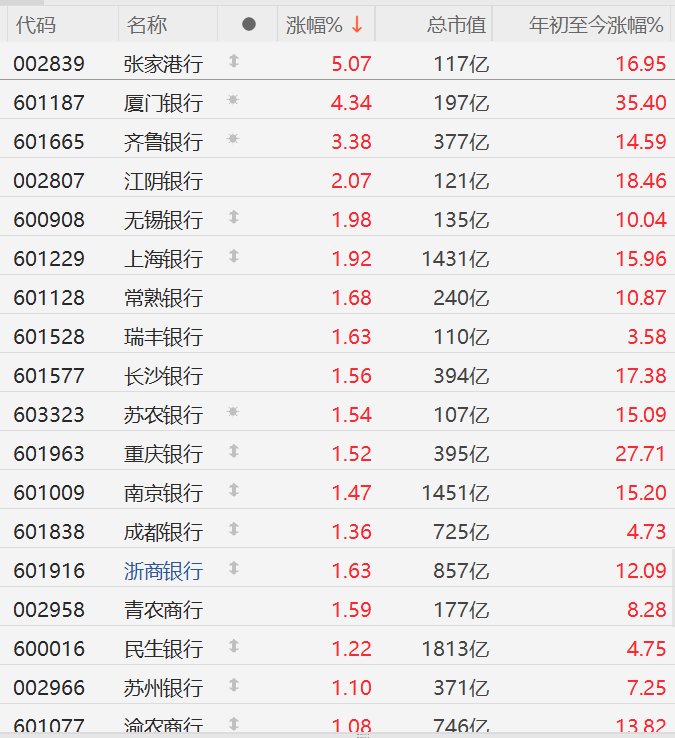
Core Viewpoint - The A-share market has seen a significant increase in bank stocks, with notable gains in several banks on December 1st, indicating positive market sentiment towards the banking sector [1]. Summary by Category Stock Performance - Zhangjiagang Bank increased by 5.07%, with a total market capitalization of 11.7 billion and a year-to-date increase of 16.95% [2]. - Xiamen Bank rose by 4.34%, with a market cap of 19.7 billion and a year-to-date increase of 35.40% [2]. - Qilu Bank saw a 3.38% increase, with a market cap of 37.7 billion and a year-to-date increase of 14.59% [2]. - Jiangyin Bank increased by 2.07%, with a market cap of 12.1 billion and a year-to-date increase of 18.46% [2]. - Wuxi Bank and Shanghai Bank both rose nearly 2%, with market caps of 13.5 billion and 143.1 billion respectively, and year-to-date increases of 10.04% and 15.96% [1][2]. Technical Indicators - The formation of a MACD golden cross signal suggests a positive trend for these bank stocks, contributing to their upward momentum [1].


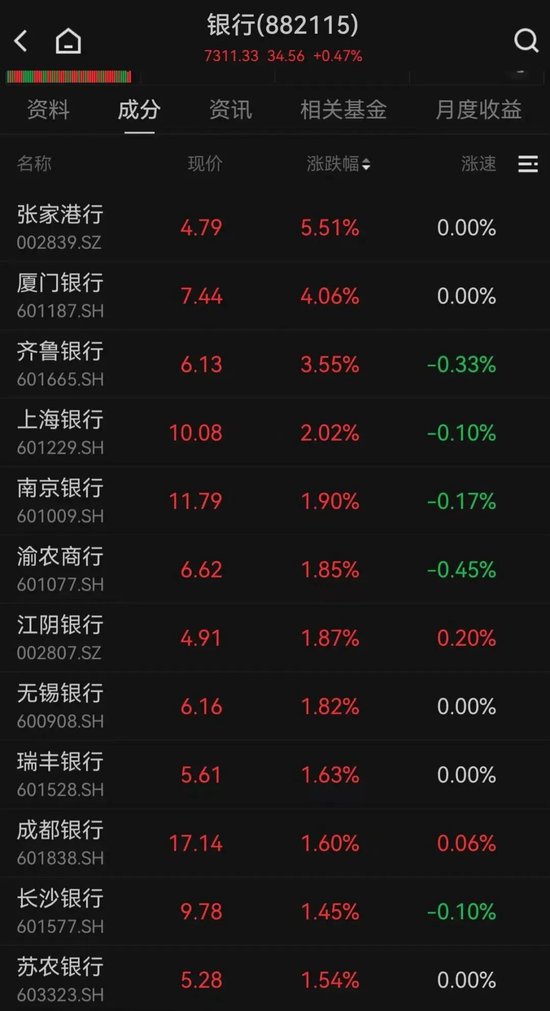
银行股,再度发力
Di Yi Cai Jing· 2025-12-01 02:45
Core Viewpoint - The banking sector experienced a notable upward trend on December 1, with several banks showing significant gains in their stock prices, indicating positive market sentiment towards the banking industry [1][2]. Group 1: Stock Performance - Zhangjiagang Bank saw an increase of over 5%, reaching a price of 4.79 [2]. - Xiamen Bank rose by more than 4%, with its stock priced at 7.44 [2]. - Qilu Bank experienced a gain of over 3.5%, with its stock priced at 6.13 [2]. - Other banks such as Nanjing Bank, Chongqing Rural Commercial Bank, and Jiangyin Bank also reported increases in their stock prices, contributing to the overall positive performance of the banking sector [1][2].
成都两银行秋招现“神仙打架”,名校人才青睐“新一线”发展
Hua Xia Shi Bao· 2025-11-29 04:41
本报(chinatimes.net.cn)记者张萌 卢梦雪 北京报道 2026届校园秋招正在进行,金融行业"抢人大战"持续升温。 近日,成都两家地方银行公布的总行管培生岗位过审名单在社交平台引发热议。两个仅各招聘10人的岗 位,竟吸引了数百名来自全球顶尖高校的应届毕业生参与角逐。 具体来看,成都银行总行管培生岗位共有82人通过资格审核,其中北京大学与清华大学毕业生合计占比 超过七成,其余候选人也均来自复旦大学等国内外一流高校;而成都农商银行的这一岗位有279人通过 资格审核,来自香港大学、北京大学、复旦大学、南洋理工大学和新加坡国立大学的毕业生占比超六 成。 "其实并不意外。"有应届生向记者表示,"一方面大家普遍'广撒网',多点投递;另一方面,周围确实有 不少同学考虑到新一线城市发展。" 总行管培生受青睐 今年秋招季,记者前往北京多所高校银行宣讲会,深入了解2026届校园招聘情况。在这些宣讲会 上,"总行管培生"项目及其培养政策成为最受关注的焦点之一。 据多家银行介绍,总行管培生主要作为总行各部门业务与管理岗位的人才储备,通常需经历实践锻炼、 轮岗培养等阶段,培养期满并通过考核后,将正式进入总行工作。除总行外 ...