青岛银行

Search documents
青岛银行(03866) - 海外监管公告 - 董事会决议公告
2025-12-30 11:30
( 於 中 華 人 民 共 和 國 註 冊 成 立 的 股 份 有 限 公 司 ) (H股股份代號:3866) 海外監管公告 本公告乃根據《香港聯合交易所有限公司證券上市規則》第13.10B條作出。 香港交易及結算所有限公司及香港聯合交易所有限公司對本公告的內容概不負責,對其準確性 或完整性亦不發表任何聲明,並明確表示,概不對因本公告全部或任何部份內容而產生或因倚 賴該等內容而引致的任何損失承擔任何責任。 Bank of Qingdao Co., Ltd.* 青 島 銀 行 股 份 有 限 公 司 * * 青島銀行股份有限公司並非一家根據銀行業條例(香港法例第155章)之認可機構,並不受 限於香港金融管理局的監督,亦不獲授權在香港經營銀行及╱或接受存款業務。 证券代码:002948 证券简称:青岛银行 公告编号:2025-050 如下公告已於深圳證券交易所網站刊登,僅供參閱。 特此公告。 承董事會命 青島銀行股份有限公司* 景在倫 董事長 中國山東省青島市 2025年12月30日 於本公告日期,董事會包括執行董事景在倫先生、吳顯明先生、陳霜女士及劉 鵬先生;非執行董事周雲傑先生、Rosario Strano先 ...
青岛银行(002948) - 董事会决议公告
2025-12-30 11:15
会议审议通过了《关于<青岛银行股份有限公司 2026-2028 年战略规划>的议 案》 本议案同意票 14 票,反对票 0 票,弃权票 0 票。 备查文件 证券代码:002948 证券简称:青岛银行 公告编号:2025-050 青岛银行股份有限公司董事会决议公告 本行及董事会全体成员保证公告内容的真实、准确和完整,没有虚假记载、误导性陈 述或者重大遗漏。 青岛银行股份有限公司(以下简称"本行")于2025年12月25日以电子邮件方 式向董事发出关于召开第九届董事会第二十四次会议的通知,会议于2025年12 月30日以书面传签方式召开,应参与表决董事14名,实际表决董事14名。本次会 议召开符合《中华人民共和国公司法》《深圳证券交易所股票上市规则》和《青 岛银行股份有限公司章程》的规定。 经与会董事签字的通讯表决书及加盖董事会印章的董事会决议。 特此公告。 青岛银行股份有限公司董事会 2025 年 12 月 30 日 ...
【微头条】青岛数字金融创新大赛破解行业共性难题
Xin Lang Cai Jing· 2025-12-30 11:04
Core Insights - The fourth Qingdao Digital Financial Innovation Competition successfully concluded, focusing on the theme "Leading the Financial Wave with Data, Wisdom Gathering Wealth in Qingdao" and achieving a strategic shift from "single-point breakthroughs" to "systematic tackling" [1][6] Group 1: Competition Overview - The competition featured two main units: "Outstanding Financial Technology Projects" and "Financial Technology Challenge," selecting a range of forward-looking, practical, and replicable industry-level solutions to support high-quality regional digital financial development [1][6] - A total of 28 outstanding projects were recognized, showcasing the hard power and diversified layout of local financial institutions in their digital transformation [7] Group 2: Award-Winning Projects - The first prize projects included Qingdao Rural Commercial Bank's "Technology Financial Empowerment Project based on Big Data Analysis and Privacy Computing," China Merchants Bank Qingdao Branch's "Qing Chain Pass," and Qingdao Bank's "Smart Credit Assistant System Construction Project," representing the highest level in data value release, supply chain financial ecosystem construction, and credit intelligence transformation [7] - Other notable projects included Industrial and Commercial Bank of China Qingdao Branch's "General Plug-and-Play Large Model Empowerment System," Rizhao Bank Qingdao Branch's "New Paradigm for Agricultural Product Pledge Business," and Bank of Communications Qingdao Branch's "Smart Anti-Fraud Risk Control Ecosystem," reflecting a comprehensive digital innovation landscape in Qingdao's financial sector [2][7] Group 3: Technology Companies Participation - Top technology companies such as 360 Digital Security, iFLYTEK, Ant Blockchain, and Hang Seng Electronics participated in the "Financial Technology Challenge," submitting high-scoring solutions that matched the core pain points identified by financial institutions [3][8] - A total of 21 benchmark solutions were selected, including 360 Digital Security's "Host Protection System Thinking," which won the "Network Security Protection and Micro-Isolation Technology" category, and iFLYTEK's AI digital human application that supports over 130 languages and enhances financial services [8][9] Group 4: Collaborative Mechanism - The competition introduced a collaborative mechanism involving three organizing bodies and four financial institutions, addressing the challenges of resource fragmentation and demand diversification in financial innovation [4][10] - Joint lists focused on key aspects of digital financial scene implementation, elevating the goals from individual institutional needs to addressing systemic challenges affecting regional financial development [10] Group 5: Ecosystem Development - The Qingdao Digital Financial Innovation Competition has evolved into a significant platform for deepening financial supply-side structural reform and building a regional financial technology innovation ecosystem [11] - The competition has successfully established a fusion system of "government guidance, enterprise leadership, and market operation," facilitating the transition of innovative results from the laboratory to practical applications [11][12]




银行金融投资如何摆布记账?
GF SECURITIES· 2025-12-30 05:34
Investment Rating - The report provides a "Buy" rating for all listed banks analyzed, indicating a positive outlook for their stock performance [6]. Core Insights - The report focuses on the classification of financial investments, the current allocation of listed banks, and how related revenues are accounted for under new accounting standards [5]. - As of Q3 2025, the financial investments of 42 listed banks total approximately 101.5 trillion CNY, with 87% allocated to the configuration portfolio and 13% to the trading portfolio [5][23]. - The bond market is the primary investment direction for listed banks, accounting for 87.6% of their financial investments, with government bonds making up 59.5% of this total [5]. Summary by Sections 1. Classification of Financial Investments - Financial assets are classified into three categories under the new accounting standards: FVTPL (fair value through profit or loss), AC (amortized cost), and FVOCI (fair value through other comprehensive income) [12][13]. - The classification is based on the business model for managing financial assets and the cash flow characteristics of the financial assets [14]. 2. Accounting for Market Revenues - FVTPL assets reflect market fluctuations through "fair value changes" in profit or loss, while AC assets do not reflect fair value changes and primarily generate income from interest [5]. - FVOCI assets account for market fluctuations in other comprehensive income, with interest income recognized in profit or loss [5]. 3. Financial Investment Structure - The configuration portfolio is dominant, with state-owned banks showing the highest allocation to AC, while joint-stock banks and city commercial banks have a higher proportion of trading assets [23][24][25]. - The report notes a structural shift where FVOCI is becoming the main growth area, as banks seek flexibility in their investment strategies [5][23].




发布“海贝计划2.0”合作方案,青岛银行资产托管开启生态化未来新篇章
Da Zhong Ri Bao· 2025-12-29 12:28
本次发布的"海贝计划2.0"方案,在原有集团各板块资源持续发力的基础上,增加了多个精细化服务合 作客群、定制化支持合作客户的"新思维"。在集团协同方面,新方案从集团业务板块分别支持托管客户 升级为综合化、体系化、联动化服务,将自营资金、资管资金与财富销售整合,链接各类型同业客户的 多方面合作需求;在客群合作方面,首次提出青银同业客群生态圈理念,充分分析挖掘集团数百家重点 同业客户数据库,将客户业务类型、发展需求与金融资源相匹配,推动"客户服务客户,青银服务全 部"的合作模式;在产品合作方面,新方案将"共育成长"的节点进一步前置,在合作初期即与客户针对 宏观经济、市场环境、业务机遇、资产配置、产品创设等方面开展深度合作研究,以实现托管产品的市 场化竞争力与长期成长力。更值得一提的是,青岛银行在新方案中创新性的将科技协同纳入合作重要环 节,提出后续将以更多资源契合客户的运营"小需求""微创新",助力合作伙伴在数字化运营、数智化风 控方面提质增效。 "海贝计划2.0"方案推出后,青岛银行将全面开启资产托管业务的生态化未来打造之路,以"规模跨越式 增长+体系化布局升级"双轮驱动,全面打造基于客户服务和共生共赢的集团内 ...
9家A股ESG强信披银行碳排同比上升
2 1 Shi Ji Jing Ji Bao Dao· 2025-12-29 08:20
Group 1: Climate Disclosure Standards - The Ministry of Finance, along with nine other departments, issued the "Corporate Sustainable Disclosure Standard No. 1 - Climate (Trial)" on December 25, marking a significant step towards a unified sustainable disclosure standard system in China [1] - The "Climate Standard" is currently positioned as a trial document, with voluntary implementation by companies until specific requirements are established [1] - The Ministry of Finance plans to adopt a gradual approach to implementation, expanding from listed companies to non-listed companies, and from large enterprises to small and medium-sized enterprises [1] Group 2: ESG Disclosure in A-Share Banks - The A-share ESG strong disclosure list has expanded to 27 banks, including 6 state-owned banks, 9 joint-stock banks, 10 city commercial banks, and 2 rural commercial banks [2] - Among the 27 banks, 16 reported a year-on-year decrease in carbon emissions, while 9 banks, including 1 state-owned bank and 6 city commercial banks, reported an increase in carbon emissions [2] - The top five banks with the highest year-on-year increase in carbon emissions are Beijing Bank (13.88%), Nanjing Bank (13.23%), Qingdao Bank (11.92%), Chongqing Bank (10.96%), and Hangzhou Bank (10.02%) [3] Group 3: Regulatory Actions and Penalties - First Capital's subsidiary was fined 12.7358 million yuan for failing to diligently supervise a convertible bond project [4] - Jinghua Pharmaceutical's subsidiary was fined 500,000 yuan for environmental pollution, which is not expected to significantly impact the company's net profit for 2025 [5] - Tianyi Medical is facing a potential fine of 8.7852 million yuan for not producing medical devices according to registered technical requirements [6][7] Group 4: Energy Sector ESG Developments - The "National Energy Sustainable Development Index" was officially launched, achieving a cumulative return rate of 40% [8] - Five thermal power companies have been included in the ESG strong disclosure category, which will require them to improve ESG governance and reporting by 2026 [9] - A report evaluated the low-carbon transition performance of 33 thermal power companies, indicating significant disparities in transition progress and a slower development of non-fossil energy compared to national averages [9]



2025青岛财富论坛:探究财富管理助力中国式现代化的“青岛实践”
凤凰网财经· 2025-12-26 12:44
Core Viewpoint - The 2025 Qingdao Wealth Forum serves as a significant platform for discussing the future of wealth management in China, focusing on the theme of "Wealth Management Supporting the Practice of Chinese-style Modernization in Qingdao" [1][5][22]. Group 1: Forum Overview - The forum, hosted by the Qingdao Municipal Government, gathered over 500 leaders, experts, and entrepreneurs from the economic and financial sectors, establishing a high-quality platform for collaboration [1][5]. - This event marks the 11th consecutive year of the Qingdao Wealth Forum, which has evolved into a benchmark platform for high-end, professional, and international dialogue in the wealth management industry [5][7]. Group 2: Key Discussions and Insights - The main forum featured speeches from prominent figures, including former Deputy Governor of the People's Bank of China, Li Dongrong, who discussed the role of digitalization and intelligence in advancing the wealth management sector [10]. - Experts emphasized the unprecedented opportunities for the wealth management industry due to the deepening application of digitalization and intelligence, while also addressing challenges such as changes in financing structures and declining interest rates [16]. Group 3: Financial Development in Qingdao - Qingdao has been recognized as a significant source of wealth management innovation in China, having established a wealth management financial reform pilot zone in 2014, which has contributed to its evolution into a financial stronghold [19][21]. - The Qingdao Financial Center ranked 35th among 120 global financial centers in the 38th Global Financial Center Index, marking its continuous presence in the top 50 for 18 consecutive times [19]. Group 4: Financial "Five Major Articles" - The central financial work conference highlighted the importance of financial services in supporting high-quality economic and social development, focusing on five major areas: technology finance, green finance, inclusive finance, pension finance, and digital finance [22]. - Qingdao aims to achieve an average annual loan growth rate of no less than 10% in these five areas by 2027, fostering a unique "Qingdao model" for financial development [22]. Group 5: Sector-Specific Financial Initiatives - In the technology finance sector, Qingdao's financial institutions have increased support for technological innovation, with a technology loan balance reaching 575.4 billion yuan, a 9.7% increase from the beginning of the year [24]. - The green finance sector has seen a loan balance of 587.9 billion yuan, growing by 15.34%, positioning Qingdao among the leaders in national growth rates [24]. Group 6: Inclusive and Pension Finance - Qingdao has been selected as a demonstration zone for inclusive finance development by the central government for four consecutive years, enhancing financial accessibility for small and micro enterprises [26]. - The city has also expanded its pension finance sector, with over 2.31 million personal pension accounts opened by mid-year [26]. Group 7: Future Outlook - The 2025 Qingdao Wealth Forum is positioned as a pivotal event for transitioning into the "15th Five-Year Plan," continuing to leverage its platform to gather global insights and empower Qingdao in becoming a competitive emerging wealth financial center [26].


【微头条】多领域突破,青岛金融业规模与质量同步跃升
Xin Lang Cai Jing· 2025-12-26 12:21
Core Viewpoint - The financial sector in Qingdao has achieved significant growth and quality improvements during the "14th Five-Year Plan" period, focusing on high-quality development and structural reforms to support the real economy and enhance financial stability [2][3][17]. Financial Growth and Performance - As of November 2023, the total balance of deposits and loans in both domestic and foreign currencies reached 6.4 trillion yuan, marking a significant milestone [2][3][17]. - Insurance premium income increased to 71.6 billion yuan, achieving two hundred billion-level improvements [2][3][17]. - The number of listed companies reached 86, ranking third among northern cities [2][3][17]. - The non-performing loan ratio remains low, with high-risk institutions being effectively managed [2][3][17]. Financial Innovation and Reforms - Over 30 national-level financial innovation pilot projects have been approved, including cross-border currency pools and pension financial products [4][19]. - The wealth management asset scale surpassed 4 trillion yuan, with over 300 private equity fund managers and a management scale exceeding 220 billion yuan [4][20]. - The amount invested in Qingdao projects by national equity venture capital funds reached 90.7 billion yuan, with significant increases in funding for high-tech and startup enterprises [4][20]. Financing Services and Support for the Real Economy - The average interest rate for new corporate loans was 3.31% as of November 2025, down 1.04 percentage points from the end of 2020 [8][19]. - More than 500 specialized financial matching events were held annually, and over 10,000 key enterprise projects were visited each year [6][19]. - Direct financing through domestic capital markets exceeded 600 billion yuan, a growth of over 70% compared to the "13th Five-Year Plan" period [7][19][23]. Risk Management and Regulatory Improvements - A multi-layered risk prevention system has been established, enhancing local financial regulatory effectiveness and monitoring capabilities [28][29]. - The establishment of a financial big data monitoring platform supports risk assessment and early warning for key enterprises [28][29]. - Measures to prevent illegal financial activities have been strengthened, with a dedicated task force and community outreach initiatives [29]. Future Outlook - The focus for the "15th Five-Year Plan" will be on risk prevention, regulatory strengthening, and promoting high-quality development, with an emphasis on innovative financing tools and support for high-quality listed companies [15][29].
城商行板块12月26日跌0.67%,厦门银行领跌,主力资金净流出5996.58万元
Zheng Xing Xing Ye Ri Bao· 2025-12-26 09:07
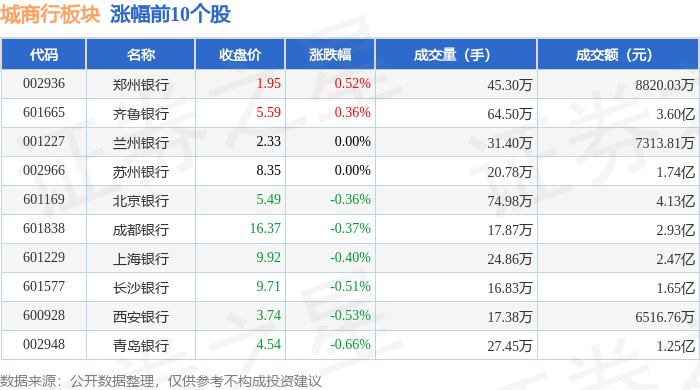
Core Viewpoint - The city commercial bank sector experienced a decline of 0.67% on December 26, with Xiamen Bank leading the drop, while the Shanghai Composite Index rose by 0.1% and the Shenzhen Component Index increased by 0.54% [1] Group 1: Market Performance - The closing price of Xiamen Bank was 7.56, reflecting a decrease of 2.45% with a trading volume of 139,200 shares and a transaction amount of 106 million yuan [2] - Other notable banks included Guizhou Bank at 5.90 (-1.17%), Ningbo Bank at 28.00 (-1.10%), and Chongqing Bank at 10.85 (-0.91%) [2] - The overall city commercial bank sector saw a net outflow of 59.97 million yuan from main funds, while retail funds experienced a net outflow of 80.69 million yuan [2] Group 2: Fund Flow Analysis - Hangzhou Bank had a main fund net inflow of 11.5 million yuan, but retail funds saw a net outflow of 76.27 million yuan [3] - Ningbo Bank recorded a main fund net inflow of 56.33 million yuan, while retail funds had a net outflow of 6.51 million yuan [3] - The overall trend indicates that while some banks attracted main fund inflows, retail investors were largely withdrawing their investments [3]
举牌、重组!银行业十大关键词→
证券时报· 2025-12-26 09:07
Core Viewpoint - In 2025, the Chinese banking industry is expected to demonstrate resilience amidst economic cycles, focusing on serving the real economy, embracing transformation, and maintaining a bottom line as a "certainty anchor" [1][2]. Group 1: Banking Industry Overview - The banking sector is navigating through challenges such as interest margin pressures, risk exposures, and customer behavior changes, leading to a collective reassessment of development strategies [1][4]. - The total assets of commercial banks are projected to grow from 380.52 trillion yuan at the end of 2024 to 409.63 trillion yuan by September 2025, with state-owned banks' assets increasing from 190.26 trillion yuan to 208.15 trillion yuan during the same period [3]. - The non-performing loan ratio is expected to fluctuate slightly, with estimates of 1.51% in March and 1.52% in September 2025 [3]. Group 2: Industry Trends - The concept of "anti-involution" has emerged as a consensus in the industry, shifting focus from aggressive scale expansion to a more sustainable and risk-aware approach [4][5]. - Regulatory measures have been implemented to curb unhealthy competition, including prohibiting high-interest deposit solicitation and blind low-price lending [4]. - The average net interest margin for commercial banks has dropped to a historical low of 1.42%, prompting banks to optimize asset allocation and diversify revenue sources [6][8]. Group 3: Deposit Trends - The trend of "deposit migration" has accelerated, with residents seeking better yield opportunities as deposit rates decline [11]. - The scale of bank wealth management products has increased from 30 trillion yuan to nearly 34 trillion yuan, indicating a shift from traditional deposit reliance to asset management [12]. Group 4: Mergers and Restructuring - Over 400 banking institutions are expected to exit the market through mergers, dissolutions, or cancellations, marking a significant increase compared to previous years [14]. - The restructuring efforts are characterized by a focus on quality improvement rather than mere reduction in numbers, with a systematic approach to governance [14]. Group 5: Technological Advancements - The banking sector is increasingly prioritizing technology finance, with a notable rise in specialized products for tech companies and a significant increase in tech loans, which accounted for 28.8% of new loans by August 2025 [15][30]. - The application of AI in banking has evolved from efficiency enhancement to a core driver of business growth and risk management, with banks investing in AI capabilities across various operational areas [30][31]. Group 6: Capital Increases - A notable "capital increase wave" is anticipated, with state-owned banks raising 520 billion yuan through stock issuance to bolster capital adequacy [18][20]. - Regulatory bodies are facilitating timely capital replenishment while ensuring that the capital is effectively utilized to enhance service capabilities [20]. Group 7: Shareholder Engagement - The banking sector has seen a surge in insurance capital participation, with seven banks receiving significant investments from insurance companies, reflecting the attractiveness of bank stocks [22]. - Major shareholders and executives have also been actively increasing their stakes in various banks, indicating confidence in the sector's prospects [22].