南洋商业银行

Search documents
跨境支付通香港收款行扩容至17家,首次纳入数字银行
2 1 Shi Ji Jing Ji Bao Dao· 2025-07-16 04:34
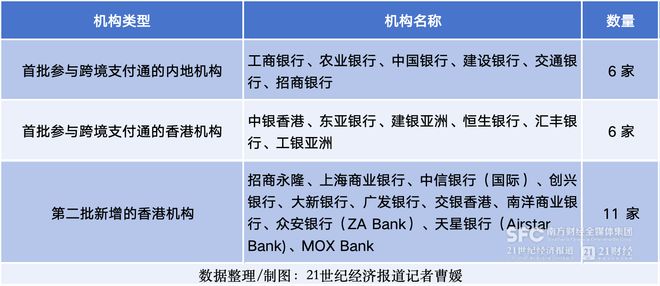
Core Insights - The Cross-Border Payment System has expanded to 17 banks in Hong Kong within a month of its launch, enhancing connectivity between mainland China's online payment system and Hong Kong's Fast Payment System [1][2] - The system offers advantages over traditional cross-border remittances, including instant transfers, simplified documentation, lower costs, and ease of use [1] - The initial participating banks include six from mainland China and six from Hong Kong, with an additional eleven Hong Kong banks recently added to the system [1][3] Summary by Category Participating Institutions - The first batch of participating mainland banks includes: Industrial and Commercial Bank of China, Agricultural Bank of China, Bank of China, China Construction Bank, Bank of Communications, and China Merchants Bank [1][3] - The first batch of participating Hong Kong banks includes: Bank of China (Hong Kong), Bank of East Asia, China Construction Bank (Asia), Hang Seng Bank, HSBC, and ICBC (Asia) [1][3] - The second batch of newly added Hong Kong banks includes: CMB Wing Lung Bank, Shanghai Commercial Bank, CITIC Bank International, Chuangxin Bank, Dah Sing Bank, Guangfa Bank, China Everbright Bank, Nanyang Commercial Bank, ZA Bank, Airstar Bank, and MOX Bank [1][3] Digital Banking Inclusion - This expansion marks the first inclusion of digital banks in the Cross-Border Payment System, with MOX Bank, ZA Bank, and Airstar Bank being notable participants [2][3] User Experience and Limitations - Some newly added banks have not yet officially opened cross-border payment services to customers, leading to mixed experiences among users [4] - The system supports bilateral currency and RMB cross-border remittance between mainland China and Hong Kong, with specific limits on transaction amounts [4][5] Transaction Limits - For northbound transactions, the limit is set at HKD 10,000 per person per day and HKD 200,000 per year, while southbound transactions are subject to an annual foreign exchange limit of USD 50,000 [4][5]




四川金融界大消息!
券商中国· 2025-07-15 06:07
Core Viewpoint - The article discusses the recent transfer of ownership of Changcheng Huaxi Bank from Changcheng Asset Management to Sichuan Bank, highlighting the ongoing trend of national Asset Management Companies (AMCs) divesting from banking assets [1][2][4]. Group 1: Ownership Transfer Details - Sichuan Bank has acquired 9.4259 billion shares of Changcheng Huaxi Bank, resulting in a 40.92% ownership stake [6]. - The previous controlling shareholder, Changcheng Asset Management, has completely exited its stake after over ten years of holding [6]. - The transaction was valued at 4.332 billion yuan, with the book value of Changcheng Huaxi Bank's total assets at 148.29 billion yuan and net assets at 10.064 billion yuan [6]. Group 2: Financial Metrics - As of the end of Q1 2023, Sichuan Bank reported total assets of 456.711 billion yuan and total liabilities of 419.824 billion yuan, with a revenue of 2.131 billion yuan and a net profit of 646 million yuan [3][7]. - Changcheng Huaxi Bank's total assets were reported at 156.261 billion yuan and total liabilities at 145.937 billion yuan, with total equity of 10.324 billion yuan [8]. - The capital adequacy ratio for Changcheng Huaxi Bank was 15.22%, with core tier one capital amounting to 10.324 billion yuan [9]. Group 3: AMC Divestment Trend - Following the exit of Changcheng Asset Management from Changcheng Huaxi Bank, only two banks remain under the control of national AMCs: Dalian Bank and Nanyang Commercial Bank [4][12]. - AMCs have been accelerating their exit from non-core banking subsidiaries, as evidenced by previous divestitures, including the transfer of Jilin Bank and Hunan Bank [12]. - Regulatory guidance has been issued to encourage AMCs to focus on their primary responsibilities and avoid unnecessary expansion into banking [14][15].

深圳新增一家外资银行 外资银行营业性机构总数将达39家
Xin Hua Cai Jing· 2025-07-09 11:51
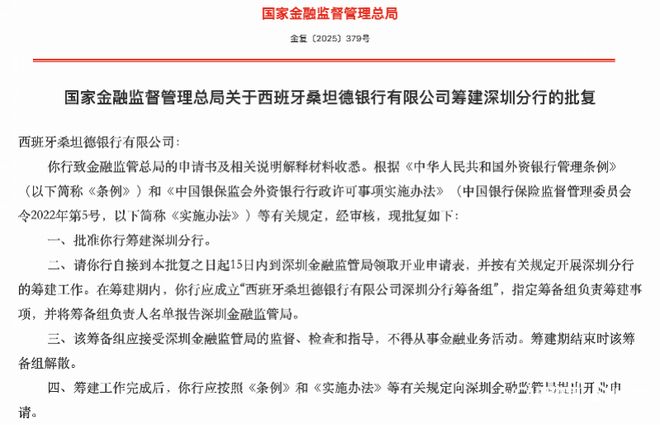
Group 1 - The National Financial Regulatory Administration has approved Banco Santander to establish a branch in Shenzhen, marking the addition of a European bank in the region [1] - By the end of 2024, Shenzhen will have 38 foreign-funded banks, including 5 legal entities and 33 branches, with total assets exceeding 400 billion RMB [1] - Banco Santander, founded in 1857, is Spain's largest commercial bank with total assets of 1.8 trillion euros and a net profit of 13.744 billion euros in 2024 [1] Group 2 - Nine foreign banks in Shenzhen have joined the "Cross-Border Wealth Management Connect" pilot program, facilitating cross-border investment for residents in the Greater Bay Area [2] - The total amount of cross-border fund transfers has exceeded 1.6 billion RMB, accounting for nearly 80% of the total for foreign banks in the Greater Bay Area [2] - Foreign banks in Shenzhen are actively participating in the green finance market, with initiatives such as ESG-linked loans and offshore RMB bond issuance to support sustainable development [2]
西班牙桑坦德银行深圳分行获批筹建,外资金融版图再扩容
Nan Fang Du Shi Bao· 2025-07-08 12:00
Group 1 - The core point of the news is the approval of Banco Santander to establish a branch in Shenzhen, marking its third presence in China after Shanghai and Beijing, and reflecting the ongoing expansion of foreign financial institutions in the region [1][4][10] - Banco Santander, as Spain's largest commercial bank, has a significant global presence with total assets of €1.8 trillion and annual revenue of €61.876 billion as of the end of 2024 [1][4] - The establishment of the Shenzhen branch aligns with China's financial opening policies, which have seen over 50 measures introduced since 2018 to facilitate foreign investment in the banking sector [4][9] Group 2 - Shenzhen has become a hub for foreign banks, with 38 institutions having total assets exceeding 400 billion RMB, ranking among the top in the country [5][6] - The historical context of foreign banks in Shenzhen dates back to 1982, with significant milestones including the establishment of the first foreign bank and the introduction of various international banking giants [5][6] - Recent developments indicate a trend of foreign banks increasing their presence in Shenzhen, supported by favorable policies and the city's strong economic performance [6][9] Group 3 - Foreign banks in Shenzhen are actively participating in cross-border financing and settlement, with significant contributions to the "Cross-Border Wealth Management Connect" pilot program [7] - These banks are also supporting Chinese enterprises in their global expansion efforts, leveraging their international networks to provide comprehensive services [7][8] - In the green finance sector, foreign banks are involved in innovative practices, such as ESG-linked loans and sustainable bond issuance, contributing to Shenzhen's green development initiatives [8] Group 4 - Shenzhen's favorable business environment, recognized as one of the best in the country, has attracted a significant number of foreign enterprises, with a 21.7% increase in newly established foreign companies in 2024 [9][10] - The city continues to enhance its policies to attract foreign investment, with new measures introduced to optimize the international business environment [9][10] - The ongoing development of foreign financial institutions in Shenzhen reflects China's commitment to high-level financial openness and a mutually beneficial financial development framework [10]

深圳外资银行,再添新成员
Zhong Guo Ji Jin Bao· 2025-07-08 11:33
Group 1 - Santander Bank has received approval to establish a branch in Shenzhen, marking the establishment of a new European-funded bank in the region [1] - Santander Bank, founded in 1857, is the largest commercial bank in Spain and a globally significant bank, with total assets of €1.8 trillion and a net profit of €13.744 billion as of the end of 2024 [1] - The establishment of the new branch signals foreign investors' confidence in the Chinese economy and the Guangdong-Hong Kong-Macao Greater Bay Area market [1] Group 2 - China has been actively expanding high-level financial openness, implementing over 50 measures since 2018 to attract foreign investment and improve the business environment [2] - Recent policies have removed foreign ownership limits in various financial sectors, allowing foreign institutions to enjoy national treatment and expand their business scope [2] Group 3 - Shenzhen is a key destination for foreign financial institutions, with over 35 foreign banks operating in the city, holding total assets exceeding 400 billion yuan [3][7] - The presence of foreign banks in Shenzhen has significantly contributed to the development of the local financial industry, enhancing management practices and technological innovation [7][10] Group 4 - Foreign banks in Shenzhen have been actively involved in cross-border financing and settlement, with nine banks participating in the "Cross-Border Wealth Management Connect" pilot program [8] - These banks have facilitated cross-border investment channels and improved efficiency in corporate account opening and credit approval processes [8][9] Group 5 - Foreign banks are supporting Chinese enterprises in their global expansion by providing a range of financial services, including credit, bond issuance, and risk management [9] - They are also assisting in building supply chains and connecting with local governments and service providers in foreign markets [9] Group 6 - Foreign banks are playing a significant role in promoting green finance in Shenzhen, participating in various sustainable finance initiatives and projects [10] - They are collaborating with local governments to issue offshore RMB bonds, including green bonds and social responsibility bonds, to support urban development and sustainability [10]
深圳外资银行,再添新成员!
中国基金报· 2025-07-08 11:20
Core Viewpoint - The approval for Banco Santander to establish a branch in Shenzhen signals foreign investors' confidence in the Chinese economy and the Guangdong-Hong Kong-Macao Greater Bay Area market [1] Group 1: Banco Santander's Expansion - Banco Santander, established in 1857, is Spain's largest commercial bank and a globally significant bank, with total assets reaching €1.8 trillion and net profit of €13.744 billion by the end of 2024 [1] - The bank has been actively expanding in China, having previously established branches in Shanghai and Beijing in 2008 and 2014, respectively [1] Group 2: Foreign Investment in China's Financial Sector - Since 2018, over 50 measures have been introduced to enhance foreign investment in China's financial sector, including the removal of foreign ownership limits in various financial services [2] - The recent notification from the financial regulatory authority further expands the business scope for foreign banks, encouraging more foreign institutions to invest in China [2] Group 3: Foreign Banks in Shenzhen - Shenzhen is a key destination for foreign financial institutions, with 35 foreign banks operating 5 legal entities and 33 branches, totaling over ¥400 billion in assets by the end of 2024 [8] - The presence of foreign banks has significantly contributed to the advancement of Shenzhen's financial industry, enhancing management practices and technological innovation [8] Group 4: Cross-Border Financial Services - Nine foreign banks in Shenzhen are participating in the "Cross-Border Wealth Management Connect" pilot program, facilitating cross-border investment for residents in the Greater Bay Area [9] - These banks are also involved in cross-border data verification and credit information sharing, improving efficiency in corporate financing processes [9] Group 5: Support for Chinese Enterprises Going Global - Foreign banks leverage their global resources to provide comprehensive financial services for Chinese enterprises expanding overseas, including credit, bond issuance, and risk management [11] - Collaborations between foreign banks and Chinese companies are evident in various international markets, such as Southeast Asia [11] Group 6: Green Finance Initiatives - Foreign banks in Shenzhen are actively participating in the green finance sector, supporting low-carbon transitions and sustainable development projects [13] - Initiatives include issuing offshore RMB bonds and facilitating ESG-linked loans, showcasing the banks' commitment to environmental sustainability [13]

复星国际与南洋商业银行签署战略合作协议
Zhong Jin Zai Xian· 2025-04-25 03:24
Core Insights - Nanyang Commercial Bank ("NCB") and Fosun International Limited ("Fosun") signed a strategic cooperation agreement, marking a deepening of their partnership and commitment to support Fosun's future development strategy [1][3] Group 1: Strategic Cooperation - The signing of the strategic cooperation agreement signifies a long-term, stable, and deep financial partnership between NCB and Fosun, entering a new phase of collaboration [3] - NCB will leverage its experience in cross-border operations to provide professional banking services, combining with Fosun's global and industrial advantages for mutual benefit and development [3] Group 2: Historical Context - NCB and Fosun have been collaborating since 2010, establishing a solid foundation for their partnership over the past fifteen years [3] - The cooperation has allowed both entities to build a strong relationship, paving the way for deeper ties in the future [3] Group 3: Future Directions - NCB aims to continue working alongside high-quality enterprises like Fosun, utilizing its strengths in cross-border operations and integrating financial technology and AI to enhance product and service offerings [3] - The goal is to provide comprehensive and high-quality financial services to support Fosun's strategic development and achieve mutual benefits [3]