英大信托

Search documents
超2万亿资金“搬家”证券市场
Xin Lang Cai Jing· 2025-12-22 05:12
Core Insights - The trust industry in China has seen its total asset scale exceed 30 trillion yuan for the first time, reaching 32.43 trillion yuan, making it the third largest sector in the asset management market, surpassing the wealth management market [1][11] - After facing significant profit pressure and a decline in profitability, the industry has shown signs of recovery in the first half of this year, with revenue and profit growth returning to positive territory, indicating a potential "bottoming out" [1][2][12] - The shift towards "returning to the essence" of business operations is beginning to yield results, with asset management trusts and asset service trusts becoming the dominant business models, replacing traditional financing and channel trusts [1][4][12] Revenue and Profit Trends - In the first half of 2024, the trust industry experienced a significant decline in operating income and total profit, with operating income down 32.73% and total profit down 40.63% compared to the previous year [2][12] - However, in the first half of 2025, the industry reported operating income of 343.62 billion yuan and total profit of 196.76 billion yuan, marking a year-on-year increase of 3.34% and 0.45% respectively, suggesting stabilization and recovery [2][12] - The industry has been fluctuating, with annual operating income hovering between 80 billion to 95 billion yuan and total profit between 20 billion to 45 billion yuan since 2022 [2][12] Asset Allocation Trends - The trust industry has seen a significant shift in asset allocation, with 15.05 trillion yuan directed towards financial markets, accounting for 61.60% of total funds, a substantial increase from 42.38% at the end of 2022 [5][15] - The allocation to the securities market reached 10.83 trillion yuan, with a notable increase of 2.49 trillion yuan from the previous year, indicating a trend of funds moving towards securities [5][15] - Bonds remain the primary investment, with 9.36 trillion yuan allocated to the bond market, while the combined allocation to stocks and funds is only 1.47 trillion yuan [5][15] Changes in Business Structure - The traditional high-return trust business has significantly reduced, leading to a change in the profit structure of the industry [3][13] - As of mid-2025, asset management trusts accounted for approximately 75.33% of total trust assets, with standard assets becoming the dominant allocation method [4][15] - The industry is also seeing a decline in funds directed towards real estate, which has dropped to 3.15% of total allocations, down from over 15% in 2019 [6][16] Asset Service Trusts - Asset service trusts are emerging as a significant area of growth, with various types of trusts, including wealth management and risk disposal services, showing potential despite being in the exploratory phase [7][17] - The total scale of asset service trusts reached 11.2 trillion yuan, indicating a growing interest in this area [7][17] - Challenges remain in developing green trusts, including issues related to asset identification and risk management, but regulatory support is expected to facilitate growth in this sector [8][18]
超2万亿资金“搬家”证券市场,资管业“老三”触底反弹?
Di Yi Cai Jing· 2025-12-21 12:34
Core Viewpoint - The trust industry in China has experienced a significant transformation, with a notable shift towards asset management trusts and asset service trusts, leading to a recovery in revenue and profit growth after a period of decline [1][2][4]. Group 1: Industry Overview - As of mid-2025, the total trust asset scale in China reached 32.43 trillion yuan, marking a significant milestone as it surpassed the scale of the wealth management market [1][4]. - The trust industry has faced profitability pressures, with profits having been halved from peak levels in recent years, but signs of recovery are emerging as revenue and profit growth turned positive in the first half of 2025 [2][3]. Group 2: Financial Performance - In the first half of 2025, the trust industry achieved operating income of 343.62 billion yuan and total profit of 196.76 billion yuan, reflecting year-on-year increases of 3.34% and 0.45%, respectively [2]. - The overall profit for 2024 was reported at 230.87 billion yuan, a decrease of 192.87 billion yuan compared to 2023, indicating a significant decline in profitability prior to the recovery [2]. Group 3: Asset Allocation Trends - Trust funds have increasingly shifted towards financial markets, with 15.05 trillion yuan allocated to this sector by mid-2025, representing 61.60% of total trust assets, a substantial increase from 42.38% at the end of 2022 [5][6]. - The allocation to bonds remains dominant, with 9.36 trillion yuan directed towards the bond market, while investments in stocks and funds totaled only 1.47 trillion yuan [6]. Group 4: Asset Service Trusts - Asset service trusts are emerging as a significant area of growth, with wealth management service trusts reaching 4.37 trillion yuan and administrative management service trusts at 2.80 trillion yuan by mid-2025 [7]. - Despite the potential for growth, asset service trusts face challenges such as regulatory constraints and the need for a more defined business model [8][9]. Group 5: Future Outlook - The industry is expected to see further development in asset service trusts, particularly in wealth management, as regulatory barriers are gradually addressed, paving the way for more robust business models [9]. - The "three-category" regulation is reshaping the functions of trust businesses, enhancing both wealth management and asset management capabilities [9].
万亿元市场可期,绿色信托凭多元创新激活双碳金融
Hua Xia Shi Bao· 2025-12-19 09:02
Core Viewpoint - The green trust sector is positioned to play a crucial role in the low-carbon transformation of the trust industry, driven by the dual goals of "dual carbon" targets and high-quality transformation of the trust industry [2][5]. Group 1: Green Trust Development - The China Trust Industry Association has released the "Top Ten Green Trust Cases for 2025," showcasing diverse practices in asset services, asset management, and public welfare charity within the green development sector [2]. - Green trusts can serve as protectors of ecological conservation, supporters of rural revitalization, and enablers of industrial upgrades, indicating a broad potential for future development [2][5]. Group 2: Case Examples - In asset services, the "Solar Energy Series" household photovoltaic service trust by Foreign Trade Trust has enabled farmers to generate their own electricity and sell it, resulting in an average annual income increase of over 3,000 yuan per household, with some remote areas seeing income growth of 40% [3]. - The Shandong Guoxin CCER carbon asset income rights project has successfully mobilized trust funds to help enterprises realize carbon asset benefits, supporting expansion and environmental upgrades [4]. - The Yunnan Trust's endangered species protection charity trust has raised 470,000 yuan, focusing on habitat restoration and species protection, while also emphasizing cultural and talent development [4]. Group 3: Market Trends and Challenges - In 2024, the green trust sector is projected to see a significant increase, with 390 new projects and a total scale exceeding 300 billion yuan, driven by investments in infrastructure and energy transition [6][8]. - Despite growth, challenges such as structural imbalances and insufficient research capabilities hinder the development of green trusts, with many smaller firms struggling to participate [7]. - The introduction of the "Green Trust Guidelines" and ESG disclosure standards aims to clarify operational boundaries and improve the recognition of new green projects, providing a clearer framework for trust companies [7]. Group 4: Future Outlook - By 2025, the green trust market is expected to exceed 1.2 trillion yuan, accounting for 27% of the total trust market, with a compound annual growth rate of over 28% [8]. - The marginal profit margin for green trusts is projected to be 58%, surpassing the industry average by 17 percentage points, highlighting their potential as a key growth driver for the industry [8].


中国信托业协会发布2025绿色信托十大案例
2 1 Shi Ji Jing Ji Bao Dao· 2025-12-18 08:09
Core Viewpoint - The 2025 Central Economic Work Conference emphasizes the importance of "dual carbon" goals, promoting a comprehensive green transformation, with green trust emerging as a key tool for activating green assets and enabling low-carbon transitions [1] Group 1: Green Trust Development - The China Trust Industry Association recently released the "Top Ten Green Trust Cases of 2025," showcasing the achievements of the trust industry in green transformation [2] - The ten cases cover three main categories: asset services, asset management, and public welfare charity, highlighting exemplary practices in the trust business [2] - Notable projects include carbon asset revenue rights, biodiversity charity trusts, and various renewable energy investment trusts [2] Group 2: Industry Insights - The development of green trust is seen as a necessary choice for the trust industry to return to its core, reshape business logic, and find new growth points [3] - The release of these cases reflects the industry's active exploration and aims to inspire more capital and professional resources to participate in green development [3] - Trusts are recognized for their diverse, full-chain service capabilities in supporting the green transformation of the economy and society [3] Group 3: Future Directions - The trust industry is encouraged to enhance innovation in green trusts to further advance green transformation [4] - Green trusts are positioned as protectors of ecological conservation, supporters of rural revitalization, and enablers of industrial upgrades [3][4] - The published cases provide replicable and promotable practice models for the industry, indicating a broad and promising future for green trust development [3]
英大集团:促进上市公司高质量发展
Zhong Guo Zheng Quan Bao· 2025-12-11 04:29
Core Viewpoint - The company emphasizes high-quality development in financial services, aligning with national economic goals and focusing on risk prevention, structural adjustment, and governance improvement [1][2]. Group 1: Business Performance - The company achieved over 80% growth in total revenue and a more than 70-fold increase in net profit compared to the three-year average before restructuring [2]. - The asset management scale of the company surpassed 1 trillion yuan, maintaining the highest A-level rating in the trust industry [2]. - The company has expanded its service offerings in carbon asset management, establishing a comprehensive ecosystem for carbon asset services [2]. Group 2: Risk Management and Compliance - The company has implemented a comprehensive risk management system, focusing on preemptive, ongoing, and post-event risk control [3]. - There is an ongoing optimization of risk governance mechanisms, including risk preference management tools and risk responsibility lists [3]. - The company has enhanced its compliance management capabilities, aligning with regulatory requirements and improving compliance risk control [4]. Group 3: Internal Management - The company has established a modern corporate governance structure, enhancing decision-making and risk management processes [5]. - The governance structure has been improved with strict oversight of board decisions and the establishment of independent director work systems [5]. - The company has developed an ESG governance framework to promote sustainable development and integrate ESG performance into assessments [5]. Group 4: Information Disclosure - The company has improved the readability and transparency of its reports, achieving "zero errors" in disclosures [6]. - There is a dynamic tracking system for related transactions and significant contracts to ensure timely and accurate disclosures [6]. Group 5: External Governance and Market Recognition - The company has received multiple honors from authoritative institutions, enhancing its reputation in the capital market [7]. - The company has actively participated in industry forums and exhibitions, showcasing its achievements in energy efficiency and green innovation [7]. - The company's credit rating has improved from AA+ to AAA, reflecting its strong market position and brand value [7]. Group 6: Investor Relations - The company has enhanced its investor relations management, focusing on investor needs and maintaining high-quality communication [8][9]. - The company has established a market value management system, ensuring a cash dividend ratio of over 30% since restructuring [9]. - The company's stock performance has consistently ranked among the top in its sector, with positive ratings from brokerage firms [9].

绿色信托为低碳产业发展注入动能
Jin Rong Shi Bao· 2025-11-12 01:33
Core Viewpoint - The article emphasizes the importance of green trust in supporting the development of the real economy, aligning with China's "14th Five-Year Plan" which focuses on the real economy and green development [1]. Group 1: Green Trust and Real Economy - Green trust is significantly aiding the development of the real economy, with the China Trust Industry Association reporting that in 2024, the main investment directions for trust companies in green low-carbon industries will be infrastructure green upgrades and energy green low-carbon transitions, with existing scales of 59.39 billion and 52.00 billion respectively, accounting for 32.60% and 28.55% [1]. - The successful launch of the first green financial products, "Tianhe Green Power Industry Investment No. 1 Collective Fund Trust Plan" and "Ruixia Green Power No. 5 Collective Fund Trust Plan," by Huaneng Trust in collaboration with Huaxia Bank and Trina Solar, represents an innovative practice in green trust services for the real economy [2][3]. Group 2: Challenges in Green Financing - Traditional credit often has a term mismatch, with typical loan durations of 3 to 5 years, while investments in green projects like wind and solar energy often exceed 10 years, creating a gap that hinders quality projects [2]. - The new 25-year green equity investment trust launched by Huaneng Trust does not follow the traditional model of "fixed income + corporate repurchase," but instead uses real equity to invest in distributed photovoltaic power stations across five provinces [3]. Group 3: Diverse Models of Green Trust - Besides equity investment, green trust can also utilize various models such as green credit, green bonds, green asset securitization, and green industry funds to create a comprehensive financial support system for green projects [5]. - As of the end of 2024, the main business model for green trust is green trust loans with a scale of 92.22 billion, while green asset securitization stands at 64.48 billion, and green equity investment, green bond investment, and green industry funds have scales of 24.51 billion, 14.58 billion, and 7.99 billion respectively [5]. Group 4: Enhancing Trust Services - The "14th Five-Year Plan" suggests accelerating the formation of green production and lifestyle, promoting green low-carbon transitions in key sectors such as industry, urban construction, transportation, and energy [6]. - Trust mechanisms provide comprehensive services in the green sector, ensuring transparency in fund flows and standardized management, as demonstrated by the involvement of China National Offshore Oil Corporation Trust in a charging station project [6].
信托行业头部阵营扩容至7家 “万亿级”机构竞争格局引关注
Jing Ji Guan Cha Bao· 2025-10-27 04:50
Core Insights - The trust industry is experiencing significant changes, with at least seven trust companies surpassing the "trillion" yuan management scale, indicating a profound shift in the industry landscape [1] Industry Overview - As of June 2025, Ping An Trust reported a managed asset scale of 1,052.416 billion yuan, joining the ranks of "trillion-level" trust institutions [1] - By the end of 2024, five trust companies, including China Resources Trust, CITIC Trust, Foreign Trade Trust, CCB Trust, and Yingda Trust, had already surpassed the "trillion" mark [1] - Shanghai International Trust also achieved a management scale exceeding "trillion" yuan by June 2025, expanding the "trillion-level" head institutions to seven [1] Market Growth - According to the Chief Economist of the China Trust Industry Association, the total asset management scale of the trust industry reached 32.43 trillion yuan as of June, an increase of 2.87 trillion yuan from the end of the previous year, representing a growth rate of 9.7% [1] - Compared to the same period last year, the asset management scale increased by 5.43 trillion yuan, reflecting a growth rate of 20.11% [1] Future Outlook - There is ongoing speculation about whether more trust companies will surpass the "trillion" yuan threshold by the end of 2025 [1] - The increasing number of leading institutions raises questions about the nature of competition and collaboration among these seven head institutions and its potential impact on the industry structure [1]
上海信托跻身万亿俱乐部
Jing Ji Guan Cha Bao· 2025-10-22 03:21
Core Insights - Shanghai International Trust Co., Ltd. has officially entered the "trillion-level" trust sector with a combined trust asset management scale of 1,186.369 billion yuan as of June 2025 [1] - In the first half of 2025, Shanghai Trust reported a consolidated operating income of 1.4 billion yuan and a net profit of 436 million yuan, showing slight growth compared to the same period in 2024 [1] - As of the end of 2024, the trust industry has five trillion-level institutions, including China Resources Trust, CITIC Trust, Foreign Trade Trust, China Construction Trust, and Yingda Trust, with management scales of 2.68 trillion yuan, 2.62 trillion yuan, 2.15 trillion yuan, 1.47 trillion yuan, and 1.09 trillion yuan respectively [1] - The approval of the appointment of Cui Bingwen as the chairman of Shanghai Trust marks the end of a transitional period of over a year for the company's leadership [1] Company Overview - Shanghai Trust was established in 1981 and is one of the earliest trust companies in China, with a registered capital of 5 billion yuan [2]
领域拓展至多元场景 信息披露体系持续完善
Jin Rong Shi Bao· 2025-10-17 00:57
Core Insights - Charitable trusts are emerging as an innovative philanthropic method, showcasing advantages over traditional donations such as operational transparency, asset independence, and flexible management [1][4] - As of October 15, there are 2,582 registered charitable trusts in China, with a total asset scale of 9.876 billion [1] - The China Trust Industry Association projects that by the end of 2024, the cumulative number of registered charitable trusts will reach 2,244, with a total asset scale of 8.507 billion [1] Summary by Sections Charitable Trusts Growth - In 2024, 539 new charitable trusts were registered, an increase of 85 from the previous year, representing a year-on-year growth of 18.72% [1] - The new asset scale for 2024 is projected to be 1.661 billion, an increase of 384 million from the previous year, reflecting a year-on-year growth of 30.07% [1] Focus Areas of Charitable Trusts - The trust industry is expanding the application of charitable trusts, focusing on grassroots community development, traditional cultural heritage, rare diseases, and elderly healthcare [1] - For instance, the "Wenrun Dongcheng" charitable trust project by Yingda Trust aims to promote the transmission of traditional Chinese culture and support cultural heritage protection in Beijing [1] New Initiatives and Regulations - The establishment of the "China Trust - Greater Bay Area Youth Red Gene Charitable Trust" by China Resources Trust focuses on red culture protection and youth patriotism education [2] - The trust industry is diversifying asset types, including non-cash assets like artworks and equity, to enhance participation in public welfare [3] - New regulations for charitable trusts, including the registration of equity-based charitable trusts, are being implemented to facilitate social capital involvement in philanthropy [3] Transparency and Accountability - The revised Charity Law of the People's Republic of China emphasizes the importance of transparency and accountability in charitable trusts, mandating timely reporting and information disclosure [4] - The new Charity Organization Information Disclosure Measures, effective January 1, 2026, require charitable organizations to publicly disclose trust details within 30 days of establishment [5] - Industry experts stress that transparency in fund management is crucial for building trust and ensuring that donations are effectively utilized [6]
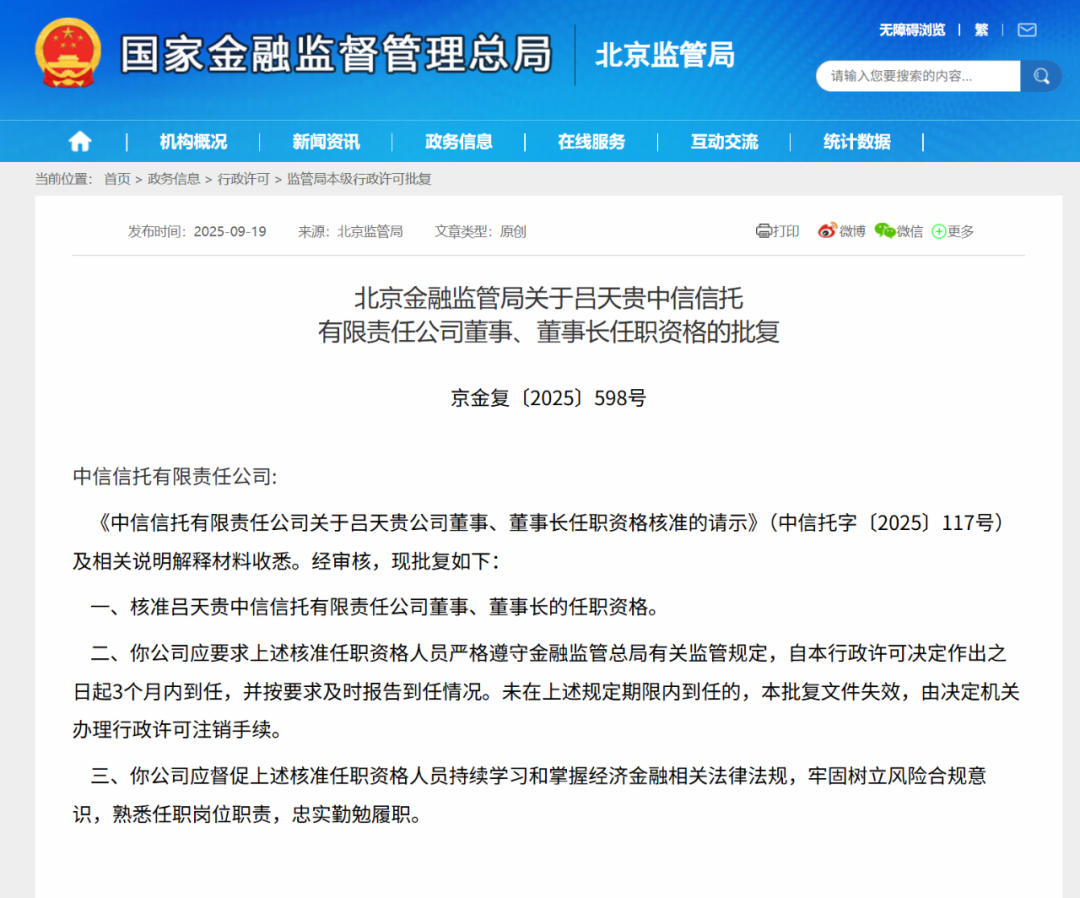
金融老将接棒,吕天贵出任中信信托董事长获批
Zhong Guo Zheng Quan Bao - Zhong Zheng Wang· 2025-09-20 10:18
国家金融监督管理总局9月19日发布批复,核准吕天贵中信信托有限责任公司董事、董事长的任职资格。此次批复意味着中信信托自原董事长芦苇离任 后,正式迎来新任掌舵人。 金融老将接棒 图片来源:金融监管总局网站 今年3月,中信银行公告称,吕天贵因工作调整辞去副行长职务。 吕天贵拥有高级会计师职称、国际注册内部审计师、中国注册会计师资格,毕业于四川大学工商管理专业,获工商管理硕士学位,拥有数十年中国银行业 从业经验。 吕天贵长期任职于银行系统,在担任中信信托董事长前,担任中信银行副行长。他自2018年8月起任中信银行业务总监,2020年10月起担任党委委员, 2021年4月起,任中信银行副行长。今年3月,中信银行发布公告称,吕天贵因工作调整辞去副行长职务。 在中信银行2024年半年度业绩发布会上,时任副行长的吕天贵在回答有关财富管理的问题时表示,各类资产收益率持续走低,给个人财富的保值增值带来 较大挑战,确实需要专业机构,用专业的方法帮助客户解决这些问题。策略就是在客户洞察、财务规划、投资研究、资产配置、投顾服务上着力。 除了董事长一职出现变动外,此前中信信托总经理也发生人事变动。中信信托原副总经理涂一锴已升任总经理。 ...