风控合规

Search documents
流量、增量“两手抓” 险企多元化布局销售渠道
Shang Hai Zheng Quan Bao· 2026-01-16 18:34
Core Insights - Insurance companies are increasingly exploring diversified sales channels, focusing on internet and brokerage platforms to capture new customer growth and enhance market penetration [1][5] - The shift towards online channels is driven by the saturation of traditional sales channels and changing consumer behavior, necessitating a strategic pivot for insurers [1][2] Group 1: Channel Development - Major insurance companies are actively establishing a presence on internet platforms like Xiaohongshu and Douyin, utilizing educational content to attract customers and drive sales [1][3] - Brokerage channels are being leveraged by firms like CITIC Securities and Ping An Securities, which have introduced insurance service sections in their apps, focusing on products like dividend and health insurance [1][3] Group 2: Customer Engagement and Strategy - Different channels require tailored strategies, as customer characteristics vary significantly across platforms, increasing operational complexity for insurers [3][4] - The internet platform has shown potential for high-value sales, with one company reporting a billion-yuan policy sold through online channels, indicating a growing trend in investment-type insurance products [2][3] Group 3: Challenges and Considerations - The fragmented attention of online users poses challenges for building deep trust and effectively selling high-ticket insurance products, which traditionally rely on face-to-face interactions [4][6] - Insurers must balance channel development with compliance and risk management, embedding risk control measures into their digital transformation processes to protect consumer rights while pursuing growth [5][6]
恒丰银行董事长辛树人回答了三个灵魂之问
Sou Hu Cai Jing· 2026-01-08 02:10
Core Viewpoint - The New Year message from Xin Shuren, Chairman of Hengfeng Bank, emphasizes the theme of "staying true to the original intention and embarking on a new journey," reflecting on the achievements during the 14th Five-Year Plan and outlining the direction for the 15th Five-Year Plan. The message addresses three key questions from the market regarding the bank's recovery, transformation, and risk control [2][6]. Group 1: Recovery and Growth - Hengfeng Bank has shown a significant recovery since its restructuring, with a total asset forecast of 1.6 trillion yuan by 2025, achieving 1.568726 trillion yuan by September 2025. The bank's liabilities reached 1.428065 trillion yuan, indicating steady growth [3]. - The bank reported a revenue of 20.7 billion yuan for the first three quarters of 2025, a year-on-year increase of 7.25%, and a net profit of 4.536 billion yuan, up 16.96% year-on-year, marking two consecutive years of revenue and profit growth [3]. - The non-performing loan ratio has been declining for 28 consecutive quarters, although it stood at 1.49% at the end of 2024, higher than the average of 1.27% for joint-stock banks. The acquisition of a non-performing asset package by Shandong Jinzi for 5.465 billion yuan is aimed at further supporting recovery [3][4]. Group 2: Transformation Strategy - Hengfeng Bank's transformation strategy focuses on "returning to the source and concentrating on the main business," with a target system of "3510" and a transformation strategy of "1476," aiming to create a differentiated development path [4]. - The bank is enhancing its deposit base and increasing the proportion of high-quality deposits while building a service network that covers customer supply chains and transaction chains through over 360 branches [4]. Group 3: Risk Control and Compliance - The bank faces challenges in risk control and compliance, highlighted by a fine of 61.5 million yuan due to management issues in loans, bills, and wealth management, with a total of over 20 million yuan in fines from 2023 to 2025 [5]. - Hengfeng Bank is adopting a "risk-based" approach, improving its three-line defense system, and implementing a data-driven risk management strategy through an intelligent approval system that utilizes AI technology [5]. - The bank's ESG rating is BB, indicating that governance and social responsibility compliance need improvement. The ongoing preparations for the bank's IPO are also under scrutiny, with uncertainties regarding profit distribution and capital replenishment adding complexity to the process [5][6].

英大集团:促进上市公司高质量发展
Zhong Guo Zheng Quan Bao· 2025-12-11 04:29
Core Viewpoint - The company emphasizes high-quality development in financial services, aligning with national economic goals and focusing on risk prevention, structural adjustment, and governance improvement [1][2]. Group 1: Business Performance - The company achieved over 80% growth in total revenue and a more than 70-fold increase in net profit compared to the three-year average before restructuring [2]. - The asset management scale of the company surpassed 1 trillion yuan, maintaining the highest A-level rating in the trust industry [2]. - The company has expanded its service offerings in carbon asset management, establishing a comprehensive ecosystem for carbon asset services [2]. Group 2: Risk Management and Compliance - The company has implemented a comprehensive risk management system, focusing on preemptive, ongoing, and post-event risk control [3]. - There is an ongoing optimization of risk governance mechanisms, including risk preference management tools and risk responsibility lists [3]. - The company has enhanced its compliance management capabilities, aligning with regulatory requirements and improving compliance risk control [4]. Group 3: Internal Management - The company has established a modern corporate governance structure, enhancing decision-making and risk management processes [5]. - The governance structure has been improved with strict oversight of board decisions and the establishment of independent director work systems [5]. - The company has developed an ESG governance framework to promote sustainable development and integrate ESG performance into assessments [5]. Group 4: Information Disclosure - The company has improved the readability and transparency of its reports, achieving "zero errors" in disclosures [6]. - There is a dynamic tracking system for related transactions and significant contracts to ensure timely and accurate disclosures [6]. Group 5: External Governance and Market Recognition - The company has received multiple honors from authoritative institutions, enhancing its reputation in the capital market [7]. - The company has actively participated in industry forums and exhibitions, showcasing its achievements in energy efficiency and green innovation [7]. - The company's credit rating has improved from AA+ to AAA, reflecting its strong market position and brand value [7]. Group 6: Investor Relations - The company has enhanced its investor relations management, focusing on investor needs and maintaining high-quality communication [8][9]. - The company has established a market value management system, ensuring a cash dividend ratio of over 30% since restructuring [9]. - The company's stock performance has consistently ranked among the top in its sector, with positive ratings from brokerage firms [9].

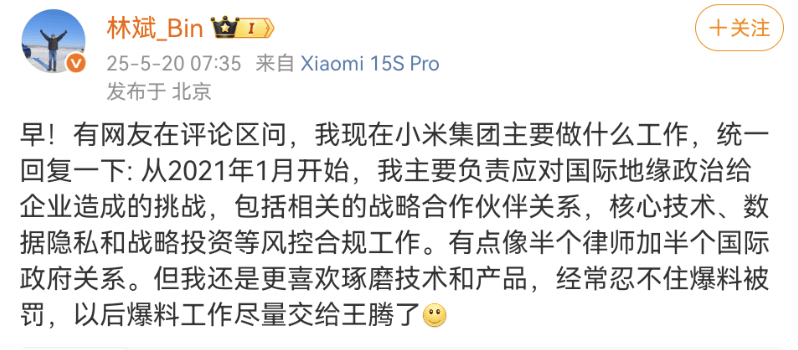
小米林斌回应现在工作:主要负责应对国际地缘政治给企业造成的挑战
Sou Hu Cai Jing· 2025-05-20 01:41
Core Insights - Xiaomi's co-founder and vice chairman, Lin Bin, has been primarily responsible for addressing challenges posed by international geopolitical issues since January 2021, focusing on strategic partnerships, core technology, data privacy, and compliance in strategic investments [1][2] Group 1: Leadership and Responsibilities - Lin Bin describes his role as a combination of a lawyer and an international government relations expert, although he prefers to focus on technology and products [2] - Lin Bin, aged 57, holds a Bachelor's degree in Wireless Electronic Engineering from Sun Yat-sen University and a Master's degree from Drexel University [2] - He co-founded Xiaomi with Lei Jun in 2010 and served as the company's president until 2019, after which he became vice chairman [2] Group 2: Career Background - Prior to joining Xiaomi, Lin Bin worked at Google as an Engineering Director from 2006 to 2010 and held various positions at Microsoft from 1995 to 2006, including Software Design Engineer and Engineering Director [2] - Lin Bin's early responsibilities at Xiaomi included recruitment, administration, legal affairs, finance, and strategic partnerships, as well as expanding international business in markets like India and Indonesia [2]