Alcon Inc.

Search documents
医疗检验标准化赋能分级诊疗:从制度到技术的IVD市场全链条解析
思宇MedTech· 2026-01-14 07:19
Core Viewpoint - The article emphasizes the importance of standardization and mutual recognition in medical testing as a key direction for China's hierarchical diagnosis and treatment reform, reshaping the development landscape of the medical testing industry and presenting new market opportunities and challenges for IVD manufacturers [2][3]. Group 1: Hierarchical Medical System - China's medical hierarchical system is structured into a "three-level, nine-grade" system, categorizing hospitals into three levels, each further divided into three grades, with tertiary hospitals having an additional special grade [5]. - Each level of hospital has distinct functional characteristics: - Primary hospitals focus on community health services, managing common diseases and public health [6]. - Secondary hospitals serve as regional medical centers, providing specialized services and handling referrals from primary hospitals [6]. - Tertiary hospitals offer comprehensive medical services, including advanced specialty care and research, and serve as training centers [6]. Group 2: Policy and Development Trends - The hierarchical diagnosis and treatment system is a core component of China's medical reform, with a target of establishing 3,099 tightly-knit county medical communities by November 2025, covering 9.24 billion people [7]. - Specific regional goals have been set, such as in Henan Province, aiming for 65% of medical services to be provided at the grassroots level by 2025 [7]. Group 3: Hospital Distribution and Trends - As of the end of 2024, there are 1,093,551 medical institutions in China, with 38,710 hospitals. The growth rate of hospitals has slowed to 0.93%, primarily due to a significant slowdown in the growth of private hospitals [8]. - Tertiary hospitals are experiencing rapid growth, with an increase of 256 hospitals in 2024, reflecting a trend of concentrating quality medical resources at higher levels [8]. Group 4: Testing Department Standards and Equipment Requirements - Different levels of hospitals have varying standards and requirements for their testing departments, directly impacting the demand structure for IVD products [9]. - The construction and equipment standards for testing departments vary significantly across hospital levels, with tertiary hospitals requiring the most advanced and comprehensive equipment [10]. Group 5: IVD Demand Decoding - Primary hospitals are moving towards integrated and simplified equipment needs, with a focus on upgrading outdated devices and ensuring compliance with new standards [12]. - Secondary hospitals require modular and mid-level automated equipment to meet both routine and specialized testing demands, with a growing emphasis on laboratory information management systems [15]. - Tertiary hospitals focus on high-throughput and cutting-edge platforms, emphasizing the need for comprehensive automation and integration to support clinical research and advanced diagnostics [18]. Group 6: Revenue Structure Analysis - In 2023, the examination and testing revenue for secondary public hospitals accounted for approximately 30% of their total revenue, while for tertiary hospitals, it constituted about 29.59% of their medical service revenue [22]. - The income structure varies significantly across hospital levels, with primary hospitals relying on basic testing projects, secondary hospitals benefiting from specialized projects, and tertiary hospitals driving revenue growth through high-value specialized projects [23][24]. Group 7: Market Transformation in Primary Care - The focus of enhancing primary healthcare institutions is shifting from mere equipment updates to deeper system standardization and centralized operations [26]. - Standardization in testing is driven by the need for result mutual recognition and cost control, making standardized reagents and quality control systems essential for primary healthcare institutions [28]. - The "medical community" model is changing procurement and supply methods, leading to a market shift towards centralized purchasing and integrated solution offerings [30][31].


最新解读!第六批高值医用耗材国家集采开标
思宇MedTech· 2026-01-14 07:19
Core Viewpoint - The sixth batch of national organized high-value medical consumables centralized procurement has introduced significant changes in procurement rules, emphasizing systematic governance rather than merely price reduction [2][12]. Group 1: Drug-Coated Balloons (DCB) - DCB has been officially included in the national procurement, reflecting a clear policy logic that aligns with previously procured coronary and peripheral vascular stents [3]. - All 42 DCB products submitted by 32 companies were selected, indicating a focus on maintaining clinical options and technological integrity while reducing costs [4]. Group 2: Urological Interventions - The inclusion of urological intervention consumables marks a significant development, as this area has long been considered a "blank zone" for centralized procurement due to its complexity [5]. - In this round, 195 companies submitted 454 products, with 398 products selected, covering essential instruments such as guidewires and ureteral catheters, showcasing a shift towards managing complex consumables [6]. Group 3: Key Rule Changes - The procurement process has introduced group bidding based on the demand size of medical institutions and their national supply capabilities, ensuring clinical continuity rather than imposing a uniform standard [9]. - A pricing coefficient for differentiated products with certain functional innovations has been established, allowing for a more nuanced approach to pricing that recognizes clinical value [9]. - The handling of extreme low pricing has changed, with the baseline for price calculations set at 65% of the average selected price, discouraging practices that disrupt the overall pricing structure [10]. Group 4: Evolution of Procurement Role - Since 2020, six batches of high-value medical consumables procurement have been completed, covering nine categories and 142 types of consumables, indicating a shift from rapid cost control to more refined governance objectives [12][14]. - The new procurement framework aims to balance price, quality, supply, and clinical continuity, moving away from a singular focus on price to a more comprehensive regulatory approach [14].

最新!2026年首款创新医疗器械获批!
思宇MedTech· 2026-01-09 07:39
Core Viewpoint - Shanghai Weimi Medical Technology Co., Ltd. has received approval from the National Medical Products Administration (NMPA) for its self-expanding aneurysm embolization device, MeshCoil®, marking it as the first domestically approved device for treating wide-neck bifurcation intracranial aneurysms in China [2][3]. Clinical Pain Points - Bifurcation wide-neck aneurysms are considered a challenging subtype in intracranial aneurysm intervention due to their complex anatomical structures and the need for effective treatment strategies that minimize long-term intervention on normal vascular structures while ensuring adequate neck coverage [5]. Product Introduction - MeshCoil® utilizes an "intra-aneurysmal turbulence" technology, positioned within the aneurysm cavity to alter hemodynamic conditions and promote thrombosis, thereby occluding the aneurysm. This device aims to provide a supplementary solution for specific complex aneurysm morphologies, bridging the gap between stent-assisted coiling and flow diversion devices [6][7]. Design and Materials - The device is made from nickel-titanium alloy and composite wire, featuring self-expanding properties. Its design focuses on achieving neck coverage and device stability while minimizing long-term effects on normal vascular segments [7][10]. Clinical Validation - A multi-center clinical trial led by Xuanwu Hospital of Capital Medical University included 139 participants, demonstrating that MeshCoil® exhibits good safety and efficacy in treating bifurcation wide-neck aneurysms. The results indicated a 12-month complete occlusion rate of 88.5% and a bleeding rate of 0.7% [11][13]. Company Overview - Shanghai Weimi Medical Technology Co., Ltd. is based in the Zhangjiang International Medical Park in Shanghai, focusing on innovative technology development and promotion in the field of minimally invasive and precision medicine, particularly for intracranial aneurysms [12].

Broadwood Partners Comments on STAAR Surgical Shareholders' Rejection of the Company's Proposed Sale to Alcon

Businesswire· 2026-01-06 14:52
Core Viewpoint - Broadwood Partners, L.P. and its affiliates, owning 30.2% of STAAR Surgical Company, announced that shareholders decisively rejected the proposed acquisition of STAAR by Alcon Inc. during the Special Meeting of Shareholders [1] Group 1 - Broadwood Partners and affiliates hold a significant stake of 30.2% in STAAR Surgical Company [1] - The Special Meeting of Shareholders was held to discuss the acquisition proposal by Alcon Inc. [1] - Preliminary results indicate a strong rejection from shareholders regarding the acquisition [1]

活动报名!医疗器械IPO招股书解读、上市前后传播合规实践
思宇MedTech· 2026-01-05 04:38
Core Viewpoint - The article emphasizes the importance of the IPO stage for medical device companies, highlighting that these companies often feel hesitant to communicate during this critical period [2]. Summary by Sections IPO Documentation and Communication - The article discusses the contents of the prospectus and the information that can be interpreted and utilized, as well as the communication limitations for companies before and after going public [3]. - It raises questions about the roles of marketing and branding departments during this phase, indicating a lack of systematic guidance and reliance on experiences from investment banks and listing teams [3]. Event Information - An organized event for a small group of participants is scheduled for January 15, 2026, in Shanghai, focusing on IPO-related discussions for medical device companies [4]. - The event is free but requires registration, which will be reviewed [4]. Agenda and Participants - The agenda includes self-introductions, a presentation by a guest speaker, and open discussions, targeting market/brand leaders from companies planning or undergoing IPOs, as well as management and strategic personnel [6]. - The guest speaker will cover three main topics: the readability of medical device prospectuses, compliance boundaries for communication before and after IPO, and executable promotional strategies for companies [7]. Key Topics of Discussion - The article outlines the basic structure and key modules of a prospectus, what different roles (marketing, investment, partners) typically focus on, and the distinction between factual statements and potentially misused content [7]. - It also addresses what can be communicated and what should be avoided, along with common pitfalls in promotional activities [7]. - The differences in risks before and after the IPO stage are highlighted, along with recommendations for effective communication strategies during the IPO process [7].

数千万融资! 透析液再生技术企业完成A1轮
思宇MedTech· 2026-01-04 03:08
# 一个规模巨 大 、但变化缓慢的器械赛道 透析是终末期肾病患者不可替代的长期治疗方式,也是医疗器械领域中规模最大的单一治疗场景之一。但 与其市场体量并不匹配的是,该领域在治疗模式和系统效率上的变化相对有限。 在国内,透析治疗仍高度依赖中心化医疗机构,患者需长期、高频往返医院完成治疗。这一模式在保障安 全性的同时,也带来了明显的现实问题:患者时间与体力负担沉重,基层地区可及性不足,医疗机构在医 保控费和耗材集采背景下面临持续运营压力。 在此基础上,透析治疗对患者生存质量的改善空间也相对有限,使得这一领域逐渐呈现出 "刚需、高频、但 系统效率偏低" 的特征。 近日, 上海心光生物医药有限责任公司 (以下简称"心光生物")宣布完成 数千万元A1轮融资 。本轮融资 由国际知名机构领投,老股东 兴富资本 跟投,凯乘资本担任长期财务顾问。公司表示,募集资金将主要用 于再生型腹膜透析产品的型式检验、临床试验及注册申报等关键节点。 在当前医疗器械投资更加关注 "是否解决真实系统性问题" 的背景下,心光生物所切入的透析赛道,并非高 速变化的热门领域,却长期存在结构性矛盾。本轮融资,更多体现的是资本对透析治疗模式调整可能性的 ...

医疗器械加速中:十大高增长市场的真实图景
思宇MedTech· 2026-01-01 03:30
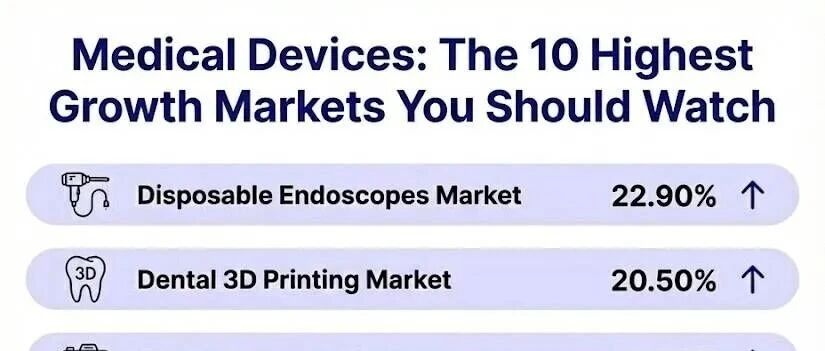
Core Viewpoint - The medical device sector is becoming one of the most certain and continuously evolving segments within the healthcare system, with ten related markets entering an acceleration phase due to clinical demand, payment logic, and technological maturity [2]. Summary by Relevant Sections Accelerating Medical Device Markets - Ten medical device markets are identified as entering an acceleration phase, indicating a significant shift in how medical services are provided, executed, and managed [2][3]. Market Growth Projections - **Disposable Endoscopes Market**: Expected to grow from $840 million in 2024 to $2.67 billion by 2030, with a CAGR of 22.9% [5]. - **Dental 3D Printing Market**: Projected to increase from $3.4 billion in 2024 to $10.06 billion by 2030, with a CAGR of 20.5% [6]. - **Surgical Imaging Market**: Anticipated to rise from $3.9 billion in 2023 to $12.2 billion by 2030, with a CAGR of 17.6% [7]. - **Surgical Robots Market**: Expected to grow from $9.6 billion in 2023 to $23.7 billion by 2029, with a CAGR of 16.5% [8]. - **Medical Robots Market**: Projected to increase from $13.8 billion in 2023 to $33.8 billion by 2029, with a CAGR of 16.1% [9]. - **Minimally Invasive Surgery Market**: Expected to grow from $81.65 billion in 2024 to $199.3 billion by 2030, with a CAGR of 16.1% [10]. - **Surgical Instrument Tracking System Market**: Anticipated to rise from $31.4 million in 2024 to $75.1 million by 2030, with a CAGR of 15.2% [12]. - **Autoinjectors Market**: Expected to grow from $1.08 billion in 2024 to $3.02 billion by 2030, with a CAGR of 13.6% [14]. - **Medical Aesthetics Market**: Projected to increase from $17.16 billion in 2024 to $35.32 billion by 2030, with a CAGR of 12.8% [15]. - **Diabetes Care Devices Market**: Expected to grow from $34.3 billion in 2025 to $61.2 billion by 2030, with a CAGR of 12.3% [16]. Common Directions Behind Growth - The ten markets are not isolated; they point towards several clear trends: - Medical services are becoming "de-experienced," with devices taking over tasks previously reliant on personal experience to reduce uncertainty [18]. - Efficiency is becoming a critical consideration in payment and procurement, driving growth in imaging, tracking, and disposable products [19]. - Minimally invasive and low-invasion procedures are becoming the default assumption rather than an optional choice [19]. - Healthcare is transitioning from "single-point devices" to "systematic operations," with platform, modular, and process capabilities becoming the new core of competition [20]. Reasons for Current Acceleration - The changes are not sudden but are the result of the convergence of technological maturity, shifts in payment logic, and structural labor shortages in healthcare, leading to a focus on devices that can change operational methods [21].
最新出炉!2025全球医疗科技产业贡献奖
思宇MedTech· 2025-12-31 10:00
Core Viewpoint - The article emphasizes the importance of continuous technological innovation and stable industrial systems in the global medical technology industry, highlighting the launch of the "Global MedTech Awards" by Siyu MedTech to recognize companies that positively impact the industry through innovation, collaboration, and long-term investment [2]. Group 1: Award Criteria - The awards focus on companies' capabilities in technology and product innovation, assessing their ability to convert innovations into stable product systems that provide clinical value [3]. - The evaluation also considers the role of companies in industrial collaboration and ecosystem building, including their efforts in resource integration and enhancing industry efficiency through capital, technology, or organizational capabilities [4]. - Companies are assessed on their sustainable development and long-term investment strategies, particularly in R&D, manufacturing, localization, and social responsibility in key markets like China [5]. Group 2: Award Winners - Medtronic, a leading global medical technology company, received the "Medical Technology Industry Contribution Award" for its long-term commitment to cardiovascular, neurostimulation, and chronic disease management, showcasing significant contributions in technology innovation and industry collaboration [9][10]. - Stryker, recognized for its advancements in orthopedic and minimally invasive technologies, was awarded for its systematic investments in technology and ecosystem development, particularly in surgical robotics and pain management [13][14]. - Boston Scientific was acknowledged for its leadership in cardiovascular and neurostimulation fields, with notable innovations like the FARAPULSE™ system for atrial fibrillation treatment and a focus on enhancing clinical capabilities through strategic acquisitions [17][18]. - Alcon, a prominent player in the ophthalmic sector, was awarded for its continuous innovation in eye care technologies, including the Voyager™ DSLT system and advancements in cataract and refractive surgery [22][23]. - MicroPort, recognized for its multi-platform capabilities in high-end medical devices, demonstrated significant progress in product maturity and international market expansion, earning the award for its systematic approach to technology and clinical application [25][27]. - United Imaging Healthcare, a representative of high-end medical imaging equipment in China, was awarded for its technological innovations and global expansion efforts, particularly in ultrasound and AI applications [31][32].

近亿元!外泌体研发企业完成A轮战略融资
思宇MedTech· 2025-12-30 14:40
Core Viewpoint - Erui Xinyue Technology Co., Ltd. has completed a nearly 100 million yuan A-round strategic financing, reflecting the capital market's ongoing interest in the clinical application of exosomes as they transition from research tools to clinical products [2]. Group 1: Financing and Use of Funds - The recent financing round was led by Guozhong Capital, with Chengdu Sibaiyi Fund participating, marking the company's fourth round of funding in four years [2]. - The funds will primarily be used for capacity layout, platform technology upgrades, and the clinical and commercial advancement of exosome-related products [2][6]. Group 2: Technological Pathway and Product Development - Since its establishment, the company has focused on the research and development of exosome-related technologies, building a comprehensive platform covering research, diagnostics, and raw material preparation [4]. - The company has developed an in vitro diagnostic kit for detecting alpha-synuclein in plasma neuronal exosomes, aimed at early auxiliary diagnosis of neurodegenerative diseases like Parkinson's [4]. - The company is also involved in the extraction of exosome-related equipment and raw material preparation, providing services across various application stages [5]. Group 3: Industry Context and Future Outlook - The exosome industry is transitioning from concept-driven to product and data-driven, with the company making initial strides from a technology platform to specific diagnostic products [6]. - Future observations will focus on the depth of clinical validation, the pace of product rollout, and the sustainability of the business model [6].

高管变动!全球透析巨头
思宇MedTech· 2025-12-30 14:40
Core Viewpoint - The appointment of Dr. Charles Hugh-Jones as Global Chief Medical Officer of Fresenius Medical Care signals a shift in the dialysis and kidney care industry, where competition is moving from "equipment performance" to "medical systems and long-term efficacy management" [2]. Group 1: Fresenius Medical Care's Role - Fresenius Medical Care is not just a device manufacturer but provides a comprehensive life support system for chronic kidney disease patients, covering dialysis equipment, consumables, and service networks [3][4]. - The company's responsibilities extend beyond merely selling equipment to hospitals; it must maintain high stability in long-term safety, treatment consistency, and care quality [4]. Group 2: Transition from Maddux to Hugh-Jones - Dr. Franklin W. Maddux, who served as Global Chief Medical Officer since 2020, oversaw a period where the dialysis industry increasingly emphasized real-world evidence, long-term follow-up, and clinical quality management [5][7]. - Dr. Hugh-Jones brings a diverse background from Allergan, Pfizer, and Sanofi, aligning with a trend where chronic disease management is integrating broader medical strategies and data systems [9]. Group 3: Why "Medical Leadership" is Being Highlighted - The technological ceiling for dialysis devices is approaching, with differentiation increasingly based on long-term complication management, patient quality of life, and systemic care capabilities rather than single-treatment outcomes [11]. - Regulatory and payment systems are demanding clearer evidence of "clinical value," transforming the medical department from a compliance supporter to a builder of evidence systems [12]. - Data and services are reshaping the boundaries of device companies, pushing dialysis from "standardized device treatment" to "continuous medical services," necessitating deeper integration of medical decision-making into product and system design [13][14]. Group 4: Implications for the Medical Device Industry - The appointment of Hugh-Jones reflects a broader industry trend where medical functions are gaining strategic importance, especially in chronic disease management and long-term life support systems [15]. - Companies are increasingly recognizing that when product lifecycles span years, medical judgment becomes a critical component of product competitiveness [16].