
Henkel

Search documents
中国线上美妆:市场龙头相对整体市场保持强劲增长-China Online Beauty_ Market leaders sustained strong growth vs. broader market
2025-10-19 15:58
Summary of Key Points from the Conference Call Industry Overview - The Chinese beauty e-commerce market experienced a slight contraction in September with a Gross Merchandise Value (GMV) decline of -1.0% and a -2.6% decline in Q3, following a -2.2% decline in August [2][21] - Despite the overall market decline, tracked cosmetics leaders outperformed with +8.1% growth in September, up from +6.5% in August, and a solid +12% two-year CAGR [2][21] - The tracked beauty companies gained market share by +125 basis points (bps) in September, with Q3 growth improving to +6.5% compared to +3.5% in Q2 [2][21] Company Performance Highlights L'Oréal - Achieved +11% GMV growth in September, expanding market share by +177bps [4] - Q3 GMV growth accelerated to +10%, a significant improvement from flat growth in Q2 [4] Estée Lauder - Delivered impressive GMV growth of +16% in September and maintained strong momentum with a +14% increase in Q3 [5] - Market share gains of +299bps were driven by flagship brands La Mer and Estée Lauder [5] LVMH - GMV grew +7% YoY in September, gaining +122bps in market share [6] - The brand Dior was a key driver, with pricing increases offsetting volume declines [6] Proya - Experienced a -9% YoY decrease in September, with its flagship brand declining -11% [8] - Despite frequent new product launches, the company struggled to rejuvenate core brand growth [8] Giant Biogene - Declined -7% YoY in September, with flagship brand Kefumei falling -10% [9] - Consumer confidence was impacted by resurfaced product quality concerns [9] Shiseido - Overall online sales increased by +2% YoY in September, with flagship brand Shiseido seeing a +28% growth [10] - The premium line Clé de Peau declined -15% YoY [10] Beiersdorf - GMV performance rebounded with a +7% increase in September, following a -21% decline in August [11] - Eucerin achieved a +107% GMV increase in September [11] P&G Beauty Brands - Posted robust GMV growth of +21% in September, rebounding from +5% growth in August [12] - Significant market share gain of +148bps was noted [12] Unilever - Continued to face challenges with a -4% decline in September, following a -21% drop in August [13] - Market share gains were robust, increasing by +133bps [13] Henkel - Beauty Care division faced pressure with a -16% decline in September and -24% in Q3 [14] Investment Implications - Outperform ratings on Beiersdorf and Unilever, with Market-Perform ratings on Henkel and L'Oréal [16] - In the Chinese cosmetics market, Shiseido is rated Underperform, Proya is rated Market-Perform, and Giant Biogene is rated Outperform [18] Additional Insights - The upcoming 11.11 Singles Day festival is seen as a critical checkpoint for assessing brand market positions amid ongoing controversies [9] - The Douyin platform has been a significant contributor to market growth, while T+T continues to observe declines [21] This summary encapsulates the key points from the conference call, highlighting the performance of major companies within the beauty industry and the overall market dynamics.
iTherM 2025十大亮点,全景呈现热管理产业新格局
DT新材料· 2025-09-28 16:03
Core Insights - The article emphasizes the growing importance of thermal management as a "hidden core" in cross-industry collaborative innovation, driven by advancements in new energy, semiconductors, data centers, automotive, and low-carbon economies [2] - The iTherM 2025 conference aims to create a comprehensive platform for the thermal management industry, integrating exhibition, forums, results release, and resource matching to foster collaborative development [3] Group 1: Event Overview - iTherM 2025 is set to take place in Shenzhen, featuring an exhibition area of 20,000 square meters and attracting over 350 core enterprises from the thermal management industry [4] - The previous conference attracted over 10,000 professional visitors and 1,500 attendees, highlighting its significance as a leading event in the thermal management sector [4] Group 2: Participation and Networking - The event will gather over 300 top enterprises, including international representatives like Honeywell, 3M, and NVIDIA, as well as domestic leaders such as BYD and Huawei, showcasing the latest products and technologies [7] - iTherM 2025 is expected to connect with over 1,000 targeted buyers from major companies, facilitating efficient supply-demand matching through VIP buyer channels [9] Group 3: Expert Engagement - The conference will feature over 100 expert reports from industry leaders and researchers, focusing on key topics such as thermal science and battery cooling, providing strategic insights and technology trend analyses [11] - A series of specialized forums will be held, allowing participants to share cutting-edge research and innovative applications across various sectors [13] Group 4: Exhibition Structure - The exhibition will be organized into six thematic areas, covering the entire thermal management process from materials to systems, with a focus on practical applications [14] - A dedicated area for innovative achievements will showcase the latest research breakthroughs from academic institutions, promoting the transition from research to industry applications [23] Group 5: Investment and Collaboration - iTherM 2025 will emphasize investment and entrepreneurial project matching, inviting industry capital and startups to engage in discussions, particularly in areas like innovative materials and data center systems [25] - The event aims to create a positive cycle of technological breakthroughs, industrial implementation, and capital empowerment within the thermal management industry [25] Group 6: Future Outlook - The conference is positioned as a key platform for driving technological innovation and industrial upgrades in the thermal management sector, with a focus on multi-scenario applications and comprehensive industry engagement [27]


行业聚焦:全球白车身结构胶市场头部企业份额调研(附Top10 厂商名单)
QYResearch· 2025-09-10 06:15
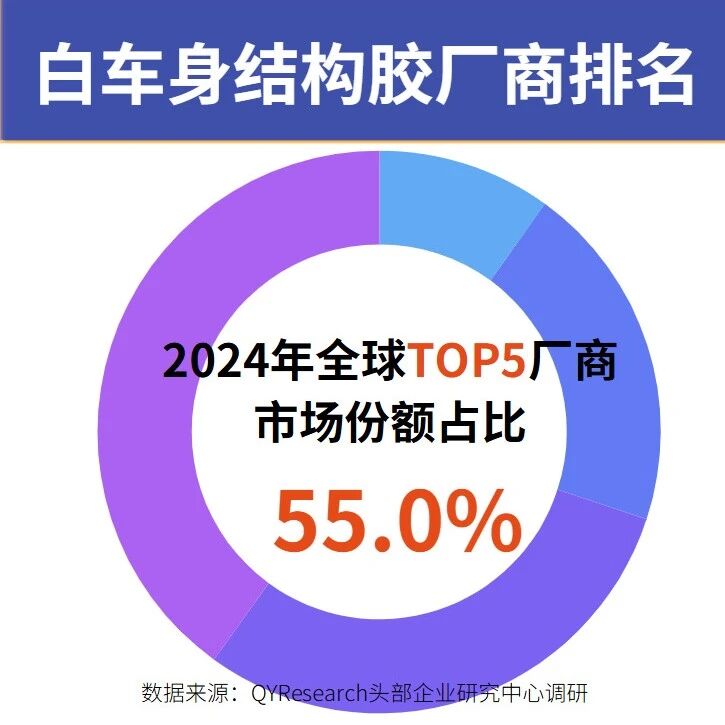
Core Viewpoint - The white body structural adhesive is crucial in modern automotive manufacturing, enhancing vehicle strength, rigidity, and safety while meeting the increasing demands for lightweight, energy-efficient, and environmentally friendly designs [1][2]. Market Overview - The global market for white body structural adhesives is projected to reach $1.9 billion by 2031, with a compound annual growth rate (CAGR) of 2.9% in the coming years [2]. - The epoxy resin type dominates the market, accounting for approximately 65.9% of the total share, while passenger vehicles represent the largest application segment, holding about 80.5% of the market [8][10]. Key Drivers - The trend towards automotive lightweighting is driving the use of aluminum, high-strength steel, and composite materials, thereby increasing the demand for structural adhesives [12]. - The rapid expansion of electric and hybrid vehicle platforms is creating a greater need for adhesive connections that do not require welding [12]. - Stricter collision safety standards necessitate high-strength, fatigue-resistant adhesives to enhance vehicle stability [12]. - Improvements in noise, vibration, and harshness (NVH) performance are supported by structural adhesives, contributing to overall vehicle comfort [12]. - Increased automation in manufacturing processes facilitates the widespread adoption of structural adhesives among mainstream OEMs [12]. Market Challenges - Long curing times and high thermal treatment requirements complicate production processes and demand higher control capabilities from automotive manufacturers [12]. - Sensitivity to surface pre-treatment can lead to unstable adhesion and interface aging in multi-material connections [12]. - Traditional connection methods, such as spot welding and riveting, are still preferred by some OEMs, limiting the adoption of adhesive technologies [12]. - High material costs and lengthy validation periods for high-performance structural adhesives can slow down the commercialization of new materials [12]. Regional Insights - Europe leads in the application of structural adhesives, driven by a strong focus on electric vehicle development, lightweight design, and collision safety [2]. - North America follows closely, particularly in the demand for structural performance in larger vehicles like trucks and SUVs [2]. - The Asia-Pacific region, especially China, shows significant growth potential due to supportive policies for new energy vehicles and advancements in manufacturing technology [2]. Competitive Landscape - Major global manufacturers of white body structural adhesives include Henkel, Sika, DuPont, H.B. Fuller, and Sunstar, with the top five companies holding approximately 55.0% of the market share in 2024 [7]. - The market is characterized by a strong presence of epoxy resin products, which are essential for various automotive applications [9].
股票雷达:拆解人工智能、资本支出及本周关键研究-GS Equity Radar_ Unpacking AI, capex and key research from the week
2025-08-24 14:47
Summary of Key Points from the Conference Call Industry and Company Involvement - **Industry Focus**: The discussion primarily revolves around the **AI** and **capital expenditure (capex)** trends, particularly in **Europe** and the **semiconductors** sector. - **Companies Mentioned**: Notable companies include **ASML**, **Infineon**, **Logitech**, and **Nokia** as part of the AI and Semiconductors Symposium. Core Insights and Arguments - **AI and Capex Trends**: There is a consensus on the significant increase in capex related to AI, with a focus on its implications for investment strategies and market dynamics [1][4][51]. - **European Capex Revival**: Evidence suggests a revival in European capex, with companies that have positive capex revisions being rewarded by the market, contrasting with the previous trend of prioritizing buybacks over investments [1][8][42]. - **Capacity Utilization**: The report highlights that capacity utilization in Europe is showing a sequential increase, which is a positive leading indicator for future capex [1][10][28]. Additional Important Insights - **Market Reactions to Earnings**: There is a noted trend of outsized market reactions to earnings misses, with companies like Novonesis experiencing a 7% drop despite meeting revenue expectations, indicating a disconnect between share price movements and fundamental performance [12][14][30]. - **Sector Performance**: The report discusses various sectors, including consumer staples, healthcare, and utilities, with specific companies like Carlsberg and Henkel facing challenges, while others like Flutter and DHL show strong performance [17][18][19][20][23]. - **Macro Environment**: The overall macroeconomic environment is described as favorable, with expectations of continued growth in Europe, driven by fiscal policies and a strong earnings season in the US [39][40]. Conclusion The conference call provides a comprehensive overview of the current trends in AI and capex, particularly in Europe, while also addressing the broader market dynamics and sector-specific performances. The insights gathered can inform investment strategies and highlight potential opportunities and risks in the market.
全球与中国食品机械润滑油脂市场规模预测及前景动态分析报告2025-2031年
Sou Hu Cai Jing· 2025-06-07 22:28
Core Insights - The report provides a comprehensive analysis of the global and Chinese food machinery lubricants market, including market size forecasts and dynamic trends from 2025 to 2031 [1][3]. Market Overview - The food machinery lubricants market is categorized into several product types, including H1, H2, and 3H lubricants, with sales growth trends projected from 2020 to 2031 [3][4]. - The market is segmented by application, covering areas such as meat processing, fruits and vegetables, confectionery, beverages, animal feed, and others [4][5]. Global Market Size Analysis - The global food machinery lubricants market is expected to see significant growth in capacity, production, and utilization rates from 2020 to 2031 [4][5]. - The report outlines the supply and demand dynamics, including production and demand trends across major regions [4][5]. Regional Analysis - The report details the production trends and market shares of food machinery lubricants across key regions, including North America, Europe, China, Japan, Southeast Asia, and India from 2020 to 2031 [4][5]. - It highlights the sales revenue and growth rates for these regions, indicating a robust market expansion [4][5]. Major Manufacturers Analysis - The report identifies key players in the food machinery lubricants market, analyzing their production capacities, sales volumes, and revenue from 2020 to 2025 [5][6]. - It includes a ranking of major manufacturers based on their revenue in 2024, providing insights into market concentration and competitive landscape [5][6]. Product Type and Application Analysis - The report presents a detailed analysis of different product types and applications, including sales volume and revenue forecasts from 2020 to 2031 [6][7]. - It discusses the pricing trends for various product types and applications, indicating market dynamics and consumer preferences [6][7]. Industry Opportunities and Challenges - The report outlines the opportunities and driving factors for the food machinery lubricants industry, as well as potential challenges and risks [8][9]. - It includes a SWOT analysis for Chinese enterprises in the sector, providing insights into competitive positioning and strategic planning [8][9].

China Automotive Adhesives Market Forecast & Opportunities Report 2030: China's Auto Adhesives Industry Booms Amid Sustainability Push & Rising EV Production
Globenewswire· 2025-03-11 14:22
Market Overview - The China automotive adhesives market is projected to grow from USD 574.03 million in 2024 to USD 737.4 million by 2030, at a CAGR of 4.2% [1][3][14] - The market plays a significant role in the broader adhesives market in China, with a notable contribution to overall growth [3] Key Market Drivers - Increasing vehicle production and the adoption of lightweight materials are primary drivers of market growth, as automakers seek to improve fuel efficiency and reduce emissions [4][7] - Government initiatives promoting domestic production and technological innovation are enhancing the competitiveness of Chinese automakers [5][6] Market Trends - There is a growing emphasis on lightweighting in the automotive industry, leading to increased demand for high-performance adhesives that can bond lightweight materials [11][12] - The shift towards lightweight vehicles is driven by sustainability goals and the need for reduced carbon emissions [11][12] Key Market Players - Major players in the market include Henkel, H.B. Fuller, 3M China, and Sika China, among others [1][16] Market Challenges - The complexities associated with high performance and durability requirements for automotive adhesives present challenges, as they must withstand harsh operating conditions [10]
