
太极集团

Search documents
最高价差915倍,医保让中成药降价
经济观察报· 2025-07-31 10:24
Core Viewpoint - The article discusses the ongoing price governance of traditional Chinese medicine (TCM) products across multiple provinces in China, highlighting the significant price discrepancies and the government's efforts to regulate these prices to alleviate the financial burden on patients and the healthcare system [2][3][5][21]. Group 1: Price Governance Initiatives - Multiple provinces, including Guangxi, Liaoning, Heilongjiang, and Tianjin, have announced price governance measures for TCM products, indicating a nationwide effort to address high prices [2][3]. - The National Healthcare Security Administration (NHSA) has issued a report identifying TCM products with prices significantly higher than the lowest available options, prompting provincial authorities to take action [15][16]. Group 2: Price Discrepancies - There are extreme price differences for the same TCM products across different regions, with some products priced over 100 times higher than the lowest price available [6][9][10][11][12]. - For example, in Ningxia, a single unit of An Gong Niu Huang Wan is priced at 998 yuan, which is 11 times the lowest daily treatment cost for the same product [8]. Group 3: Factors Contributing to Price Variability - Price differences can be attributed to variations in ingredients, dosage forms, quality standards, and insufficient market competition, leading to concentrated pricing power among certain manufacturers [13]. - The complexity of TCM formulations and the lack of standardized quality control further exacerbate pricing issues [24]. Group 4: Impact on Pharmaceutical Companies - The price governance measures affect various pharmaceutical companies, including both small enterprises and established publicly listed firms like Tai Chi Group and Huason Pharmaceutical [21]. - Companies are under pressure to adjust their pricing strategies in response to the new regulations, with some indicating that the impact on their operations will be minimal [22]. Group 5: Patient Benefits and Future Outlook - The governance is expected to reduce the financial burden on patients, particularly for commonly used medications for chronic diseases, promoting fairer pricing and rational drug use [23]. - Experts suggest that while price governance is a step forward, it may not fully resolve the issue of price discrepancies, and additional measures such as collective procurement and improved industry standards are necessary [24].


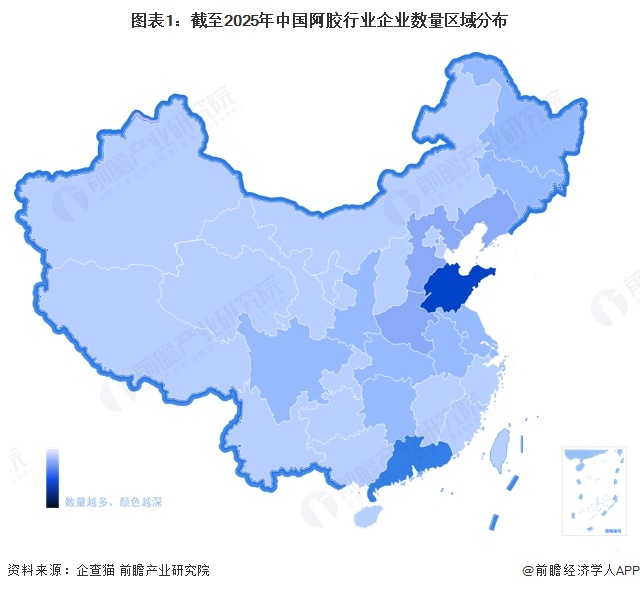
2025年山东省阿胶行业发展现状 发源地东阿县具有较好的产业集群化优势【组图】
Qian Zhan Wang· 2025-07-31 07:19
Core Insights - The article highlights the significance of Shandong Province as the primary region for the Chinese ejiao (donkey-hide gelatin) industry, with a concentration of registered companies and production capacity [1][11]. Industry Overview - The ejiao industry in China is predominantly located in Shandong Province, with major companies also found in Guangdong, Henan, Hebei, and Jilin [1]. - Shandong Province is home to over 200 ejiao production enterprises, with a duopoly market structure led by Dong'e Ejiao and Fupai Ejiao, while other brands compete in the market [7][11]. Production and Supply - The total number of donkeys in Shandong Province is projected to decline to 21,000 by 2024, with the province accounting for only 1.83% of the national donkey population as of the end of 2023 [3][4]. - The donkey breeding regions in Shandong are concentrated in seven cities, which account for over 95% of the province's donkey population [4]. Development Plans - The "Shandong Province Donkey Industry High-Quality Development Plan (2024-2035)" aims to double the donkey population by 2030 and establish 3-5 leading ejiao production enterprises, with a target of over 100 billion yuan in industry output value by 2035 [4][12]. - Dong'e County is recognized as a key area for ejiao production, contributing over 60% of the national ejiao output [12]. Key Companies - Dong'e Ejiao Co., Ltd. is a major player in the ejiao market, established in 1952 and known for its high-quality products and significant market presence [10]. - Fupai Ejiao Co., Ltd. has a long history dating back to 1950 and has developed into a comprehensive health industry group [10]. - Other notable companies include Jinan Guben Tang Biotechnology Co., Ltd., Jinan Qian Nian Biological Engineering Co., Ltd., and Shandong Hongjitang Pharmaceutical Group Co., Ltd., each contributing to the diverse ejiao product offerings [10].

最高价差915倍,医保让中成药降价
Jing Ji Guan Cha Wang· 2025-07-31 05:44
Core Viewpoint - A nationwide price governance action for traditional Chinese medicine (TCM) is being implemented across multiple provinces in China, addressing the issue of inflated prices and the pressure it places on medical insurance funds [2][9]. Price Governance Action - Provinces such as Guangxi, Liaoning, Heilongjiang, and Tianjin have announced price governance measures for TCM, with additional provinces like Ningxia, Inner Mongolia, Shanxi, Henan, Hebei, and Jilin also participating [2]. - The governance is a response to the significant price discrepancies and the pressure on medical insurance funds caused by high TCM prices [2][11]. Price Discrepancies - Notable TCM products, including An Gong Niu Huang Wan and Ban Lan Gen Granules, have been identified with price differences exceeding 100 times between various manufacturers [3][4]. - A study indicated that out of 93 high-priced TCM products, only 6 had prices close to their theoretical retail prices, highlighting widespread price inflation [3]. Factors Contributing to Price Differences - Price variations are attributed to differences in ingredients, dosage forms, quality standards, and insufficient market competition, leading to concentrated pricing power among certain products [7][11]. - For instance, the daily treatment cost of An Gong Niu Huang Wan can reach 1,898 yuan in Inner Mongolia, significantly higher than the lowest price available [4]. Regulatory Measures - The National Medical Insurance Administration has initiated measures to regulate high-priced TCM products, requiring provinces to verify and adjust prices by July 31 [9][10]. - Provinces have been instructed to impose penalties on companies that fail to comply with price adjustments, including procurement risk identification and potential suspension of product listings [10]. Impact on Pharmaceutical Companies - The price governance affects various pharmaceutical companies, including well-known listed firms such as Taiji Group and Yabao Pharmaceutical, which are now under scrutiny for their pricing practices [12]. - Companies are expected to adapt to a new pricing model based on cost and efficacy, as reliance on high pricing and marketing strategies may no longer be sustainable [13]. Benefits for Patients - The price governance is anticipated to reduce the financial burden on patients, particularly for commonly used medications for chronic diseases, promoting fairer drug pricing and usage [13]. - Increased price transparency is expected to help regulate prescription practices and reduce the misuse of high-priced medications [13].




太极集团(600129) - 太极集团2025年第二次临时股东大会资料
2025-07-30 08:00
重庆太极实业(集团)股份有限公司 2025 年第二次临时股东大会会议资料 重庆太极实业(集团)股份有限公司 2025 年第二次临时股东大会资料 2025 年 8 月 重庆太极实业(集团)股份有限公司 2025 年第二次临时股东大会会议资料 目录 | 一、关于变更会计师事务所的议案 3 | | --- | | 二、关于增补公司董事的议案 7 | | 三、关于取消监事会并修订《公司章程》的议案 8 | | 四、关于修订部分公司治理制度的议案 36 | | 五、《关于以集中竞价交易方式回购公司股份预案》的议案 43 | 1 重庆太极实业(集团)股份有限公司 2025 年第二次临时股东大会会议资料 重庆太极实业(集团)股份有限公司 2025 年第二次临时股东大会资料 一、主持人宣布会议开始; 二、主持人报告股东现场到会情况; 三、到会股东审议如下议案: 重庆太极实业(集团)股份有限公司 2025 年 8 月 6 日 2 1.关于变更会计师事务所的议案; 2.关于增补公司董事的议案; 3.关于取消监事会并修订《公司章程》的议案; 4.关于修订部分公司治理制度的议案; 5.《关于以集中竞价交易方式回购公司股份预案》的议案 ...
再获关注,盘中资金持续流入,中药ETF(159647)上涨近2%,中药饮片保质期标注新规即将施行
Xin Lang Cai Jing· 2025-07-30 03:43
Group 1 - The core viewpoint of the news is the strong performance of the Traditional Chinese Medicine (TCM) sector, highlighted by the rise of the Zhongzheng TCM Index and its constituent stocks, driven by new regulations on the labeling of TCM decoction pieces [1][2] - As of July 30, 2025, the Zhongzheng TCM Index increased by 1.80%, with notable gains from stocks such as Da Ren Tang (up 4.85%), Yunnan Baiyao (up 3.31%), and Dong'e Ejiao (up 3.10%) [1] - The new labeling regulations for TCM decoction pieces, effective from August 1, 2025, require detailed information on product attributes, including shelf life, which is expected to impact the market positively [1] Group 2 - The Zhongzheng TCM Index (930641) includes companies involved in the production and sales of TCM, reflecting the overall performance of TCM-related listed companies [2] - As of June 30, 2025, the top ten weighted stocks in the Zhongzheng TCM Index accounted for 55.96% of the index, with key players including Pian Zai Huang, Yunnan Baiyao, and Tong Ren Tang [2] - The TCM ETF (159647) closely tracks the Zhongzheng TCM Index, indicating a strong correlation between the ETF's performance and the underlying index [3]

太极集团(600129)7月29日主力资金净流入3133.03万元
Sou Hu Cai Jing· 2025-07-29 11:04
金融界消息 截至2025年7月29日收盘,太极集团(600129)报收于24.12元,上涨3.12%,换手率 5.91%,成交量32.90万手,成交金额7.77亿元。 资金流向方面,今日主力资金净流入3133.03万元,占比成交额4.03%。其中,超大单净流入1426.71万 元、占成交额1.84%,大单净流入1706.32万元、占成交额2.2%,中单净流出流入565.41万元、占成交额 0.73%,小单净流出3698.44万元、占成交额4.76%。 天眼查商业履历信息显示,重庆太极实业(集团)股份有限公司,成立于1979年,位于重庆市,是一家以 从事医药制造业为主的企业。企业注册资本55689.0744万人民币,实缴资本16684.2万人民币。公司法定 代表人为俞敏。 通过天眼查大数据分析,重庆太极实业(集团)股份有限公司共对外投资了52家企业,参与招投标项目 255次,知识产权方面有商标信息424条,专利信息47条,此外企业还拥有行政许可35个。 来源:金融界 太极集团最新一期业绩显示,截至2025一季报,公司营业总收入28.28亿元、同比减少32.79%,归属净 利润7454.40万元,同比减少69.8 ...
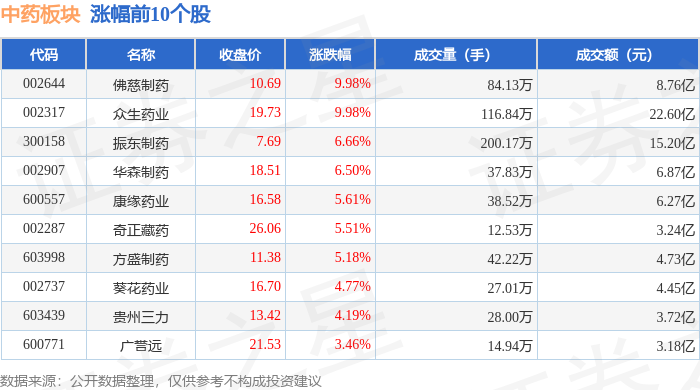
中药板块7月29日涨1%,佛慈制药领涨,主力资金净流入7.98亿元
Zheng Xing Xing Ye Ri Bao· 2025-07-29 08:34
Market Overview - The Chinese medicine sector rose by 1.0% on July 29, with Foci Pharmaceutical leading the gains [1] - The Shanghai Composite Index closed at 3609.71, up 0.33%, while the Shenzhen Component Index closed at 11289.41, up 0.64% [1] Top Gainers in Chinese Medicine Sector - Foci Pharmaceutical (002644) closed at 10.69, up 9.98% with a trading volume of 841,300 shares and a turnover of 876 million yuan [1] - Zhongsheng Pharmaceutical (002317) also rose by 9.98% to 19.73, with a trading volume of 1,168,400 shares and a turnover of 2.26 billion yuan [1] - Other notable gainers include: - Zhendong Pharmaceutical (300158) up 6.66% to 7.69 [1] - Huasen Pharmaceutical (002907) up 6.50% to 18.51 [1] - Kangjia Pharmaceutical (600557) up 5.61% to 16.58 [1] Top Losers in Chinese Medicine Sector - Qidi Pharmaceutical (000590) fell by 2.65% to 12.13, with a trading volume of 134,500 shares and a turnover of 163 million yuan [2] - Zhenbaodao (603567) decreased by 2.21% to 12.40, with a trading volume of 182,700 shares and a turnover of 227 million yuan [2] - Other notable losers include: - Yunnan Baiyao (000538) down 1.20% to 55.82 [2] - Kangmei Pharmaceutical (600518) down 0.94% to 2.10 [2] Capital Flow Analysis - The Chinese medicine sector saw a net inflow of 798 million yuan from institutional investors, while retail investors experienced a net outflow of 625 million yuan [2][3] - Notable net inflows from institutional investors include: - Zhongsheng Pharmaceutical (002317) with a net inflow of 308 million yuan [3] - Zhendong Pharmaceutical (300158) with a net inflow of 96.32 million yuan [3] - Conversely, significant net outflows from retail investors were observed in: - Zhongsheng Pharmaceutical (002317) with a net outflow of 98.88 million yuan [3] - Zhendong Pharmaceutical (300158) with a net outflow of 65.62 million yuan [3]


上海浦东:打造全球创新药械首发地!国内首只药ETF冲高2%,海思科涨停!A股最大医疗ETF冲击九连阳
Xin Lang Ji Jin· 2025-07-28 02:35
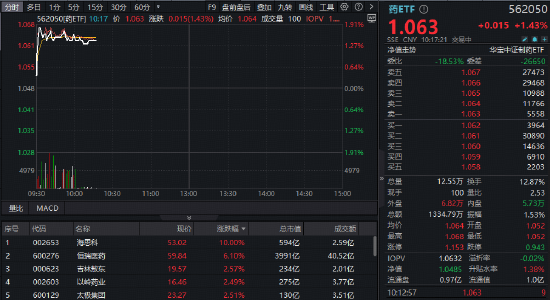
Group 1 - The pharmaceutical sector showed strength on July 28, with leading stocks in chemical, biological, and traditional Chinese medicine rising, and the first domestic drug ETF (562050) initially surged by 2% [1] - Key stocks such as Haizhu Pharmaceutical hit the daily limit, while major player Heng Rui Pharmaceutical rose over 6%, and traditional Chinese medicine leaders like Taiji Group and Yiling Pharmaceutical increased by more than 2% [1] - The largest medical ETF in A-shares (512170) also experienced significant activity, hitting a nine-day winning streak with real-time transactions exceeding 300 million yuan [1] Group 2 - On July 26, the Shanghai Pudong New Area released a plan to enhance the biopharmaceutical industry park, aiming to establish it as a global hub for innovative drugs and medical devices by 2027, with an industry scale expected to exceed 500 billion yuan [4] - The National Healthcare Security Administration recently introduced a new directory for innovative drugs in commercial health insurance, with over 100 drugs currently applying for inclusion [4] - Huashan Securities' report suggests that innovation remains a key theme in the pharmaceutical and medical sectors, recommending focus on leading pharmaceutical companies and undervalued medical device stocks [4] Group 3 - The medical device and CXO sectors are also viewed positively, with attention on the largest medical ETF (512170) that focuses on "medical devices + medical services," closely related to AI medical applications [5]




多个知名品种被点名!中成药挂网价格治理风暴来袭
Bei Jing Shang Bao· 2025-07-27 12:11
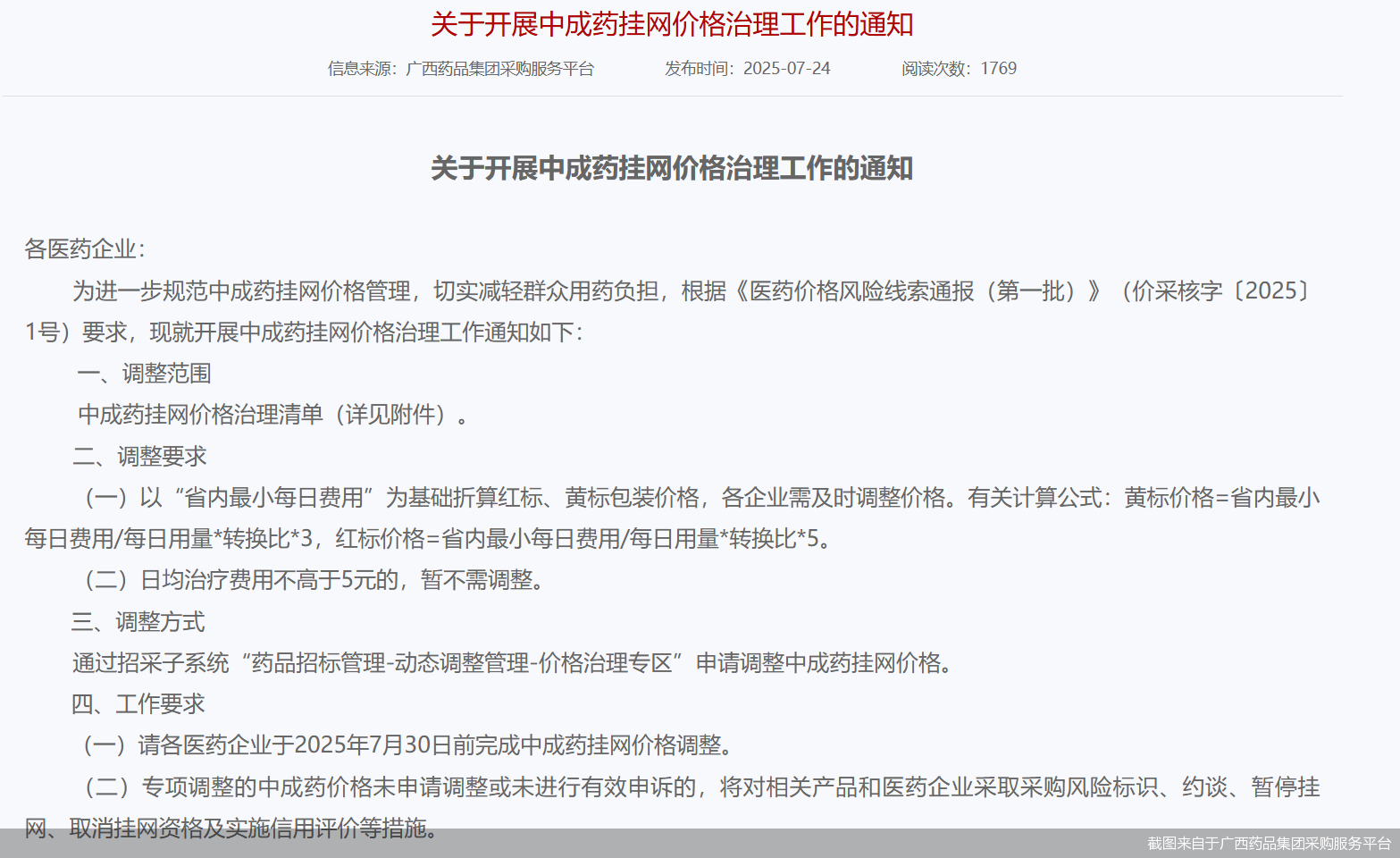
Core Viewpoint - The nationwide governance of traditional Chinese medicine (TCM) pricing is intensifying, marking a shift from a "policy safe haven" to a "transparent competitive pool," indicating the TCM industry is entering a "cost + efficacy" dual pricing era [1][11][12] Group 1: Price Governance Actions - Multiple regions, including Inner Mongolia, Hebei, Ningxia, Jilin, and Guangxi, have initiated special governance on TCM prices, requiring companies to adjust prices of products deemed excessively high [1][3] - The Guangxi Drug Group Procurement Service Platform announced a governance notice targeting 169 high-priced TCMs, mandating price adjustments based on the "minimum daily cost" within the province [3][4] - A total of 123 TCMs were identified with price discrepancies, with some exceeding the minimum daily treatment cost by over 915 times [3][4] Group 2: Industry Impact and Future Outlook - The governance is expected to pressure companies that have relied on high pricing and marketing costs, pushing them to focus on cost control, process innovation, and genuine clinical value [1][9] - The combination of "volume-based procurement + price governance" is seen as a key path to standardizing drug prices, addressing unreasonable premiums in the distribution chain [11] - Long-term, companies with strong compliance and cost advantages are likely to dominate the market, while smaller firms may face elimination risks if they cannot achieve scale and quality standardization [12] Group 3: Specific Products and Companies Affected - Notable TCM products such as Xiao Chai Hu Granules, Niu Huang Jie Du Pian, and Ban Lan Gen Granules are included in the governance list, with specific pricing adjustments mandated [8][9] - Well-known companies like Shandong Hongjitang Pharmaceutical Group and Taiji Group's subsidiaries are among those named in the governance actions [8][11] - A-share listed company Keyuan Pharmaceutical is planning to acquire 99.42% of Hongjitang, indicating potential consolidation in the industry [8]
中药ETF(159647)周线冲击五连阳,夏荔芪胶囊获批首家中药二级保护品种
Xin Lang Cai Jing· 2025-07-25 02:18
Group 1 - The Chinese traditional medicine index (930641) has shown a slight increase of 0.20% as of July 25, 2025, with notable gains from companies such as Zhenbao Island (603567) up 5.92% and Fangsheng Pharmaceutical (603998) up 1.67% [1] - The Chinese traditional medicine ETF (159647) has increased by 0.19%, with a recent price of 1.03 yuan and a one-month growth of 5.56% [1] - The National Medical Products Administration has approved the first secondary protection variety of traditional Chinese medicine, the Xia Liqi Capsule from Shijiazhuang Yiling Pharmaceutical Co., with a protection period of seven years [1] Group 2 - Chinese innovative drug companies are transitioning from quantitative to qualitative changes, with expectations of significant business development (BD) transactions in the coming years, leading to potential mergers and acquisitions [2] - The next 5 to 10 years are anticipated to be a period of explosive growth for Chinese innovative drugs, with domestic companies expected to emerge as globally competitive multinational corporations (MNCs) [2] - The traditional Chinese medicine ETF closely tracks the traditional Chinese medicine index, which reflects the overall performance of listed companies involved in the production and sales of traditional Chinese medicine [2] Group 3 - As of June 30, 2025, the top ten weighted stocks in the traditional Chinese medicine index account for 55.96% of the index, including companies like Pian Zai Huang (600436) and Yunnan Baiyao (000538) [3]