
宏和科技

Search documents
一块布,卡了英伟达的脖子?
首席商业评论· 2026-01-18 04:41
Core Viewpoint - The article emphasizes the critical role of high-end electronic fabric in the AI computing power revolution, highlighting that Japanese companies dominate this market, controlling nearly 70% of the global high-end electronic fabric market, which is essential for AI chip performance [4][6][9]. Group 1: Japanese Dominance in High-End Electronic Fabric - Japanese companies such as Nitto Denko, Asahi Kasei, and AGC dominate the high-end electronic fabric market, which is crucial for AI computing power [6][9]. - These companies have established a significant competitive advantage through decades of research and development, creating a robust patent network that covers the entire production process [9][10]. - The high cost of entry into this market, with investments in production facilities reaching up to 1.5 billion yuan, deters potential competitors, allowing Japanese firms to maintain their market position [9][10]. Group 2: Chinese Companies' Response and Innovations - Chinese companies have begun to challenge the Japanese monopoly, with firms like Honghe Technology and Linzhou Guangyuan making significant advancements in ultra-thin and low-dielectric electronic fabrics [10][11]. - Honghe Technology successfully produced 9-micron ultra-thin electronic fabric in 2021, breaking the long-standing foreign monopoly [10][11]. - Linzhou Guangyuan achieved mass production of low-dielectric fabric in 2021, marking a significant milestone in the industry [11][12]. Group 3: Material Revolution and Future Opportunities - The next generation of quartz electronic fabric is emerging as a critical material for AI applications, providing an opportunity for Chinese companies to leapfrog in technology [12][19]. - Companies like Feilihua are leading the charge in developing M9-level quartz fabric, which has been certified by NVIDIA, thus providing an alternative to Japanese suppliers [12][14]. - The ongoing material revolution is seen as essential for China's technological independence and advancement in various high-tech sectors, including aerospace, new energy, and semiconductors [19][20].


一块布,卡了英伟达的脖子?
创业邦· 2026-01-16 10:14
Core Viewpoint - The article emphasizes the critical role of high-end electronic fabric in supporting AI computing power, highlighting the dominance of Japanese companies in this sector and the emerging competition from Chinese firms. Group 1: Importance of Electronic Fabric - Electronic fabric is likened to the chassis of a supercar, essential for the performance of AI servers, which rely on advanced chips [7][10] - High-end electronic fabric is made from electronic-grade glass fiber, integrating cutting-edge materials science [8] Group 2: Market Dynamics - Japanese companies like Nitto Denko, Asahi Kasei, and AGC dominate nearly 70% of the global high-end electronic fabric market, creating an oligopoly [9] - These companies do not manufacture AI chips but control a crucial segment of AI computing power [10] Group 3: Competitive Landscape - Chinese companies are primarily engaged in the mid-to-low-end market, lacking the technological advancements of their Japanese counterparts [12] - Japanese firms have built a formidable barrier to entry through decades of research and development, creating a dense patent network [17] Group 4: Innovation and Breakthroughs - Chinese companies are beginning to challenge the Japanese monopoly, with firms like Honghe Technology successfully producing ultra-thin electronic fabric [32] - The development of low-dielectric fabric has also seen breakthroughs from companies like Linzhou Guangyuan, marking a significant shift in the competitive landscape [36] Group 5: Material Revolution - The next generation of quartz electronic fabric is emerging as a critical material for AI, with companies like Feilihua leading the charge in this new material revolution [40] - The article underscores the importance of material science in technological advancements, asserting that breakthroughs in materials are essential for the evolution of high-end manufacturing in China [56]
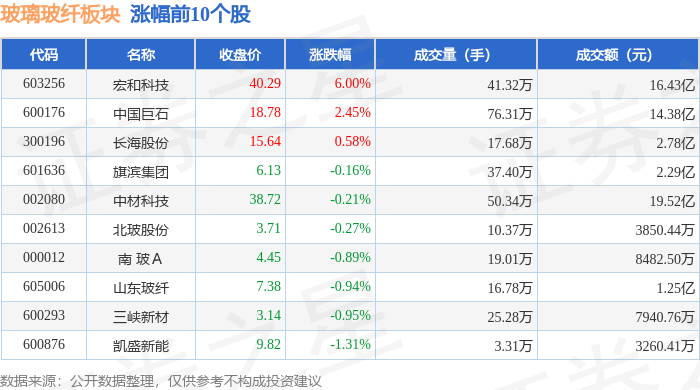
玻璃玻纤板块1月16日涨0.65%,宏和科技领涨,主力资金净流出4475.94万元
Zheng Xing Xing Ye Ri Bao· 2026-01-16 08:55
Group 1 - The glass fiber sector increased by 0.65% on January 16, with Honghe Technology leading the gains [1] - The Shanghai Composite Index closed at 4101.91, down 0.26%, while the Shenzhen Component Index closed at 14281.08, down 0.18% [1] - Key stocks in the glass fiber sector showed varied performance, with Honghe Technology rising by 6.00% to a closing price of 40.29, while other stocks like Qibin Group and China National Building Material experienced slight declines [1] Group 2 - The glass fiber sector saw a net outflow of 44.76 million yuan from main funds, while retail investors experienced a net outflow of 106 million yuan [2] - The sector attracted a net inflow of 151 million yuan from speculative funds [2] - Detailed fund flow data indicates that Honghe Technology had a main fund net inflow of 10.3 million yuan, while China National Building Material saw a net inflow of 56.69 million yuan [3]


这种“电子布”,英伟达、苹果、高通都在抢购
阿尔法工场研究院· 2026-01-16 05:37
Core Viewpoint - The article discusses the severe shortage of high-end electronic-grade glass cloth (glass cloth) required for AI chip substrates, driven by the explosive demand for artificial intelligence (AI) technologies. Major tech companies, including Apple, are competing for limited supplies, with Nvidia's CEO personally visiting suppliers to secure materials [5][12]. Group 1: Supply Shortage - The shortage of high-end glass cloth is primarily due to the dominance of Nittobo, which holds over 90% of the market share for Low CTE glass cloth, essential for AI chips and high-end processors [10][12]. - The production of Low CTE glass cloth requires high temperatures and expensive materials, making it a complex and costly process. The stability of glass cloth directly impacts the quality of substrates used in electronic devices [7][10]. - The demand for Low CTE glass cloth has surged not only from Nvidia but also from other companies like AMD, Google, and Amazon, leading to a situation similar to the DRAM chip shortage experienced last year [12][13]. Group 2: Market Dynamics - Nittobo has been the exclusive supplier for Nvidia's AI chips due to its ability to meet stringent quality requirements. The company has a long history in the glass fiber industry, having been established in 1923 [10][11]. - Other companies, such as Taiwan Glass and Taishan Fiberglass, are attempting to enter the market, but Nvidia has been cautious about including state-owned Taishan Fiberglass in its supply chain due to geopolitical sensitivities [15][17]. - Apple has proactively sought alternative suppliers, including Grace Fabric Technology, to secure its supply of Low CTE glass cloth, reflecting the competitive landscape and urgency in the supply chain [19][20].


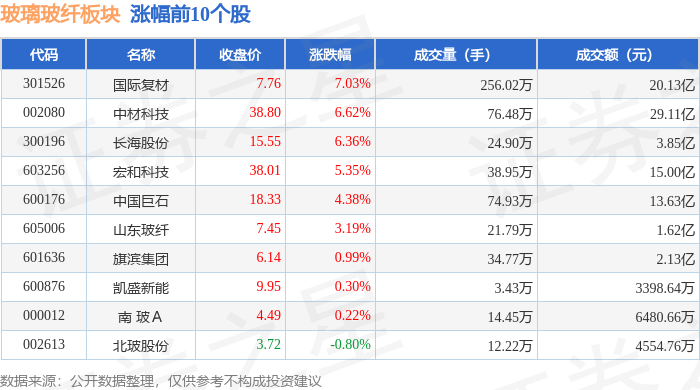
玻璃玻纤板块1月15日涨3.23%,国际复材领涨,主力资金净流入4.19亿元
Zheng Xing Xing Ye Ri Bao· 2026-01-15 08:59
Group 1 - The glass and fiberglass sector increased by 3.23% compared to the previous trading day, with International Composite Materials leading the gains [1] - The Shanghai Composite Index closed at 4112.6, down 0.33%, while the Shenzhen Component Index closed at 14306.73, up 0.41% [1] - Key stocks in the glass and fiberglass sector showed significant price increases, with International Composite Materials rising by 7.03% to a closing price of 7.76, and China Jushi increasing by 4.38% to 18.33 [1] Group 2 - The glass and fiberglass sector saw a net inflow of 419 million yuan from institutional investors, while retail investors experienced a net outflow of 490 million yuan [2] - The trading volume for International Composite Materials was 2.56 million shares, with a transaction value of 2.01 billion yuan [1] - The stock with the highest decline was Zai Sheng Technology, which fell by 10.03% to a closing price of 10.67 [2] Group 3 - Major stocks like Zhongcai Technology and Honghe Technology had varying net inflows and outflows, with Zhongcai Technology seeing a net inflow of 385 million yuan from institutional investors [3] - The net outflow for retail investors in Zhongcai Technology was 273 million yuan, indicating a significant divergence in investor sentiment [3] - The overall market sentiment in the glass and fiberglass sector reflects a mixed response, with some stocks experiencing strong institutional support while others faced retail selling pressure [3]


一块布,卡了英伟达的脖子?
芯世相· 2026-01-15 04:23
Core Viewpoint - The article emphasizes the critical role of high-end electronic fabric in the AI computing power revolution, highlighting the dominance of Japanese companies in this sector and the emerging competition from Chinese firms [5][21]. Group 1: Japanese Dominance in High-End Electronic Fabric - Japanese companies like Nitto Denko, Asahi Kasei, and AGC dominate nearly 70% of the global high-end electronic fabric market, creating a near monopoly [7][12]. - These companies do not manufacture AI chips but control a crucial component that supports AI computing power [8]. - The unique chemical formulations of NE-glass and T-glass developed by Japanese firms provide superior dielectric properties, making them difficult to compete against [12][16]. Group 2: Challenges and Innovations from Chinese Companies - Chinese companies have been primarily active in the mid to low-end electronic fabric market, but recent innovations are challenging the Japanese monopoly [10][21]. - Companies like Honghe Technology and Linzhou Guangyuan have made significant breakthroughs in producing ultra-thin and low-dielectric electronic fabrics, breaking the long-standing foreign dominance [27][31]. - The successful production of 9-micron ultra-thin electronic fabric by Honghe in 2021 marked a significant milestone in the industry [27]. Group 3: The Material Revolution - The article discusses the importance of material science in technological advancements, asserting that breakthroughs in materials are essential for the progress of industries like AI and aerospace [39][41]. - The development of M9-level quartz fabric by companies like Feilihua represents a new frontier in high-end electronic materials, providing alternatives to Japanese products [35][36]. - The ongoing material revolution is seen as a critical step for China to achieve self-sufficiency and reduce reliance on foreign technology [49].


卡 AI 芯片脖子的日企,黄仁勋亲自登门抢货!
是说芯语· 2026-01-15 04:11
Core Viewpoint - The article discusses the severe shortage of high-end electronic-grade glass cloth (glass cloth) required for AI chip substrates, driven by the explosive demand for artificial intelligence (AI) technologies. Major tech companies, including Apple, are competing for limited supplies, with Nvidia's CEO personally visiting suppliers to secure materials [3][5][10]. Group 1: Supply Shortage of High-End Glass Cloth - The electronic-grade glass cloth is a critical component for IC substrates and PCBs, essential for signal transmission in electronic devices. Its manufacturing requires high temperatures and expensive materials, leading to a supply bottleneck [5][7]. - Nittobo dominates the market, holding over 90% of the supply for Low CTE glass cloth, which is crucial for high-frequency and high-density designs in AI chips [7][9]. - The demand for Low CTE glass cloth has surged due to the needs of various companies, including Nvidia, AMD, Google, and Amazon, leading to a situation similar to the DRAM chip shortage experienced last year [9][10]. Group 2: Production Capacity and Expansion - Nittobo's production capacity is currently insufficient to meet the skyrocketing demand, with a forecast that supply issues may not improve until new production lines come online in 2027, which are expected to increase capacity by 20% [10]. - The company prioritizes quality over quantity in its production, which has contributed to the slow expansion of capacity [10]. Group 3: Alternative Suppliers and Market Dynamics - Nvidia is actively seeking alternative suppliers, such as Taiwan Glass, to mitigate the supply constraints caused by Nittobo's bottleneck. However, the initial production capacity from these suppliers will be limited [11][13]. - Apple has also taken proactive measures to secure its supply of Low CTE glass cloth, including engaging with smaller manufacturers and seeking government assistance to ensure material availability for upcoming products [14][15].

玻璃玻纤板块盘中走强,国际复材涨超11%
Mei Ri Jing Ji Xin Wen· 2026-01-15 01:57
(文章来源:每日经济新闻) 每经AI快讯,1月15日,玻璃玻纤板块盘中走强,国际复材涨超11%,九鼎新材涨停,宏和科技、长海 股份、山东玻纤等股跟涨。 ...
电子布概念震荡拉升 国际复材涨超10%
Xin Lang Cai Jing· 2026-01-15 01:45
Group 1 - The electronic fabric concept experienced a volatile rise in early trading, with international composite materials increasing by over 10% [1] - Dongcai Technology and Honghe Technology hit the daily limit, indicating strong investor interest and demand [1] - Changhai Co., Nanya New Materials, Feilihua, and Zhongyi Technology also showed significant gains, contributing to the overall positive trend in the sector [1]


玻璃玻纤板块盘中走强 九鼎新材涨停
Xin Lang Cai Jing· 2026-01-15 01:43
Group 1 - The glass fiber sector showed strong performance during trading, with international composite materials rising over 11% [1] - Jiuding New Materials reached the daily limit increase, indicating significant investor interest [1] - Other companies such as Honghe Technology, Changhai Co., and Shandong Glass Fiber also experienced stock price increases [1]