Xiaomi

Search documents
Here's the best time to buy Tesla stock, according to ChatGPT
Finbold· 2025-07-20 11:06
Core Viewpoint - Current market conditions may not favor buying shares in Tesla, despite a long-term bullish outlook [1][4] Group 1: Stock Performance - Tesla's stock closed at $329, reflecting a 3% increase on the day and nearly a 50% gain since its dip in April [1] - Historically, Tesla shares tend to move between 7% and 10% after earnings, indicating potential volatility around earnings reports [5] Group 2: Earnings Expectations - Analysts anticipate weaker revenue and earnings per share for Tesla, which could lead to a stock pullback if expectations are not met [5] - The upcoming second-quarter earnings report is scheduled for July 23, and it is suggested that investors may want to wait until after this date to make investment decisions [4][10] Group 3: Risks and Competition - The removal of the $7,500 U.S. EV tax credit by September could negatively impact demand for Tesla vehicles [5] - CEO Elon Musk's divisive political persona may alienate parts of Tesla's customer base and ESG-focused investors [6] - Rising competition from companies like BYD, Waymo, and Xiaomi is putting pressure on Tesla's market dominance in the EV and autonomous driving sectors [6] Group 4: Future Developments - Upcoming events, such as Tesla's robotaxi event on August 8, could shift market sentiment positively if a convincing roadmap for autonomy is presented [6] - Long-term innovation drivers, including the Dojo supercomputer and advancements in Full Self-Driving technology, could strengthen the investment case for Tesla [7] Group 5: Investment Strategy - If Tesla's upcoming earnings fall short, waiting for a dip toward the $270 to $290 range may present a better buying opportunity [8] - For mixed results, dollar-cost averaging between $300 and $310 could be a prudent strategy for investors with high conviction in Tesla's future [9] - Overall guidance suggests that accumulating shares below $300 could be a strategic approach for medium-term investors [10]


Nvidia CEO: Next Wave of AI is "Physical AI," Taps China's Expanding Role in Global AI Ecosystem
Tai Mei Ti A P P· 2025-07-17 11:33
Core Insights - Nvidia's CEO Jensen Huang emphasized the strategic importance of the Chinese market during his recent visit to Beijing, highlighting significant developments such as regulatory approval for the H20 AI chip and the upcoming launch of the RTX Pro GPU, alongside Nvidia's market capitalization surpassing $4.1 trillion [2][3][15] Group 1: AI Development in China - Huang addressed the rapid progress in AI development in China, particularly in large models and computing infrastructure, during the 3rd China International Supply Chain Expo [3][4] - He noted China's strength in AI lies in its talent density and educational foundation, training about half of the world's AI researchers [5] - Companies like Alibaba and DeepSeek are advancing quickly in model development and product integration, fostering a competitive innovation ecosystem [5] Group 2: Nvidia's Product Developments - The approval of Nvidia's H20 chip aligns with U.S. export controls and is designed for large model training, although supply chain uncertainties remain [6] - The RTX Pro GPU is focused on digital twin simulations and robotics, which are key growth areas for Nvidia [7] Group 3: Strategic Partnerships and Ecosystem - Nvidia has a long-standing history in China, with partnerships dating back three decades with companies like Tencent and Xiaomi, which are crucial for its strategy as AI integrates into consumer applications [8] - Nvidia's platform supports over 1.5 million developers in China, enabling the development of commercially viable AI models [9] Group 4: Robotics and Mechatronics - Huang identified robotics as a major AI frontier, with China's unique position in AI software and manufacturing providing a competitive advantage [10] - The combination of advanced mechatronics and strong AI capabilities positions China to lead in the global robotics economy [11] Group 5: Geopolitical Context and Company Strategy - Nvidia's role as a global technology provider is emphasized, with increasing government engagement to understand AI deployment for national priorities [12] - Huang highlighted that practical effectiveness, rather than theoretical intelligence, will drive long-term value in AI models [13] Group 6: Company Evolution and Future Outlook - Founded in 1993, Nvidia has evolved from a gaming chip designer to a key player in global AI infrastructure, significantly impacting various sectors [14] - Huang's increasing visibility in China underscores the importance of the Chinese market in Nvidia's global strategy [15]


车载显示-虚拟全景显示驱动交互革新
2025-07-16 06:13
Summary of Conference Call on Car Intelligence and Huayang Group Industry Overview - The focus of the conference was on the car intelligence sector, particularly intelligent driving and smart cabin experiences, which have seen rapid advancements in recent years [1][2] - The penetration rate of smart cabin technologies, such as Driver Monitoring Systems (DMS) and Head-Up Displays (HUD), has significantly increased in the domestic market [1] Key Insights on Car Intelligence - Car intelligence is viewed as a structural opportunity, with new categories like virtual full-screen displays gaining attention [2] - Xiaomi's recent car model launch highlighted a new weather screen display system, which is expected to enhance user experience [2][7] - The virtual full-screen display technology is anticipated to replace traditional display solutions in vehicles, offering a wider projection area and improved visual clarity [3][7] Market Trends and Data - The HUD market in China is projected to grow, with an expected penetration rate increase from 11% in 2023 to 16% in 2024, and a single-month penetration rate reaching 17% in December 2023 [5] - The H-UOD model, priced under 300,000 yuan, is expected to dominate the market, accounting for 70% of exports by Q1 2025 [6] - Domestic manufacturers are gaining market share in the HUD sector, with Huayang Group leading with a 22% market share in 2024 [6] Huayang Group Insights - Huayang Group is collaborating with Xiaomi to launch the virtual full-screen display system, supported by its subsidiaries focusing on automotive electronics [13] - The company has seen significant growth in its warehouse control products, with sales increasing by over 200% compared to 2013 [14] - Huayang's customer base is diversifying, with a balanced income growth from multiple clients, including international orders [15] Financial Performance - Huayang Group has experienced rapid income growth, although net profit growth dipped below 10% in Q1 2024 due to fluctuations in major customer sales [16] - The overall revenue for Huayang Communications and Huayang Economy increased by 25% in the first quarter, indicating strong performance despite challenges in the multimedia segment [16] Technical Challenges and Future Outlook - The virtual full-screen display technology faces technical challenges, including light interference and system integration issues, which need to be addressed for mass production [10][12] - The long-term potential of virtual full-screen displays is significant, with expectations of replacing traditional display systems and enhancing the overall user experience in vehicles [9][14] Conclusion - The conference highlighted the promising future of car intelligence, particularly through innovations like virtual full-screen displays and the strong positioning of Huayang Group in the automotive electronics market [17]

野村:中国汽车市场再迎两位数同比增长,展望中期电动汽车市场存部分担忧
野村· 2025-07-15 01:58
Investment Rating - The report assigns a "Buy" rating to BYD (1211 HK), Desay SV (002920 CH), and Contemporary Amperex Technology (300750 CH) [54][60][65]. Core Insights - The China auto market has shown another double-digit year-on-year growth, with wholesale unit deliveries reaching 2.5 million units in June, marking a 14.5% increase year-on-year and a 7.8% increase month-on-month [1][7]. - The electric vehicle (EV) market is experiencing suboptimal growth, with EV penetration at 52.7% in June, which is below expectations and historical highs [1][7]. - Concerns are raised regarding the slowing growth of EV penetration, potentially due to aggressive pricing strategies from internal combustion engine (ICE) car manufacturers and the upcoming 50% cut to EV purchase tax exemptions starting next year [2][7]. Summary by Sections China Auto Market Performance - In 1H25, the China auto market reported a total of 13.5 million wholesale shipments, reflecting a 12.9% year-on-year growth, while retail sales (excluding minivans) reached 10.9 million units, up 10.8% year-on-year [8]. - The overall growth momentum in 1H25 was slightly above expectations, supported by government subsidies for scrapping and trade-in programs [8]. Electric Vehicle Market - Monthly retail sales of PV EVs reached 1.1 million units in June, representing a 30.2% year-on-year increase [1][9]. - The report highlights that BEVs outperformed PHEVs/EREVs in terms of growth, with BEVs showing 45% year-on-year growth in wholesale shipments during 1H25 [9]. OEM Strategies and Market Dynamics - OEMs are currently preparing their strategies for 2H25, with expectations of model launches and adjustments in response to government policies against over-competition [3]. - BYD remains a top pick due to its strategies aimed at regaining market share, including reducing SKUs and improving model features without price increases [4]. Battery Market Insights - EV battery installations grew by 35.9% year-on-year to 58.2 GWh in June, with total installations for 1H25 reaching 300 GWh, a 47.3% increase year-on-year [5]. - CATL and BYD maintained their market leadership in the battery sector, holding 43.7% and 21.5% market shares, respectively [5]. Lithium Market Trends - The price of lithium carbonate in China rebounded from a low of CNY 60,000 per tonne in late June to CNY 63,000 per tonne in early July [5][48]. - The report anticipates potential downside risks to lithium production in July due to weakened demand and government interventions [5][48].


How Chinese EVs are taking on Tesla
CNBC Television· 2025-07-14 15:12
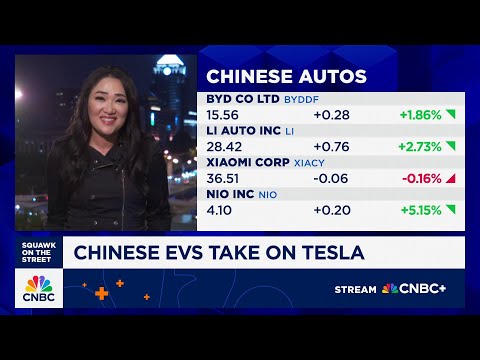
Thanks, Sarah. Well, it's called the Xiaomi U7. This is an SUV that's going head-to-head with Tesla's Model Y here at $35,000.It's just slightly less than the Model Y. Um, it also includes a driver assistance technology. This is their most advanced one.They give that one away for free. So, that's unlike uh Tesla. And then both are seen as performance cars.And the Xiaomi is seen as one that has a bit of a a better range. Now in China, of course, as you guys were talking about, there are so many car makers th ...
Alibaba vs. JD.com: Which Chinese E-Commerce Stock Has Better Upside?
ZACKS· 2025-07-11 16:26
Core Insights - Alibaba and JD.com represent two distinct strategies in capturing the digital commerce market, with both companies expanding beyond traditional retail into cloud computing, logistics, AI, and global markets [2][3] - Recent strategic moves and financial performances of both companies highlight contrasting adaptation and growth potential in a competitive landscape [2][3] Alibaba's Position - Alibaba's transformation into an AI-powered technology platform marks a significant shift, enhancing its growth prospects [4] - The partnership with HONOR for integrating AI agents into consumer hardware opens new monetization pathways and expands Alibaba's influence [4][5] - A commitment to invest RMB 380 billion over three years in AI infrastructure reflects strong confidence in this strategic direction [5] - The Qwen3 language model's adoption across various platforms validates the commercial viability of Alibaba's AI strategy [5][6] - The cloud division is experiencing accelerating revenue growth due to rising AI demand, with over 300 million global downloads of Qwen [6] - Core e-commerce platforms show resilient user engagement and improved monetization efficiency through AI enhancements [7] - The Zacks Consensus Estimate for fiscal 2026 earnings is projected at $10.14 per share, indicating a 12.54% year-over-year increase [8] JD.com's Challenges - JD.com faces strategic misalignment, particularly in its aggressive food delivery expansion, leading to cash outflows and unsustainable profitability [11] - International logistics investments in Abu Dhabi and the UK are seen as poorly timed, straining resources amid domestic competition [12] - JD's historical logistics advantage is becoming commoditized, with partnerships lacking transformative impact [13] - The launch of JoyExpress in Saudi Arabia exemplifies JD's capital-intensive expansion approach, which may limit scalability [14] - The consensus estimate for 2025 earnings is pegged at $3.6 per share, indicating a 15.49% year-over-year decline [14] Valuation and Performance Comparison - Both companies trade at discounted valuations, with Alibaba's P/E ratio at 10.02x compared to JD's 7.66x, reflecting Alibaba's superior financial metrics and growth prospects [15] - Recent price performance shows Alibaba shares have increased by 25.8% year-to-date, while JD.com has declined by 10%, indicating investor confidence in Alibaba's strategy [18] Conclusion - Alibaba is positioned as the superior investment choice due to its transformative AI capabilities, diversified revenue streams, and strategic growth positioning [20] - JD's capital-intensive growth strategy and competitive challenges present significant headwinds, suggesting a potential reduction in exposure to JD [20]



X @Bloomberg
Bloomberg· 2025-07-11 11:33
Chinese smartphone maker Xiaomi has pulled off something Apple failed to do despite a decade-long attempt, and that’s to make a car.@Lindadalew looks at what helped Xiaomi overtake Apple’s EV ambitions https://t.co/kteGLsksYg https://t.co/CcnyZStONT ...
摩根士丹利:中国科技硬件-人工智能与非人工智能
摩根· 2025-07-11 02:23
Investment Rating - The investment rating for the Greater China Technology Hardware industry is "In-Line" [2]. Core Insights - The technology hardware sector has outperformed major market indexes year-to-date (YTD), with smartphone-related stocks showing significant gains [5][6]. - YTD share price performance for tech hardware stocks indicates an increase of 66% for top performers and a decrease of 38% for bottom performers, compared to HSI's increase of 19% [9]. - Demand forecasts suggest limited shipment volume growth across various segments, including servers, PCs, and smartphones, with specific projections for 2025 indicating a slight increase in server shipments to 14.5 million units [11]. Summary by Sections Performance Overview - Greater China tech hardware stocks have outperformed major market indexes YTD, except for the Hang Seng Index (HSI) [5][6]. - The share price performance of tech hardware stocks shows a range of increases from 66% for top performers to declines of 38% for the bottom performers [9]. Demand Forecasts - Limited shipment volume growth is expected across various categories, including servers, PCs, and smartphones, with specific figures indicating a forecast of 14.5 million server units for 2025 [11]. - Smartphone shipments are projected to show a cyclical recovery starting in 2024, with significant growth anticipated in 5G smartphone sales [28]. Valuation Insights - The report highlights a justified valuation premium for companies involved in the AI hardware supply chain, with specific companies showing significant AI revenue contributions [12]. - The analysis includes a detailed breakdown of AI revenue and profit mixes for various companies, indicating a strong focus on AI-related hardware [12]. Production and Cost Analysis - The report discusses the cost implications of producing Apple products in different regions, noting that iPhones produced in the US have a 75% higher FOB price compared to those made in China [15]. - A detailed cost analysis shows that the bill of materials (BoM) for iPhones varies significantly by production location, impacting overall pricing strategies [15]. Market Trends - The report identifies Xiaomi as a key player with a rich product portfolio and rapid growth in electric vehicle (EV) deliveries, indicating a diversification strategy beyond traditional tech hardware [34][36]. - The smartphone market is experiencing a cyclical recovery, with expectations for increased shipments and demand in the coming years [28].
Will Solid Momentum in Premium Handset Vertical Drive QCOM's Growth?
ZACKS· 2025-07-10 13:56
Core Insights - Qualcomm has been selected by Samsung to provide the Snapdragon 8 Elite Mobile Platform for its Galaxy Z Fold7 devices, enhancing performance and AI capabilities [1] - The Snapdragon 8 Elite chipsets are gaining traction in the premium smartphone market, with several manufacturers adopting them [2] - Qualcomm's QCT segment revenues increased to $9.47 billion in Q1 from $8.03 billion year-over-year, with expectations of $27.7 billion in handset revenue for 2025, reflecting an 11.3% year-over-year growth [3] Market Dynamics - Healthy demand in the premium smartphone segment is driving growth for Qualcomm, but competition from low-cost manufacturers like MediaTek and Rockchip is impacting profitability [4] - Apple is moving towards in-house chip development, which is affecting Qualcomm's revenue growth, as Apple has replaced Qualcomm's RF modem in its latest iPhone [4] - Broadcom is also a competitor, leveraging strong relationships with OEMs to gain insights into customer requirements [5] Financial Performance - Qualcomm shares have declined by 20.2% over the past year, contrasting with the industry's growth of 18.1% [6] - The company's shares trade at a price/earnings ratio of 13.51, significantly lower than the industry average of 33.07 [8] - Earnings estimates for 2025 have decreased by 0.17% to $11.71 per share, while 2026 estimates have declined by 2.23% to $11.82 [9]