加速进化

Search documents
IDC报告:智元人形机器人整体和全尺寸出货量全球第一
Zhong Guo Zheng Quan Bao· 2026-01-23 12:21
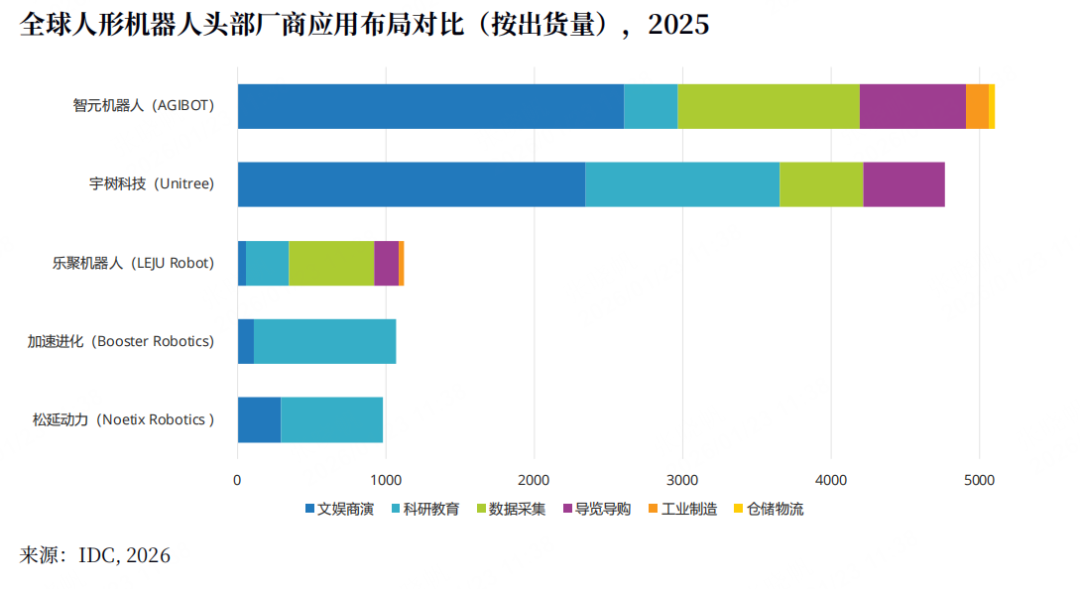
1月23日,知名市场研究机构IDC发布的《全球人形机器人市场分析》报告提到,2025年人形机器人市场迎来爆发式增长,中国厂商整体在引领行业的规 模化商用进程。 其中,智元(AGIBOT)一举斩获 "五大主流场景出货量第一""全球整体出货量第一"与"全尺寸细分领域出货量第一"三重桂冠,以显著优势引领产业规模 化商用。 报告提到,目前,人形机器人市场的应用场景呈现出多元化发展的趋势,需求主要来自文娱商演、科研教育、数据采集、导览导购、工业智造与仓储物流 六大场景,其中智元在五个场景出货量均位列第一。 IDC表示,智元不仅有多元的应用场景布局,既注重交互展示,也兼顾服务型应用;同时引入机器人租赁RaaS(Robot-as-a-Service)创新模式,降低用户 使用门槛,加快人形机器人在多场景中落地普及,推动商业模式由单一硬件交付向"产品+平台+服务"演进。 全球出货量荣登榜首 规模化交付实力凸显 根据IDC数据,2025年,全球人形机器人出货量约1.8万台,同比增长约508%,中国厂商占主导,智元以5200台的出货量稳居全球榜首,市场份额显著领 先。这一数据标志着智元不仅完成了从技术研发到产品量产的关键跨越,更在 ...


IDC:2025年全球人形机器人出货量约1.8万台,中国厂商占主导
Guo Ji Jin Rong Bao· 2026-01-23 10:20
Core Insights - The global humanoid robot market is expected to experience explosive growth by 2025, with an estimated shipment of 18,000 units and sales revenue of approximately $440 million, representing a significant year-on-year increase of 508% [1] - Chinese manufacturers dominate the market, with Zhiyuan Robotics and Yuzhu Technology leading with around 5,000 units shipped, while international firms are still in the pilot phase [1] - Full-sized humanoid robots are projected to account for 41.6% of the overall market revenue in 2025 due to their wide applicability and high unit price [1] Industry Trends - The humanoid robot industry is transitioning from hardware sales to a model that includes Robot as a Service (RaaS), operational services, and platform ecosystems [1][4] - The focus of competition is shifting from hardware performance to technological depth, service capabilities, and ecosystem development, with leading firms expected to continue expanding their advantages [1] - The demand for humanoid robots is diversifying across six main application areas: entertainment, education, data collection, guiding and shopping, industrial manufacturing, and warehousing logistics [4] Technological Developments - Humanoid robots are moving from laboratory validation to engineering implementation, with advancements in the coordination of the body, cerebellum (motor control), and brain (cognitive decision-making) systems [3] - Modular and lightweight designs are enhancing system stability and deployment convenience, while end-to-end embodied intelligent models are enabling higher levels of autonomous operation and human-robot collaboration in complex scenarios [3] Market Dynamics - The global humanoid robot industry is shifting from a phase of broad participation to one characterized by concentration among leading firms and differentiation among tiers [4] - As technology matures and application scenarios expand, the market is entering a rapid development phase with clear distinctions in market strategies, technical capabilities, and ecosystem layouts between leading and smaller firms [4]
谁是去年人形机器人出货量第一?智元和宇树给出不同版本
Nan Fang Du Shi Bao· 2026-01-23 08:01
Core Viewpoint - The competition among humanoid robot manufacturers regarding shipment volumes for 2025 has sparked significant industry debate, with conflicting reports from various market research firms [2][3]. Group 1: Company Performance - Yuzhu Technology announced that its actual shipment volume for humanoid robots in 2025 will exceed 5,500 units, with over 6,500 units produced, clarifying that these figures only account for pure humanoid robots [2]. - Omdia's report estimated Yuzhu Technology's shipment volume at 4,200 units for 2025, while another report by Counterpoint suggested a similar figure of approximately 4,224 units [2]. - IDC's analysis projected Yuzhu Technology's humanoid robot sales at around 4,700 units, indicating a competitive position in the market [3]. Group 2: Market Dynamics - The global humanoid robot market is expected to reach approximately 18,000 units in shipments and $440 million in sales by 2025, with Yuzhu Technology and Zhiyuan being key players [3]. - The highest application scenario for humanoid robots remains in entertainment performances, with Yuzhu Technology focusing on research and education as its second-largest application area [3]. - The reports highlight that Chinese humanoid robot manufacturers are advancing their commercialization efforts more rapidly than their international counterparts, who are still in pilot phases [4]. Group 3: Competitive Landscape - The Omdia report faced criticism for not including other manufacturers like Accelerated Evolution and Galaxy General, which also have notable shipment volumes [4]. - Accelerated Evolution reported a shipment of 1,034 humanoid robots for 2025, indicating a growing competitive landscape [4]. - Tesla's humanoid robot, Optimus, is still in internal testing, with plans for public sale by the end of 2027, showcasing the different stages of development among global competitors [4].
人形机器人企业积极规划产能扩张
Zheng Quan Ri Bao· 2026-01-21 16:29
Core Insights - The humanoid robot industry is transitioning from technology demonstration to large-scale commercialization, with significant growth expected in 2026 [1][3][4] Group 1: Market Growth and Orders - The humanoid robot market is projected to experience strong order growth in 2025, with companies like Qingbao Robot and Zhiyuan Robot reporting substantial increases in order volumes [1][2] - Qingbao Robot's sales exceeded 50 million yuan in 2025, with a notable order of 7 million yuan from South China and 1,000 intention orders from various industries [3] - Omdia's report indicates that Zhiyuan Robot's shipments surpassed 5,100 units in 2025, while Yushu Technology's shipments exceeded 5,500 units, highlighting a competitive landscape [2] Group 2: Production Capacity and Strategy - Companies are ramping up production capacity in anticipation of a significant demand surge in 2026, marking the beginning of a capacity competition [4][5] - Qingbao Robot plans to enhance production scale to optimize costs and facilitate the commercialization of products across various scenarios [4] - Industry experts predict that global shipments of humanoid robots could exceed 50,000 units in 2026, representing a year-on-year increase of over 700% [3][4] Group 3: Industry Outlook - 2026 is seen as a critical year for assessing the commercialization capabilities of the humanoid robot industry, with leading companies beginning to secure substantial orders [3][4] - The industry is still in its early stages, and companies must balance capacity expansion with technological advancements to maintain competitive advantages [5][6]
高瓴出手!机器人租赁赛道火了
Shang Hai Zheng Quan Bao· 2026-01-15 15:48
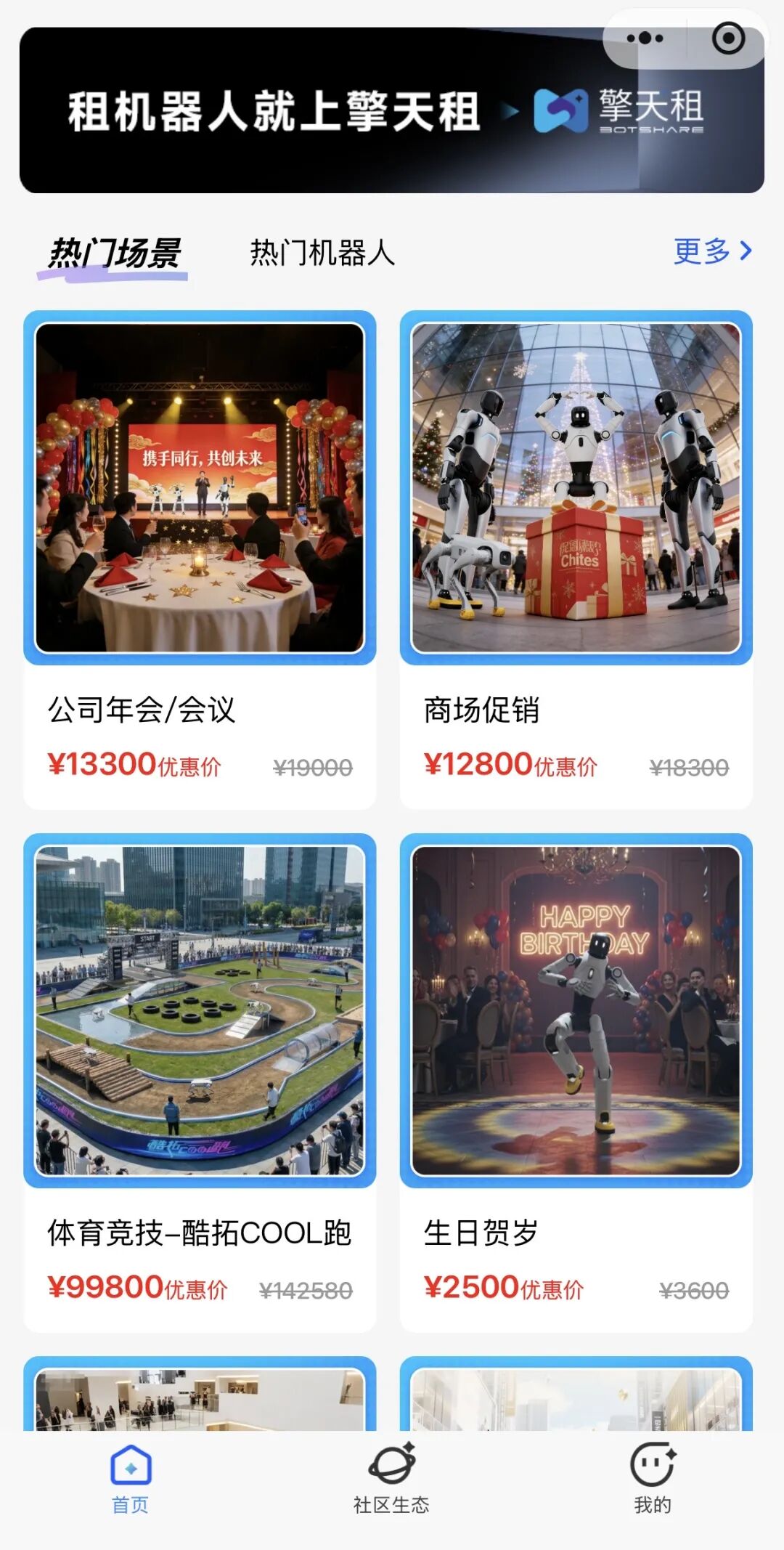
Group 1 - The first financing round for the global robot rental platform, Qingtian Rental, has been completed, led by GL Ventures with participation from several other investors [1] - Qingtian Rental is viewed as the "Didi of the robot industry," offering a standardized, low-cost, and scalable Robot as a Service (RaaS) model through resource integration [1][12] - The platform has already registered over 200,000 users and maintains an average of over 200 rental orders per day within three weeks of launch [12] Group 2 - The rental prices for robots on the platform range from 200 yuan to over 10,000 yuan per day, with specific examples such as the Lingxi X2 for 2,299 yuan per day [8] - Qingtian Rental aims to collaborate with over 10 robot manufacturers by 2026, expanding beyond its parent company, Zhiyuan Robotics [12] - The robot rental market is expected to reach a scale of no less than 10 billion yuan next year, driven by platform operations addressing the fragmentation and communication gaps in the market [12] Group 3 - Qingtian Rental has established partnerships with various chain brands such as Meiyijia and Haidilao, applying robot services in high-frequency scenarios like store promotions and operational activities [13] - The platform's approach reduces the trial and error costs of introducing new technologies into traditional settings, facilitating rapid deployment and optimization of robots in real commercial environments [13]
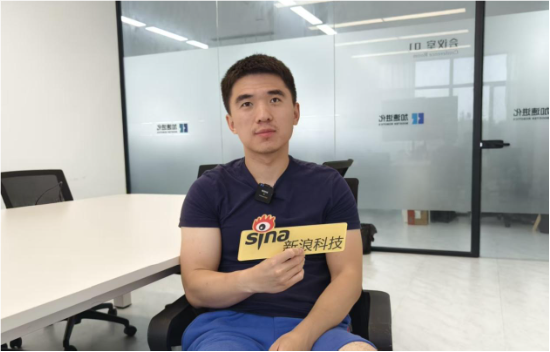
对话加速进化赵维晨:机器人只有“做小”才能进入家庭,越小门槛越高|财之道
Xin Lang Cai Jing· 2026-01-15 12:17
Core Insights - The company, Accelerated Evolution, focuses on smaller humanoid robots, emphasizing safety and practicality over larger models that may appear impressive but are deemed unsafe for home use [2][20][30] - The company has achieved significant growth, with sales increasing from 45 units in 2024 to 1,034 units in 2025, representing nearly a 22-fold increase [21] - The company has successfully established a sustainable business model by integrating education and robotics competitions, which has garnered recognition from the capital market [3][21] Business Model - Accelerated Evolution's commercialization strategy mirrors the early adoption of personal computers, targeting both tech enthusiasts and educational institutions to foster a new generation of developers [4][22][23] - The company aims to leverage educational settings to build awareness and skills in robotics, similar to how programming was taught in schools during the rise of personal computing [5][23] - The integration of robotics competitions into their business model serves to validate skills for both students and educators, enhancing engagement and development [7][25][26] Market Potential - The Chinese market for educational robotics is substantial, with approximately 3,000 higher education institutions, indicating a significant opportunity for growth [8][26] - The company sees a potential for global expansion, aiming to establish partnerships with international educational institutions to promote Chinese robotics technology [9][28] Product Focus - The company prioritizes stability, safety, and interaction capabilities in its robots, with a focus on lightweight designs to enhance safety [10][29] - The smaller robot models, such as the Booster K1, are designed to be user-friendly and safe for educational environments, contrasting with larger models that pose safety risks [11][30] Competitive Advantage - Accelerated Evolution is the only company currently focusing on 95 cm humanoid robots, positioning itself uniquely in the market [14][32] - The company has a strong AI capability, which is essential for developing educational robotics programs, ensuring that their products are not just hardware but also include robust software ecosystems [15][32][33] Financial Outlook - The company anticipates achieving breakeven by 2026, supported by a strong cash flow and a sustainable business model [16][35] - The long-term vision for the robotics industry is seen as a prolonged battle, requiring substantial investment and strategic focus to achieve widespread adoption [16][35][36]
能干活、接地气,中国机器人领跑全球
Xin Lang Cai Jing· 2026-01-11 17:16
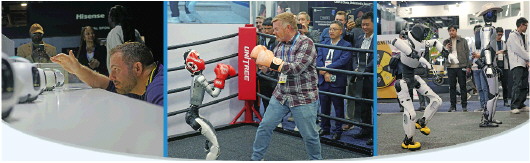
Core Insights - The CES 2026 showcased a significant "Chinese moment" in the robotics sector, highlighting the transition of humanoid robots from experimental stages to market-ready products, emphasizing their practicality and readiness for household integration [2][5] Industry Overview - Among the 598 exhibitors in the robotics sector, 149 were Chinese companies, accounting for nearly a quarter of the total. In the humanoid robot segment, 21 out of 38 exhibitors were from China, representing over half [3] - The event featured a diverse range of products from industrial to consumer-grade robots, with notable participation from both established companies and new entrants [3][4] Product Innovations - Zhiyuan Robotics, leading in humanoid robot shipments, showcased a full range of products, including the portable Q1 robot, which redefines humanoid robot design [3][4] - The introduction of the fully autonomous humanoid nanny robot by "Chinese Figure" Wan'an targets the vast household service market, capable of performing laundry tasks autonomously [5] - The Jupiter robot, equipped with a specialized training environment, can navigate complex home settings, while the W1 robot integrates emotional interaction capabilities [6] Market Trends - The trend towards consumer-grade humanoid robots is accelerating, with significant price reductions making them more accessible. The price of humanoid robots is expected to drop by over 25% compared to 2024 due to increased domestic production of key components [6][7] - Companies like Yushutech and Songyan Power are breaking the traditional high-price barrier, with products priced below 30,000 yuan and even under 10,000 yuan [6][7] Sales and Delivery Projections - The humanoid robot shipment volume in China is projected to reach 18,000 units in 2025, a more than 650% increase from 2024, with expectations of further growth to 62,500 units in 2026 [7][8] - Leading companies are already achieving significant delivery volumes, with estimates of over 5,100 units for Zhiyuan Robotics in 2025 and plans to increase to tens of thousands in 2026 [8] Global Competitive Landscape - The competition in the global humanoid robot market is shifting towards engineering, commercialization, and ecosystem development, with Chinese companies gaining more influence in this trillion-dollar sector [8]
进入“千台俱乐部”,加速进化创始人程昊:2025年卖了1034台机器人
Xin Lang Cai Jing· 2026-01-11 03:13
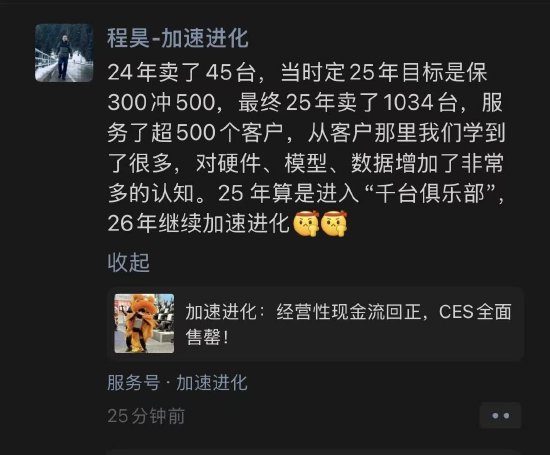
责任编辑:杨赐 新浪科技讯 1月11日上午消息,今日,加速进化创始人程昊在其个人朋友圈发文称,24年卖了45台,当 时定25年目标是保300冲500,最终25年卖了1034台,服务了超500个客户,从客户那里我们学到了很 多,对硬件、模型、数据增加了非常多的认知。25年算是进入"千台俱乐部",26年继续加速进化。 新浪科技讯 1月11日上午消息,今日,加速进化创始人程昊在其个人朋友圈发文称,24年卖了45台,当 时定25年目标是保300冲500,最终25年卖了1034台,服务了超500个客户,从客户那里我们学到了很 多,对硬件、模型、数据增加了非常多的认知。25年算是进入"千台俱乐部",26年继续加速进化。 据悉,今年1月6日至9日举办的CES2026大会中,加速进化所有展示机器人被全部预定售罄,创下了可 观的展位"平效比"(每平方米销售额)。并且官方表示,2025年12月,公司实现了创立以来首次月度经 营性现金流回正。 据悉,今年1月6日至9日举办的CES2026大会中,加速进化所有展示机器人被全部预定售罄,创下了可 观的展位"平效比"(每平方米销售额)。并且官方表示,2025年12月,公司实现了创立以来首 ...
【环时深度】2026 CES展,中国AI企业拉高国际能见度
Huan Qiu Shi Bao· 2026-01-09 22:37
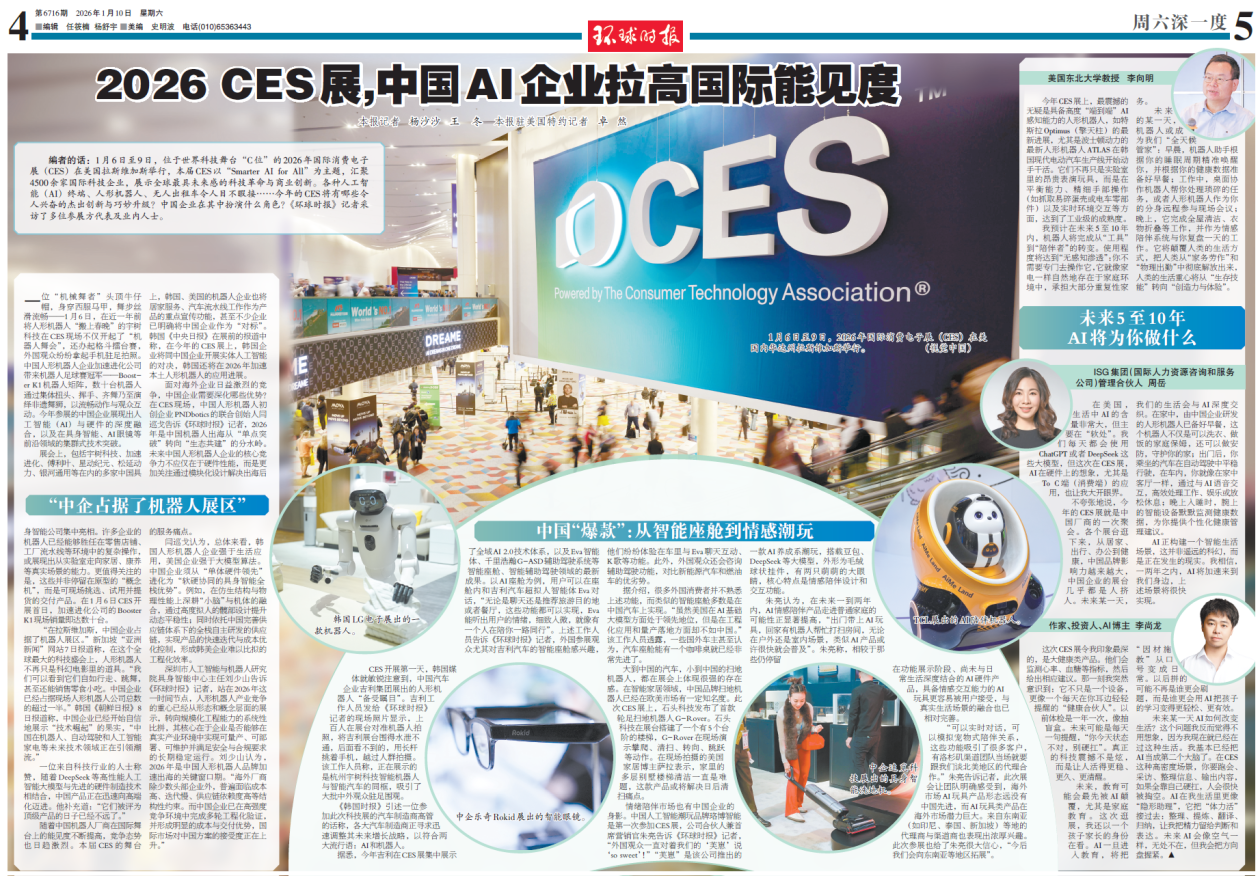
Group 1 - The 2026 International Consumer Electronics Show (CES) in Las Vegas showcased over 4,500 international tech companies, focusing on the theme "Smarter AI for All" [2] - Chinese companies demonstrated significant advancements in humanoid robots and AI integration, with many products ready for immediate purchase and use [5][10] - The presence of Chinese firms in the humanoid robot sector exceeded half of the total exhibitors, indicating a strong competitive stance against Korean and American companies [5][11] Group 2 - Chinese humanoid robot companies are evolving from hardware-centric approaches to a focus on modular design and service solutions for international markets [7] - The competition in the humanoid robot industry is shifting towards the ability to produce scalable, deployable, and maintainable systems that meet safety and compliance standards [9] - Chinese brands are increasingly recognized for their engineering efficiency and cost advantages, enhancing their acceptance in international markets [9] Group 3 - The automotive sector, represented by companies like Geely, highlighted the integration of AI in smart cabins and autonomous driving systems, attracting significant attention from international audiences [11][12] - The CES showcased a variety of AI products, from smart home devices to emotional companion toys, indicating a growing market for AI in everyday life [12][15] - The potential for AI to transform daily living is emphasized, with expectations for AI to become an integral part of household management and personal assistance in the near future [18][21]


国产机器人会师CES
3 6 Ke· 2026-01-09 13:02
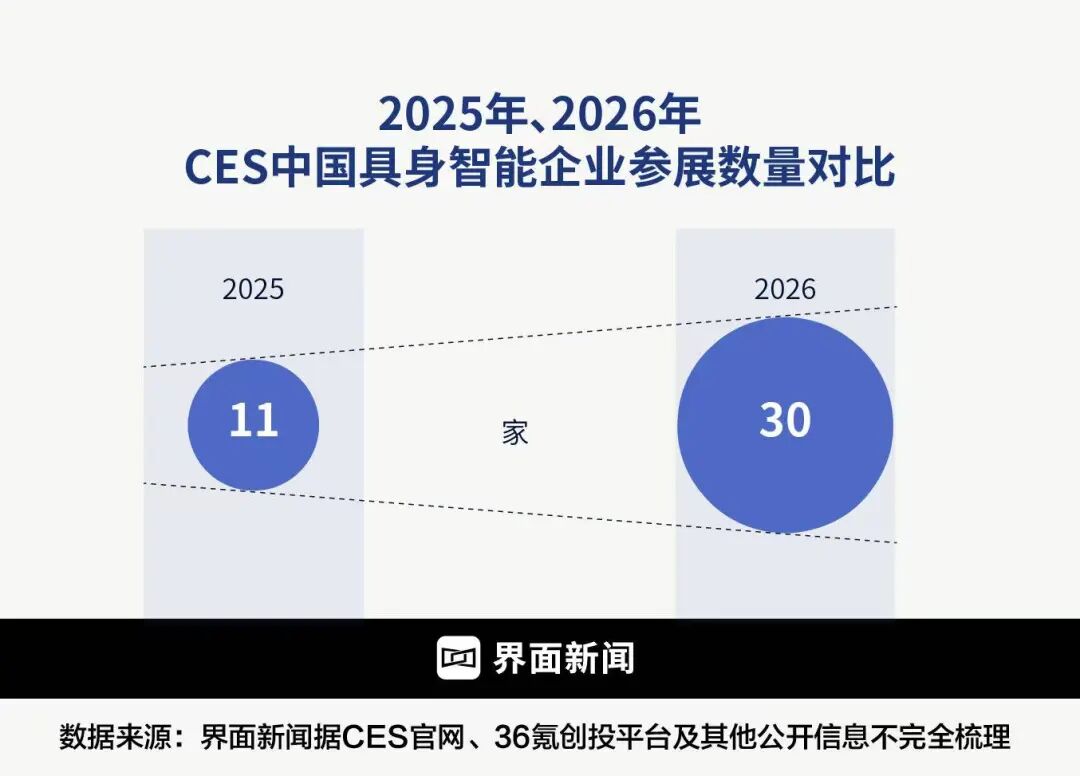
Core Insights - The CES exhibition has become a crucial platform for Chinese robotics companies to expand their overseas strategies, with the number of participating companies increasing from nearly 10 in 2025 to around 30 in 2026 [1][3] - The Chinese embodied intelligence industry is transitioning from basic research to commercialization, with a focus on securing orders and deliveries as key competitive metrics [3][20] - The competitive landscape is intensifying, with Chinese companies expected to dominate the humanoid robot sector, as noted by industry leaders [3][22] Group 1: Industry Trends - The CES exhibition serves as a global market showcase, with companies investing significant resources in preparation, often spending millions to secure prime exhibition space [3][16] - Chinese robotics companies are increasingly focusing on overseas markets due to heightened domestic competition and the potential for greater success abroad [3][20] - The demand for localized delivery and support services is critical for success in international markets, with companies emphasizing the need for on-the-ground support [20][28] Group 2: Company Highlights - Notable companies participating include Yushu Technology, ZhiYuan Robotics, and Accelerated Evolution, showcasing a wide range of products from humanoid robots to dexterous hands [4][7] - Accelerated Evolution reported significant sales, achieving dozens of orders for their humanoid robot Booster K1 on the first day of the exhibition [18] - Companies are adopting diverse strategies to attract attention, with some focusing on interactive demonstrations while others emphasize product variety [9][11] Group 3: Competitive Landscape - The competition between Chinese and American robotics companies is intensifying, with both sides focusing on technological advancements and market penetration [22][25] - Chinese companies benefit from a robust manufacturing ecosystem, particularly in core components like harmonic reducers, which have seen significant market share growth [25][26] - The challenge for Chinese firms lies in adapting to the more conservative acceptance of new technologies in Western markets, necessitating a focus on quantifiable product outcomes [26][28]