丸美生物

Search documents
那个你熟悉的自然堂,要去港股敲钟了
3 6 Ke· 2025-10-09 10:26
Core Viewpoint - The company, Chando, is preparing for an IPO on the Hong Kong Stock Exchange, marking a significant shift from its historically cautious approach to capital markets. The brand has established itself as a leading domestic cosmetics player in China, but faces challenges in innovation and market dependence on a single brand [1][4][11]. Company Overview - Chando Group has developed five main brands, including "Chando," "Pofuyan," "Meisu," "Chunxia," and "Jichu," covering a comprehensive range of skincare, makeup, personal care, and children's products [2]. - The founding family, led by Zheng Chunying, maintains significant control over the company, with the Zheng family holding nearly 87% of the shares post-IPO [2][4]. Financial Performance - The company reported revenues of 42.92 billion RMB in 2022, 44.42 billion RMB in 2023, and projected 46.01 billion RMB in 2024, with a net profit of 1.39 billion RMB in 2022, increasing to 3.13 billion RMB in 2023, and a projected 2.03 billion RMB in 2024 [4]. - The gross margin has shown a steady increase from 66.5% in 2022 to 69.4% in 2024, while the net profit margin fluctuated between 3.2% and 6.8% during the same period [4]. Digital Transformation - Chando Group is recognized as the first in the Chinese beauty industry to establish a "one inventory system," enhancing its digital operations and supply chain management [5]. - The company has received strategic support from investors like Cathay Capital, which has facilitated its digital transformation efforts [5]. Challenges and Risks - The company faces a significant imbalance between marketing and R&D expenditures, with R&D spending decreasing from 2.8% of revenue in 2022 to 1.7% in 2025, while marketing expenses remain high [6]. - Chando's revenue is heavily reliant on its flagship brand, accounting for approximately 95% of total income, indicating a lack of market presence for its other brands [6][7]. Market Position - The domestic beauty market is experiencing growth, with Chando positioned as a leading player. However, the market remains fragmented, with the top five brands holding less than single-digit market shares [11]. - The upcoming IPO is seen as a starting point for Chando, with future growth potential hinging on diversifying its product offerings and reducing reliance on a single brand [11][12].


从10元到100万:一场企业家间的“礼物交换”游戏
吴晓波频道· 2025-10-07 00:29
Core Viewpoint - The article discusses the annual Hu Run China Rich List and highlights a unique gift exchange game initiated by Hu Run with Chinese entrepreneurs, aiming to raise funds for charity through the value of exchanged gifts [2][3]. Group 1: Gift Exchange Process - Hu Run started the gift exchange with a 10 yuan mobile phone stand, successfully trading it for various items, including a small robot, an ancient zither, and a painting created by a blind grandmother [5][6][7]. - The exchange process continued with a series of trades, culminating in a controversial exchange involving a biography book from the founder of Liby Group, which was perceived as undervalued compared to the previous jade item [11][13]. - The gift exchange gained significant attention on social media, especially after Hu Run traded a blue sapphire for a unique Labubu toy, which later sold for 108 million yuan [15][16]. Group 2: Public Reaction and Controversy - The exchange involving the biography book sparked criticism from netizens, leading to the return of the jade item by the Liby Group founder [14]. - Hu Run's exchanges have been compared to a grassroots "trading up" phenomenon, where the value of items is subject to public perception and debate, similar to stock market trends [34][35]. - The article notes that while Hu Run's exchanges occur within an elite circle, they still generate significant public interest and discussion, contrasting with more open grassroots initiatives [36]. Group 3: Cultural and Symbolic Aspects - The gift exchange reflects a ceremonial and symbolic act rather than a mere transactional exchange, akin to the Kula exchange among the Trobriand Islanders, emphasizing identity and social bonds [38]. - The article draws parallels between Hu Run's initiative and other successful "trading up" stories, highlighting the narrative and community engagement aspects that drive interest and participation [33][34].

国货美妆超级独角兽要上市了!郑春颖家族迎来资本盛宴!
IPO日报· 2025-09-30 15:59
Core Viewpoint - The article discusses the upcoming IPO of China's beauty brand "Chando" and its significance in the market, highlighting its growth and the strategic moves made by its parent company, Jala Group, led by founder Zheng Chunying [1][4]. Group 1: Company Overview - Chando, a leading Chinese beauty brand, has applied for a listing on the Hong Kong Stock Exchange, with Huatai International and UBS serving as joint sponsors [1]. - Founded by Zheng Chunying in 2001, Chando has expanded its presence across China, with over 62,700 retail points and more than 45,000 stores nationwide [5]. - The company operates a multi-brand matrix, including Chando, Pechoin, Meisu, and others, covering skincare, makeup, and personal care products [5]. Group 2: Financial Performance - Chando's revenue has shown consistent growth, with figures of 4.292 billion yuan, 4.442 billion yuan, 4.601 billion yuan, and 2.448 billion yuan for the years 2022 to the first half of 2025, respectively, with a year-on-year growth of 6.4% in the first half of 2025 [5][6]. - The company's net profit for the same periods was 139 million yuan, 302 million yuan, 190 million yuan, and 191 million yuan, indicating a stable profit trajectory [5]. Group 3: Market Position and Strategy - Chando ranks as the third-largest domestic cosmetics group in China by retail sales in 2024, with its brand being the second-largest among domestic brands, following Pechoin [5]. - The growth in revenue is attributed to the expansion of online channels, with online sales increasing from 59.7% in 2022 to 68.8% in the first half of 2025 [6]. - The company aims to enhance its direct-to-consumer (DTC) capabilities and improve the synergy between online and offline sales networks through the funds raised from the IPO [10]. Group 4: Ownership and Corporate Structure - Zheng Chunying and family hold approximately 87.82% of the voting rights in Chando, following a red-chip restructuring to facilitate the IPO [9]. - The company has a strategic partnership with L'Oréal, which holds a 6.67% stake in Chando [10].

国货美妆超级独角兽要上市了!郑春颖家族迎来资本盛宴!
Guo Ji Jin Rong Bao· 2025-09-30 15:48
Core Viewpoint - Chando Global Holdings Limited, a Chinese beauty unicorn, has applied for a listing on the Hong Kong Stock Exchange, marking a significant milestone for the company and its founder, Zheng Chunying, after 24 years in the capital market [1][3]. Group 1: Company Overview - Founded in 2001 by Zheng Chunying, Chando has grown from a beauty chain in Northeast China to a major player in the beauty industry, launching brands like "Meisu" and flagship brand "Chando" [3]. - Chando has established a multi-brand matrix, including five main brands: Chando, Peffy, Meisu, Chunxia, and Jichu, covering skincare, color cosmetics, and personal care categories [3]. - As of 2024, Chando is the third-largest domestic cosmetics group in China by retail sales, with its single brand ranking second among domestic brands, just below Pechoin [3]. Group 2: Financial Performance - Chando's revenue has shown consistent growth, with reported revenues of 4.292 billion, 4.442 billion, 4.601 billion, and 2.448 billion yuan for the years 2022 to 2025 H1, respectively, with a year-on-year growth of 6.4% in the first half of 2025 [3][4]. - The net profit for the same periods was 139 million, 302 million, 190 million, and 191 million yuan, indicating a stable profit trajectory [3]. Group 3: Market Position and Strategy - The growth in revenue is primarily attributed to the expansion of online channels and an increase in the number of offline retailers, with online revenue share rising from 59.7% in 2022 to 68.8% in the first half of 2025 [4]. - Chando's gross margin improved from 66.5% to 70.1%, although it remains lower than some high-end competitors, indicating potential for further premiumization [4]. Group 4: IPO and Future Plans - The IPO proceeds will be used to enhance direct-to-consumer capabilities, improve online and offline sales synergy, expand the multi-brand matrix, invest in R&D, and strengthen digital capabilities in membership, supply chain, and sales management [7]. - The company aims to enhance its production facilities and expand its international market presence to increase brand recognition and penetration [7].

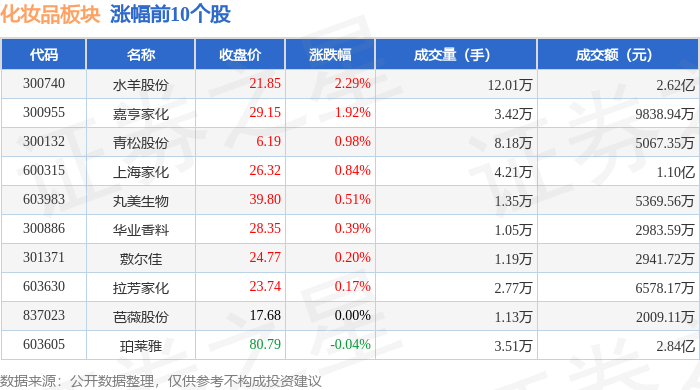
化妆品板块9月30日涨0.26%,水羊股份领涨,主力资金净流出944.4万元
Zheng Xing Xing Ye Ri Bao· 2025-09-30 08:51
Group 1 - The cosmetics sector increased by 0.26% on September 30, with Shuiyang Co., Ltd. leading the gains [1] - The Shanghai Composite Index closed at 3882.78, up 0.52%, while the Shenzhen Component Index closed at 13526.51, up 0.35% [1] - Key stocks in the cosmetics sector showed varied performance, with Shuiyang Co., Ltd. closing at 21.85, up 2.29%, and Proya Cosmetics Co., Ltd. closing at 80.79, down 0.04% [1][2] Group 2 - The net outflow of main funds in the cosmetics sector was 9.444 million yuan, while retail investors saw a net inflow of 8.3265 million yuan [2] - The table of fund flows indicates that Shuiyang Co., Ltd. had a main fund net inflow of 12.6721 million yuan, while retail investors had a net outflow of 16.2603 million yuan [3] - Other notable fund flows include Jiahen Home Chemical with a main fund net inflow of 9.0194 million yuan and a retail net outflow of 13.1271 million yuan [3]


化妆品板块9月29日跌0.13%,青岛金王领跌,主力资金净流出1.04亿元
Zheng Xing Xing Ye Ri Bao· 2025-09-29 08:53
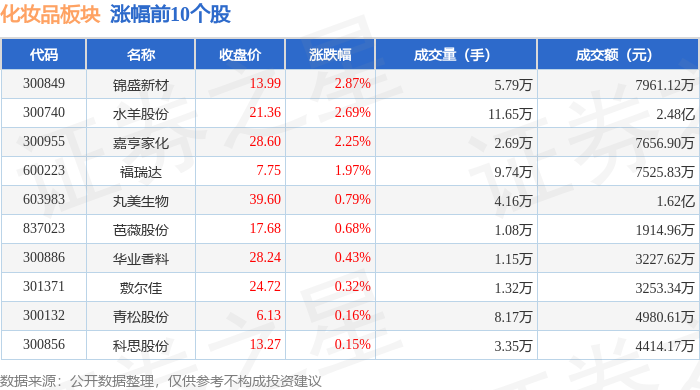
Core Insights - The cosmetics sector experienced a slight decline of 0.13% on September 29, with Qingdao Jinhao leading the drop [1] - The Shanghai Composite Index closed at 3862.53, up 0.9%, while the Shenzhen Component Index closed at 13479.43, up 2.05% [1] Group 1: Stock Performance - The top-performing stocks in the cosmetics sector included: - Jinsong New Material (300849) with a closing price of 13.99, up 2.87% and a trading volume of 57,900 shares [1] - Shuiyang Co. (300740) closed at 21.36, up 2.69% with a trading volume of 116,500 shares [1] - Jiahen Home Care (300955) closed at 28.60, up 2.25% with a trading volume of 26,900 shares [1] - Qingdao Jinhao (002094) was the biggest loser, closing at 7.77, down 2.88% with a trading volume of 287,600 shares [2] - Other notable declines included: - Lafang Home Care (603630) down 1.66% [2] - Beitaini (300957) down 1.37% [2] Group 2: Capital Flow - The cosmetics sector saw a net outflow of 104 million yuan from major funds, while retail funds experienced a net inflow of 58.59 million yuan [2] - The capital flow for specific stocks showed: - Furuida (600223) had a net inflow of 9.18 million yuan from major funds [3] - Jinsong New Material (300849) saw a net inflow of 2.32 million yuan from major funds [3] - Beitaini (300957) experienced a net outflow of 2.96 million yuan from major funds [3]


2025上半年美妆行业“变局”
3 6 Ke· 2025-09-28 11:48
Core Insights - The global beauty industry is projected to exceed $677 billion by 2025, indicating strong growth, while the Chinese cosmetics market is undergoing significant structural changes, moving away from reliance on single blockbuster products or marketing gimmicks to a focus on genuine brand strength [1][2]. Market Performance - The Chinese cosmetics retail market is expected to maintain moderate growth in the first half of 2025, with retail sales reaching 2.291 billion yuan, a year-on-year increase of 2.9%, although this is below the overall retail growth rate of 5.0% [2][4]. - International beauty giants are facing pressure in the Chinese market, with L'Oréal leading with sales of 186.19 billion yuan, a 3% increase year-on-year, while Estée Lauder reported a 10.88% decline in net sales, marking its lowest sales in five years [4][6]. Domestic Brand Performance - Domestic brands are showing resilience, with the retail scale of the Chinese cosmetics market reaching 1.0738 trillion yuan in 2024, and domestic brands capturing 55.2% of the market share [6][8]. - The top ten domestic beauty companies reported a total revenue growth of 11.72% in the first half of 2025, with Proya, Shiseido, and Shanghai Jahwa leading the rankings [7][8]. Consumer Trends - The beauty market is witnessing a shift towards rational consumption, with consumers increasingly sensitive to price and favoring cost-effective products. The sales of beauty and skincare products reached 235.23 billion yuan in the first half of 2025, a 10.1% increase year-on-year [12][13]. - The anti-aging market is experiencing significant growth, with total sales reaching 65.49 billion yuan, a 30.3% increase year-on-year, and the demand for anti-aging products is expanding to younger demographics [13][14]. Brand Strategies - Brands are increasingly adopting multi-brand strategies to address diverse consumer needs, moving from a single product focus to a more comprehensive brand matrix [14][19]. - Investment in research and development is on the rise among leading domestic brands, with a focus on building technological barriers and enhancing product efficacy [15][16]. Marketing and Distribution - Douyin (TikTok) has solidified its position as a growth engine for the beauty industry, with daily views of beauty videos exceeding 2.5 billion, reflecting a shift towards more refined and systematic marketing strategies [17][18]. - The competition is evolving from a focus on single-channel strategies to an integrated approach that balances online and offline resources, emphasizing the importance of brand experience and customer loyalty [18][19].


化妆品板块9月26日涨0.1%,青岛金王领涨,主力资金净流入5580.27万元
Zheng Xing Xing Ye Ri Bao· 2025-09-26 08:48
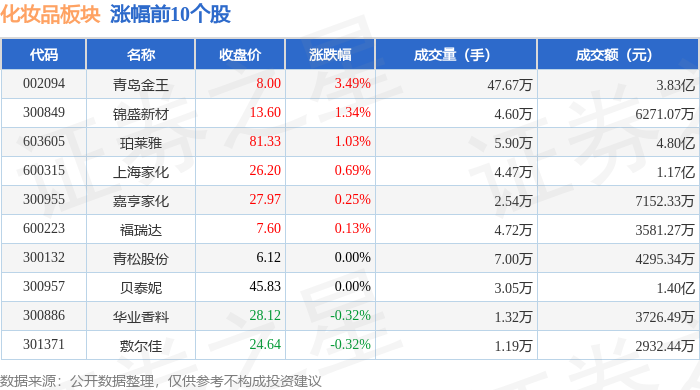
Group 1 - The cosmetics sector experienced a slight increase of 0.1% on September 26, with Qingdao King leading the gains [1] - The Shanghai Composite Index closed at 3828.11, down 0.65%, while the Shenzhen Component Index closed at 13209.0, down 1.76% [1] - Key stocks in the cosmetics sector showed varied performance, with Qingdao King rising by 3.49% to a closing price of 8.00 [1] Group 2 - The cosmetics sector saw a net inflow of 55.80 million yuan from main funds, while retail investors experienced a net outflow of 30.36 million yuan [2] - Major stocks like Qingdao King and Shanghai Jahwa had significant net inflows from main funds, indicating investor interest [3] - The overall trading volume and turnover in the cosmetics sector reflected active market participation, with Qingdao King achieving a turnover of 3.83 billion yuan [1][2]
化妆品板块9月25日跌0.34%,嘉亨家化领跌,主力资金净流出4989.87万元
Zheng Xing Xing Ye Ri Bao· 2025-09-25 08:44
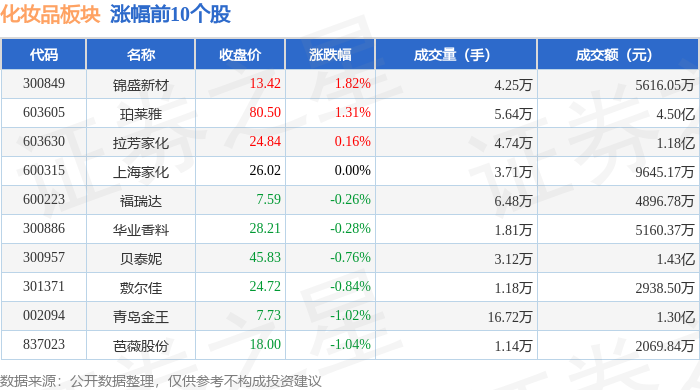
Market Overview - On September 25, the cosmetics sector declined by 0.34%, with Jiaheng Jiahua leading the drop [1] - The Shanghai Composite Index closed at 3853.3, down 0.01%, while the Shenzhen Component Index closed at 13445.9, up 0.67% [1] Individual Stock Performance - Notable gainers included: - Jinsheng New Material (300849) with a closing price of 13.42, up 1.82% [1] - Tiancaiya (603605) with a closing price of 80.50, up 1.31% [1] - Major decliners included: - Jiaheng Jiahua (300955) with a closing price of 27.90, down 2.04% [2] - Wanmei Biological (603983) with a closing price of 39.81, down 1.87% [2] Trading Volume and Capital Flow - The cosmetics sector experienced a net outflow of 49.89 million yuan from main funds, while retail investors saw a net inflow of 29.38 million yuan [2] - The trading volume for key stocks included: - Shanghai Jahwa (600315) with a trading volume of 37,100 shares and a turnover of approximately 96.45 million yuan [1] - Qingdao Kingway (002094) with a trading volume of 167,200 shares and a turnover of approximately 130 million yuan [2] Fund Flow Analysis - Main fund inflows and outflows for selected stocks: - Shanghai Jahwa had a main fund net inflow of 3.17 million yuan, while retail investors contributed a net inflow of 3.43 million yuan [3] - Jiaheng Jiahua saw a main fund net outflow of 393,800 yuan, with retail investors contributing a net outflow of 387,720 yuan [3]
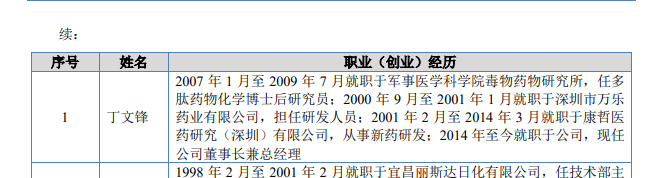
学霸掌门+肽概念镀金,宝洁供应商维琪科技闯关北交所,将复制下一个“玻尿酸神话”?
Mei Ri Jing Ji Xin Wen· 2025-09-25 06:32
Core Viewpoint - Shenzhen Weiqi Technology Co., Ltd. is preparing for an IPO on the Beijing Stock Exchange, driven by the rising popularity of peptide-based cosmetics and a strong performance in recent years [1][7]. Company Overview - Weiqi Technology is a supplier of cosmetic raw materials, primarily focusing on peptide cosmetics. The company is controlled by Ding Wenfeng and Lai Yanmin, who together hold 62.0687% of the shares [1][2]. - Ding Wenfeng, the actual controller, has a PhD and extensive experience in research and development within the pharmaceutical and cosmetic industries [1][2]. Financial Performance - The company's revenue for the years 2022 to 2024 is projected to grow from 135 million yuan to 248 million yuan, with net profits increasing from approximately 35.13 million yuan to 70.64 million yuan [7]. - The growth is attributed to the increasing application of active peptide ingredients in well-known cosmetic brands, enhancing consumer awareness and demand [7]. Client Dependency - The revenue contribution from the top five clients has shown a decline, with percentages of 36.14%, 29.48%, and 38.76% for the respective years [7][8]. - Notably, the second to fifth largest clients in 2022 have exited the top five list by 2023, raising concerns about client retention and dependency [7]. Market Trends and Risks - The cosmetic industry is subject to rapid changes in consumer preferences, as evidenced by the decline of hyaluronic acid products. This raises questions about the sustainability of the current demand for peptide ingredients [8][9]. - Weiqi Technology acknowledges the potential volatility in its business due to reliance on a single category of products, emphasizing the need for continuous market promotion and brand support [9][10]. Business Strategy - The company is increasing its share of finished cosmetic products, with ODM (Original Design Manufacturer) products contributing 47.05% of its main revenue by 2024 [9][10]. - The ODM business is strategically positioned to promote the sale of raw materials, indicating a dual focus on both raw material supply and finished product development [10].