三六零

Search documents
行业点评报告:火山引擎FORCE大会召开在即,关注字节产业链及AI应用投资机会
KAIYUAN SECURITIES· 2025-12-14 14:11
Investment Rating - The industry investment rating is "Overweight" (maintained) [1] Core Insights - The upcoming Volcano Engine FORCE conference is expected to showcase significant advancements in AI models and ecosystem, with a focus on the release of new members of the Doubao model family, which aims to enhance performance and reduce costs [5][6] - The conference will also highlight upgrades to Agent development tools and the expansion of the Agent ecosystem, which are crucial for integrating AI into enterprise production scenarios [7] - The report emphasizes investment opportunities in the ByteDance ecosystem and AI applications, recommending various companies that are expected to benefit from these trends [8] Summary by Sections Industry Overview - The computer industry is projected to outperform the overall market [1] - The industry has shown a significant trend with a 24% fluctuation in the past months [2] Upcoming Events - The Volcano Engine FORCE conference is scheduled for December 18-19, 2025, featuring major announcements and advancements in AI technology [5] Model Developments - The new Doubao model members are anticipated to improve capabilities while lowering costs, particularly in video generation [6] Agent Ecosystem - Upgrades to Agent development tools are expected to enhance AI development processes, making them more efficient and comprehensive [7] Investment Recommendations - The report suggests focusing on companies like Hand Information, Zhongke Chuangda, and others that are positioned to benefit from AI applications and computing power [8]
研判2025!中国网络安全测试软件行业政策、产业链图谱、发展现状、企业布局及未来发展趋势分析:网络安全监管趋严,测试软件迈向数字转型护航新赛道[图]
Chan Ye Xin Xi Wang· 2025-12-14 02:04
Core Insights - The strategic value of network security testing software is increasingly highlighted amid the deepening digital transformation and rising cybersecurity risks, with the market expected to reach approximately 80 billion yuan in 2024 and continue to expand in 2025 [1][5] - The industry structure is shifting from a hardware-dominated model to one driven by software and services, with security software and services gaining a larger market share, while network security testing software is experiencing significant growth compared to the overall industry [1][5] - The competitive landscape is characterized by a mix of comprehensive vendors and specialized firms, with leading companies focusing on "technology + scenarios + compliance" to drive future development [1][5] Industry Overview - Network security testing software is designed to assess the security of network systems, applications, and related infrastructure, utilizing techniques such as simulated hacking and automated vulnerability scanning to identify potential security risks [2][3] - The software plays a crucial role throughout the entire lifecycle of system development, deployment, and maintenance, generating evaluation reports that include risk levels and remediation suggestions [2][3] Policy Framework - China has established a multi-layered policy framework to support the network security testing software industry, with laws such as the Cybersecurity Law and the Data Security Law providing a solid compliance basis and broad market development space [4][5] Industry Chain - The industry chain is well-defined, with upstream components including high-performance servers and core technologies like AI detection algorithms, while midstream focuses on product development and service provision [4][5] - Downstream demand is concentrated in critical sectors such as finance, government, telecommunications, and energy, driven by compliance requirements and data security needs [4][5] Current Market Analysis - The network security market in China is projected to reach approximately 80.36 billion yuan in 2024 and exceed 94 billion yuan in 2025, reflecting a healthy growth trend [5][6] - The market structure is evolving towards a model driven by software and services, with the share of security services increasing from 20.5% in 2019 to an expected 28% in 2024 [5][6] Competitive Landscape - The industry has formed a diverse competitive landscape, with key players like Qihoo 360, Sangfor, and Venustech leading the market, while specialized firms focus on niche areas such as cloud security and web application protection [6][7] - Companies are increasingly integrating AI and security technologies to enhance detection accuracy and expand market coverage [7][8] Future Development Trends - The industry is expected to evolve towards intelligent technology, standardized compliance, and diversified scenarios, with AI and automation becoming integral to the testing process [8][9] - The tightening of compliance frameworks will drive the adaptation of testing standards and tools to meet both domestic and international requirements [9][10] - The demand for tailored testing solutions in emerging fields such as the Internet of Things and cloud-native environments will lead to a shift towards vertical and integrated product offerings [10]


“智汇”九三京西发展座谈会 共商AI时代机遇
Zhong Guo Xin Wen Wang· 2025-12-12 06:20
Core Insights - The meeting emphasized the importance of computing power as a fundamental resource in the AI era, with a focus on transforming the Mentougou District from a traditional mining area to a high-tech industry hub [2][3] - AI is recognized as a strategic technology driving a new wave of technological and industrial transformation, becoming a key direction for national development [3] - Experts highlighted the need for a robust AI infrastructure led by state-owned capital, ensuring safety and security in AI applications [3] Group 1: AI Development and Infrastructure - The meeting discussed the necessity of building a national integrated computing power network to support the growing demand for AI, emphasizing the importance of efficient distributed training and inference optimization [3] - Recommendations were made to create a comprehensive computing infrastructure that is inclusive, user-friendly, efficient, green, and secure, which would empower high-quality economic development [3] - The focus on AI for scientific research was highlighted, suggesting the establishment of platform-based research paradigms utilizing AI [3] Group 2: Local Applications and Innovations - Experts proposed various applications of AI in local contexts, such as expanding autonomous driving demonstration zones and developing smart parking management systems [5] - The use of drones for intelligent mountain patrols and data analysis to uncover hidden routes was discussed, aiming to enhance safety and intelligence in natural environments [5] - The potential of reviving historical railway sites using AI and VR technology was presented as a means to activate local development [5] Group 3: Collaborative Efforts and Future Directions - The meeting resulted in a compilation of over 100,000 words of research findings from experts, which will be organized into actionable lists for implementation [6] - The commitment to a "3+3" comprehensive performance platform was reiterated, showcasing the responsibility of the political party in regional development [6] - The meeting aimed to foster a distinctive path for high-quality development in the Beijing West region, aligning with national strategic goals [6]

金融网络安全靶场市场深度分析-筑牢数字金融的“数字沙盘”
QYResearch· 2025-12-12 02:22
Core Viewpoint - The financial cybersecurity range is evolving from a technical validation tool to a core infrastructure for digital financial security, enhancing the defensive capabilities of financial institutions and promoting proactive immunity against cyber threats [5]. Industry Overview - The financial cybersecurity range integrates virtualization, big data, and other technologies to provide a comprehensive security infrastructure for financial institutions, including attack-defense drills, vulnerability verification, emergency response training, and system testing [1]. - The industry value chain consists of upstream technology providers, midstream platform developers, and downstream financial institutions, forming a complete chain from equipment supply to operational services, with a gross margin of approximately 50-65% [3]. Market Trends - According to QYResearch, the global financial cybersecurity range market is projected to reach $1.37 billion by 2031, with a compound annual growth rate (CAGR) of 7.1% over the coming years [3]. - The financial cybersecurity range is becoming a critical infrastructure in the digital transformation of the financial industry, driven by the acceleration of digitalization and the evolution of cyberattack methods [5]. Industry Chain Collaboration - The industry chain covers three main segments: upstream technology support focusing on core technology development, midstream platform construction and operation, and downstream application scenarios expanding to fintech companies and third-party payment platforms [7]. - Upstream focuses on core technology research, including virtualization engines and AI attack-defense algorithms, while midstream involves specialized security vendors providing modular designs for core functional modules [7]. Policy Drivers - Global financial regulatory frameworks have set clear requirements for the construction of cybersecurity ranges, with policies accelerating their adoption among financial institutions [8]. - The Chinese "Financial Technology Development Plan (2022-2025)" emphasizes the establishment of a cybersecurity attack-defense exercise system, mandating regular drills for financial institutions [8]. Challenges and Opportunities - The financial cybersecurity range faces challenges such as reliance on imported technologies, high construction costs, and a significant talent gap in the industry [9]. - The market has high entry barriers, requiring expertise in core patents, substantial funding, and compliance with security certifications [10]. Future Directions - The financial cybersecurity range is expected to evolve into a "financial security brain," integrating various technologies and expanding its application scenarios [10]. - Companies are encouraged to pursue differentiated competition by focusing on full-scenario coverage in the financial industry and collaborating with academic institutions to overcome technological bottlenecks [10].
360创始人周鸿祎:“黑客智能体”让黑客成为“超级黑客”
Xin Lang Cai Jing· 2025-12-11 14:26
Core Viewpoint - The existence of vulnerabilities has fundamentally changed the rules of cybersecurity, allowing attackers to exploit a single vulnerability to bypass traditional defenses and directly invade systems [1] Group 1: Vulnerabilities and Cybersecurity - The current era is characterized by a software-defined world where government operations, city management, corporate activities, and daily life are all built on code, increasing the destructive potential of vulnerabilities [1] - The emergence of "hacker agents" is expected to exacerbate the asymmetry in cyber offense and defense, transforming the nature of cyber warfare from "human vs. human" to "human vs. machine" [1]
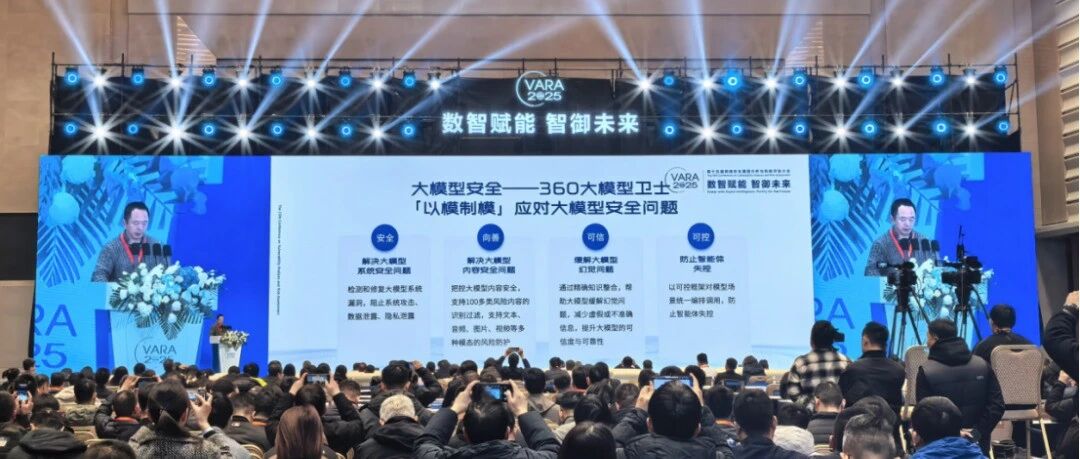
第十五届VARA大会在天津开幕 周鸿祎发表主题演讲:筑牢AI安全底座 护航高质量发展
Zheng Quan Ri Bao· 2025-12-11 11:13
Group 1 - The 15th Vulnerability Analysis and Risk Assessment Conference (VARA) was held in Tianjin, featuring Zhou Hongyi, founder of 360 Group, as the only representative from the industry, discussing new challenges in cybersecurity in the era of artificial intelligence [2] - 360 Digital Security Technology Group received two significant honors from the National Information Security Vulnerability Database (CNNVD) and the China Information Security Testing Center, recognizing its contributions and technical support capabilities in national vulnerability governance [2] - Zhou Hongyi emphasized that the existence of vulnerabilities has fundamentally changed the rules of cybersecurity, allowing attackers to exploit a single vulnerability to bypass traditional defenses and directly invade systems [2] Group 2 - The emergence of "hacker agents" is raising concerns, as they can automate tasks such as vulnerability discovery and network attacks, allowing a single human hacker to manage multiple agents, thus shifting the cybersecurity landscape from "human vs. human" to "human vs. machine" [3] - 360's core strategy to combat these challenges is "using AI to fight AI," enhancing vulnerability detection efficiency and accuracy through its self-developed 360 security model, which includes multiple expert models working in collaboration [3][4] - 360 has developed a swarm intelligence model for automated vulnerability analysis and discovery, significantly simplifying the vulnerability management process and reducing reliance on human intervention [4]
第十五届VARA大会在津开幕 周鸿祎强调筑牢AI安全底座
Zheng Quan Shi Bao Wang· 2025-12-11 10:55
Group 1 - The VARA conference, a significant annual event in the cybersecurity field, focuses on vulnerability management and AI security, highlighting the importance of collaboration among government, industry, academia, and research [1] - Zhou Hongyi, founder of 360 Group, emphasized the changing landscape of cybersecurity due to vulnerabilities, which allow attackers to bypass traditional defenses with minimal effort [2] - The emergence of "hacker agents" has transformed the nature of cyber warfare, shifting the confrontation from "human vs. human" to "human vs. machine," increasing the asymmetry in cyber defense [2] Group 2 - 360's core strategy to combat AI threats involves using its self-developed 360 security model to enhance the efficiency and accuracy of vulnerability detection, transitioning from rule-based to learning-driven methods [3] - The company has developed multiple expert models that work collaboratively to address various issues in vulnerability management, laying the groundwork for creating intelligent security agents [3] - 360 has introduced a swarm intelligence model for automated vulnerability analysis and discovery, significantly streamlining the vulnerability management process and reducing reliance on manual operations [4]
聚焦AI时代网络安全新挑战 周鸿祎:用AI对抗AI
Zhong Guo Xin Wen Wang· 2025-12-11 10:21
他表示,传统网络攻击往往需要强行突破防御体系,而如今攻击者仅需利用一个漏洞即可绕过传统防 护。更为严峻的是,基于AI的"黑客智能体"可将人类黑客的经验与能力程序化,自动执行漏洞挖掘、利 用和攻击任务,并能被大规模复制与管理,形成"超级黑客"效应,推动网络攻防从"人与人"对抗转 向"人与机器"对抗。 面对新型挑战,周鸿祎提出"用AI对抗AI"的应对思路。他介绍,通过自主研发的360安全大模型,可将 传统规则驱动的检测升级为学习驱动,并构建协同工作的专家模型群,为打造应对威胁的安全智能体提 供"大脑"。基于大模型、知识库与专用工具开发的专业安全智能体,能复刻人类高级安全专家能力,实 现全天候快速响应,提升防御自动化水平。 据悉,VARA大会自2008年创办以来,已成为国内网络安全领域凝聚"政产学研用"各方力量的重要年度 交流平台。本届大会由中央网信办、国家市场监督管理总局指导,中国信息安全测评中心主办。(完) 【编辑:刘阳禾】 中新网天津12月11日电 (记者 周亚强)"漏洞的存在已彻底改变了网络安全的游戏规则。"360集团创始人 周鸿祎10日表示,AI既是新质生产力与安全防御的新载体,也是全新的风险源头。 当天 ...
L3认知型智能体时代来临,如何重塑企业核心竞争力?
Sou Hu Cai Jing· 2025-12-11 09:37
Group 1 - The core viewpoint of the report indicates that from 2023 to 2025, AI software applications will enter the "L3 cognitive intelligent agent" era, characterized by the integration of large-scale pre-trained models and deep domain knowledge, transforming industries' competitive landscape [1] - Cognitive intelligent agents have penetrated core value chains in enterprise operations, with examples such as Tencent Cloud's platform enhancing code writing efficiency by up to 40%, JD's supply chain agent enabling dynamic optimization decisions, and 360's security agent improving threat detection accuracy by 20% [3][4] - The report suggests that this shift redefines competitive dimensions among enterprises, where those with advanced AI cognitive capabilities will establish new barriers in product innovation, customer service, and operational efficiency [4] Group 2 - The transition to L3 cognitive agents is seen as a critical differentiator between industry leaders and followers, with the ability to deeply integrate intelligent agents into organizational and business processes being a key metric [4] - The next two years are identified as a golden window for industries to build their own "cognitive intelligence" moats, emphasizing the urgency for companies to adapt and innovate [4]
周鸿祎第十五届VARA演讲:筑牢AI安全底座,护航高质量发展
华尔街见闻· 2025-12-11 08:21
Core Viewpoint - The VARA conference highlights the increasing importance of cybersecurity in the age of artificial intelligence, emphasizing the need for advanced strategies to combat new threats posed by vulnerabilities and AI-driven attacks [3][5][8]. Group 1: Conference Overview - The 15th VARA conference took place in Tianjin, attended by representatives from 27 national ministries, 52 state-owned enterprises, over 100 cybersecurity companies, and more than 30 universities and research institutions [1]. - The conference serves as a significant platform for collaboration among government, industry, academia, and research, focusing on key issues such as vulnerability management and AI security [3]. Group 2: Recognition and Achievements - 360 Digital Security Technology Group received two prestigious awards from the National Information Security Vulnerability Database (CNNVD) and the China Information Security Testing Center, recognizing its contributions to the national vulnerability management ecosystem [2][4]. Group 3: Key Challenges and Strategies - Zhou Hongyi, founder of 360, discussed the transformative impact of vulnerabilities on cybersecurity, noting that attackers can exploit a single vulnerability to bypass traditional defenses [3][5]. - The emergence of "hacker agents" has shifted the landscape of cyber warfare, allowing individuals to manage multiple automated hacking entities, thus intensifying the asymmetry in cyber defense [3][5]. Group 4: AI-Driven Solutions - 360's strategy to combat AI-driven threats involves developing an AI-powered security model that enhances the efficiency and accuracy of vulnerability detection [5]. - The company has created multiple expert models that work collaboratively to address various security challenges, laying the groundwork for the development of intelligent security agents [5][7]. - The introduction of automated vulnerability analysis and discovery through the "hive intelligence" model significantly streamlines the vulnerability management process, reducing reliance on manual operations [7]. Group 5: Future Outlook - Zhou emphasized that AI represents both a new productivity driver and a potential source of risk, advocating for collaborative efforts to strengthen digital security foundations [8].