
SK Hynix

Search documents
Asian Shares Decline Amid Profit Booking
RTTNews· 2025-10-10 08:32
Market Overview - Asian stocks experienced broad declines as investors took profits amid warnings of stretched valuations from the IMF and BOE, raising concerns of a potential market collapse similar to the dotcom bubble [1][2] - The benchmark Shanghai Composite index fell 0.94% to 3,897.03, influenced by China's restrictions on rare earth exports and U.S. proposals to ban Chinese airlines from certain routes [2] - Hong Kong's Hang Seng index dropped 1.73% to 26,290.32, while Japanese markets faced sharp declines due to concerns over a potential bubble in AI-linked tech [2][3] Japanese Market Dynamics - The Nikkei average decreased by 1.01% to 48,088.80, with the broader Topix index down 1.85% at 3,197.59 [3] - Notable stock movements included SoftBank Group losing 3.1% and Tokyo Electron dropping 1.4%, while Fast Retailing surged 6.7% after reporting record profits [3] - Japanese wholesale prices rose 2.7% year-on-year as households expect continued price increases [4] South Korean Market Performance - The Kospi index in Seoul jumped 1.73% to 3,610.60, reaching a record high as traders returned from a holiday [4] - Samsung Electronics saw a 6.1% increase in shares following reports of revived partnerships with U.S. chipmakers Qualcomm and Intel, while SK Hynix shares soared 8.2% [5] Australian and New Zealand Markets - Australian markets ended slightly lower, with the S&P/ASX 200 dipping 0.13% to 8,958.30, affected by underperformance in mining and gold stocks [6] - New Zealand's S&P/NZX-50 index fell 0.76% to 13,467.26, primarily due to losses in healthcare stocks [6] Commodity and Currency Trends - The dollar remained near two-month highs amid political and economic crises in France and ongoing U.S. government shutdown [7] - Gold faced selling pressure for the second consecutive day, while oil prices extended losses after a 1.6% drop in the previous session [7] U.S. Market Sentiment - U.S. stocks ended slightly lower after a week of record gains, with caution emerging as the IMF and JPMorgan Chase warned of potential market corrections [8] - The tech-heavy Nasdaq Composite finished marginally lower, while the S&P 500 and Dow also saw slight declines [10]


Asian shares are mostly lower following Wall Street's pause from its feverish rally
ABC News· 2025-10-10 05:57
Market Overview - Asian shares mostly fell, influenced by a pause in Wall Street's recent rally, with the price of gold also retreating from record highs [1][2] - U.S. futures and oil prices were higher, but nearly all Asian indexes declined, except for South Korea's Kospi, which rose 1.3% to 3,596.36 after a holiday [2] Company Performance - South Korea's tech shares, including SK Hynix and Samsung Electronics, saw significant gains, with SK Hynix up nearly 7% and Samsung rising 5.4% following Nvidia-backed Reflection AI's $2 billion funding [2] - Dell Technologies experienced a 5.2% drop, the largest loss in the S&P 500, despite a nearly 11% increase for the week due to AI growth discussions [7] - Delta Air Lines reported stronger-than-expected summer profits and forecasted a profit range for the final quarter that exceeded analysts' estimates, contributing to a 4.3% stock increase [8] Economic Indicators - The S&P 500 slipped 0.3% to 6,735.11, marking its second loss in ten days, while the Dow Jones and Nasdaq also experienced declines [4] - Concerns are rising about the sustainability of stock prices, particularly in the AI sector, following a 35% increase in the S&P 500 since April [6] - The U.S. government shutdown has delayed key economic reports, increasing the importance of corporate earnings as indicators of economic strength [9]

Asia-Pacific markets set to open lower, tracking Wall Street losses
CNBC· 2025-10-09 23:37
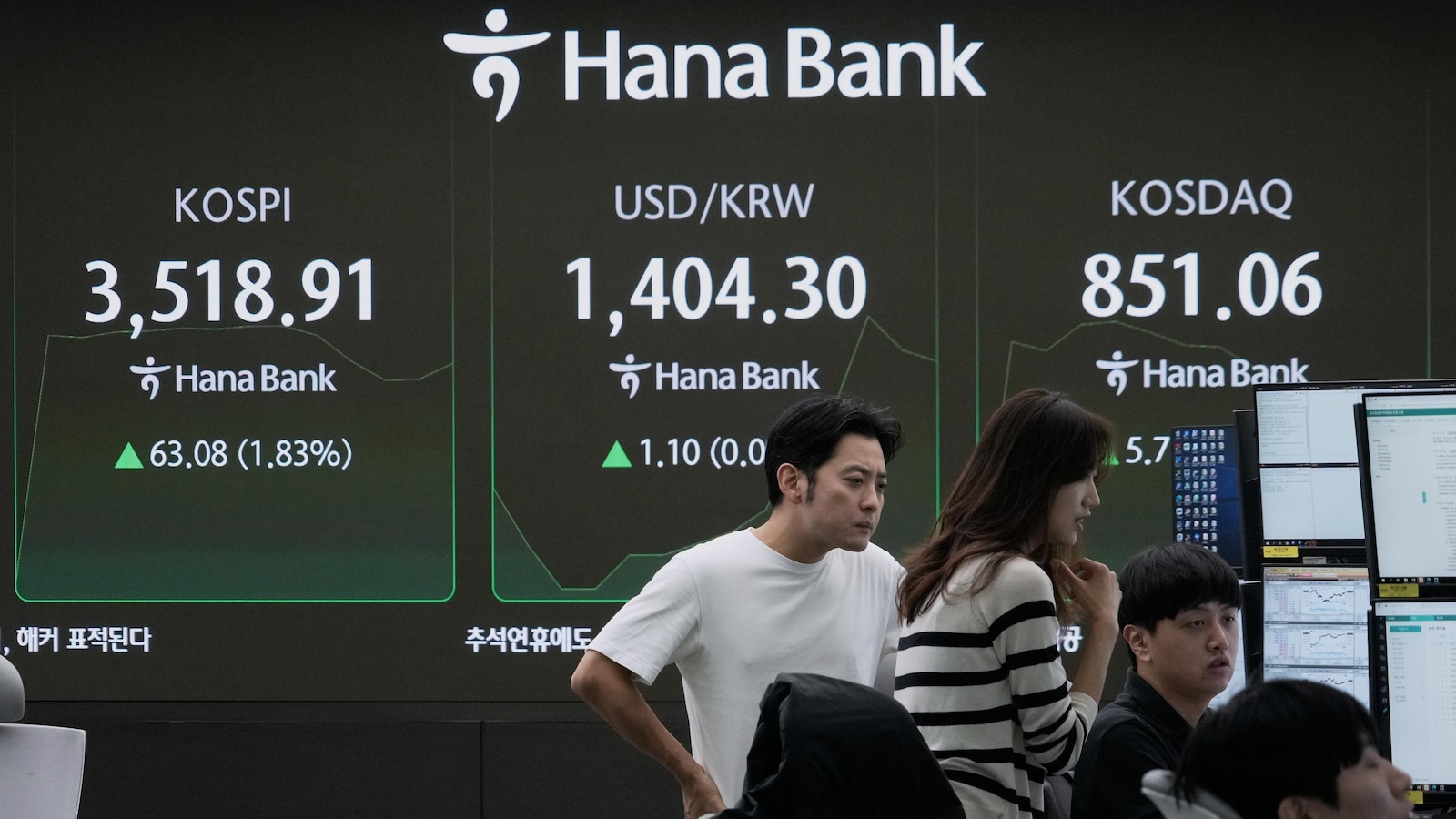
Sunset scene of light trails traffic speeds through an intersection in Gangnam center business district of Seoul at Seoul city, South KoreaShares of South Korean chipmakers SK Hynix and Samsung Electronics hit record highs Friday, after a near-weeklong holiday, boosted by a series of artificial intelligence deals.SK Hynix shares jumped 10% while Samsung Electronics rose nearly 6% to hit fresh records, according to data from FactSet.The two companies are set to benefit from an OpenAI and Advanced Micro Devic ...

This Nation's Stocks Are Beating the World. Should You Invest $1,000?
Yahoo Finance· 2025-10-09 10:32
Group 1: Market Performance - South Korea's stock market is experiencing significant growth, with the Korea Composite Stock Price Index (Kospi) up 48% year to date, outperforming major indices like the S&P 500, which is up about 15% [5] - The iShares MSCI South Korea ETF has climbed 64% year to date, indicating strong performance among large and mid-cap stocks in the Korean market [4] - The Kospi is currently around 3,550, with a target set by President Lee Jae Myung to push it past 5,000 during his term [3] Group 2: Investment Opportunities - There is increased interest from global investors in Korean companies, with overseas investors making $11.5 billion in stock purchases since May, significantly above historical averages [1] - Korean stocks are considered undervalued, with a trailing-12-month price-to-earnings ratio of about 16.5 compared to the S&P 500's ratio of around 28 [8] - The iShares MSCI South Korea ETF is highly diversified, holding 82 stocks with no single company outside the top two accounting for more than 5% of the fund [5] Group 3: Government Initiatives - President Lee has committed to ending the "Korea discount" by implementing new shareholder protections and lowering capital gains tax thresholds [2] - Improving corporate governance standards and stock market returns are top priorities for the government, which is expected to boost investor confidence [3] - A recent trade deal with the U.S. aims to lower tariffs on South Korean goods to 15%, which could positively impact the economy and stock market [6]
China's top DRAM maker CXMT edges closer to mainland IPO amid AI memory chip supply crunch
Yahoo Finance· 2025-10-09 09:30
Core Viewpoint - ChangXin Memory Technologies (CXMT) is progressing towards a significant initial public offering (IPO) amid supply shortages in the high-end memory chip market driven by the global AI boom [1][6] Company Developments - CXMT has resolved issues related to the election of employee representative directors and the identification of state-owned shareholders, facilitating the IPO process [1][2] - The company is expected to increase its market share for DDR5 and LPDDR5 chips from below 1% in Q1 to 7% and 9% respectively by the end of the year [4][5] - CXMT completed its IPO counselling recordation in July, a necessary step for companies seeking to list on the mainland [3] Market Context - The global DRAM market is experiencing a supply crunch due to rising demand for AI computing power, with DRAM chips being essential for high-speed memory in AI systems [6] - CXMT aims to challenge the dominance of South Korean firms SK Hynix and Samsung Electronics, as well as US-based Micron Technology in the memory chip sector [3]
大中华半导体 - 内存更新:前所未有的超级周期-Greater China Semiconductors-Memory Refresh Unprecedented Supercycle
2025-10-09 02:39
Summary of Conference Call on Greater China Semiconductors Industry Overview - The semiconductor industry, particularly memory segments (DRAM, NAND, NOR Flash), is experiencing an unprecedented supercycle driven by AI demand [1][2][3] - Chinese memory players are aggressively expanding capacity to meet rising demand [1][2] Key Points on DRAM - **DDR4 Shortage**: Expected to continue until at least Q4 2026, with a projected 10-15% undersupply over the next three quarters, potentially worsened by back-end constraints [2][10][12] - **Price Increases**: Nanya Tech reported a preliminary revenue increase of 79% Q/Q, with average selling prices (ASPs) expected to rise at least 20% Q/Q as market dynamics favor sellers [2][11] - **Long-term Outlook**: Mainstream DRAM players are likely to focus on DDR5 and HBM, providing minimal support for DDR4, which is expected to see a significant decline in demand [14][15] Key Points on NAND - **Demand Divergence**: NAND demand is increasing significantly in AI applications, with CSPs doubling their NL eSSD orders for 2026 [3][48] - **Projected Shortages**: Anticipated 2% NAND shortage in 2026, with a bull case projecting up to an 8% shortage by year-end [3][48] - **Price Expectations**: NAND pricing is expected to rise by at least mid-teens percentage in 2026, benefiting companies like Phison [3][48] Key Points on NOR Flash - **Pricing Support**: NOR pricing is expected to remain well-supported due to capped supply growth and potential demand from IoT applications [4] - **Market Dynamics**: AirPods could account for 5-10% of global NOR demand by 2026, indicating sustained price hikes into 2026 [4] Company-Specific Insights - **Price Target Adjustments**: Price targets raised for Nanya Tech (from NT$90 to NT$110), Phison (from NT$800 to NT$1,000), and Silicon Motion (from US$88 to US$100) [7] - **Investment Recommendations**: Companies like Nanya Tech, Winbond, and GigaDevice are favored due to their positioning in the memory upcycle [5][16] - **Earnings Forecasts**: Phison's EPS forecasts have been revised upward by 3% for 2026 and 6% for 2027, reflecting strong NAND pricing trends [68] Additional Insights - **Localization Trends**: Ongoing localization of wafer fab equipment in China is expected to strengthen the domestic semiconductor industry [59][60] - **Capacity Expansion**: CXMT and YMTC are set to expand their capacities significantly, with CXMT potentially exceeding 300k wpm in the long term [61][62] Conclusion - The semiconductor industry, particularly in memory segments, is poised for significant growth driven by AI demand and capacity expansions from Chinese players. Companies like Nanya Tech, Phison, and SIMO are well-positioned to benefit from these trends, with favorable pricing dynamics expected to continue into 2026 and beyond.

野村 - 全球存储芯片:前所未有的超级周期-Nomura-Global memory:Unprecedented super_cycle
野村· 2025-10-09 02:00
Investment Rating - The report maintains a "Buy" rating for Samsung Electronics and SK Hynix, with target prices raised to KRW123,000 and KRW540,000 respectively [34][5]. Core Insights - The memory market is expected to enter an unprecedented super-cycle, driven by significant investments from US Big Tech in AI and traditional servers, leading to a substantial increase in memory demand by 2026 [1][4]. - Demand for traditional server-related memory, such as DDR4 and DDR5, is projected to grow by around 50% in 2026, while enterprise SSD demand is expected to nearly double [2]. - Operating profit margins for commodity DRAM are anticipated to recover to levels approaching 70% by 2026, while NAND margins are expected to reach 30-40% [3]. Summary by Sections Market Overview - The memory market is poised for a super-cycle, with substantial investments continuing into 2027 and 2028, followed by a likely downturn in 2028 [4]. - US Big Tech's capital expenditures are projected to increase significantly, with a 30% year-on-year growth expected in 2026 [13]. Demand Projections - Traditional server investments declined by 30% year-on-year in 2023 but are expected to grow by 20-30% in 2026 [2]. - Demand for enterprise SSDs, which account for approximately 40% of total NAND demand, is projected to grow by over 100% in 2026 due to strong storage needs from both traditional and AI data centers [2]. Profitability Forecasts - Samsung's operating profit is projected to reach KRW90 trillion in 2026 and KRW130 trillion in 2027, with a significant increase in target price reflecting this growth [5]. - SK Hynix is expected to achieve operating profit of KRW72 trillion in 2026 and KRW88 trillion in 2027, with a 50% increase in target price [5]. Competitive Landscape - Samsung is expected to have the highest relative capacity flexibility among memory manufacturers, with significant production scaling capabilities at its Pyeongtaek fabs [4]. - The entry of Samsung into Nvidia's HBM market is considered highly probable, which could enhance its competitive position [30].
亚洲投资者对韩国存储技术、电动汽车电池材料及控股公司的市场反馈-Asian investor marketing feedback on memory Korea tech, EV battery materials, and holdco
2025-10-09 02:00
J P M O R G A N Asia Pacific Equity Research 07 October 2025 Asia Technology Asian investor marketing feedback on memory/Korea tech, EV battery/materials, and holdco (82-2) 758-5725 jay.h.kwon@jpmorgan.com J.P. Morgan Securities (Far East) Limited, Seoul Branch Sangsik Lee (82-2) 758 5146 sangsik.lee@jpmorgan.com J.P. Morgan Securities (Far East) Limited, Seoul Branch Neelay Y Kamath (91-22) 6157 3764 neelay.kamath@jpmchase.com J.P. Morgan India Private Limited See page 9 for analyst certification and impor ...
美股异动|拉姆研究股价回调背后暗藏AI驱动的未来潜力
Xin Lang Cai Jing· 2025-10-07 23:38
Group 1 - Lam Research Corporation (LRCX) experienced significant stock price volatility in October, with a 5.90% decline on October 7 [1] - Jefferies raised the target price for Lam Research from $110 to $175 on October 6, reflecting confidence in the company's growth potential [1] - Strong demand for AI technology is driving the semiconductor market, with OpenAI's agreements with Samsung and SK Hynix indicating a surge in demand for memory chip production equipment [1] Group 2 - Lam Research specializes in wafer deposition and etching technologies, positioning the company to benefit from the increasing demand in the semiconductor equipment sector [1] - The introduction of the VECTOR® TEOS 3D deposition system in September highlights the company's commitment to technological innovation and its strategic focus on high-end markets [1] - The semiconductor market is currently influenced by macroeconomic changes, industry trends, and the company's strategic adjustments, with AI technology development providing new growth opportunities [2]

AMD to supply 6GW of compute capacity to OpenAI in chip deal worth tens of billions
TechCrunch· 2025-10-06 13:33
Core Insights - AMD has signed a multi-year chip supply agreement with OpenAI, potentially generating tens of billions in revenue for AMD and enhancing its position in the AI sector [1] - The deal involves AMD supplying 6 gigawatts of compute capacity, sufficient to power approximately 4.5 million homes, starting with the Instinct MI450 GPU [1] - OpenAI will receive the first gigawatt of capacity in the second half of 2026 [1] AMD's Product Performance - AMD claims that the MI450 series will outperform Nvidia's comparable offerings through hardware and software enhancements, many of which will be developed with OpenAI's collaboration [2] - Current MI355X and MI300X series GPUs are already effective for AI inference in large language models due to their substantial memory capacity and bandwidth [2] Stock Agreement Details - As part of the agreement, OpenAI has the option to purchase up to 160 million shares of AMD stock, representing a 10% stake [3] - The first tranche of shares will vest with the initial 1 gigawatt deployment, with additional tranches vesting as OpenAI acquires the total 6 gigawatts [3] Stock Price Milestones - OpenAI's stake is linked to AMD's stock price milestones, with the final tranche vesting when AMD's stock reaches $600 per share [4] - AMD shares experienced a significant increase, closing at $164.67 before opening at $222.24, a nearly 35% rise following the announcement of the deal [4] OpenAI's Strategic Moves - OpenAI is actively pursuing multiple chip partnerships to build its AI infrastructure, including plans for five new Stargate data centers with a total capacity of 7 gigawatts [4] - OpenAI CEO Sam Altman described the partnership with AMD as a significant advancement in building the necessary compute capacity for AI [7] Recent Partnerships - In the previous month, OpenAI secured a $100 billion investment from Nvidia for at least 10 gigawatts of compute capacity and signed a $10 billion deal with Broadcom for custom AI chips [8] - OpenAI is also collaborating with Samsung Electronics and SK Hynix to source DRAM memory chips for its Stargate project and to establish data centers in South Korea [8]
