Adobe

Search documents
Figma Stock Soars 3x, Now Comes The Hard Part
Forbes· 2025-08-01 10:55
Core Insights - Figma made a strong public market debut, with its stock price increasing over three times its IPO price, closing at $115.50, valuing the company at over $55 billion [2] Financial Performance - Figma reported revenue of $228.2 million for the quarter ending March 31, representing a 46% year-over-year growth, leading to an annual revenue run rate of $913 million [3] - The company achieved a net income of $44.9 million in the last quarter, with adjusted operating margins of 17% and free cash flow margins of 24% for 2024 [3] Customer Engagement - Figma's Net Dollar Retention rate is 132%, indicating existing customers are spending 32% more annually, showcasing strong product stickiness [4] - The company's pricing model is seat-based, which encourages organic growth within organizations, minimizing customer acquisition costs and shortening sales cycles [4] - Figma maintains a balanced cost structure, with R&D spending nearly equal to sales and marketing, emphasizing product innovation over aggressive selling [4] Valuation and Market Position - Figma's valuation exceeds 50 times its estimated 2025 run rate revenue, significantly higher than mature peers like Adobe, which trades at around 7.5 times forward sales [5] - The premium valuation reflects Figma's strong growth rate of approximately 40%, compared to Adobe's 9%, but also sets high expectations for future performance [5] - Figma is expanding its offerings beyond design tools to become a broader collaboration hub, which is crucial for its long-term success [5] Competitive Landscape - Competition is intensifying with Microsoft integrating design tools into Office 365, Canva expanding its offerings, and AI-native tools potentially reducing reliance on traditional design platforms [6] - Figma's enterprise customer base is still developing, with only 1,031 customers paying over $100,000 annually, highlighting the need for deeper integration within organizations [6][7]



Figma more than triples in NYSE debut after selling shares at $33
CNBC Television· 2025-08-01 10:48
Take a look at shares of software design developer Figma soaring. And when I say soaring, that's probably an understatement. Uh in their public debut yesterday, the company pricing its IPO $33 uh a share. That was originally open for trading yesterday at $85, then closed at more than $115. At that point, Fig's market cap was close to $70 billion. As you remember, and we've talked about it, um Adobe agreed to buy that company back in 2022 for $20 billion, but that deal had fallen apart over concerns from Bri ...
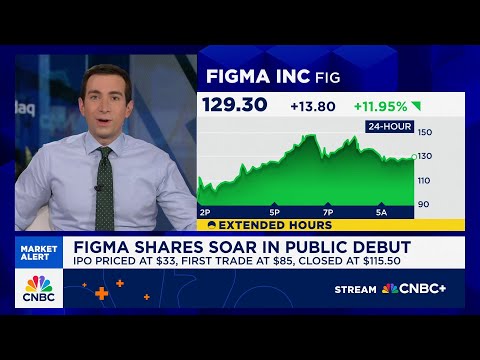
2025年最强IPO?Figma上市首日股价暴涨250%,32岁CEO缔造650亿美元设计帝国
Sou Hu Cai Jing· 2025-08-01 10:40
Core Insights - Figma Inc. had a remarkable IPO debut, with its stock price soaring from the IPO price of $33 to $115.50, marking a gain of over 250% and setting a record for the largest first-day increase for companies raising over $1 billion in nearly 30 years [1][2][5] IPO Performance - The IPO was priced at $33 per share, which was at the upper end of the previously raised pricing range. The stock opened at $85 and reached a high of $107 during the trading day, closing at $115.50 [2][5] - Figma's market capitalization surged to approximately $56.3 billion on the first day, with a fully diluted valuation exceeding $65 billion, significantly higher than the $19.3 billion valuation at the time of the IPO and nearly three times the $20 billion acquisition offer from Adobe in 2022 [5][6][14] Financial Details - Figma issued 36.937 million shares, raising approximately $411 million from direct issuance and $807 million from existing shareholders selling shares. The IPO saw a subscription rate exceeding 40 times, with over half of the orders not receiving stock allocation [6][14] - The Marin Community Foundation was a major beneficiary, selling 13.4 million shares for about $441 million. CEO Dylan Field's holdings were valued at around $6 billion, making him one of the youngest billionaires in tech [6][14] Company Background - Founded in 2012 by Dylan Field and Evan Wallace, Figma was designed to address collaboration challenges in the design software industry, moving away from traditional desktop applications to a cloud-based, real-time collaborative platform [7][8] - Figma's growth strategy focuses on expanding its product offerings beyond design tools to encompass the entire product development workflow, aiming to empower product teams rather than just individual designers [9][12][13] Strategic Goals - Figma's growth strategy includes maintaining rapid product innovation, converting free users to paid customers, deepening relationships with existing clients, expanding internationally, and seeking acquisition opportunities [16][17] - The company aims to fill gaps in the product development lifecycle with new offerings like Figma Make, Figma Sites, and Figma Buzz, which integrate AI technology and enhance collaboration across teams [15][18] Market Impact - Figma's successful IPO sets a new benchmark for the SaaS industry, demonstrating that the capital market is willing to pay a premium for high-quality, scarce assets even amid economic uncertainty [18]

Figma上市 国内设计协作平台MasterGo战略价值凸显
Sou Hu Cai Jing· 2025-08-01 04:35
Core Insights - Figma's IPO on July 31, 2025, marked the largest IPO in the U.S. stock market for the year, with a closing stock price of $115.5, a 250% increase, and a market capitalization of approximately $56.3 billion, reflecting a price-to-sales (P/S) ratio exceeding 75x, significantly higher than the average of 7x for private SaaS companies [1] - The high valuation of Figma is attributed to its mature business model and clear growth path, rather than just market hype, indicating strong market recognition of its position as a comprehensive tool for creativity, collaboration, and project management [1] Valuation Logic - Figma's valuation signals that AI enhances the value of collaboration rather than replacing SaaS tools, as the complexity of design processes necessitates ongoing communication and iteration among teams [2][3] - The proliferation of content generated by AI raises challenges in management and consensus, increasing the value of collaborative platforms like Figma that organize and streamline creative processes [3] Product Innovation and AI Integration - Figma has actively integrated AI into its product offerings, enhancing user efficiency through features like automatic layer naming and code semantic interpretation, although these features are still in beta and not yet major revenue sources [5][6] - The underlying architecture of Figma, which defines interfaces through code, positions it favorably for collaboration with AI, allowing for natural language interface generation and direct conversion to front-end code [8][9] Strong Business Metrics - Figma's financial performance is robust, with $821 million in revenue, a 46% year-over-year growth, a gross margin of 91%, and a net revenue retention rate of 132%, indicating strong customer loyalty and engagement [10] - The company has established a wide moat through a strong community ecosystem, plugin market, and educational resources, creating high switching costs for customers [10] Market Opportunities - The success factors of Figma, including strong collaboration capabilities, AI-friendly architecture, continuous product innovation, and a solid community ecosystem, are mirrored in domestic competitor MasterGo, which also addresses unique strategic needs in China [13][14] - MasterGo offers private and hybrid cloud deployment options, catering to industries with stringent data security requirements, which Figma cannot provide [16] - MasterGo's rapid integration of AI capabilities and its understanding of local design contexts position it as a strong competitor in the market [17] Industry Dynamics - Figma's IPO has reshaped perceptions in the tech industry, demonstrating that established products with unique value propositions can thrive alongside new AI-native products, rather than being replaced [18]
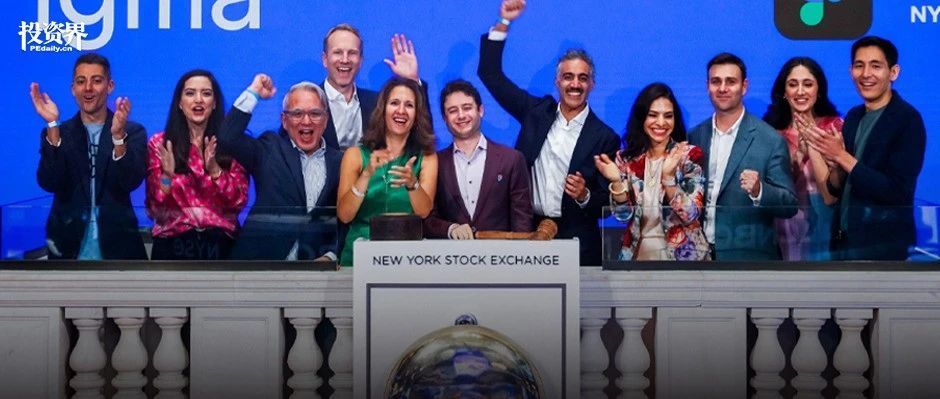
4000亿,一位90后IPO敲钟了
3 6 Ke· 2025-08-01 03:49
Core Insights - Figma has officially gone public on the New York Stock Exchange, marking the largest IPO in the U.S. tech sector this year, with shares priced at $33 and closing up 250%, resulting in a market capitalization of $56.3 billion (approximately 400 billion RMB) [2][3] - The company was founded by Dylan Field, a dropout from Brown University, who aimed to create an online collaborative design platform to challenge Adobe's dominance in graphic design software [4][6] - Figma's revenue model includes free access for individual and educational users, while enterprise users are charged based on different pricing tiers [8] Company Background - Dylan Field, born in 1992, demonstrated early mathematical talent and pursued computer science and mathematics at Brown University before dropping out to start Figma [4][6] - The initial concept of Figma faced challenges, including unclear product direction and business model, leading to difficulties in securing investment [6][7] - The company gained traction after launching its first official version in 2016 and capitalized on the remote work trend during the COVID-19 pandemic, generating $75 million in revenue in 2020 [9] Financial Performance - Figma's revenue is projected to reach $749 million in 2024, a 48% increase year-over-year, with Q1 2025 revenue at $228 million, up 46% [11] - The company reported a net income of $44.9 million for Q1 2025, with a significant increase in high-paying clients, totaling 1,031 clients paying over $100,000 annually, a 47% increase [11] Investment and Valuation - Figma has attracted significant venture capital investment, with early funding from Index Ventures and subsequent rounds leading to a valuation of $10 billion before the IPO [13][14] - The IPO has created substantial wealth for investors, with the total value of shares held by major venture capital firms estimated at around $24 billion [16] - The IPO is seen as a potential indicator for future valuations of other tech unicorns, as it reflects a renewed optimism in the market for venture capital exits [16][17]

4000亿,一位90后IPO敲钟了
投资界· 2025-08-01 03:24
Core Viewpoint - Figma's IPO on July 31 marked the largest IPO in the U.S. tech sector since 2021, with shares priced at $33 and closing up 250%, resulting in a market capitalization of $5.63 billion (approximately 40 billion RMB) [1][3][21]. Company Background - Figma was founded by Dylan Field, a college dropout, aiming to challenge Adobe by creating an online graphic design platform [2][5]. - The company has received backing from numerous venture capital firms over its 13-year history [2][6]. Financial Performance - Figma's revenue for 2024 is projected to be $749 million, a 48% increase year-over-year, with Q1 2025 revenue at $228.2 million, up 46% [12]. - The company has over 1,031 annual paying customers exceeding $100,000, a 47% increase, including major clients like Netflix and Duolingo [12]. Investment and Valuation - Figma's journey includes multiple funding rounds, with significant investments from firms like Index Ventures and Greylock Partners, leading to a valuation of $10 billion by 2021 [17][18]. - The latest funding round before the IPO raised $416 million, with major stakeholders including Durable Capital and Morgan Stanley [19]. Wealth Creation - The IPO generated substantial wealth for early investors, with the potential for returns exceeding 10 times their initial investments [22][23]. - Dylan Field's net worth surged to $6.1 billion post-IPO, reflecting the financial success of the venture [21][22]. Market Impact - Figma's IPO is seen as a bellwether for future valuations of other tech unicorns, indicating a potential resurgence in the IPO market [23][24]. - The overall sentiment in the venture capital and private equity markets is improving, with a notable increase in IPO activity in 2025 [24][25].
【大涨解读】人工智能:加速推动“人工智能+”,AI应用迎来密集催化,美股AI设计龙头大涨250%
Xuan Gu Bao· 2025-08-01 03:21
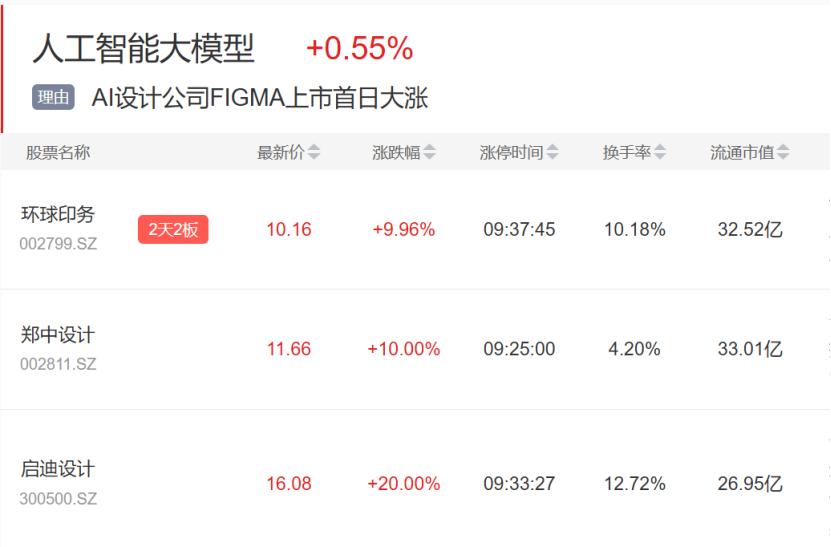
Core Viewpoint - The surge in AI applications has led to significant stock price increases for companies like Global Printing, Zhengzhong Design, and Qidi Design, following the strong market debut of AI design company Figma [1][2][3]. Group 1: AI Market Developments - The State Council, led by Premier Li Qiang, approved the "Artificial Intelligence +" action plan to promote the commercialization of AI applications across various sectors [3]. - The National Development and Reform Commission emphasized the importance of market confidence and practical implementation in advancing AI initiatives [3]. Group 2: Figma's Market Impact - Figma's IPO on the New York Stock Exchange saw its opening price at $85, a 157% increase from the IPO price of $33, closing at $115.5, marking a 250% rise [3]. - Figma is positioned as a disruptor to Adobe, which has dominated the market for 30 years, and is expected to reshape production processes and expand the overall market size [4]. Group 3: Industry Insights - Figma's success is attributed to its collaborative platform that integrates various workflow nodes, enhancing efficiency in front-end design [4]. - The total addressable market (TAM) for Figma is estimated at $33 billion, with a projected workforce of 144 million involved in product development by 2029 [5]. - The global software spending is expected to exceed $1.2 trillion by 2025, indicating a robust growth trajectory for AI applications [5].


深度|AI越强,Figma越贵?深入解读563亿美金超级IPO背后的“反共识”逻辑
Z Potentials· 2025-08-01 02:41
Core Insights - Figma's IPO on July 31, 2025, marked a significant event in the tech sector, with shares soaring 250% on the first day, leading to a market valuation of approximately $56.3 billion, surpassing Adobe's previous acquisition offer of $20 billion [1][2] - The company demonstrated strong financial health with an annual recurring revenue (ARR) of nearly $1 billion and a year-over-year growth rate of 46%, alongside a gross margin of around 90% and an adjusted operating margin of 17-18% [7][8] - Figma's unique collaborative design platform has redefined workflows, creating a natural growth engine that leverages product-led growth (PLG) strategies [9][10] Group 1: Financial Performance - Figma's ARR reached $912 million as of Q1 2025, maintaining a remarkable growth rate of 46% year-over-year [7] - The company's price-to-sales (P/S) ratio is nearly 75 times, significantly higher than the SaaS industry average of 7.1 times [2] - Figma's net dollar retention rate (NDRR) stands at 132%, indicating a 32% annual increase in spending from existing customers [7] Group 2: Market Position and Strategy - Figma's success is attributed to its innovative cloud-based collaborative design approach, which eliminates inefficiencies associated with traditional desktop software [9] - The platform's core value lies in its collaborative capabilities rather than just design execution, positioning it as a central hub for both AI and human decision-making [10][14] - Figma's AI strategy aims to lower barriers for non-designers, creating new user entry points and enhancing network effects [11][12] Group 3: Competitive Landscape and Future Outlook - The emergence of generative AI tools poses questions about Figma's core value, but the company views AI as a means to enhance its collaborative strengths rather than a threat [10][20] - Figma's platform is evolving from a simple design tool to a comprehensive collaborative operating system, integrating design systems, version control, and community resources [18][23] - The IPO reflects a broader trend in the SaaS market, emphasizing the importance of collaboration in the AI era, where platforms that facilitate human decision-making will become essential infrastructure [26][28] Group 4: Local Market Insights - The rise of MasterGo in China illustrates how Figma's principles can be adapted to local market needs, focusing on enterprise-level solutions and data security [21][24] - MasterGo's strategy involves leveraging partnerships with major companies to validate its product value, creating strong internal network effects [22] - Both Figma and MasterGo demonstrate that AI can amplify core values rather than replace them, enhancing productivity and collaboration [25]

从9美分到115美元:Figma(FIG.US)千亿市值背后的风头盛宴,Greylock40倍回报创纪录
Zhi Tong Cai Jing· 2025-08-01 02:25
Core Insights - Figma (FIG.US) made its debut on the New York Stock Exchange, soaring 250% on its first day, resulting in significant returns for early venture capital investors [1][2] - Index Ventures, Figma's largest backer, invested nearly $100 million during the seed round, with its stake valued at $72.3 billion by the end of the first trading day [1] - Greylock Partners, the second-largest investor, invested approximately $50 million, seeing its stake rise to about $67.5 billion after the IPO [1][3] Investment Returns - Figma's IPO price was set at $33 per share, with a fully diluted valuation of $18.5 billion, which increased to $65 billion by the end of the first trading day [2] - Index Ventures' partner Danny Rimer highlighted the long-term vision of Figma's co-founder Dylan Field, who holds 11% of the company [2] - Kleiner Perkins invested $90 million during the B round at $0.33 per share, with its stake valued at $60.5 billion by the end of the first trading day [3] Other Notable Investors - Sequoia Capital invested approximately $150 million in Figma, with its stake valued at around $37.5 billion post-IPO [3] - Other significant investors include Andreessen Horowitz and Durable Capital Partners, who participated in various funding rounds as Figma's valuation increased [3] - Figma raised over $300 million in total funding during its private phase, indicating strong investor confidence in its growth potential [3]
Figma:硅谷独角兽的链上IPO新探索,重塑协作与资本边界
Sou Hu Cai Jing· 2025-08-01 00:47
在科技界迎来又一重要时刻之际,硅谷设计软件巨头Figma于7月31日在纽交所正式挂牌上市,此举由摩根士丹利、高盛、艾伦公司及摩根大 通等多家顶级投行联合承销,成为2025年度备受瞩目的科技股IPO之一。Figma的招股书中一项创新举措尤为引人注目:公司宣布已获授权发 行"区块链普通股",这一做法在全球尚属首例。 Figma与加密世界的渊源并非始于今日。此前,该公司已将比特币ETF纳入资产负债表,显示出其对加密领域的持续关注。Figma的创始人 Dylan Field更是Web2创业者中较早关注Crypto动态的一员,这并非一次偶然的尝试,而是对Crypto长期潜力的认可。 作为全球前沿公司之一,Figma正通过实际行动展示其对加密技术的接纳。本文将从独特的视角重新审视这家公司,不仅关注其估值与增长曲 线,还深入探讨其产品哲学与资本结构设计。这一切的核心人物,正是Dylan Field。 Dylan Field并非典型的硅谷明星创始人。他身材微胖,穿衣随意,早年甚至有过演艺经历。五岁时,他便首次登上舞台,这段经历让他深刻体 会到"协作的力量"。高中时期,他开始接触编程,并在大学期间与未来Figma的另一位创始人 ...