
成都银行

Search documents
服务消费领域信贷支持加强
Xiangcai Securities· 2025-09-21 10:02
Investment Rating - The industry investment rating is maintained at "Overweight" [6][8][32] Core Viewpoints - The report highlights the strengthening of credit support in the service consumption sector, with the People's Bank of China implementing structural monetary policies to guide financial institutions in increasing credit allocation to key service consumption areas [6][27][30] - A total of 500 billion yuan has been allocated for "service consumption and elderly re-loans" to support credit for sectors such as accommodation, catering, cultural and entertainment, education, resident services, tourism, and elderly care [6][27][30] - The report indicates that as of the end of July, the loan balance in key service consumption areas reached 2.79 trillion yuan, reflecting a year-on-year growth of 5.3% [6][29][30] Summary by Sections 1. Market Review - The banking index fell by 4.21% during the period from September 15 to September 21, 2025, underperforming the CSI 300 index by 3.77 percentage points [10] - Among different bank types, rural commercial banks showed relatively better performance [10] 2. Funding Market - The central bank's net injection in the open market was 1.1923 trillion yuan, indicating a tightening of the funding environment [17] - The average issuance rates for 1-year interbank certificates of deposit for various bank types showed slight changes, with state-owned banks at 1.67% [20] 3. Industry and Company Dynamics - The report emphasizes the collaborative efforts between the People's Bank of China and local business departments to address the financial needs of private and small to medium-sized enterprises in the service consumption sector [30] - Financial institutions have reported nearly 60 billion yuan in applications for "service consumption and elderly re-loans" [29] 4. Investment Recommendations - The report suggests that with the ongoing implementation of fiscal interest subsidies, bank credit demand is expected to improve, and the performance of bank stocks is anticipated to remain relatively stable [8][32] - Specific banks recommended for investment include CITIC Bank, Jiangsu Bank, Chengdu Bank, and others, highlighting their potential for absolute return investment value [8][32]
成都银行(601838):增持稳步落地,彰显配置信心
HTSC· 2025-09-21 08:31
Investment Rating - The investment rating for Chengdu Bank is maintained at "Buy" with a target price of RMB 23.33 [1][9]. Core Views - The report highlights the steady progress of the major shareholder's increase in holdings, reflecting confidence in the bank's value and development potential [5][6]. - Recent trends show a wave of share buybacks among listed banks, indicating strong recognition of value and confidence in future growth [8]. - The bank's fundamentals remain solid, with a stable transition in management and a focus on risk control, maintaining a high provision coverage ratio [7]. Financial Performance and Forecast - Chengdu Bank's revenue and net profit are projected to grow steadily, with expected revenues of RMB 22,982 million in 2024 and RMB 24,311 million in 2025, reflecting growth rates of 5.89% and 5.78% respectively [4][19]. - The bank's net profit attributable to shareholders is forecasted to reach RMB 12,858 million in 2024 and RMB 13,817 million in 2025, with growth rates of 10.17% and 7.46% respectively [4][19]. - The non-performing loan ratio is expected to remain stable at 0.66% for 2025 and 2026, indicating strong asset quality management [4][19]. Valuation Metrics - The report maintains a target price-to-book (PB) ratio of 1.10 for 2025, with a corresponding target price of RMB 23.33, reflecting the bank's strong position in the industry [9]. - The forecasted earnings per share (EPS) for 2025 is RMB 3.26, with a price-to-earnings (PE) ratio of 5.38 [19]. - The dividend yield is projected to increase from 4.99% in 2024 to 5.37% in 2025, indicating a commitment to returning value to shareholders [19].

成都银行:人力资源总监魏小瑛女士因退休离任
Zheng Quan Ri Bao· 2025-09-19 15:45
Group 1 - Chengdu Bank announced the resignation of its Human Resources Director, Ms. Wei Xiaoying, due to retirement, effective from September 18, 2025 [2] - After her resignation, Ms. Wei Xiaoying will no longer hold any position within the company [2]

银行板块高位回调超11%,揭秘后续走势
第一财经· 2025-09-19 15:12
Core Viewpoint - The banking sector has experienced a significant correction after a strong performance earlier in the year, with a cumulative decline of 11.46% since July 10, while other major indices have risen significantly [3][5]. Group 1: Recent Performance and Market Trends - After a period of continuous decline, the banking sector saw a slight recovery on September 19, with a marginal increase of 0.08% [3]. - The banking stocks have been under pressure due to a shift in market sentiment, with funds moving towards high-growth sectors, leading to a withdrawal of capital from the banking sector [3][5]. - From the beginning of the year until July 10, the banking sector had an impressive gain of over 21%, outperforming the CSI 300 index [5]. Group 2: Factors Influencing the Decline - The recent downturn in banking stocks is attributed to three main factors: profit-taking after a strong rally, seasonal dividend-related selling, and potential shareholder sell-offs [7]. - The banking sector has seen a significant adjustment, with share prices of various banks dropping over 10%, and some, like Everbright Bank and Beijing Bank, experiencing declines exceeding 20% [6][7]. Group 3: Shareholder and Management Support - In response to the declining stock prices, several banks have announced share buybacks by major shareholders, indicating confidence in their future growth [9][10]. - Notable examples include Everbright Bank and Chengdu Bank, where significant share purchases were made by their respective major shareholders [9]. Group 4: Future Outlook - Analysts suggest that the banking sector's high dividend yield and low volatility make it an attractive option for risk-averse investors, especially if market risk appetite decreases [10]. - The banking industry is expected to shift from a growth-driven model to one focused on quality, enhancing profitability and making it a valuable asset class for long-term investment [10].

银行板块已高位回调超11%,揭秘后续走势
Di Yi Cai Jing· 2025-09-19 14:25
Core Viewpoint - The banking sector has experienced a significant correction over the past two months, with a cumulative decline of 11.46% since July 10, despite a strong performance earlier in the year, where the sector rose over 21% by July 10 [1][2]. Group 1: Market Performance - After a five-day decline, the banking sector saw a slight increase of 0.08% on September 19, but major banks like Industrial and Agricultural Bank of China faced notable declines, with the former dropping 1.23% and the latter 1.77% [1]. - The banking sector's performance contrasts sharply with other major indices, such as the CSI 300, which rose over 12.79% during the same period [1]. - The banking sector had previously been a focal point of market attention, with 17 bank stocks reaching historical highs before the recent downturn [2]. Group 2: Factors Influencing the Decline - The recent downturn in bank stocks is attributed to several factors, including a shift in market risk appetite, profit-taking behavior, and the seasonal impact of dividend distributions [4]. - The adjustment period has seen the largest declines in joint-stock banks, with a drop exceeding 15%, while regional banks fell over 11% and state-owned banks decreased by over 4% [3]. Group 3: Shareholder and Management Support - In response to the declining stock prices, several bank shareholders have announced plans to increase their holdings, reflecting confidence in the banks' future growth [6]. - Notable examples include Everbright Bank and Chengdu Bank, where significant share purchases were made by major shareholders [6]. - Additionally, bank executives and board members have also committed to buying shares, indicating a strong belief in the banks' long-term value [7]. Group 4: Future Outlook - Analysts suggest that the current high dividend yields and low valuations of bank stocks may attract risk-averse investors, positioning the banking sector as a stabilizing force in the market [7]. - The banking industry is expected to transition from a growth-driven model to one focused on quality, enhancing profitability and resilience [7]. - Historical trends indicate that the banking sector often experiences a second wave of growth following periods of strong performance in growth stocks, suggesting potential for future recovery [7].
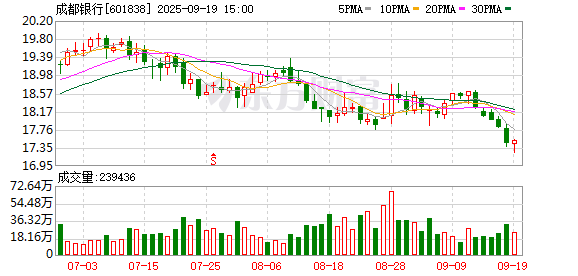
成都银行:股东成都产业资本集团增持1142万股,持股比例增至6.00%
Bei Jing Shang Bao· 2025-09-19 14:12
Core Viewpoint - Chengdu Bank has received a notification from Chengdu Industrial Capital Holding Group regarding the progress of its shareholding increase, which has triggered a 1% change in equity [1] Summary by Relevant Sections Shareholding Increase - From August 27, 2025, to September 19, 2025, Chengdu Industrial Capital Group has cumulatively increased its shares in Chengdu Bank by 11,424,450 shares, representing 0.2695% of the total shares [1] - The total amount spent on this share increase is 207.7291 million yuan [1] Current Shareholding Status - As of September 19, 2025, Chengdu Industrial Capital Group's shareholding in Chengdu Bank has increased from 24,765,708.6 shares to 25,430,603.6 shares, raising its ownership percentage from 5.8431% to 6.00% [1]
成都银行(601838) - 成都银行股份有限公司关于持股5%以上股东权益变动触及1%刻度的提示性公告
2025-09-19 11:33
证券代码:601838 证券简称:成都银行 公告编号:2025-058 成都银行股份有限公司关于持股 5%以上股东 权益变动触及 1%刻度的提示性公告 持股 5%以上股东成都产业资本控股集团有限公司保证向本公司提供 的信息真实、准确、完整,没有虚假记载、误导性陈述或重大遗漏。 本公司董事会及全体董事保证公告内容与信息披露义务人提供的信息 一致。 一、信息披露义务人及其一致行动人的基本信息 1.身份类别 | | □控股股东/实际控制人及其一致行动人 √ | | --- | --- | | | 其他 5%以上大股东及其一致行动人 | | 投资者及其一致行动人的身份 | □合并口径第一大股东及其一致行动人(仅适用 | | | 于无控股股东、实际控制人) | | | □其他 (请注明) | 2.信息披露义务人信息 | 信息披露义务人名称 | 投资者身份 | 统一社会信用代码 | | --- | --- | --- | | | □控股股东/实控人 | √915101006331271244 | | 成都产业资本控股集 | □控股股东/实控人的一致 | | | 团有限公司 | 行动人 | □不适用 | | | √其他直接 ...
成都银行(601838) - 成都银行股份有限公司关于高级管理人员退休离任的公告
2025-09-19 11:16
二、高级管理人员离任对公司的影响 经魏小瑛女士确认,其与本公司董事会无不同意见,亦无任何与其辞任有关 的事项需要通知本公司股东及债权人。魏小瑛女士已按照本公司相关规定做好交 接工作,并将严格履行本公司首次公开发行股票时所作的关于所持股份锁定及减 持相关承诺。 魏小瑛女士自 1996 年参与筹建并加入本公司,2015 年起担任总行领导职务, 见证、参与了成都银行近三十年的改革发展事业。魏小瑛女士恪尽职守、勤勉尽 责、锐意进取,在担任本公司人力资源总监期间,以精益求精务实的敬业精神、 姓名 离任职务 离任时间 原定任期 到期日 离任原因 是否继续在上 市公司及其控 股子公司任职 是否存在未 履行完毕的 公开承诺 魏小瑛 人 力 资 源 总监 2025年 9月 18 日 2027年6 月 11 日 退休 否 是 一、高级管理人员离任情况 证券代码:601838 证券简称:成都银行 公告编号:2025-057 成都股份有限公司 关于高级管理人员退休离任的公告 本公司董事会及全体董事保证本公告内容不存在任何虚假记载、误导性陈述 或者重大遗漏,并对其内容的真实性、准确性和完整性承担法律责任。 重要内容提示: 成都银行股份 ...
成都银行:股东成都产业资本控股集团有限公司增持0.2695%股份
Guo Ji Jin Rong Bao· 2025-09-19 11:09
成都银行公告,持股5%以上股东成都产业资本控股集团有限公司增持0.2695%股份,权益变动后持股比 例达到6.00%。此次增持通过上海证券交易所交易系统以集中竞价方式进行,累计增持金额为2.08亿 元。此次权益变动属于履行此前披露的增持股份计划,不触及要约收购,也不会导致成都银行控股股东 及实际控制人发生变化。增持计划尚未实施完毕,公司将持续关注并及时履行信息披露义务。 ...
国有资本持续增持 南京银行股权格局优化进行时
Jing Ji Guan Cha Wang· 2025-09-19 10:14
Core Viewpoint - Nanjing Bank has experienced significant shareholder increases in 2023, reflecting a strategic move by state-owned capital to optimize asset allocation and recognize the value of regional banks [1][6]. Shareholder Increases - Nanjing Gaoke increased its stake in Nanjing Bank from 9.00% to 9.99% by acquiring 123 million shares between August 7 and September 18 [1][2]. - Other shareholders, including Zijin Investment Group and Jiangsu Transportation Holding, have also increased their holdings, indicating a trend of state-owned capital investing in Nanjing Bank [2][6]. - The cumulative effect of these increases has led to significant ownership stakes, with Zijin Group and Zijin Trust holding a combined 13.02% and Jiangsu Transportation holding 14.01% [2][4]. Market Perspective - Shareholder increases are generally viewed as a positive signal regarding a company's valuation, especially in the context of the banking sector facing challenges such as narrowing net interest margins [3][8]. - The ongoing purchases by major shareholders suggest confidence in Nanjing Bank's asset quality and future strategic direction [3][8]. Shareholding Structure Changes - Jiangsu Transportation's recent transfer of shares from its subsidiary to itself increased its direct ownership in Nanjing Bank to 14.01%, enhancing its influence in corporate governance [4][5]. - This internal adjustment reflects a strategic intent to consolidate control and improve decision-making efficiency within the company [4][5]. Trends in State-Owned Capital - The increase in stakes by state-owned enterprises in Nanjing Bank is part of a broader trend where regional banks are gaining favor among state capital, indicating a long-term bet on the economic potential of the Yangtze River Delta region [6][8]. - Other regional banks, such as Suzhou Bank and Qingdao Bank, have also seen similar increases in state-owned capital, highlighting a growing trend in the sector [7][8]. Capital Operation Logic - The motivations behind shareholder increases include the attractiveness of long-term dividend yields from quality financial assets and the strategic value of bank shares for financing and investment [8]. - The recent changes in shareholding at Nanjing Bank represent a re-evaluation of the value of regional financial institutions and a dynamic adjustment in governance structures [8].

