服务消费与养老再贷款

Search documents
统筹完善发展金融“五篇大文章”
Xin Lang Cai Jing· 2026-02-26 21:46
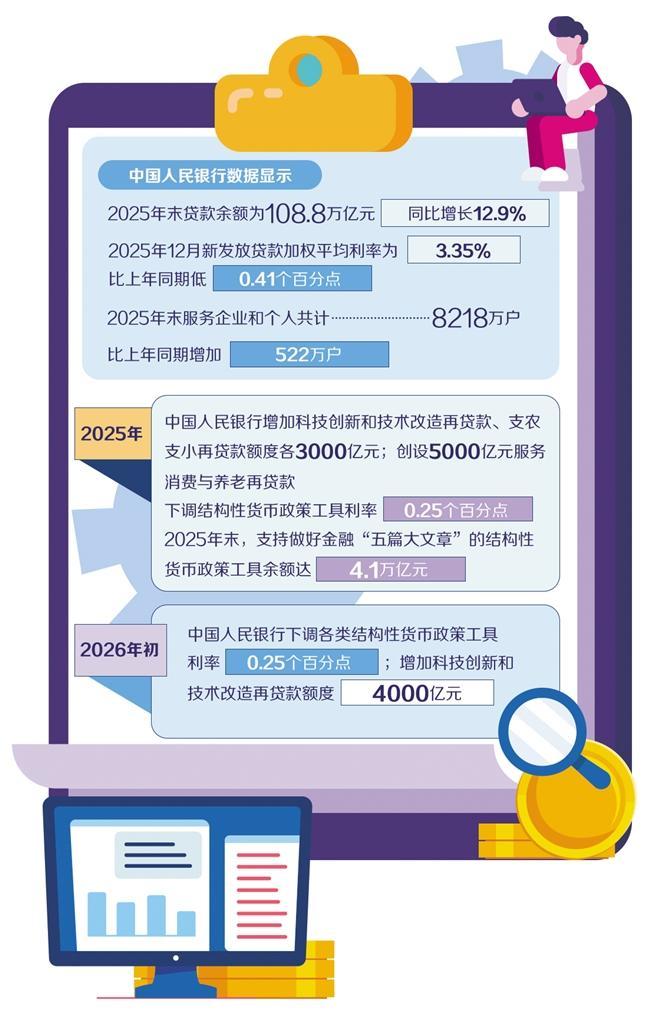
Group 1 - The core viewpoint of the articles emphasizes the importance of financial support in facilitating China's economic transformation and high-quality development, particularly through the implementation of the "Five Major Financial Articles" strategy [2][8][9] - By the end of 2025, the loan balance reached 108.8 trillion yuan, reflecting a year-on-year growth of 12.9%, with the average interest rate for new loans at 3.35%, down by 0.41 percentage points from the previous year [1][2][3] - The number of enterprises and individuals served by financial institutions increased to 82.18 million, an increase of 5.22 million from the previous year, indicating improved access to financing [2][3] Group 2 - The People's Bank of China (PBOC) has enhanced its structural monetary policy tools, increasing the quotas for re-loans aimed at technological innovation and agricultural support by 300 billion yuan each, and creating a 500 billion yuan re-loan for consumer and elderly care services [3][5] - As of the end of 2025, the balance of structural monetary policy tools supporting the "Five Major Financial Articles" reached 4.1 trillion yuan, demonstrating a significant commitment to optimizing financial structures [3][9] - The PBOC plans to further lower the interest rates of various structural monetary policy tools by 0.25 percentage points in early 2026, and increase the quotas for re-loans for technological innovation and transformation by 400 billion yuan [3][9] Group 3 - Financial institutions are increasingly focusing on supporting small and medium-sized enterprises (SMEs) and technology-driven companies, with a reported 28.6% increase in technology loans as a proportion of total loans by the end of 2025 [7] - The loan balance for technology-oriented SMEs reached 3.6 trillion yuan, growing by 19.8%, which is 13.6 percentage points higher than the overall loan growth rate [7] - The issuance of technology innovation bonds in the interbank bond market reached 1 trillion yuan, with 390 entities participating, indicating a robust market for financing innovation [7] Group 4 - The banking sector is adapting to the "Five Major Financial Articles" strategy by restructuring its capabilities and integrating more deeply into the industrial ecosystem, with large commercial banks playing a leading role [8][9] - The focus on key areas such as technological self-reliance and rural revitalization is becoming more pronounced, with different types of banks exploring differentiated services [8][9] - The PBOC aims to maintain a relatively loose monetary policy to support balanced credit growth and enhance financial services for the real economy, which is crucial for economic stability and growth [9]

货币政策适度宽松更重精准协同
Xin Lang Cai Jing· 2026-02-25 22:05
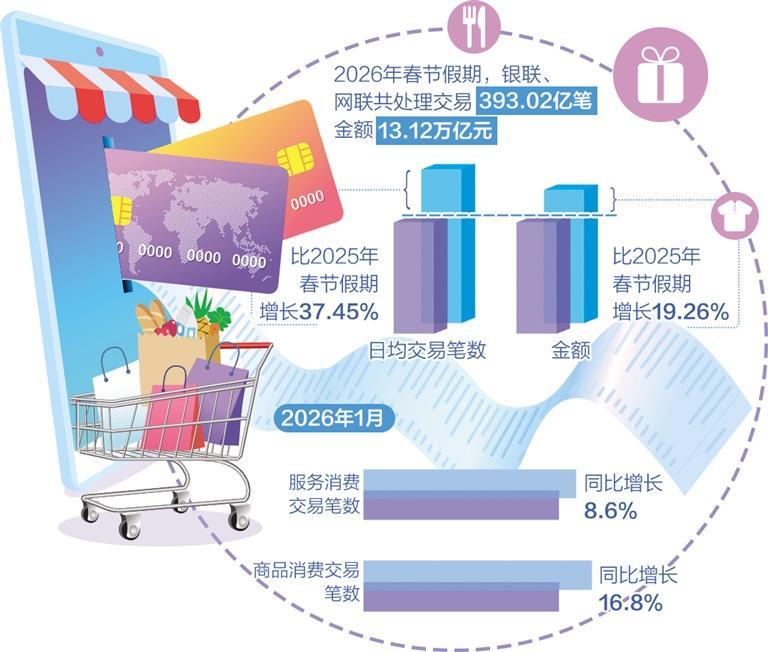
Core Insights - The data from the People's Bank of China indicates a significant increase in mobile payment transactions during the 2026 Spring Festival, with a total of 39.302 billion transactions amounting to 13.12 trillion yuan, reflecting a year-on-year growth of 37.45% in transaction volume and 19.26% in transaction value compared to the 2025 Spring Festival [2] - The supportive monetary policies implemented at the beginning of 2026 are aimed at enhancing the real economy, particularly in key areas such as private sector support, technological innovation, green initiatives, and consumption [2][4] - The overall trend in service consumption is positive, with offline transactions in travel and entertainment exceeding a 20% year-on-year increase during the Spring Festival period [3] Monetary Policy and Economic Support - The People's Bank of China has maintained a supportive monetary policy stance, with broad money supply (M2) and social financing growth rates remaining high, indicating a stable economic start for 2026 [2][4] - The central bank has established a 500 billion yuan re-lending program to support service consumption and elderly care, encouraging financial institutions to innovate consumer finance products [3][4] - The focus on expanding the support areas for service consumption and elderly care re-lending will include the health industry once recognized standards are established [5] Credit Growth and Structure - By the end of 2025, the balance of consumer loans (excluding personal housing loans) reached 21.2 trillion yuan, with a notable increase in loans to enterprises, particularly in long-term loans [4][7] - The financial sector has shown resilience in credit growth, with a total loan balance of 271.91 trillion yuan by the end of 2025, reflecting a year-on-year growth of 6.4% [6][7] - Loans directed towards high-quality development sectors, such as technology and green initiatives, have consistently outpaced overall loan growth, indicating a shift in credit resource allocation [6][7] Policy Coordination and Effectiveness - Recent government meetings have emphasized the need for coordination between fiscal and monetary policies to enhance their effectiveness in promoting consumption and investment [8][9] - The combination of re-lending and fiscal subsidy policies aims to alleviate financing difficulties for small and micro enterprises, thereby stimulating private investment [9][10] - The central bank's future policy direction will focus on structural support for specific sectors, enhancing financial backing for areas like technology innovation and small enterprises [10]
宏观政策更加积极有为
Jing Ji Ri Bao· 2026-02-25 22:01
Core Viewpoint - In 2025, China will implement a more proactive macroeconomic policy to support economic growth, with the highest fiscal deficit levels in recent years and a significant increase in government bond issuance to boost key sector spending [1][2]. Fiscal Policy - The fiscal policy for 2025 will feature a deficit rate set at around 4%, an increase of 1 percentage point from the previous year [2]. - The new government debt scale will reach 11.86 trillion yuan, an increase of 2.9 trillion yuan from the previous year [2]. - National general public budget expenditure is projected to be 287.395 billion yuan, a 1% increase from 2024, while government fund budget expenditure will be 1.129 trillion yuan, up 11.3% [2]. Government Bonds - Government bonds will play a crucial role in expanding investment and addressing shortfalls, with expenditures on special bonds reaching 619 billion yuan, a 37.6% increase from 2024 [3]. - The fiscal policy will utilize a combination of tools, including increasing the fiscal deficit rate and issuing long-term special bonds to support macroeconomic stability and high-quality development [3]. Monetary Policy - The monetary policy will see a rapid growth in the total financial volume, with M2 growth significantly outpacing nominal GDP growth [3]. - By the end of 2025, the RMB loan balance is expected to reach 272 trillion yuan, with a growth rate of around 7% after adjusting for local debt impacts [3]. - The People's Bank of China will continue to implement a package of financial support measures to solidify the economic recovery [2][3]. Support for Domestic Demand - The combination of fiscal and monetary policies aims to boost investment, enhance consumption, and improve livelihoods, with 1.3 trillion yuan allocated for special long-term bonds to support key projects [4]. - The "old-for-new" consumption program is expected to generate sales exceeding 2.6 trillion yuan, benefiting over 360 million people [4]. Financial Support for Consumption - By the end of 2025, financial institutions have reported applications for 118.4 billion yuan in re-loans to support consumption and elderly care [5]. - Consumer loans, excluding personal housing loans, are projected to reach 21.2 trillion yuan by the end of November 2025 [5]. Policy Integration - In early 2026, the continued issuance of long-term special bonds will support consumption and equipment upgrades, injecting strong momentum into the economy [6]. - The macroeconomic policies will focus on promoting domestic demand through coordinated fiscal and monetary measures [8]. Future Outlook - The central economic work conference has confirmed the continuation of proactive fiscal and moderately loose monetary policies in 2026, emphasizing precision and effectiveness in policy implementation [7]. - The collaboration between fiscal and monetary policies is expected to enhance the consistency of macroeconomic policies and stimulate domestic demand [8].
中国人民银行副行长邹澜:继续实施好适度宽松的货币政策
Zhong Guo Ji Jin Bao· 2026-02-11 06:33
Core Viewpoint - The People's Bank of China (PBOC) will continue to implement a moderately accommodative monetary policy to support economic growth and stabilize market expectations, with a focus on the effectiveness of previously implemented policies [4][5]. Group 1: Monetary Policy Implementation - In the first half of 2025, the total social financing increased by 22.83 trillion yuan, which is 4.74 trillion yuan more than the same period last year [1]. - The PBOC has reduced the reserve requirement ratio (RRR) 12 times and policy interest rates 9 times since 2020, leading to a decrease of 115 basis points for the 1-year Loan Prime Rate (LPR) and 130 basis points for the 5-year LPR [2]. - The average interest rate for newly issued corporate loans in the first half of 2025 was approximately 3.3%, down about 45 basis points from the previous year [3]. Group 2: Financial Market Developments - The bond market in China issued various bonds totaling 44.3 trillion yuan in the first half of 2025, a year-on-year increase of 16% [7]. - The balance of loans in the "Five Major Financial Articles" reached 103.3 trillion yuan, with a year-on-year growth of 14% [6]. - The average issuance rate for corporate credit bonds was 2.08%, which is a decrease of 32 basis points compared to the same period last year [7]. Group 3: Structural Policies and Support - The PBOC has established a 500 billion yuan re-lending facility for service consumption and elderly care to stimulate demand in these sectors [9]. - Structural monetary policy tools will continue to focus on supporting technological innovation and boosting consumption, enhancing the effectiveness of economic restructuring [14]. - A total of 288 entities issued technology innovation bonds amounting to approximately 600 billion yuan, promoting the development of emerging industries [12].
人民银行:适度宽松货币政策效果逐步显现
Bei Jing Shang Bao· 2026-02-10 16:54
Group 1 - The core viewpoint of the articles is that the People's Bank of China (PBOC) is implementing a moderately loose monetary policy to support stable economic growth and financial market stability in 2025, with a GDP growth target of 5% [1][4]. Group 2 - In 2025, the PBOC is utilizing various monetary policy tools, including adjusting the reserve requirement ratio and open market operations, to maintain ample liquidity and support effective credit demand in the real economy [2][4]. - The PBOC is also focused on reducing the overall financing costs in society by lowering policy interest rates and specific loan rates, which will help in supporting key sectors and strategic areas [2][4]. Group 3 - By the end of 2025, the total social financing scale and broad money supply (M2) are expected to grow by 8.3% and 8.5% year-on-year, respectively, significantly outpacing nominal GDP growth [3]. - The interest rates for newly issued corporate loans and personal housing loans are projected to be around 3.1% by December 2025, indicating a decline in financing costs [3]. - The loan structure is improving, with significant year-on-year growth in loans for technology (11.5%), green projects (20.2%), inclusive finance (10.9%), elderly care (50.5%), and digital economy (14.1%) [3]. Group 4 - The PBOC plans to continue its moderately loose monetary policy, focusing on promoting stable economic growth and reasonable price recovery while adjusting the implementation of policies based on domestic and international economic conditions [4]. - There will be an emphasis on enhancing the interest rate adjustment framework and improving the transmission mechanism of market interest rates to lower bank funding costs [4]. Group 5 - The PBOC aims to maintain the stability of the RMB exchange rate through a managed floating exchange rate system, ensuring it remains at a reasonable and balanced level while preventing excessive fluctuations [5]. - The central bank will also enhance its macro-prudential and financial stability functions to maintain market stability and prevent systemic financial risks [5]. Group 6 - Experts indicate that the cumulative effects of the previous year's moderately loose monetary policy will continue to manifest, and new measures introduced in early 2026 will work in conjunction with existing policies to foster a conducive monetary environment for stable economic growth [6].
央行最新报告定调 适度宽松货币“不换挡”!
Bei Jing Shang Bao· 2026-02-10 14:58
Core Viewpoint - The People's Bank of China (PBOC) is committed to implementing a moderately loose monetary policy to support stable economic growth and financial market stability in 2025, with a GDP growth target of 5% for the year [1]. Monetary Policy Implementation - In 2025, the PBOC employed various monetary policy tools, including reserve requirement ratios and open market operations, to maintain ample liquidity and support effective credit demand from the real economy [3]. - The PBOC aims to lower the overall financing costs in society by reducing policy interest rates and specific loan rates, thereby enhancing support for key sectors and strategic areas [3]. Financial Indicators - By the end of 2025, the total social financing scale and broad money supply (M2) grew by 8.3% and 8.5% year-on-year, respectively, significantly outpacing the nominal GDP growth rate [4]. - The new corporate loan and personal housing loan rates were approximately 3.1% in December 2025, indicating a decline in financing costs [4]. - Key loan categories such as technology loans, green loans, and loans for the elderly industry saw significant year-on-year growth rates, with technology loans increasing by 11.5% and loans for the elderly industry by 50.5% [4]. Future Policy Directions - The PBOC plans to continue its moderately loose monetary policy, focusing on promoting stable economic growth and reasonable price recovery while adjusting the implementation of policies based on domestic and international economic conditions [5]. - There will be an emphasis on improving the interest rate adjustment framework and enhancing the transmission mechanism of market interest rates to lower financing costs further [6]. - The PBOC aims to maintain the stability of the RMB exchange rate while expanding financial support for key areas such as domestic demand, technological innovation, and small and micro enterprises [6].
中国人民银行报告:继续实施好适度宽松的货币政策
Xin Hua Wang· 2026-02-10 13:25
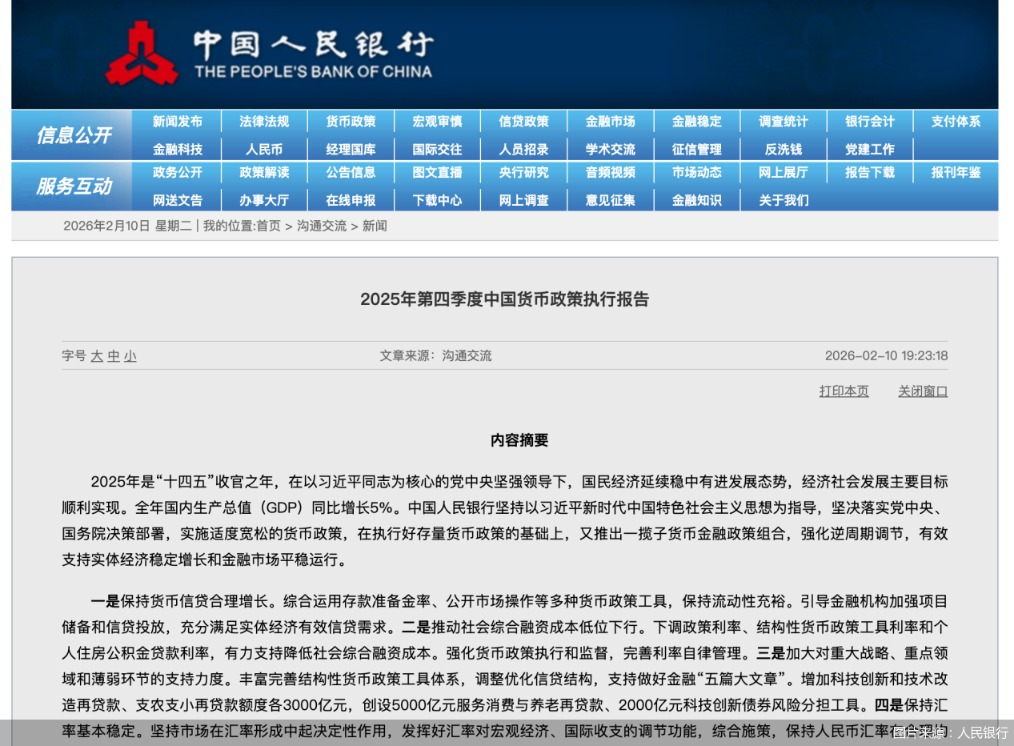
Core Viewpoint - The People's Bank of China (PBOC) will continue to implement a moderately accommodative monetary policy, focusing on promoting stable economic growth and reasonable price recovery, while adjusting the policy's intensity, rhythm, and timing based on domestic and international economic conditions [1][2]. Group 1: Monetary Policy Implementation - The PBOC's report for the fourth quarter of 2025 indicates that it will introduce a comprehensive monetary and financial policy package to strengthen counter-cyclical adjustments, effectively supporting stable growth in the real economy and smooth operation of financial markets [1]. - By the end of 2025, the total financial volume is expected to maintain rapid growth, with the social financing scale and broad money supply (M2) increasing by 8.3% and 8.5% year-on-year, respectively, significantly outpacing nominal GDP growth [1]. Group 2: Credit Structure and Support - After adjusting for local government debt impacts, RMB loans are projected to grow by around 7%, indicating sustained strong credit support [1]. - The credit structure continues to optimize, with technology loans, green loans, inclusive loans, elderly care industry loans, and digital economy industry loans growing by 11.5%, 20.2%, 10.9%, 50.5%, and 14.1% year-on-year, respectively, all exceeding the overall loan growth rate [1]. Group 3: Future Monetary Tools and Support - In 2025, the PBOC increased the quotas for re-loans for technological innovation and agricultural support by 300 billion yuan each, established 500 billion yuan for consumer services and elderly care re-loans, and created a 200 billion yuan risk-sharing tool for technology innovation bonds [2]. - The PBOC aims to effectively implement various structural monetary policy tools, enhance financial support for key areas such as domestic demand expansion, technological innovation, and small and micro enterprises, while also improving macro-prudential and financial stability management tools [2].
热点问答丨2026年信贷资源,将重点流向哪里?
Sou Hu Cai Jing· 2026-02-05 13:44
Key Points - The People's Bank of China (PBOC) has outlined its credit market work for 2026, focusing on supporting key areas such as expanding domestic demand, technological innovation, and small and micro enterprises [1] - The PBOC aims to enhance financial support for technological innovation, small and micro enterprises, and regional collaboration, while promoting high-quality development of inclusive finance [1][2] - The chief economist of Zhaolian, Dong Ximiao, stated that monetary policy will act as an "irrigation channel," ensuring that financial institutions effectively utilize credit support and risk mitigation provided by fiscal policies to direct funds to key areas [1] Credit Support Areas - In the technological innovation sector, the PBOC plans to increase the re-lending quota for technological innovation and technological transformation by 400 billion yuan, raising the total quota to 1.2 trillion yuan [3] - The policy support will also expand to include private small and medium enterprises with high R&D investment levels starting in 2026 [4] - In the green development sector, projects with direct carbon reduction effects, such as energy-saving renovations and green upgrades, will be included in the carbon reduction support tool, with an annual operation volume not exceeding 800 billion yuan [4][5] Expanding Domestic Demand - The PBOC will continue to implement a moderately loose monetary policy to create a favorable financial environment for boosting consumption and expanding domestic demand [6] - The PBOC plans to enhance the effectiveness of financial support for consumption by expanding the support areas for re-lending related to consumption and elderly care, including the health industry once recognized by relevant authorities [6] - Financial institutions will be encouraged to increase credit supply in the consumption sector through re-lending at preferential rates, focusing on industries closely related to people's livelihoods such as accommodation, catering, cultural tourism, sports entertainment, elderly care, and domestic services [6]

2026年信贷资源,将重点流向哪里?
Zhong Guo Zheng Quan Bao· 2026-02-05 13:21
Group 1 - The People's Bank of China (PBOC) has outlined key areas for credit allocation in 2026, focusing on expanding domestic demand, supporting technological innovation, and aiding small and micro enterprises [1] - The PBOC aims to enhance financial support for technology innovation, small and micro enterprises, and regional collaboration, while promoting high-quality development of inclusive finance [1] - Chief economist Dong Xiemiao emphasizes that monetary policy will act as an "irrigation channel," ensuring precise funding allocation to key sectors and weak links, integrating investments in both human and physical capital [1] Group 2 - In the technology innovation sector, the PBOC plans to increase the quota for re-lending for technological innovation and technological transformation by 400 billion yuan, raising the total to 1.2 trillion yuan [2] - The PBOC will expand policy support to include private small and micro enterprises with high R&D investment levels starting in 2026 [2] - For green development, projects with direct carbon reduction effects will be included in the carbon reduction support tool, with an annual operation volume not exceeding 800 billion yuan [2] Group 3 - The PBOC will continue to implement a moderately loose monetary policy to create a favorable financial environment for boosting consumption and expanding domestic demand [3] - The PBOC plans to enhance financial support for service consumption and pension re-lending, with potential inclusion of the health industry once standards are established [3] - Incentives will be provided through preferential interest rates on re-lending to encourage financial institutions to increase credit in the consumption sector, focusing on industries closely related to people's livelihoods [3]
央行2026年信贷市场工作的五大重点
Sou Hu Cai Jing· 2026-02-05 05:07
Core Viewpoint - The People's Bank of China (PBOC) has outlined the key directions and tasks for the 2026 credit market, emphasizing the service to the real economy and addressing current economic challenges while ensuring financial stability [2][5]. Summary by Sections Review of 2025 Achievements - The PBOC's efforts in 2025 laid a solid foundation for 2026, with significant progress in financial support for the real economy, particularly in the "Five Major Financial Articles" and local government financing platform debt risk resolution [3][4]. - By the end of Q3 2025, structural monetary policy tools supporting the "Five Major Financial Articles" reached CNY 3.9 trillion, with related loans growing over 10%, significantly above the average loan growth rate [3]. Current Economic Analysis - The economy is recovering, but issues such as insufficient domestic demand, innovation gaps, and challenges for small and medium enterprises (SMEs) persist, necessitating continued focus on local government financing platform debt risk [5]. Key Focus Areas for 2026 - The PBOC has identified five core tasks for 2026, focusing on precise efforts, quality improvement, risk prevention, and collaborative actions [5][6]. Key Task One: Monetary Policy Tools - The PBOC will maintain a moderately loose monetary policy, emphasizing the integration of incremental and stock policies to support stable economic growth and reasonable price recovery [8][9]. - Structural monetary policy tools will be enhanced, with a focus on increasing support for SMEs and technological innovation [8]. Key Task Two: Financial "Five Major Articles" - The PBOC aims to improve mechanisms for the "Five Major Financial Articles," focusing on technology finance, green finance, inclusive finance, pension finance, and digital finance to optimize credit structure [10]. Key Task Three: Multi-layered Financial Service System - A multi-layered financial service system will be established to support domestic demand, technological innovation, and SMEs, aligning with the "14th Five-Year Plan" for high-quality economic development [11][12]. Key Task Four: Debt Risk Resolution - Continued efforts will be made to resolve local government financing platform debt risks, with a focus on market-oriented transformations and preventing the emergence of new hidden debts [13][14]. Key Task Five: Policy Management and Effectiveness - The PBOC will enhance the dynamic management of policies, ensuring effective implementation and evaluation to address the "last mile" issue in policy transmission [15][16]. Strategic Considerations - The five key tasks reflect a strategic choice to optimize credit structure for economic transformation, stabilize growth through policy collaboration, and ensure financial safety [17][18]. Conclusion - The PBOC's 2026 credit market focus is characterized by precision and collaboration, aiming to maintain liquidity while optimizing credit allocation to key sectors, thus supporting the "14th Five-Year Plan" and ensuring sustainable economic development [19][20][21].