
三博脑科

Search documents
暴涨、熔断!年内涨超50倍,股民直呼“我看不懂,大为震撼”泡泡玛特领跌,新消费三姐妹惨烈杀跌,是调整还是转折?
雪球· 2025-06-17 08:30
今日A股三大指数小幅下跌,截至收盘,沪指跌0.04%报3387点,深证成指跌0.12%,创业板指跌0.36%。 全天成交1.24万亿元,较前一交易日缩量 64亿元。 板块方面,脑机接口、油气、电池、核污染防治等板块涨幅居前,游戏、创新药、美容护理、IP经济等板块跌幅居前。 | < | 倍盗康 ··· Q | | --- | --- | | 870199 已收盘 06-17 15:34:55 北京 | | | 3125人加自选(一) > | | | 41.86 +9.66 +30.00% | CN 融 L1 | | 高 41.86 开 39.00 量 91575.00手 总市值 28.51亿 。 | | | . 低 38.50 换 24.62% 额 3.73亿 | 市盈TTM -- | 五日 分时 日K 月K 李K 年K 分钟 · 周K 均价:40.76 最新:41.86 +9.66 +30.00% | 86 | | 30.00% 卖5 | | | 0 | | --- | --- | --- | --- | --- | --- | | | | 英4 | | | 0 | | | | 卖3 | -- | | 0 | ...


“30CM” “20CM” “10CM”全齐了!这个板块掀涨停潮
天天基金网· 2025-06-17 05:45
Core Viewpoint - The market is experiencing a "fan" trend with rapid rotation among various sectors, particularly strong performances in brain-computer interfaces, AI glasses, and solid-state batteries [1][3]. Market Performance - As of the morning close, the Shanghai Composite Index fell by 0.19%, while the Shenzhen Component Index was close to flat, and the ChiNext Index decreased by 0.14% [2]. Market Characteristics - Two main characteristics were observed in the market: rapid sector rotation with most sectors experiencing a rise followed by a decline, and the influence of external geopolitical events leading to fluctuations in indices [3][4]. - The digital currency sector saw significant trading volume, indicating a trend where one sector attracts excessive capital, leading to the observed market behavior [3]. Sector Highlights - The brain-computer interface and AI glasses sectors showed strong performance, with the brain-computer interface sector leading in gains among concept sectors [6]. - Specific stocks within the brain-computer interface sector experienced notable increases, with companies like Beiyikang and Aipeng Medical hitting their daily price limits [6]. External Influences - New geopolitical events prompted a rise in oil and gas extraction and port shipping sectors, although the actual impact on Chinese assets was deemed limited [4]. - The market is expected to see increased volatility in high-cap stocks that have formed a consensus, while smaller stocks and thematic rotations may weaken [4]. Industry Developments - The brain-computer interface sector has seen significant advancements, including FDA approval for a new neural control chip and collaborations with leading medical institutions [9]. - Recent policy initiatives aim to develop a robust ecosystem for brain-computer interfaces in China, focusing on talent, technology, products, and services [9]. AI Glasses Market - The AI glasses sector is transitioning from expectation management to actual sales, with predictions of global sales reaching 5.5 million units by 2025 and potentially 1.4 billion units by 2035 [10][11].

AH股脑机接口概念齐涨,机构称该技术正快速走向商业化应用
Di Yi Cai Jing· 2025-06-17 03:16
Core Insights - China has successfully conducted its first prospective clinical trial of an invasive brain-computer interface (BCI), marking the country as the second globally to enter the clinical trial phase for this technology [1][3]. Industry Developments - The clinical trial was a collaboration between the Chinese Academy of Sciences' Center for Excellence in Brain Science and Intelligent Technology, Fudan University Huashan Hospital, and relevant enterprises [3]. - The trial involved a male subject who lost his limbs due to a high-voltage accident. Since the implantation of the BCI device in March 2025, the system has operated stably, allowing the subject to perform tasks like playing chess and racing games after 2-3 weeks of training [3]. - The BCI technology aims to improve the quality of life for patients with spinal cord injuries and amputations through motor function replacement technology [3]. Market Response - Following the announcement, stocks related to brain-computer interface technology saw significant increases, with companies like Beiyikang and Aipeng Medical reaching 30% and 20% gains, respectively [1][2]. - The Hong Kong stock market also showed strong performance in BCI-related stocks, with Nanjing Panda Electronics rising over 40% [1]. Regulatory Environment - Multiple government departments, including the National Medical Products Administration and the National Healthcare Security Administration, have introduced policies to encourage the development of BCI technology and accelerate clinical applications [3]. - In February, the National Medical Products Administration approved a project to revise industry standards for medical devices using BCI technology [3]. Future Outlook - According to Shanghai Securities research, the BCI technology is rapidly transitioning from laboratory to commercial application, indicating significant growth potential in the Chinese market [4]. - The BCI industry is suitable for medium to long-term investment, with a focus on technology stability, mass production capabilities, and monitoring of research and product development [4].
【大涨解读】脑科学:中概股年内涨幅超50倍,掀起脑科学板块上涨狂潮,多重催化下行业商业化进程再迎提速
Xuan Gu Bao· 2025-06-17 02:22
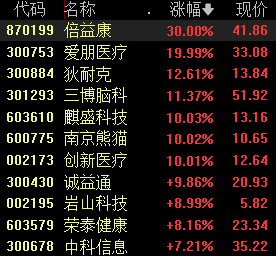
Market Overview - On June 17, the brain science sector experienced a collective surge, with stocks like Aipeng Medical and Innovation Medical hitting the daily limit, while others like Nanjing Panda and Beilu Pharmaceutical also saw significant gains [1][2]. Industry Developments - Chinese concept stocks in brain regeneration technology surged by 283% in the US market, with a cumulative increase of over 50 times this year [3]. - A research team from the University of California, Davis, developed a brain-machine interface that could help individuals with speech loss due to neurological diseases regain their ability to "speak" [3]. - Researchers have created a neuromorphic computer that mimics the human brain structure, potentially operating 250,000 to 1,000,000 times faster than a biological brain while consuming only 10 kilowatts of power [3]. - China has successfully conducted its first prospective clinical trial for invasive brain-machine interfaces, becoming the second country after the US to enter this stage [3]. Institutional Insights - The advancement of invasive brain-machine interface technology in China is expected to drive rapid growth in related industries, including high-end imaging equipment, surgical robots, and AI medical applications, benefiting leading companies in these sectors [4]. - The potential of neuromorphic computing could revolutionize fields such as AI, robotics, and healthcare, with applications in smart medical devices and autonomous vehicles [4]. - The brain-machine interface industry is witnessing breakthroughs in applications for movement recovery, communication, and hearing restoration, supported by favorable national policies [5].
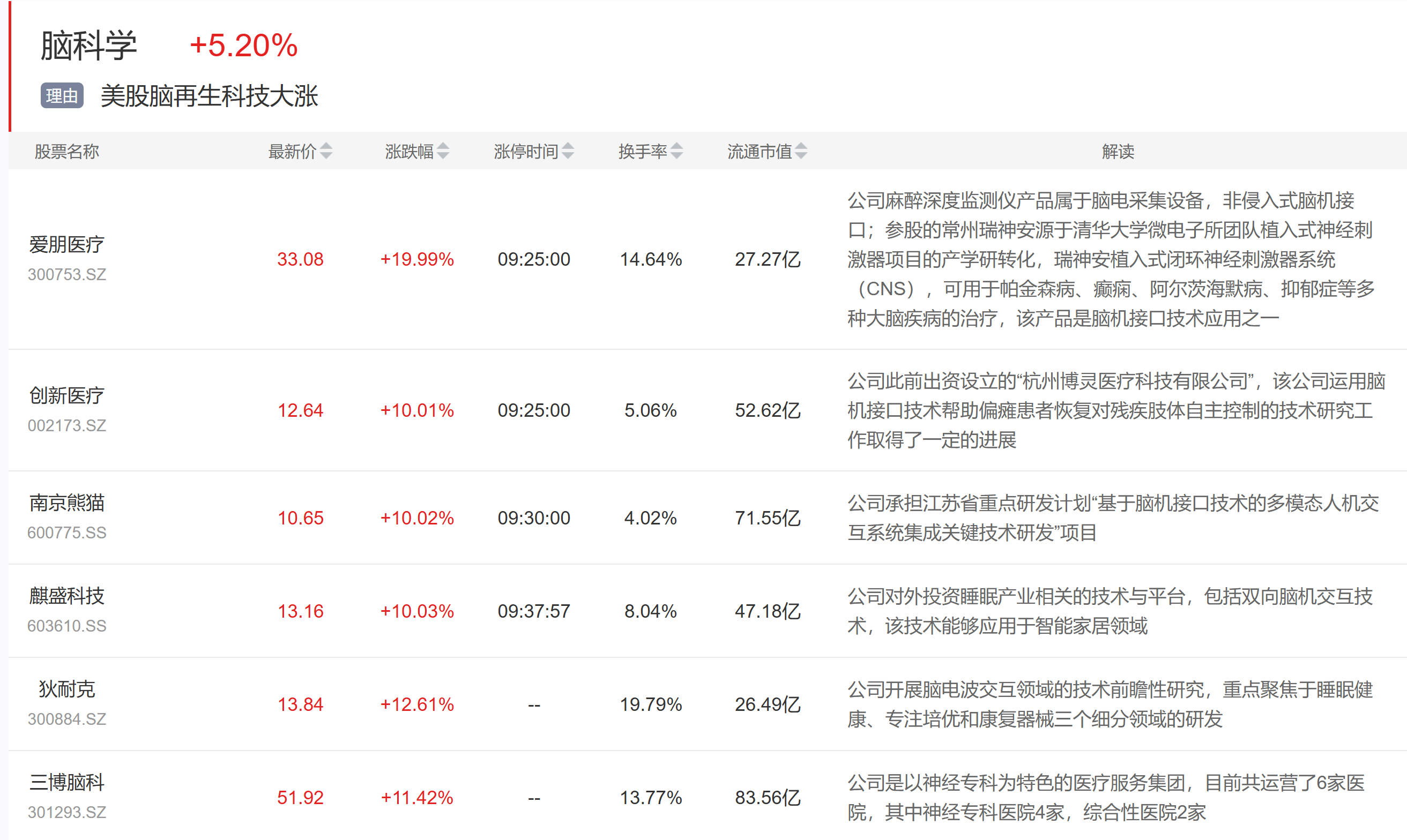
A股脑机接口概念股开盘大涨,爱朋医疗、创新医疗竞价涨停,南京熊猫、三博脑科、诚益通、翔宇医疗等多股高开。
news flash· 2025-06-17 01:30
Group 1 - The A-share market saw a significant rise in neuro-interface concept stocks, with companies like Aipeng Medical and Innovation Medical hitting the daily limit up [1] - Other companies such as Nanjing Panda, Sanbo Brain Science, Chengyitong, and Xiangyu Medical also opened high [1]





脑机接口概念盘初活跃 创新医疗、爱朋医疗涨停
news flash· 2025-06-17 01:27
Group 1 - The brain-computer interface concept is gaining initial traction, with companies such as Innovent Medical (002173) and Aipeng Medical (300753) hitting the daily limit up [1] - Other companies like Nanjing Panda (600775), Sanbo Neuroscience (301293), Chengyitong (300430), and Dineike (300884) also opened significantly higher [1] - Overnight, US stocks in the brain regeneration technology sector surged by 283% [1]
从实验室到门诊室 脑机接口产业驶入“快车道”
Shang Hai Zheng Quan Bao· 2025-06-16 18:28
Core Insights - The establishment of the first brain-computer interface (BCI) outpatient clinic in Central China marks a significant step in the development of BCI technology, providing assessment and treatment consultations for patients nationwide [1] - The BCI industry is experiencing rapid growth driven by favorable policies and technological breakthroughs, with 2023 being a pivotal year for transitioning from research to clinical applications [1][2] - The global market for BCIs in the medical field is projected to reach $40 billion by 2030 and exceed $145 billion by 2040, with China's market expected to grow from 3.2 billion yuan in 2024 to over 5.5 billion yuan by 2027, maintaining an annual growth rate of around 20% [3] Policy Developments - The establishment of a BCI standardization technical committee by the Ministry of Industry and Information Technology aims to develop industry standards across various domains, including ethics and safety [2] - The National Healthcare Security Administration has introduced guidelines for pricing BCI services, paving the way for clinical applications [2] - Local governments are actively promoting BCI industry cultivation plans, with Beijing and Shanghai aiming to become global leaders in BCI technology and applications by 2030 [2] Clinical Applications - BCI technology is rapidly advancing from laboratory research to clinical applications, with several hospitals already implementing BCI systems [4] - Shanghai's Shuli Intelligent Technology has reported its AI multimodal BCI platform entering clinical use in multiple top-tier hospitals [4] - The first long-term implantation clinical trial of an invasive BCI system was completed at Fudan University, with plans for market launch by 2028 [4] Corporate Strategies - Companies are increasingly investing in BCI applications, with Sanbo Neuroscience collaborating with research institutions to bridge innovation and clinical application [5] - Cheng Yi Tong is pursuing a dual-track strategy for invasive and non-invasive BCI technologies, positioning BCI as a key growth area [5] - Yike De is working on a collaborative project to develop an implantable speech synthesis BCI product aimed at helping patients with speech impairments [5] Industry Challenges - Experts highlight several key challenges to large-scale BCI commercialization, including technical standardization, ethical concerns, and the need for interdisciplinary talent [6] - Issues such as biocompatibility, signal interference, and the lack of unified standards hinder the scalability of BCI devices [6] - The high costs of invasive systems and limited insurance coverage pose significant barriers to market entry [6] Recommendations - It is suggested to accelerate the establishment of a technology, standards, and regulatory framework for BCIs, along with exploring diverse payment models for clinical applications [7] - Enhancing collaboration between industry and academia is crucial for developing interdisciplinary talent and reducing redundant efforts in BCI research [7]
临床试验加速推进,脑机接口处于应用落地的关键窗口期
Sou Hu Cai Jing· 2025-06-13 11:47
Core Insights - The global market for brain-computer interfaces (BCIs) in the medical field is projected to reach between $40 billion and $145 billion from 2030 to 2040, indicating significant growth potential [1][6] - China's BCI industry is experiencing a surge in startups, with a notable increase in patent applications and funding events, as well as over a hundred products entering clinical stages [1][6] - Elon Musk's Neuralink has raised $650 million in a new funding round, with a pre-money valuation soaring to $9 billion, reflecting strong market enthusiasm [1] Industry Development - BCIs have evolved from a scientific fantasy to a promising technological innovation, with applications in medical and research fields [2] - The current BCI technology landscape includes non-invasive, semi-invasive, and invasive methods, with invasive techniques showing the most promise for medical applications [2][4] - The establishment of clinical BCI facilities, such as the first BCI clinical ward at Beijing Tiantan Hospital, marks a significant step in applying BCI technology in clinical settings [3] Clinical Advancements - The first closed-loop spinal cord nerve interface surgery in China has been successfully completed, demonstrating significant functional recovery in the patient [3][4] - Clinical trials are underway, with teams aiming to make their BCI devices the first approved implantable medical devices globally [5] Market Trends and Government Support - McKinsey forecasts a substantial market for BCIs in the medical sector, with various regions in China, including Beijing and Shanghai, implementing plans to accelerate BCI product development and clinical trials [6][7] - Policies are being introduced to support the BCI industry, aiming to establish a robust ecosystem and promote the commercialization of innovative products [6][7] Challenges and Future Outlook - The BCI industry faces challenges such as high funding requirements, lengthy clinical validation periods, and the need for improved industry standards and regulations [8][9] - Experts emphasize the importance of collaboration among researchers, clinical institutions, and government to foster innovation and overcome existing barriers [8][9]
脑机接口概念股异动拉升 爱朋医疗午后涨超10%
news flash· 2025-06-06 05:12
智通财经6月6日电,脑机接口概念股午后异动,爱朋医疗涨超10%,倍益康、诚益通、中科信息、创新 医疗、东方中科、三博脑科等跟涨。消息面上,2025年被视为中国脑机接口技术迈向临床的关键节点, 北京、上海等地已规划在2030年前完成多款侵入式产品的临床试验。 脑机接口概念股异动拉升 爱朋医疗午后涨超10% ...
三博脑科收盘下跌1.10%,滚动市盈率83.95倍,总市值92.26亿元
Sou Hu Cai Jing· 2025-06-05 09:51
Group 1 - The core viewpoint of the article highlights that Sanbo Brain Science's stock closed at 44.79 yuan, down 1.10%, with a rolling PE ratio of 83.95 times and a total market value of 9.226 billion yuan [1] - In terms of industry comparison, the average PE ratio for the medical services sector is 40.82 times, with a median of 45.93 times, placing Sanbo Brain Science at the 38th position in the industry ranking [1] - On June 5, the net outflow of main funds for Sanbo Brain Science was 23.9984 million yuan, although there was an overall inflow of 7.3365 million yuan over the past five days [1] Group 2 - Sanbo Brain Science Hospital Management Group Co., Ltd. primarily engages in clinical medical services, with its main products including medical services, pharmaceuticals, supply chain, and other businesses [1] - The latest quarterly performance report for Q1 2025 shows that the company achieved an operating income of 393 million yuan, a year-on-year increase of 16.78%, and a net profit of 38.3136 million yuan, a year-on-year increase of 14.56%, with a sales gross margin of 26.44% [1]