
Adobe

Search documents
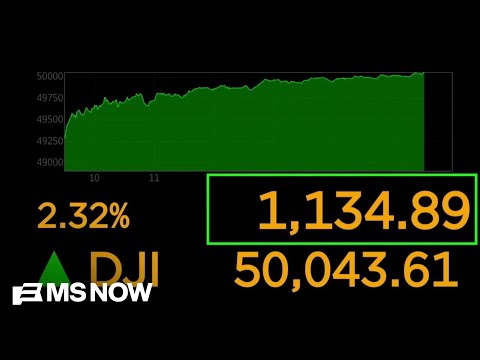
BREAKING: Dow soars above 50,000, new record
MSNBC· 2026-02-06 21:42
LOOK WHAT'S HAPPENING ON WALL STREET NOW, THE DOW HIT 50 ,000, YOU SEE IT RIGHT THERE FOR THE FIRST TIME EVER, WE'RE LIKELY GOING TO SET A NEW RECORD WHEN markets close in just about 30 minutes if it stays over 50. But this good news on Wall Street followed a sell-off this week with big techs losing a trillion dollars in market value through yesterday. And it's paired with bleak new labor supermarket data.108 ,000 jobs were cut last month, double the number of layoffs we saw at the start of last year. We ha ...

部分美国软件类股票跌幅扩大
Jin Rong Jie· 2026-02-06 15:38
Group 1 - Thomson Reuters listed stocks declined by 3% [1] - ServiceNow experienced a drop of 2.3% [1] - Adobe's stock fell by 0.9% [1] - Salesforce saw a decrease of 0.6% [1]
Low Volatility ETFs to Watch Amid Major Tech Sell-Off Over AI Panic
ZACKS· 2026-02-06 15:30
Core Insights - A significant sell-off in technology stocks, including Microsoft, Salesforce, and ServiceNow, resulted in a loss of nearly $1 trillion in market value within a week, indicating a major shift in market sentiment [1][10] - The Cboe Volatility Index (VIX) surged by 17% to close at 21.77, marking its highest level since late November, reflecting increased market volatility [2][10] - The sell-off was primarily driven by fears surrounding artificial intelligence, particularly following the launch of productivity tools by AI startup Anthropic, which raised concerns about the viability of traditional software business models [3][4][5] Market Dynamics - The panic surrounding AI has transformed it from a growth catalyst into a perceived threat, leading to significant losses for major tech companies [4][5] - There is a notable rotation from technology stocks into value-oriented sectors such as consumer staples, which aligns with low-volatility investment strategies [6][7][8] - U.S. ETFs saw inflows of $165 billion in January 2026, surpassing the total inflows of the previous three Januarys combined, indicating a shift in investor sentiment [7] Investment Opportunities - Low-volatility ETFs are becoming increasingly attractive as they typically hold stocks with smaller price fluctuations, often found in sectors like consumer staples, utilities, and healthcare [6] - Suggested low-volatility ETFs include: - iShares MSCI USA Min Vol Factor ETF (USMV) with net assets of $23.08 billion, gaining 2.4% over the past year [11][12] - iShares MSCI Global Min Vol Factor ETF (ACWV) with net assets of $3.42 billion, rallying 7.9% over the past year [13] - Invesco S&P 500 Low Volatility ETF (SPLV) with a market value of $7.77 billion, gaining 3.9% over the past year [14]




Software Stocks Selloff: What's Behind the Rout?
Youtube· 2026-02-06 11:02
Group 1 - The recent selloff in the market is attributed to concerns over the impact of new technologies on traditional sectors such as legal, medical, and financial services, similar to the disruption caused by the Internet [1][2] - There has been a decline in stock values since their peak in summer 2025, indicating a prolonged downturn in certain sectors [1] - The software industry has seen many deals made at peak valuations during and after the COVID pandemic, followed by a sharp rise in interest rates, leading to concerns about overvaluation [5][6] Group 2 - Private equity firms are facing unexpected challenges, with a significant amount of financing for deals being sourced from private credit, raising concerns about the sustainability of these investments [4][6][7] - The market is experiencing a lack of clarity regarding which companies will emerge as winners or losers, leading to indiscriminate selling [9][10] - There is a growing anxiety among investors about the quality of stocks, as many companies are perceived to lack competitive advantages or "moats" [8][9] Group 3 - The current market environment is characterized by a momentum unwind, with significant declines across various asset classes, including Bitcoin and gold, indicating a broader risk-off sentiment [17][19] - The strength of the US dollar is impacting other assets negatively, suggesting a correlation between dollar strength and asset weakness [19][20] - There are concerns about systemic risks in the financial sector, particularly related to leveraged investments and margin calls, especially among retail investors in the US [16][11]

最终带崩AI叙事的只会是AI自己
虎嗅APP· 2026-02-06 10:18
Core Viewpoint - The capital market is experiencing unexpected downturns, contrary to predictions of a strong 2026 due to anticipated monetary easing and improved geopolitical relations. The primary issue is the "new technology advancements consuming old technology applications" [4]. Market Performance - As of February 5, the North American Technology Software Index has declined by 25% year-to-date [5]. - Major companies within this index, including Palantir, Microsoft, Oracle, Salesforce, and ServiceNow, have seen their stock prices drop by an average of over 30% in the past two months [10]. Company Analysis - Notable companies in the index include Palantir, Microsoft, Oracle, Salesforce, and ServiceNow, all of which have experienced significant stock price declines [9][10]. - Specific stock performance includes: - Palantir: -28.44% over 20 days, -26.93% over 60 days - Microsoft: -18.57% over 20 days, -20.61% over 60 days - Oracle: -29.09% over 20 days, -42.84% over 60 days - Salesforce: -28.61% over 20 days, -20.67% over 60 days - ServiceNow: -31.99% over 20 days, -40.47% over 60 days [11]. Impact of AI on Software Industry - The rise of AI tools is leading to reduced demand for traditional SaaS software, as companies may cut back on subscriptions when employees can enhance efficiency through AI [15]. - The second layer of impact suggests that as AI tools mature, companies might develop their own systems instead of purchasing from traditional vendors, posing a significant threat to existing software companies [16]. Broader Implications - The narrative surrounding AI has shifted from questioning its viability to considering the implications for existing software solutions, raising concerns about the future of traditional software companies [15]. - The private credit industry, heavily invested in software, is facing challenges due to the downturn in software stock prices, with significant exposure reported by firms like Barclays [19].

AI fears pummel software stocks: Is it 'illogical' panic or a SaaS apocalypse?
CNBC· 2026-02-06 04:21
Core Viewpoint - The release of new AI tools by Anthropic has raised concerns in the software sector, leading to a sell-off in software-as-a-service and data provider stocks [1][2]. Group 1: Market Reaction - The S&P 500 Software & Services Index, which includes 140 companies, fell over 4% on Thursday, marking an eight-session losing streak and a year-to-date decline of approximately 20% [2]. - Shares of major companies such as Thomson Reuters, Salesforce, and LegalZoom experienced significant declines during the sell-off, which also affected Asian IT firms like Tata Consultancy Services and Infosys [3]. Group 2: AI Tools Impact - Anthropic's new AI tools are designed to manage complex professional workflows, potentially undermining traditional software business models across various functions, including legal and technology research, customer relationship management, and analytics [2]. - There is a division among analysts and tech executives regarding the long-term impact of these AI tools on the software and data provider industries [3].



万亿市值一夜蒸发!Claude Cowork血洗全球软件业,老黄急了
猿大侠· 2026-02-06 04:12
Core Viewpoint - The release of Anthropic's new plugins for Claude Cowork has triggered a significant decline in the software sector, leading to a loss of approximately $300 billion in market value overnight and nearly $1 trillion over the past week, sparking fears of a "SaaSpocalypse" [1][2][7][9]. Group 1: Impact of Anthropic's Plugins - Anthropic's introduction of 11 new plugins allows AI to directly replace traditional software applications across various industries, including finance, sales, and legal sectors, marking a significant shift in the software landscape [5][6][18]. - The plugins enable AI to autonomously manage workflows, reducing the need for human intervention and potentially rendering traditional software solutions obsolete [25][72]. - The market reaction has been severe, with major software companies like Oracle, Adobe, and Salesforce experiencing significant stock declines, reflecting investor fears about the viability of the SaaS business model [9][80]. Group 2: Market Reactions and Trends - The S&P North American Software Index has dropped by 18% over the past month, reaching its lowest level since April 2025, while the S&P 500 Software Services Index fell nearly 13% in just five trading days [31][33]. - The decline in software stocks has not only affected the U.S. market but has also led to significant losses in European and Asian markets, with companies like WPP and Omnicom seeing declines of over 10% [62][65]. - Concerns about the impact of AI on software companies have led to a broader sell-off in related sectors, including private equity firms and cloud service providers, indicating a widespread reevaluation of the software industry's future [58][59][80]. Group 3: Future of Software and AI Integration - The emergence of AI-driven solutions like Claude Cowork suggests a transition from traditional SaaS models to "Agent as a Service" (AaaS), where AI can perform tasks previously handled by multiple software applications [72][75]. - Analysts predict that the traditional pricing models based on per-seat fees will be disrupted as AI capabilities allow for more efficient task execution, leading to a potential decline in demand for conventional software licenses [73][76]. - Despite the current turmoil, some analysts argue that the software industry will not be entirely replaced by AI but will instead evolve, with AI enhancing rather than eliminating the need for software solutions [84][86].

Software stocks fall for an eighth straight day, with a sweeping roster of decliners
MarketWatch· 2026-02-06 00:03
Core Viewpoint - The software sector is experiencing significant declines, with concerns about AI tools negatively impacting traditional financial software offerings [1] Group 1: Market Performance - Software stocks have fallen for eight consecutive days, marking the worst eight-day performance in nearly six years [1] - Out of 114 stocks in the iShares Expanded Tech-Software ETF, 102 have declined, indicating widespread losses across the sector [1] - The ETF has recorded a total loss of approximately 19% during this recent eight-day period, including a roughly 5% drop on the latest trading day [1]

Luxury Where They Said It Couldn’t Exist | Brittny Bagley | TEDxReisterstown
TEDx Talks· 2026-02-05 16:54
When people hear Baltimore, they think they know what to expect. Crime statistics, poverty, boarded up buildings. But I see something completely different.You see, I was educated in the Baltimore City public school system. I went to Coin State University and graduated with a degree in applied psychology. My 5-year-old at the time even came to evening and weekend classes so I could finish my degree.This same city that's often overlooked and written off. It gave me a foundation to dream a little bigger. Not b ...

三大股指期货齐跌,“软件股末日”论甚嚣尘上,亚马逊(AMZN.US)盘后公布财报
Zhi Tong Cai Jing· 2026-02-05 14:09
Market Overview - US stock index futures are all down, with Dow futures down 0.30%, S&P 500 futures down 0.52%, and Nasdaq futures down 0.68% [1] - European indices also show declines, with Germany's DAX down 0.63%, UK's FTSE 100 down 0.40%, France's CAC40 down 0.06%, and the Euro Stoxx 50 down 0.41% [2][3] - WTI crude oil prices fell by 2.15% to $63.74 per barrel, while Brent crude oil dropped by 2.06% to $68.03 per barrel [3][4] Software Sector - The software sector is experiencing significant declines, with Goldman Sachs' software index falling for the seventh consecutive day, down 19% year-to-date, contributing to a 1.4% drop in the Nasdaq 100 index [5] - Major software companies like Microsoft, Oracle, Salesforce, and Palantir have seen year-to-date declines exceeding 10%, with Adobe's stock plummeting by 20% [5] - The software sector has lost $2 trillion in market value from last year's peak, and hedge fund net positions have dropped to a historical low of 4.2% [5] Trade and Geopolitical Developments - The US is planning to establish a protected trade zone for rare earths, using tariffs to set price floors, as announced by Vice President Pence [6] - A recent Markets Pulse survey indicates that most respondents believe stock returns will outperform bonds due to international policy dynamics, with over half citing trade and geopolitical developments as the main catalysts for market volatility [6] Individual Company Updates - Amazon faces a $70 million fine from German antitrust regulators for price control practices, coinciding with its upcoming earnings report [8] - Barrick Gold reported a 64% increase in Q4 revenue and a 140% increase in dividends, announcing plans for an IPO to spin off its North American gold assets [9] - SiTime's Q4 revenue reached $113.3 million, a 66% year-over-year increase, with a strong performance in its communication and data center business [10][11] - Qualcomm's stock fell over 12% after it provided a weak earnings forecast, raising concerns about smartphone demand due to chip shortages [12] - Arm Holdings' stock dropped over 7% after its revenue forecast fell short of investor expectations, despite a 26% year-over-year revenue increase in Q3 [13] - BBVA's net profit grew by 4.1% to €2.53 billion, but increased provisions in emerging markets raised concerns about future growth [14] - Shell's Q4 adjusted profit fell to $3.26 billion, below market expectations, due to low oil prices and poor performance in its chemical business [15] - Vodafone's stock hit a one-year low despite a 6.5% increase in Q3 revenue, as growth in its key German market fell short of expectations [16] - NIO forecasts an operating profit of RMB 700 million to 1.2 billion for Q4 2025, marking its first anticipated quarterly operating profit [17]
