Anthropic

Search documents
Is private equity the next market crisis? How we got here and what's next
CNBC· 2026-02-22 23:31
Core Viewpoint - The article discusses the current challenges facing private equity firms, particularly in light of the recent performance declines of major players like KKR, Blackstone, and Apollo Global Management, as well as the issues surrounding Blue Owl Capital, a newer entrant in the private credit space [1][2][3]. Group 1: Private Equity and Market Sentiment - Private equity companies, historically strong performers, are now viewed as potentially toxic investments due to their exposure to risky tech companies and private credit loans [1][2]. - The market is skeptical about the credit risk assessments made by private equity firms, especially regarding their investments in small- and medium-sized businesses [1][2]. - The decline in stock prices for Apollo, KKR, and Blackstone, with year-to-date drops of 17%, 20%, and 21% respectively, reflects growing investor concerns [2]. Group 2: Blue Owl Capital's Challenges - Blue Owl Capital has seen its stock drop over 27% this year, primarily due to fears about its ability to redeem capital from its business development company funds [2][3]. - The suspension of regular redemptions by Blue Owl raises red flags about its lending practices and the quality of its loan portfolio [3][4]. - Investors are worried that Blue Owl may have made riskier loans compared to its peers, leading to a lack of transparency and confidence in its financial health [3][4]. Group 3: Impact of Artificial Intelligence - The rise of artificial intelligence is disrupting traditional software companies, which are significant components of the portfolios held by private equity firms, including Blue Owl [4][5]. - Concerns are growing that AI advancements could diminish the value of established software companies, impacting the debt associated with these investments [4][5]. - The potential for AI to reduce the need for traditional software solutions raises questions about the future profitability of companies like Salesforce, which is already experiencing stock price declines [4][5]. Group 4: Lending Practices and Market Conditions - Blue Owl's aggressive lending to data center projects, which were previously seen as safe investments, is now viewed as risky due to the increased borrowing levels in the sector [5]. - The overall economic environment is stable, but the specific risks associated with private equity lending practices are coming under scrutiny [3][5]. - The article suggests that the current market conditions may lead to a reevaluation of the value of software companies and the loans made to them, potentially resulting in lower valuations and tighter credit conditions [5].



AI Scales Up as the Biggest Players Battle for Supremacy
FinanceFeeds· 2026-02-22 19:08
Core Insights - The AI industry is undergoing a significant shakeout, leading to a concentration of power among a few major players, similar to the public cloud infrastructure battle [1] - Recent months have seen a surge in multi-billion-dollar acquisitions in the AI sector, indicating a trend towards consolidation [2][4] - The quality of AI tools is under scrutiny, with many companies struggling to deliver on promises, leading to increased pressure on AI startups [6][8] Acquisitions and Market Trends - Major acquisitions include Google’s $30 billion purchase of Wiz, SoftBank’s $5.4 billion acquisition of ABB's robotics business, and Palo Alto Networks’ $25 billion buyout of CyberArk [2] - Smaller acquisitions are also prevalent, with ServiceNow acquiring Pyramid Analytics and Nvidia taking control of SchedMD [3] - PwC's Brian Levy notes that the AI market is structurally reshaping itself, with elevated deal values expected to continue throughout the year [4] Challenges in AI Implementation - A survey revealed that 62% of CIOs have faced scrutiny from CEOs regarding AI-related decisions, and 74% feel their jobs are at risk if they cannot demonstrate productivity gains [6][7] - Studies indicate that many AI tools are not meeting expectations, with open-source developers taking 19% longer to complete tasks using AI [8] - The implementation of AI is identified as a significant challenge, requiring systemic changes rather than just technology adoption [9] Strategic Acquisitions - Acquisitions are seen as a low-risk strategy for tech companies to enhance product quality and capabilities [11] - ServiceNow's acquisition of Pyramid Analytics aims to integrate a semantic data layer to improve its AI tools [12] - OpenAI's acquisition of OpenClaw is intended to enhance the development of autonomous AI agents by providing necessary infrastructure [15][16] Future Outlook - The AI industry is predicted to follow a similar trajectory to the public cloud, with consolidation leading to a few dominant players and many startups failing to survive [24] - The excitement around AI experimentation is shifting towards a focus on delivering measurable productivity gains and real revenue growth [25]

Infosys Limited (INFY) Collaborates With Anthropic
Yahoo Finance· 2026-02-22 19:00
Group 1 - Infosys Limited (NYSE:INFY) is collaborating with Anthropic to develop AI agents for various industries, integrating Infosys Topz with Anthropic's Claude models to enhance software development [1][2] - The collaboration aims to leverage the large Indian user base of Claude tools, with India being Anthropic's second-largest market, particularly in app and production software development [2] - Infosys seeks to strengthen its relationships with global companies by being a first-mover in the AI market, focusing on sectors like financial services and engineering [2] Group 2 - Infosys Limited, based in Bangalore, India, provides digital and consulting services, helping businesses adopt AI and cloud technologies across various industries, including retail, energy, and manufacturing [2]

产品涨价、股价飙升,中国AI大模型龙头“爆”了
Mei Ri Jing Ji Xin Wen· 2026-02-22 13:45
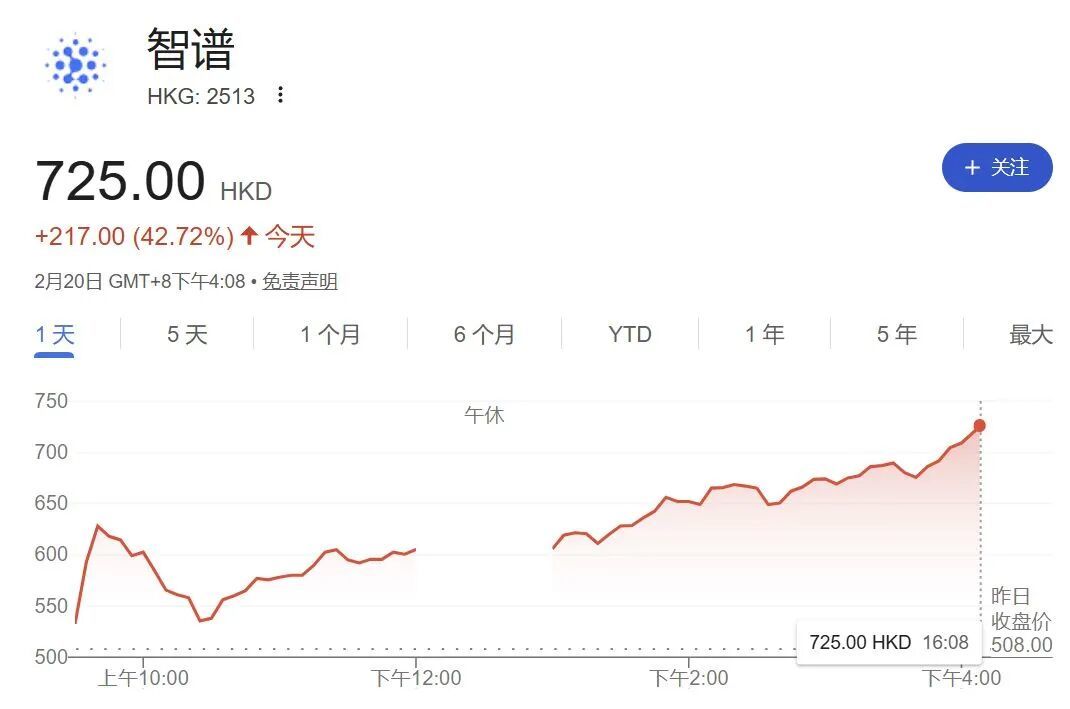
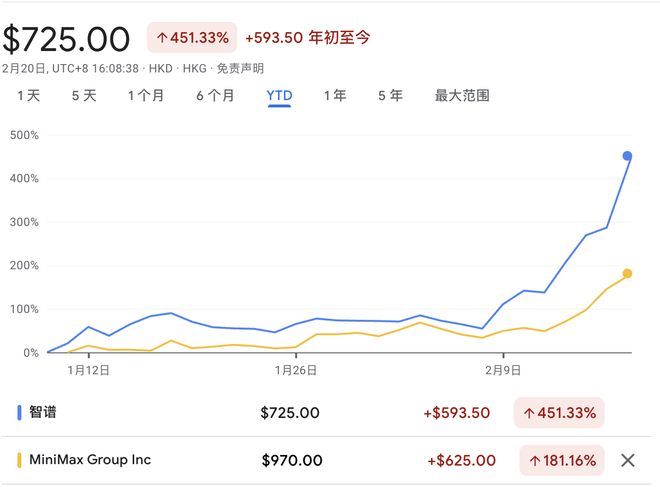
Core Viewpoint - The stock prices of AI companies Zhipu and MiniMax have surged significantly, with Zhipu's market capitalization exceeding 323.2 billion HKD and MiniMax surpassing 300 billion HKD, reflecting a strong investor interest in AI models despite both companies being in a loss-making position [1][2][3]. Market Performance - On February 20, the first trading day of the Lunar New Year, Zhipu's stock rose by 42.72% to 725 HKD per share, while MiniMax's stock increased by 14.52% to 970 HKD per share [3][8]. - Since their listings in January 2026, Zhipu's stock has increased by 523% and MiniMax's by 487.88% [8][12]. Market Capitalization - Both companies have surpassed the market capitalizations of major firms like Ctrip and Kuaishou, approaching the valuations of Pop Mart and Baidu [2][19]. - The market capitalization of Zhipu is approximately 413 billion USD, while MiniMax stands at about 389 billion USD [19]. Financial Metrics - Both companies are currently operating at significant losses, with Zhipu reporting a cumulative loss of 6.238 billion CNY from 2022 to mid-2025, and MiniMax showing a net loss of 512 million USD (approximately 3.605 billion CNY) in the first nine months of 2025 [18][21]. - Their price-to-sales ratios exceed 700, which is substantially higher than OpenAI's ratio of 65 [19]. Technological Developments - Zhipu recently launched its flagship model GLM-5, which has shown a performance improvement of over 20% compared to its predecessor, while MiniMax introduced its M2.5 model, designed for agent scenarios, achieving significant benchmarks in various tests [13][14]. - Both companies have seen a surge in model usage, with MiniMax's M2.5 model recording a token usage of 3.07 trillion, a 524% increase, and GLM-5 reaching 1.03 trillion tokens, a 462% increase [16][20]. Market Dynamics - The recent price increases for Zhipu's GLM Coding Plan indicate a shift in the AI market where token consumption is becoming a critical metric for value, moving away from traditional user engagement metrics [20]. - The rise of AI agents, which require extensive token usage for complex tasks, is expected to drive demand for these models significantly [20]. Competitive Landscape - Both companies face intense competition from established global players like OpenAI, Claude, and Gemini, which may impact their pricing power and market position [21]. - The scarcity of AI stocks in the Hong Kong market has contributed to the high valuations of Zhipu and MiniMax, attracting significant investment interest [21].
JFrog tumbles 25% after launch of Claude Code Security
En.Globes.Co.Il· 2026-02-22 13:07
Core Viewpoint - JFrog's share price dropped 24.94% following the launch of Anthropic's Claude Code Security, raising concerns about AI tools potentially replacing existing cybersecurity solutions [1][2]. Company Overview - JFrog, co-founded and led by CEO Shlomo Ben Haim, specializes in software development solutions [2]. - The company has experienced a significant decline in stock value, losing 39.6% since the beginning of 2026, which equates to a market cap reduction of nearly $3 billion, bringing it down to $4.5 billion [5]. Market Reaction - The launch of Claude Code Security by Anthropic has led to a broader decline in cybersecurity stocks, with notable drops in SentinelOne (down 4.35%) and Varonis (down 7.68%) [2]. - Investment bank Jefferies' analyst Joseph Gallo expressed that while the cybersecurity field will ultimately benefit from AI, there will be increasing headwinds until the impact of AI on cybersecurity becomes clearer [5]. Analyst Perspectives - Raymond James stated that the decline in JFrog's stock is exaggerated and views it as a short-term risk that does not affect the company's strategic position, maintaining a positive outlook due to the company's foresight and platform resilience [6].


X @Ignas | DeFi
Ignas | DeFi· 2026-02-22 13:07
The OpenClaw moment reminds me of DeFi summer:Early adopters experimenting with expensive tech and bad UX.Both have conviction that this changes everything. A community building open source stuff (smart contracts vs AI Skills now).But DeFi summer had a financial layer that let anyone capture value.Compound launched $COMP rewards. Uniswap let you LP and earn fees and a star dev Andre (vs P. Steinberger now) found ways to build on top.Every new protocol meant new tokens and new upside for retail.Many early ad ...
Nikhil Kamath announces upcoming podcast with Anthropic CEO Dario Amodei: ‘No script conversation about the tech…’
MINT· 2026-02-22 12:43
Core Insights - The upcoming podcast episode features Nikhil Kamath and Dario Amodei discussing the transformative impact of artificial intelligence (AI) on economics, geopolitics, and safety concerns [1][3][4] Group 1: Podcast Overview - The podcast will cover various topics including economics, geopolitics, and safety related to AI, emphasizing an unscripted and honest dialogue [3][4] - Dario Amodei, CEO of Anthropic, expresses the need to steer AI in the right direction, likening its potential impact to a tsunami [2][4] Group 2: Dario Amodei's Background - Dario Amodei is the CEO and co-founder of Anthropic, with a strong academic background including a PhD in Computational Neuroscience from Princeton [5][6] - His career includes roles at Google and OpenAI, where he focused on AI safety before co-founding Anthropic in February 2021 [6] Group 3: AI's Role in India - At the India AI Impact Summit 2026, Amodei highlighted India's crucial role in addressing challenges related to AI, including its autonomous behavior and potential misuse [7] - He noted the unprecedented capabilities of AI agents, which could lead to significant opportunities and concerns for humanity [8][9]


国金证券:AI应用产业趋势确立 2026年有望迎来双击
智通财经网· 2026-02-22 11:57
Core Viewpoint - The launch of ByteDance's AI video generation model Seedance 2.0 significantly lowers the barrier for high-quality video content creation, marking a pivotal moment in AI film development. The domestic AI application is accelerating its penetration into vertical fields, creating a new pattern of deep integration between technology and industry. Under policy-driven initiatives, intelligent technology is becoming a core growth engine, with applications in industrial quality inspection and medical diagnosis, pushing AI from "perception" to "decision-making." The year 2026 is anticipated to be a critical year for AI applications transitioning from "technology validation" to "commercial promotion" [1][2]. Industry Trends - AI application industry trends are solidifying, with 2026 expected to witness a dual impact. Companies are increasingly seeing AI orders and revenue constituting over 10% of their overall income, indicating that the cold start phase has passed. The Chinese IT sector, primarily project-based, necessitates deep integration of AI with complex business processes to create greater value for clients [2][3]. Recommended Directions for AI Applications - **Super Entry Points**: Large models are establishing themselves as dominant flow entry points in the AI era, with significant commercial acceleration. OpenAI's ARR is projected to exceed $20 billion by the end of 2025, while Google Gemini's token usage is expected to reach 1.3 trillion per month by October 2025. Domestic platforms are also experiencing similar growth, with daily token usage expected to surpass 50 trillion by December 2025 [3][4]. - **AI Infrastructure**: Software-defined computing is crucial for determining the cost curve and capability ceiling of AI applications. Companies like Databricks and Snowflake are leading in this space, with Databricks achieving a valuation of $134 billion and annualized revenue exceeding $4.8 billion, reflecting strong enterprise investment in data governance and computing scheduling [4][5]. - **High Growth Areas**: AI technology is evolving, with marketing and animated series becoming pioneers in commercialization. For instance, AppLovin has demonstrated that AIGC can directly enhance customer ROI, while the demand for AI-generated animated series has surged, with Douyin's daily paid traffic reaching over 10 million by August 2025 [5][6]. - **High Barriers**: Industries with deep know-how, proprietary data assets, and complex process integration capabilities will benefit from large models, which will reinforce their core advantages. The AI healthcare sector is rapidly expanding, with companies like Ant Group entering the market and achieving significant app store rankings [6][7]. Animation Series Market Insights - The short drama industry has reached a scale of hundreds of billions, indicating the commercial potential of fragmented entertainment. The animated series market is expected to exceed 22 billion yuan by 2026, with significant growth in commercial data observed in 2025. Douyin's daily GMV for animated series surpassed 10 million, reflecting a robust monetization cycle [7][8]. - ByteDance is positioned as the absolute leader in the animated series market, leveraging its comprehensive advantages in traffic, IP, and AI. By 2025, Douyin's cumulative playback volume for animated series is projected to exceed 75.772 billion [8]. Long-term Outlook - AI technology is transforming the production paradigm of animated series, reducing production cycles and costs significantly. For example, the production cycle has been compressed from over 50 days to under 30 days, with costs dropping to the thousand-yuan level. This trend is exemplified by companies like Qixiang Wuxian Network, which has integrated AI capabilities to streamline production processes [8]. - Dynamic animation agents are expected to evolve into foundational platforms for virtual worlds, with the potential for technology spillover into game development and architectural design [8].

无视海外“AI恐慌”,中国市场狂炒AI赢家
Xin Lang Cai Jing· 2026-02-22 10:43
炒股就看金麒麟分析师研报,权威,专业,及时,全面,助您挖掘潜力主题机会! (来源:网易科技) 当美国市场陷入"AI恐慌交易",投资者抛售软件公司和财富管理机构之际,中国投资者却在大举追捧人 工智能概念股。这种截然不同的市场情绪反映出两地投资者对AI技术的根本性分歧:美国担忧既有商 业模式被颠覆,中国则聚焦于增长机遇和降本潜力。 本月发布新模型或升级现有产品的国内公司成为投资者宠儿。MiniMax和智谱AI最为典型,两家公司股 价在2月均翻倍。摩根士丹利等华尔街投行的看涨评级进一步推高市场热情,纯AI概念股正从传统互联 网巨头手中抢夺资金。 这种市场分化背后是投资逻辑的差异。盛宝市场首席投资策略师Charu Chanana表示,中国市场仍专注 于AI能带来什么帮助,而非它会从现有企业手中夺走什么。美国投资者焦虑于丰厚利润池面临竞争威 胁,而中国关注的仍是市场渗透。 新上市AI股领涨 MiniMax和智谱AI受到投资者青睐,部分原因在于全球范围内构建大模型的上市公司稀缺。两家公司均 于1月在香港上市,智谱AI股价此后一度飙升524%,MiniMax大涨488%。相比之下,被视为行业先驱的 OpenAI和Anthr ...
AI Is Giving English Majors Some Unexpected Leverage in the Job Market
Business Insider· 2026-02-22 10:17
Core Insights - The University of Colorado Boulder has introduced interdisciplinary courses that combine AI and humanities, leading to increased interest in liberal arts degrees like English, which had been declining pre-pandemic [3][5][7]. Group 1: Course Offerings and Student Interest - The course "Inclusive Interdisciplinary Data Science for All" allows STEM students to explore the ethics of AI while humanities majors analyze AI's impact on writing and self-identity [1][2]. - There has been a 9% increase in English majors at the University of Colorado Boulder since 2021, reversing a previous trend of decline [3]. - Other institutions, such as Rice University, have also seen growth in English class enrollment and faculty numbers in Creative Writing [11]. Group 2: Perception of Humanities Majors - The utility of English majors is being recognized as companies seek candidates with strong communication and soft skills, which are essential in a technology-driven world [6][7]. - Despite previous skepticism about the relevance of humanities degrees, there is a growing acknowledgment of their importance in fostering critical thinking and creativity [19][30]. Group 3: Employment Landscape - The overall hiring rate has slowed, affecting all graduates, including those with humanities degrees, leading to a higher unemployment rate for early-career humanities graduates compared to other fields [20][21]. - However, the unemployment rate for humanities and liberal arts graduates remains below post-2008 recession highs, indicating some resilience in the job market [28]. - Smaller firms are beginning to show interest in hiring candidates with humanities backgrounds, suggesting a potential shift in hiring practices as larger companies adopt AI tools [29][30].