Arm Holdings

Search documents
Nvidia Pours $9,001,796,000 Into Two Stocks That Have Exploded 75%+ in Just Six Months
The Daily Hodl· 2026-02-27 03:31
Investment Summary - Nvidia invested approximately $7.93 billion in Intel Corporation (INTC) during the October-to-December quarter of 2025, resulting in a stock price increase from $24.21 to $46.51, a gain of roughly 92% [1] - Nvidia also invested around $1.08 billion in Nokia (NOK), with the stock rising from $4.23 to $7.57, marking a gain of approximately 79% [2] - However, Nvidia's investment in Synopsys Inc. worth about $2.26 billion saw a decline of around 24% since September 2nd [2] Existing Investments Performance - The value of Nvidia's stake in CoreWeave decreased from $3.32 billion to $1.58 billion, a drop of nearly 50% [3] - Nvidia's investment in Nebius fell from $133.65 million to approximately $99.65 million [3] Divestments - Nvidia divested its entire stakes in four firms: Arm Holdings, Applied Digital Corporation, Recursion Pharmaceuticals, and WeRide Inc., with a combined worth of $387.64 million [4]



Nvidia (NVDA) Partners With Meta Platforms in Multiyear Deal for Millions of Blackwell and Rubin AI Chips
Yahoo Finance· 2026-02-20 09:07
Core Insights - Nvidia Corporation (NASDAQ: NVDA) is positioned as a leading growth stock in the NASDAQ for the next two years, bolstered by a multiyear agreement with Meta Platforms for the supply of millions of AI chips and CPUs [1][3] Group 1: Partnership and Product Development - The agreement includes Nvidia's current Blackwell architecture and upcoming Rubin AI chips, as well as standalone installations of Nvidia's Grace and Vera CPUs, which utilize Arm Holdings technology [1][2] - The inclusion of Grace CPUs indicates Nvidia's strategic expansion into high-intensity data processing and database management markets, with Grace CPUs operating at half the power consumption of traditional hardware [2] Group 2: Market Position and Competitive Landscape - Meta is concurrently developing its own AI silicon and evaluating Google's TPUs, highlighting the competitive landscape in which Nvidia operates [3] - Although the financial specifics of the deal were not disclosed, analysts view this partnership as a significant retention of Meta as a major customer and a boost for Nvidia's CPU offerings [3] Group 3: Company Overview - Nvidia Corporation is recognized as a computing infrastructure company that provides graphics compute and networking solutions across various regions, including the US, Singapore, Taiwan, China, and Hong Kong [4]
1 Unstoppable Stock to Buy Before It Joins Nvidia, Apple, and Alphabet in the $3 Trillion Club
The Motley Fool· 2026-02-16 08:02
Core Viewpoint - Taiwan Semiconductor Manufacturing Company (TSMC) is positioned to potentially join the $3 trillion market cap club, driven by its leadership in advanced semiconductor manufacturing and strong financial performance [2][3]. Company Overview - TSMC is the world's largest semiconductor foundry with a market capitalization of $1.9 trillion, holding a 71% share of the global chip market and producing over 90% of the most advanced semiconductors [5][9]. - The company has transitioned from generating most of its revenue from smartphone chips to advanced chips for AI, data centers, and high-performance computing, which now account for 55% of its sales [6]. Financial Performance - In Q4, TSMC reported revenue of $33.7 billion, a 26% year-over-year increase, and earnings per American Depository share of $3.14, up 35% [7]. - The gross margin improved to 59.9%, up 380 basis points, and the operating margin increased to 50.8%, up 510 basis points, indicating enhanced operational leverage [8]. - The company forecasts Q1 revenue of $35.2 billion, representing a 38% year-over-year growth [8]. Market Position and Future Outlook - Analysts project TSMC's revenue to reach $157.8 billion by 2026, with expectations of $193.9 billion and $232.8 billion in 2027 and 2028, respectively, positioning the company for a potential $3 trillion market cap by 2029 [10][11]. - The demand for high-end semiconductors is expected to grow, with annual sales projected to approach $1 trillion by 2026, benefiting TSMC as a leading provider [12].


“软件股末日论”点燃大变革! 恐慌抛售之后,市场将捧起AI时代的“软件基石”
美股IPO· 2026-02-07 00:35
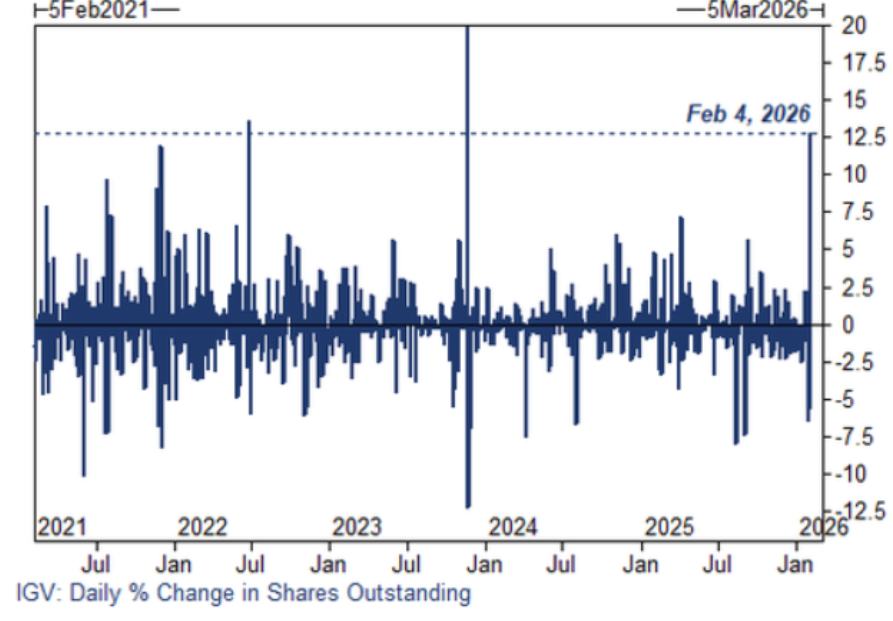
Core Viewpoint - A portion of institutional funds is beginning to enter the market for "bottom-fishing" in software stocks that have recently experienced significant declines, agreeing with Jensen Huang's positive outlook on software stocks, suggesting that the market has misjudged strong software giants focused on "AI + core operational processes" [1][4] Group 1: Market Dynamics - The narrative of a "Software-mageddon" is gaining traction, with significant sell-offs in the software sector following the launch of new AI tools by Anthropic, leading to a notable drop in the S&P 500 Software & Services Index, which has fallen approximately 30% since its recent peak at the end of October [3][9] - The software sector faced its most severe sell-off since 2022, with the S&P 500 Software & Services Index experiencing a decline of over 5% in a single day, extending its losing streak to eight consecutive trading days [3][9] - Concerns about AI's impact on traditional SaaS business models have intensified, particularly following the introduction of Anthropic's AI tools, which are designed to handle complex workflows traditionally managed by SaaS providers [7][8] Group 2: Institutional Perspectives - Some institutional investors are starting to view the recent sell-off as an opportunity, believing that high-quality software companies embracing AI may soon experience a technical rebound [4][10] - Analysts from major financial institutions, including Goldman Sachs and Wedbush Securities, suggest that the selling pressure may have peaked, indicating potential for a market bottom and a return of institutional capital to the software sector [16][18] - Rick Sherlund, a prominent analyst, emphasizes that the software industry undergoes significant transformations every 10 to 15 years, and the current AI-driven changes may lead to a new bull market rather than a decline [20] Group 3: Long-term Outlook - Despite fears that AI could completely replace enterprise software, many analysts believe that AI will instead reshape the profitability trajectories of software companies, with a focus on enhancing existing platforms rather than replacing them [12][14] - The market's panic over AI's potential to disrupt software is viewed as exaggerated, with many analysts asserting that established companies with robust platforms, like SAP, will likely benefit from AI advancements [5][19] - The ongoing transition from consumer-facing AI applications to enterprise applications is expected to drive explosive growth in demand for reasoning and computational capabilities [20]

软件股末日论”点燃大变革! 恐慌抛售之后,市场将捧起AI时代的“软件基石
Zhi Tong Cai Jing· 2026-02-06 11:49
Core Viewpoint - The recent narrative of "Software-mageddon" has led to a significant sell-off in the software sector, particularly affecting SaaS stocks, following the launch of new AI tools by Anthropic, which are perceived as threats to traditional software business models [1][4][5]. Group 1: Market Reaction - The S&P 500 Software & Services Index has experienced a decline of approximately 30% since its recent peak at the end of October, marking the most severe sell-off since 2022 [1][6]. - Major software companies, including Thomson Reuters and Salesforce, have seen their stock prices drop significantly, with some experiencing declines of up to 10% in a single day [5][6]. - The sell-off has been exacerbated by disappointing earnings guidance from major companies, including Microsoft, and heightened expectations for AI infrastructure spending [5][6]. Group 2: Institutional Response - Some institutional investors are beginning to enter the market to buy undervalued software stocks, believing that the market has overreacted to the AI threat [2][12]. - Analysts express a divided view on the long-term impact of AI on software companies, with some believing that AI will reshape profit trajectories rather than eliminate the need for existing software [9][14]. Group 3: Expert Opinions - Rick Sherlund, a prominent analyst, argues that the software industry undergoes significant transformations every 10 to 15 years, and companies with strong fundamentals, like SAP, will likely benefit from AI rather than be threatened by it [3][16]. - Nvidia's CEO Jensen Huang emphasizes that the notion of AI completely replacing software is illogical, suggesting that AI will enhance existing software rather than replace it [7][8]. - The current market panic is described as "micro-hysteria," with experts suggesting that the fears surrounding AI's impact on software are exaggerated [8][12]. Group 4: Future Outlook - The software sector is expected to experience a technical rebound as investors reassess the long-term value of companies that integrate AI into their operations [2][11]. - High-quality software companies that embrace AI are likely to emerge stronger from the current turmoil, as the market begins to differentiate between those with robust business models and those that are more vulnerable [11][15].
“软件股末日论”点燃大变革! 恐慌抛售之后,市场将捧起AI时代的“软件基石”
智通财经网· 2026-02-06 09:13
Core Viewpoint - The recent narrative of "Software-mageddon" has led to a significant sell-off in the software sector, particularly affecting SaaS stocks, following the launch of new AI tools by Anthropic, which are perceived as threats to traditional software business models [1][4][5]. Group 1: Market Reaction - The S&P 500 Software & Services Index has experienced a decline of approximately 30% since its recent peak at the end of October, marking the most severe sell-off since 2022 [1][6]. - Major software companies, including Thomson Reuters and Salesforce, have seen significant stock price drops, with some experiencing declines of up to 10% in a single day [5][6]. - The sell-off has been exacerbated by disappointing earnings guidance from major companies, including Microsoft, and heightened expectations for AI infrastructure spending [5][6]. Group 2: Institutional Response - Some institutional investors are beginning to enter the market to buy undervalued software stocks, believing that the market has overreacted to the AI threat [2][12]. - Analysts from firms like Goldman Sachs and Wedbush Securities suggest that the sell-off reflects an exaggerated "Armageddon scenario" and that companies will not abandon their existing software investments for new AI solutions [12][14]. Group 3: Expert Opinions - Rick Sherlund, a prominent technology analyst, argues that the software industry undergoes significant transformations every 10 to 15 years, and companies with strong fundamentals, like SAP, will likely benefit from AI rather than be replaced by it [3][16]. - Nvidia's CEO, Jensen Huang, emphasizes that AI will enhance existing software infrastructure rather than replace it entirely, countering the prevailing panic in the market [7][8]. Group 4: Long-term Outlook - Analysts believe that while AI may disrupt certain aspects of the software industry, it will also create new growth narratives, particularly for companies that can integrate AI into their existing platforms [9][10]. - The market is expected to see a bifurcation, where companies with strong data assets and integration capabilities, such as Microsoft and SAP, are likely to rebound more strongly than those with weaker competitive positions [11][15].
Arm Holdings美股盘前跌超6%
Jin Rong Jie· 2026-02-05 09:37
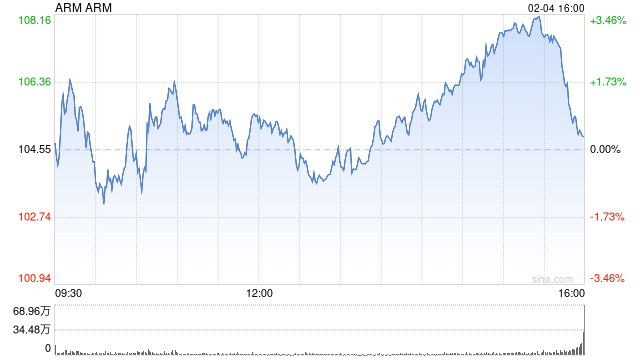
Group 1 - Arm Holdings' stock price dropped over 6% in pre-market trading, currently reported at $97.65 [1]
Arm Holdings预计第四季度营收增速放缓
Xin Lang Cai Jing· 2026-02-05 07:44
Core Viewpoint - Despite the rising demand for AI data center chip designs, Arm Holdings expects a slowdown in revenue growth [2][7]. Revenue Guidance - The company projects a revenue increase of approximately 18% year-over-year for the current quarter, down from 26% growth in Q3 of fiscal year 2025 [2][7]. - Arm anticipates that patent licensing revenue growth will decline to low double digits, compared to a 27% increase in the previous quarter, primarily due to typical seasonal factors [2][7]. - The revenue guidance for Q4 of fiscal year 2025 is approximately $1.47 billion, with a fluctuation of $50 million, while analyst expectations average $1.44 billion [2][7]. Financial Performance - In the previous quarter, Arm reported a net profit of $223 million, or $0.21 per share, down from $252 million, or $0.24 per share, in the same period last year [3][9]. - Adjusted earnings per share were $0.43, exceeding the analyst consensus of $0.41, with revenue growing 26% to $1.24 billion, surpassing the analyst expectation of $1.23 billion [3][9]. Licensing Revenue - Patent licensing revenue increased by 27% to $737 million, driven by higher single-chip licensing fees and increased application rates of Arm architecture chips in the data center sector [4][9]. - Licensing and other revenue grew by 25% to $505 million, influenced by the timing and scale of several large licensing agreements and contributions from unfulfilled orders [5][9]. Market Reaction - Following the revenue guidance announcement, Arm's stock price fell by 8.3% to $96.12, with a cumulative decline of 35% over the past year [8].
Arm公布业绩后股价下跌 凸显AI公司面临高预期门槛
Xin Lang Cai Jing· 2026-02-05 00:57
Core Viewpoint - Arm Holdings' optimistic earnings report was insufficient to boost its stock price, indicating that investors are scrutinizing AI companies more rigorously in the current tech stock market [1] Financial Performance - Arm Holdings reported third-quarter revenue of $1.24 billion, a 26% year-over-year increase, slightly exceeding analyst expectations of $1.23 billion [1] - The adjusted earnings per share were $0.43, surpassing the FactSet average estimate of $0.41 [1] - The company provided a first-quarter revenue guidance midpoint of $1.47 billion, compared to the FactSet average expectation of $1.44 billion [1] Market Reaction - Despite the positive earnings report, Arm's stock fell by 9% in after-hours trading, reflecting a broader trend of indiscriminate selling in chip stocks as noted by Bank of America analyst Vivek Arya [1]
Stock market today: S&P 500, Nasdaq poised to add to tech sell-off as Google sinks, Amazon looms, silver tanks
Yahoo Finance· 2026-02-04 23:49
Market Overview - US stock futures declined as investors reacted to a two-day tech sell-off, with S&P 500 futures down approximately 0.6% and Nasdaq 100 futures down about 0.9% [1] - The market is experiencing a significant tech wipeout, with concerns about AI disruption affecting software stocks [2] Corporate Earnings and Forecasts - Alphabet announced a substantial increase in AI investment, projecting capital expenditures of up to $185 billion, which negatively impacted its stock [3] - Amazon's quarterly report is anticipated, with expectations of a 21% increase in sales from its AWS cloud unit [3] - Qualcomm reported a 5% year-over-year revenue increase to $12.3 billion and earnings per share of $2.78, but its outlook for the second quarter is weaker due to a memory chip shortage [28][29] - Nio expects to report its first-ever profit in Q4, projecting an adjusted profit from operations between 200 million yuan (approximately $29 million) and 700 million yuan (approximately $100 million) [6][7] Stock Movements - Estée Lauder shares fell 10% despite beating earnings estimates due to tariff concerns [8] - Snap's stock rose 6% after reporting Q4 revenue of $1.71 billion, exceeding Wall Street estimates [13] - E.l.f. Beauty's stock increased by as much as 8% after raising its full-year sales outlook to between $1.6 billion and $1.61 billion [16][17] - Baidu's US-listed shares rose 5% following the announcement of a dividend and a $5 billion stock buyback program [10] Commodities and Cryptocurrencies - Silver prices plunged by as much as 17%, erasing previous gains, as market sentiment turned negative [4][24] - Bitcoin fell below $70,000 after Treasury Secretary Scott Bessent ruled out a government bailout for cryptocurrencies [5][12] Industry Trends - Broadcom's stock rose 5% following Alphabet's announcement of increased capital expenditures, which is expected to benefit companies involved in AI infrastructure [21][22] - The overall sentiment in the market appears to be dampened, affecting various asset classes including precious metals and equities [25]