
CMOC Group Ltd

Search documents
洛阳钼业_花旗 2025 中国峰会新动态_预计 KFM 二期将于 2027 年上半年投产
花旗· 2025-11-24 01:46
Investment Rating - The investment rating for CMOC is "Buy" with a target price of HK$20.60, indicating an expected total return of 22.0% including a dividend yield of 2.3% [6][8]. Core Insights - CMOC's net profit in 3Q25 exceeded market expectations, driven by a lower effective tax rate, realized cobalt sales, and strong minor metals prices [2]. - The company anticipates sustainable copper output growth due to technology upgrades, with a guidance of 0.8-1.0 million tonnes (mnt) for 2028E and the KFM phase 2 project expected to operate in 1H27E with an average output of 100,000 tonnes per annum (ktpa) [3]. - Copper production costs have decreased year-over-year in 9M25 due to increased output and cost control measures [4]. - Cobalt output is expected to remain stable despite potential adjustments in production methods, with a total cobalt quota of over 30,000 tonnes allocated for TFM and KFM projects in 2026E [5]. Financial Performance - CMOC's market capitalization is approximately HK$368.41 billion (US$47.40 billion) [6]. - The net financial expenses have decreased year-over-year in 9M25 due to the repayment of long-term debt [5]. - The DCF valuation methodology used yields a fair-value target price of HK$20.60, based on an 11% weighted average cost of capital (WACC) [8].

中国材料 - 考察要点首日 - 上海-China Materials-Trip Takeaways Day 1 – Shanghai
2025-11-11 02:47
Summary of Key Points from the Conference Call Industry Overview - **Industry Focus**: The conference call covered the materials sector in China, specifically focusing on lithium, copper, and steel industries [1][7]. Lithium Industry Insights - **Lithium Deficit**: A potential deficit of 50-60kt LCE is expected in 2026 due to stronger-than-anticipated demand from energy storage systems (ESS) [2]. - **Demand Growth**: ESS battery shipments are projected to grow by 50-80% YoY, while electric vehicle (EV) battery shipments may increase by 8-15% YoY [2]. - **Supply and Pricing**: Global lithium supply is estimated at 1.8-1.9 million tons, with demand reaching approximately 2 million tons. Industry players expect lithium prices to rise above Rmb100k/t [2][30]. Copper Industry Insights - **Copper Deficit**: The global copper deficit is anticipated to widen to around 500kt in 2026, influenced by three major accidents in 2025 [3]. - **Demand Trends**: China's copper demand is expected to grow by 5% in 2025 but slow to 2.5% in 2026 due to EV subsidy cuts. Power-related demand is projected to grow less than 1% [3][20]. - **Price Expectations**: The price outlook for copper is under pressure, with a tight supply expected moving into 2026 [17]. Steel Industry Insights - **Steel Margins**: Steel margins are under pressure, with 60% of industry participants currently operating at a loss. Production cuts are beginning due to weak earnings and seasonal demand [5][27]. - **Price Outlook**: Iron ore prices are expected to drop to around US$90/t in 2026, influenced by new supply from projects like Simandou [5][29]. - **Export Trends**: China's steel exports are expected to remain high, particularly to "Belt and Road" countries, despite challenges from the EU's lower import quotas [5][15]. Company-Specific Insights - **Baosteel**: Reported good Q3 2025 results driven by cost savings and increased auto sheet orders. However, steel gross profit per ton is narrowing due to high iron ore prices [10][11]. - **CMOC**: Guided for at least 760kt of copper production in 2026, with long-term expectations of reaching 800-1,000kt by 2028 [21]. Cobalt exports may be limited in Q4 2025 due to government regulations [23]. - **Ganfeng Lithium**: Expects lithium to be in deficit for 50-100kt LCE in 2026, with strong demand from ESS and electrification of vehicles [30]. The Goulamina project is expected to ship 500kt of spodumene concentrate in 2026 [31]. Additional Insights - **Market Dynamics**: Recent price increases have shifted Chinese buyers' price expectations from US$10k/t to US$12k/t [4]. - **Production Cuts**: Private steel mills in Tangshan have begun small production cuts due to environmental regulations and poor margins [26]. - **Future Demand**: Overall, China's domestic steel demand is expected to decline by 1-2% in 2026, but this may be offset by increased exports [28]. This summary encapsulates the key insights and trends discussed during the conference call, providing a comprehensive overview of the current state and future outlook of the materials sector in China.

太阳能玻璃专家电话会议核心要点-Greater China Materials-Solar Glass Expert Call Key Takeaways
2025-11-10 03:34
Key Takeaways from Solar Glass Expert Call Industry Overview - The focus is on the solar glass industry within the Greater China Materials sector, particularly in the Asia Pacific region [1] Core Insights 1. **Policy Controls**: - New capacity approvals for the solar glass industry are expected to be restricted, with no new approvals post-January 2024 for projects that have not started construction [2] - Stricter energy consumption standards may lead to the exit of smaller production lines [2] - Companies selling below the average production cost will face penalties, ensuring prices do not fall below this threshold [2] - Enhanced supervision and management are anticipated between companies and the industry association [2] 2. **Overseas Capacity Expansion**: - Current operating capacity overseas is approximately 11,000 tons per day (kt/d), projected to increase to around 20kt/d by the end of 2026 [3] - New production lines are planned in Southeast Asia, India, and North America [3] - Solar glass prices overseas command a premium of about 15% compared to the domestic market, with margins realized between 15-20% [3] - The price premium is expected to be sustained into 2026 due to stronger overseas demand and the timing of new line startups [3] 3. **Material Changes**: - The government has banned sodium pyroantimonate as a glass refining agent, now classified as a strategic metal [4] - Producers are testing alternative chemical compounds, which could potentially reduce refining agent costs by over 50%, although some reduction in module light transmittance is anticipated [4] 4. **Demand and Capacity Outlook**: - Demand in the second half of 2025 is impacted by the No.136 document released in February, which has reduced returns for ground-mounted power stations in China [9] - An estimated 15-17kt/d of capacity could start operations in 2026, but realistically only 12-13kt/d are likely to commence production next year [9] - Net capacity increase will be limited, with some lines expected to exit the market due to funding pressures from low profitability [9] - Operating capacity is projected to range between 83-93kt/d over the next 4-5 years [9] - Inventory levels have recently increased to approximately 24-25 days due to weakened demand and high market supply [9] - About 20-30% of capacity faces risks of exiting the market due to financial pressures [9] Additional Important Points - The insights were provided by Mrs. Wang, Shuai, a senior analyst at SCI, indicating a level of expertise in the field [4] - The report emphasizes the importance of considering these insights in the context of investment decisions, highlighting potential conflicts of interest due to Morgan Stanley's business relationships [7]

大摩最新研判:2025 年二季度中国股市成绩单出炉,这些板块最亮眼!
智通财经网· 2025-07-24 10:44
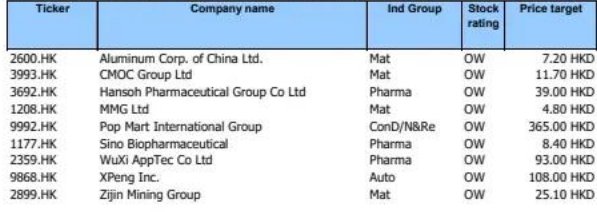
Overall Performance - The second quarter of 2025 shows signs of recovery in the Chinese stock market, with A-shares stabilizing and MSCI China improving [2][3] - As of July 21, 2025, 1,528 A-share companies (30% of total, 25% of total market capitalization) issued earnings forecasts, with a net negative warning rate of -4.8%, an improvement from -18.8% in the previous quarter [2] - The MSCI China index, covering overseas-listed Chinese core assets, reported a net positive warning rate of +6.8%, the highest in four quarters, indicating a rebound in confidence from overseas investors [3] Sector Performance - Strong sectors include financial services, materials, and technology hardware, while consumer services, real estate, and software lag behind [5][6] - Financial services benefit from stable growth policies, materials see gains from commodity price recovery, and technology hardware thrives on innovation [5] - Real estate continues to face pressure due to inventory reduction and financing challenges, while consumer services are affected by slow recovery in domestic demand [5][6] Market Capitalization - Large-cap stocks show stability with a net negative warning rate of -1.4%, indicating strong risk resistance and high earnings certainty [7] - Small-cap stocks have significantly improved, with a net negative warning rate narrowing from -31.1% to -7.4%, reflecting recovery supported by policy and industry revival [7] - Mid-cap stocks perform moderately with a net negative warning rate of -12.7%, showing improvement but still lagging behind large-cap stocks [8] Earnings Forecast Adjustments - Sectors with upward adjustments include technology hardware, consumer staples, and pharmaceuticals, driven by increased orders and stable demand [9] - Sectors facing downward adjustments include semiconductors, utilities, consumer services, and real estate, reflecting cautious market sentiment [9] Investment Recommendations - Morgan Stanley identifies nine stocks to watch, primarily from materials, pharmaceuticals, and technology hardware sectors, based on positive earnings forecasts and analyst ratings [10][11] - Caution is advised for six stocks concentrated in real estate and certain consumer services, reflecting high earnings uncertainty [10][11] Future Outlook - The report suggests focusing on sectors benefiting from policy support, such as finance and infrastructure-related materials, as well as resilient consumer services and technology growth areas [12][13] - The overall recovery remains uneven, and investors are encouraged to prioritize quality stocks with stable earnings and reasonable valuations [13]

摩根士丹利:即将到来的波动,亚洲催化因素事件概述
摩根· 2025-07-02 03:15
Investment Rating - The report does not explicitly provide an investment rating for the industry or specific companies covered [4][5]. Core Insights - The report highlights upcoming volatility events that could significantly impact equity markets, particularly for large-cap, highly liquid stocks in the Asia Pacific region [1][2]. - A tracker of key upcoming events for major companies in the region is compiled, focusing on those with substantial market capitalization and trading volume, as well as smaller stocks known for price volatility in sectors like Healthcare and Materials [2][4]. Summary by Relevant Sections Upcoming Events - Key macro catalysts for Japan are included, indicating a focus on significant market-moving events [2]. - Specific companies and their anticipated catalysts are listed, such as: - ANTA Sports Products (2020.HK) with an operational update expected in early to mid-July 2025, monitoring for faster-than-industry performance [11]. - Fast Retailing (9983.T) with FY8/25 Q4 results due in October 2025, assessing if the bottom of performance in China is confirmed [11]. - Pop Mart International (9992.HK) expected to issue a positive profit alert in early to mid-July 2025 [11]. Sector-Specific Insights - In the Materials sector, companies like Aluminum Corp. of China (2600.HK) are monitored for aluminum demand, particularly from solar applications, with developments expected in the second half of 2025 [23]. - The report also tracks developments in the Semiconductor sector, with companies like Samsung Electronics (005930.KS) and TSMC (2330.TW) expected to provide updates on market outlook and revenue guidance in the second half of 2025 [25][26].