
Doosan Enerbility

Search documents
NuScale(SMR) - 2025 Q4 - Earnings Call Transcript
2026-02-26 23:02
NuScale Power (NYSE:SMR) Q4 2025 Earnings call February 26, 2026 05:00 PM ET Company ParticipantsBill Cooper - Chief Legal Officer and Corporate SecretaryCarl Fisher - COOClayton Scott - Chief Commercial OfficerJohn Hopkins - President and CEONate Pendleton - Managing DirectorRamsey Hamady - CFORodney McMahan - Senior Director of Investor RelationsConference Call ParticipantsDerek Soderberg - Equity Research AnalystDimple Gosai - Equity Research AnalystEric Stine - Senior Research AnalystLeanne Hayden - VP ...

NuScale(SMR) - 2025 Q4 - Earnings Call Transcript
2026-02-26 23:02
NuScale Power (NYSE:SMR) Q4 2025 Earnings call February 26, 2026 05:00 PM ET Company ParticipantsBill Cooper - Chief Legal Officer and Corporate SecretaryCarl Fisher - COOClayton Scott - Chief Commercial OfficerJohn Hopkins - President and CEONate Pendleton - Managing DirectorRamsey Hamady - CFORodney McMahan - Senior Director of Investor RelationsConference Call ParticipantsDerek Soderberg - Equity Research AnalystDimple Gosai - Equity Research AnalystEric Stine - Senior Research AnalystLeanne Hayden - VP ...
NuScale(SMR) - 2025 Q4 - Earnings Call Transcript
2026-02-26 23:00
NuScale Power (NYSE:SMR) Q4 2025 Earnings call February 26, 2026 05:00 PM ET Speaker9Good afternoon, and welcome to NuScale's fourth quarter and full year 2025 earnings results conference call. Today's call is being recorded. A replay of today's conference call will be available and accessible on NuScale's investor relations website. The web replay will be available for 30 days following the earnings call. At this time, for opening remarks, I would like to turn the call over to Rodney McMahan, Senior Direct ...
为 AI 供能:燃气轮机或成 AI 发展野心的关键变量-Powering AI_ Gas Turbines Could Make or Break AI Ambitions
2026-01-26 02:49
Summary of Gas Turbine Industry Conference Call Industry Overview - The gas turbine industry is critical for meeting growing power needs, particularly in the context of AI and data centers, but demand extends beyond just these sectors [1][2] - The U.S. gas-fired power additions are projected to hit their lowest level in 2024, with only approximately 2.6 GW added, the lowest since the late 1990s [2][13] Key Insights on Demand and Capacity - Approximately 40 GW of gas turbine capacity additions are tracked by 2030, with expectations of increasing to around 90 GW [3] - Demand for gas turbines is not solely driven by data centers; there is significant international demand, coal retirements, and aftermarket needs [2][46] - Major projects include Crusoe's 2.7 GW gas-powered data center in Wyoming and xAI's expansion to 2 GW in the Midwest [2][21][23] OEM Capacity and Strategy - Legacy turbine OEMs are adopting a conservative approach to capacity additions, with some companies requiring 25% deposits for slot reservations, indicating a cautious market outlook [4] - Companies like Mitsubishi and CAT are signaling more measured growth plans, with Mitsubishi planning a 30% increase by FY2026 and CAT targeting a 50 GW capacity by 2030 [4] - New entrants like Boom Supersonic and Doosan Enerbility are attempting to enter the market, but face significant development challenges [8] Supply Chain and Operational Challenges - The gas turbine supply chain is complex, with components requiring rare earths and specialized materials, compounded by overlaps with aerospace jet engines [10] - Lead times for large frame turbines are extending into 2028+, with operational timelines stretching 18-24 months post-shipment [33][39] - There are significant labor constraints and permitting challenges affecting the commissioning of new large gas plants [30][31] Technological Trends and Preferences - There is a shift towards behind-the-meter power solutions due to the urgency of AI workloads, with smaller aeroderivative and industrial turbines gaining preference [9][30] - Gas turbines are still favored for baseload power, but there is increasing interest in gas engines and fuel cells for flexibility and rapid response to load changes [42][44] Market Dynamics and Future Outlook - The market is seeing a mix of technologies deployed to handle AI workload power fluctuations, including gas turbines, gas engines, and energy storage solutions [44] - International demand is strong, particularly in Asia and the Middle East, with significant orders coming from regions focused on local content [46] - The industry is also addressing coal capacity retirements and the need for peaking capacity to balance intermittent renewables [51] Conclusion - The gas turbine industry is at a pivotal point, balancing between traditional power generation needs and the emerging demands of AI and data centers. The cautious approach of OEMs, coupled with complex supply chain dynamics and evolving technological preferences, will shape the future landscape of the industry.
技术扩散与生成式 AI・韩国:新兴的 AI 基础设施机遇-Tech Diffusion and GenAI S. Korea The Emerging AI Infrastructure Opportunity
2026-01-22 02:44
Summary of the Conference Call on South Korea's AI Infrastructure Opportunity Industry Overview - The focus is on the emerging AI infrastructure opportunity in South Korea, particularly the construction of AI data centers supported by favorable government policies [1][3]. - The report highlights significant market opportunities as the first wave of AI data centers begins construction [1]. Key Companies Mentioned - **Samsung SDS**: Identified as a key player in AI infrastructure with ongoing AI data center projects [4]. - **HD Hyundai Electric**: Another preferred stock pick due to its involvement in the AI infrastructure build-out [1][5]. - **SK Telecom**: Actively involved in AI data center projects and partnerships with global AI companies [4][12]. Core Insights and Arguments - **Demand for AI Services**: The proliferation of AI-powered services is driving strong demand for GPU-based data centers in Korea, necessitating upgrades to supporting infrastructure [2][11]. - **Government Support**: The Lee administration is promoting data center construction through tax incentives and policy support, aiming to position Korea as an "Asia AI hub" [3][21]. - **Rural Development**: The government is focusing on economic growth in rural areas by decentralizing power and promoting AI data center build-outs outside the Seoul metropolitan area [24][26]. - **Investment in Infrastructure**: The government plans to invest W100 trillion in AI infrastructure, including the development of an "AI Superhighway" to support next-generation AI [22][21]. Data Center Developments - Multiple AI-specific data center announcements have been made, with significant projects underway, including those by SK Telecom and Samsung SDS [12][14]. - The National AI Computing Center project, led by Samsung SDS, aims to house 15,000 GPUs and is backed by government funding [23]. Supporting Infrastructure - Companies involved in power generation and grid modernization, such as KEPCO, LG ES, and Doosan Enerbility, are expected to benefit from the demand for energy storage systems and grid upgrades [5][13]. - The upcoming Energy Highway project aims to enhance the national grid's capacity to support rising power demand from AI data centers [30][34]. Economic and Environmental Impact - The energy highway is expected to facilitate the transfer of up to 20 GW of renewable energy to major demand centers, improving grid reliability and supporting Korea's carbon neutrality goals by 2050 [73][80]. - The project is anticipated to create jobs and economic opportunities in rural areas, helping to decentralize economic activity from Seoul [79]. Conclusion - The combination of government support, increasing demand for AI services, and the development of robust infrastructure positions South Korea as a potential leader in AI technology and data center operations [1][21].
全球主题:核电复兴-2026 年核心问题-Global Thematics -Nuclear Renaissance – Key Questions For 2026
2026-01-16 02:56
Summary of Nuclear Renaissance – Key Questions For 2026 Industry Overview - The report focuses on the nuclear energy sector, highlighting the potential for a nuclear renaissance in 2026 and the investment opportunities within the nuclear value chain [2][12]. Key Questions and Insights 1. **Conventional Nuclear Supply** - Incremental nuclear supply is expected in the US, Japan, and China, with a more positive outlook for the US and Japan. The fastest pathways to add capacity are restarts and life extensions of existing reactors [13][14]. - Japan's nuclear policy is supportive, with recent approvals for reactor restarts, while the US has several plant restarts underway, including Palisades and Crane Clean Energy Center [15][16]. 2. **Small Modular Reactors (SMRs)** - The SMR market is becoming selective, with only projects that have clear regulatory pathways and credible financing likely to succeed. Demand from hyperscalers is strong, but execution risks remain [3][17]. - Currently, only four SMRs are operational globally, with many still in the design phase [20]. 3. **Nuclear Fuel Supply Chain** - Uranium is highlighted as a preferred commodity for 2026, with utilities returning to the market and spot buying remaining robust. The expected price is projected to reach US$90/lb by Q3 2026 [4][23]. - The supply chain is constrained, with long-term contracting activity improving as US utilities re-engage in the uranium market [24][30]. 4. **Fusion and Thorium Technologies** - Fusion and thorium remain long-term technologies with limited near-term impact on power supply. However, they are gaining attention and funding, indicating potential future relevance [5][31]. - China is advancing thorium technology with active projects, while the US is restarting research on molten salt reactors [33][36]. Investment Opportunities - The report identifies 26 Overweight-rated stocks across the nuclear value chain, including: - **Nuclear Power Generation**: Talen Energy, Public Service Enterprise Group, Hokkaido Electric Power [2][11]. - **Uranium Mining**: CGN Mining, Paladin Energy [4][11]. - **Equipment & Plant**: Curtiss-Wright, GE Vernova, Rolls-Royce [3][11]. Market Performance - Uranium mining stocks have shown significant outperformance, indicating strong investor interest and potential for growth in this sector [6][11]. Monitoring Signals for 2026 - Key signals to watch include: - Japan's safety review processes and government support for nuclear projects [16]. - Progress on US nuclear plant restarts and regulatory streamlining [16]. - Long-term uranium contracting trends and advancements in enrichment capacity [30][31]. Conclusion - The nuclear sector is poised for growth, driven by increasing demand for clean energy and supportive policies in key markets. Investors are encouraged to focus on companies with strong fundamentals and clear pathways to capitalize on the nuclear renaissance [2][12].
拆解2025年全球最狂野股市:AI、存储以及军工推动韩国Kospi指数飙涨超76%
美股IPO· 2026-01-05 23:38
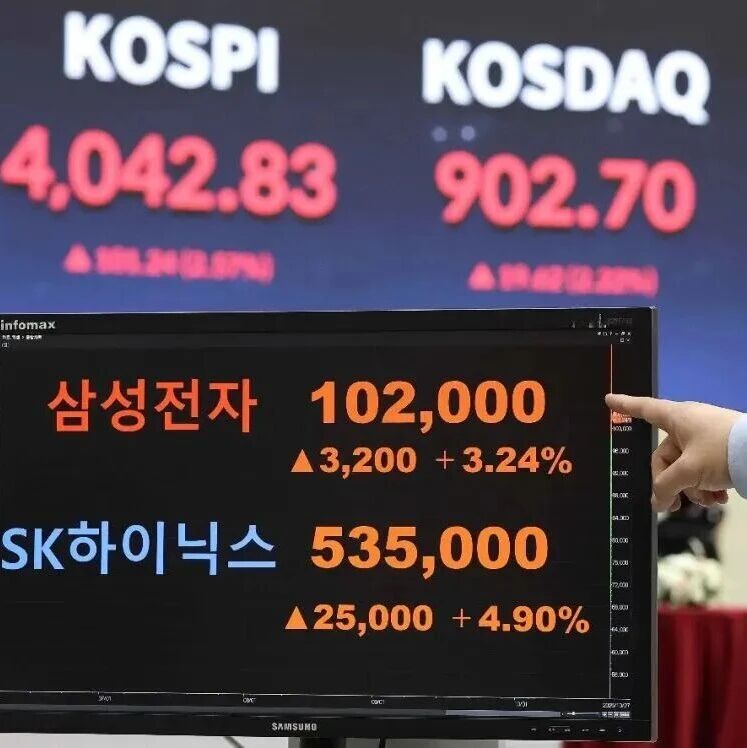
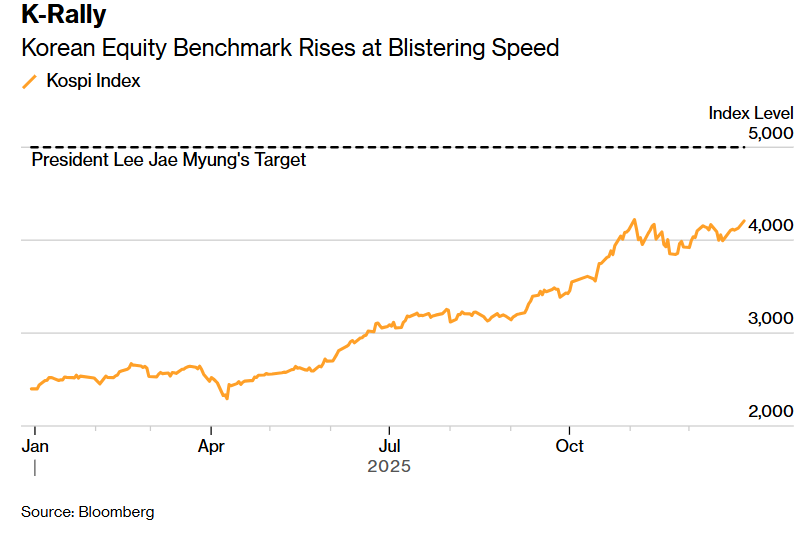
Core Viewpoint - The South Korean stock market is experiencing an unprecedented "revival-style surge" in 2025, with the Kospi index rising over 76% year-to-date, making it the best-performing major stock index globally [3][4]. AI Investment Theme - The biggest winners in the AI investment theme are not traditional chip manufacturers but industrial stocks associated with AI, such as Hyosung Heavy Industries and Doosan Enerbility, both of which have seen stock prices rise over 330% this year [5][6]. - Goldman Sachs predicts a significant increase in global data center electricity demand driven by AI, with a forecasted expansion of 175% by 2030, emphasizing the critical role of electricity in AI infrastructure [6][7]. Storage Chip Leaders - Samsung Electronics and SK Hynix have solidified their positions as the largest weight stocks in the Kospi index, with Samsung's stock rising 125% and SK Hynix's stock increasing by approximately 268% this year [8][10]. - The demand for high-performance storage chips, particularly HBM and enterprise-level NAND, is expected to continue growing, with a "storage supercycle" anticipated to last until at least 2027 [9][10]. Defense and Military Sector - The global military spending surge, driven by geopolitical tensions, has led to significant interest in South Korean defense contractors, with companies like Hanwha Aerospace seeing stock prices rise nearly 200% this year [11][12]. - The international rearmament trend is expected to sustain military stock performance over the next 2-3 years, positioning it as a core driver of stock market growth [11]. K-Beauty Sector - APR Corp., a newcomer in the K-Beauty sector, has seen its market value soar by 369%, outperforming established brands like Amorepacific Corp. and LG H&H [13]. - The success of APR is attributed to its innovative sales approach focused on social channels and user experience, contrasting with traditional retail methods [13]. Gaming Sector Struggles - Despite the overall market rally, South Korean gaming developers like Krafton and Com2uS have faced significant declines, with Krafton's market value shrinking by about 20% and Com2uS down over 30% [14][15]. - Concerns over limited appeal in the Asian market and competition from Chinese rivals have led investors to shift their focus away from these gaming stocks [14][15].

S Korea stocks crush global benchmarks with best stock rally since 1999
The Economic Times· 2025-12-31 00:13
Market Overview - South Korea's stock market experienced a significant rally in 2025, with the Kospi Index soaring 76%, outperforming the S&P 500's 17% and MSCI Asia Pacific Index's 25% gains [15] - Analysts from Citigroup, JPMorgan Chase, and Nomura Holdings forecast at least another 20% climb for the market next year, supported by strong earnings growth [15] Semiconductor Industry - Samsung and SK Hynix solidified their positions as top memory chip manufacturers, with Samsung's shares increasing by 125% and SK Hynix's by approximately 270% this year [6] - Related firms like SK Square Co. and Korea Circuit Co. also saw significant gains, each up more than 330% [15] - Shortages in memory chips are expected to drive a strong year for Korean semiconductor stocks, according to Kang DaeKwun, chief investment officer at Life Asset Management [7] Defense Sector - Increased defense spending in Europe and Asia, driven by geopolitical changes, has benefited Korean defense contractors [8] - Hanwha Aerospace Co. and Hanwha Ocean Co. emerged as major winners, with shares up nearly 200% and 204% respectively this year [8] Artificial Intelligence and Energy - Companies like Hyosung Heavy Industries and Doosan Enerbility, which are not traditional chipmakers, have seen their shares rise over 320% due to the demand for power transformers and nuclear energy in AI data centers [2][15] - Investor interest in power grid and infrastructure stocks is expected to continue into 2026, with HD Hyundai Electric Co. positioned for a multi-decade re-rating [15] Beauty Industry - APR Corp. has surpassed established beauty giants Amorepacific Corp. and LG H&H Co. in market value, with a remarkable increase of 362% since its IPO [10] - The company's success is attributed to its innovative marketing strategies, focusing on social-first channels rather than traditional retail [11][16] Gaming Industry - Despite the overall market rally, game developers like Krafton Inc. and Com2uS Corp. have struggled, with Krafton losing about 20% of its market value and Com2uS shedding over 33% [13] - Concerns about limited appeal in Asia and competition from Chinese rivals have led to decreased investor interest in these companies [13] Electric Vehicle Supply Chain - The electric vehicle supply chain has faced challenges, with companies like Enchem Co. experiencing a 50% drop in shares due to dwindling demand for EVs [14] - SK Innovation Co., a major battery supplier, also ended the year in the red, reflecting broader sector struggles [14]

拆解2025年全球最狂野股市:AI、存储以及军工推动韩国Kospi指数飙涨超76%
智通财经网· 2025-12-30 02:25
Market Overview - The South Korean stock market is experiencing an unprecedented "revival rally" in 2025, with the Kospi index rising over 76% year-to-date, making it the best-performing major stock index globally [1][4] - Major contributors to this surge include storage chip giants Samsung Electronics and SK Hynix, which account for nearly half of the index's gains, alongside defense and nuclear energy companies [1] AI Investment Theme - The leading AI investment theme in the South Korean market is not traditional chip manufacturers but industrial stocks associated with AI, such as Hyosung Heavy Industries and Doosan Enerbility, both of which have seen stock prices rise over 330% this year [5][6] - The demand for electricity driven by the rapid growth of AI data centers is expected to create a "super demand cycle" for power, emphasizing the critical role of power supply in AI infrastructure [6] Storage Chip Leaders - Samsung Electronics and SK Hynix have solidified their positions as the largest weight stocks in the Kospi index, with Samsung's stock rising 125% and SK Hynix's stock increasing approximately 268% this year [8][10] - The global demand for high-performance storage chips, particularly for AI applications, is driving a "storage super cycle" that is expected to last until at least 2027, with significant price increases anticipated for both companies [9][10] Defense and Military Sector - The global trend of "international rearmament" is boosting defense spending, with South Korean defense contractors like Hanwha Aerospace and Hanwha Ocean seeing stock price increases of nearly 200% and 210% respectively this year [11][12] - Analysts predict that the defense sector will continue to be a core contributor to stock market growth over the next few years [12] K-Beauty Sector - APR Corp., a newcomer in the K-Beauty sector, has seen its market value soar by 369%, outperforming established brands like Amorepacific and LG H&H [13] - The company's success is attributed to its innovative sales approach focused on social channels and user experience, contrasting with traditional retail methods [13] Gaming Sector Challenges - Despite the overall market rally, South Korean gaming developers like Krafton and Com2uS have faced significant declines, with Krafton's market value shrinking by about 20% and Com2uS down over 30% [14] - Concerns about limited appeal in the Asian market and competition from Chinese rivals are leading investors to shift their focus away from these companies [14]
2025 年能源行业 12 大核心要点-Bernstein Energy_ Twelve key takeaways in energy in 2025
2025-12-22 14:29
Key Takeaways from Bernstein Energy Conference Call Industry Overview - **Industry**: Energy Sector, focusing on oil, gas, and renewables - **Key Trends for 2025**: The report outlines significant trends and investment implications in the energy sector as it heads into 2025 Core Insights 1. **Energy Transition Timeline**: The transition to renewable energy will take longer than anticipated, with net zero targets being aspirational rather than achievable in the short term. The IEA has revised its peak oil demand forecast to 2040, indicating a need for continued investment in oil and gas [6][26] 2. **Oil Market Dynamics**: The oil market is oversupplied, with Brent prices declining from US$81/bbl to US$68/bbl. Demand growth is weak, particularly from China, which has reached peak gasoline and diesel consumption [7][8] 3. **Gas Supply Surge**: A significant increase in LNG supply is expected, with 150MTPA of new capacity coming online, while demand in major markets like China and Japan is declining. This could lead to a gas glut [12][26] 4. **Electricity Demand Growth**: Power demand is projected to double by 2050, driven by factors such as AI, electrification of transport, and increased cooling needs due to climate change. Electricity is becoming a larger share of final energy consumption [16][19] 5. **Investment in Renewables**: Despite some project cancellations, 2025 is expected to be a record year for solar and wind installations, particularly in China, which is leading in renewable capacity additions [26][27] 6. **Oil Majors' Investment Strategies**: Oil companies are scaling back investments in low-carbon technologies and focusing on core activities, with a resurgence in exploration and M&A activities [25][26] 7. **Critical Minerals and Supply Chains**: China’s dominance in critical minerals is crucial for clean energy technologies, and decoupling from China will take significant time and investment [34][36] 8. **AI and Power Supply**: The US and China are in an AI arms race, with China leading in power supply capacity but lagging in chip manufacturing. This creates investment opportunities in companies that address these bottlenecks [40][41] 9. **Energy Storage Market**: The energy storage market has seen unexpected growth, with demand for lithium-ion batteries increasing by nearly 50%. This trend is driven by energy storage systems (ESS) [45][46] 10. **Nuclear Power Resurgence**: Nuclear energy is experiencing a revival, particularly in China, which is expected to become the largest nuclear operator by the end of the decade [46][47] 11. **Grid Investment Needs**: Significant investment in electricity grids is necessary to support the growing demand from data centers and renewables, particularly in the US and Europe [51][52] 12. **Geopolitical Uncertainties**: Investors should remain cautious of geopolitical risks that could impact energy markets, as historical events have shown that surprises are inevitable [54][55] Additional Important Insights - **Market Performance Ratings**: Various companies in the energy sector have been rated based on their performance outlook, with notable mentions including CATL, CNOOC, and PetroChina [3][4] - **Investment Implications**: The report emphasizes the need for investors to adapt to changing market dynamics, particularly in oil and gas, as well as in renewable energy sectors [3][4][5] This summary encapsulates the critical insights and trends discussed in the Bernstein Energy conference call, providing a comprehensive overview of the current state and future outlook of the energy sector.