存储超级周期

Search documents
“存储行业缺货还要缺多久”?进不了展厅,挤不进会场,今年CFMS透露什么风向?
证券时报· 2026-03-28 10:46
Core Viewpoint - The global semiconductor storage market is expected to exceed $600 billion by 2026, indicating a significant shift in focus from price competition to supply acquisition, driven by unprecedented demand from AI applications [8][10]. Group 1: Market Dynamics - In 2023, concerns about the duration of storage price declines were prevalent, while 2024 raised questions about potential price increases [6]. - The storage industry is experiencing a "super cycle," with some products being immediately integrated into customer servers upon production, a scenario previously deemed unimaginable [8]. - Current supply constraints mean that manufacturers can only meet 30-40% of customer demand, leading to selective order fulfillment [8][10]. Group 2: Supply and Demand Outlook - Despite manufacturers increasing capital expenditures to expand capacity, the focus has shifted to disciplined production of high-value products, resulting in reduced supply elasticity and potentially extending the industry's boom cycle [10][12]. - The capacity expansion cycle typically lasts 18 to 24 months, with new capacity not expected until 2027, indicating a mismatch between current demand and future supply [12]. - The storage market is predicted to face a significant supply-demand gap in 2027, driven by structural changes due to AI rather than mere cyclical fluctuations [12][14]. Group 3: Impact on Traditional Markets - The smartphone market is projected to see a 10% decline in sales, with some models experiencing drops of up to 30% due to rising costs [14]. - Manufacturers are adapting by focusing on cost-effective solutions, such as enhancing the performance of lower-capacity memory [14]. Group 4: Technological Advancements - Major international storage manufacturers are advancing high-performance storage solutions, with Samsung accelerating the transition to PCIe Gen6 and beyond [15]. - Cloud service providers are also developing cost-effective storage solutions, exemplified by Google's new compression algorithm, which significantly reduces memory usage and enhances performance [16].


T的飞了,没T的套了
Datayes· 2026-03-16 11:56
Core Viewpoint - The article discusses the recent economic data and market performance in China, highlighting a rebound in fixed asset investment and consumer spending, while also noting the mixed performance in various sectors and the impact of geopolitical tensions on the market. Economic Data Summary - Fixed asset investment in January-February showed a significant rebound, with a year-on-year growth rate of +1.8%, up from -13.0% in December [5] - Consumer retail sales also improved, with a year-on-year growth rate of 2.8% in January-February, compared to 0.9% in December [6] - The service sector production index increased slightly to 5.2% year-on-year in January-February, indicating stronger growth in service consumption compared to goods consumption [7] Sector Performance Summary - The food and beverage sector showed varied performance, with snack foods like konjac snacks growing over 20%, while other categories like dairy and frozen foods faced declines [9][10][12] - The semiconductor sector experienced a surge, particularly after reports of advancements in chip manufacturing by Huahong Group [16] - The storage chip sector saw significant gains, with stocks like Baiwei Storage and Huahong Company rising over 10% [27] Market Dynamics Summary - The A-share market showed mixed performance, with the Shanghai Composite Index down 0.26% and the ChiNext Index up 1.41% on March 16 [27] - Northbound capital saw a total transaction volume of 302.8 billion yuan, with notable inflows into electronic and food and beverage sectors [42][39] - The geopolitical situation in the Middle East is affecting commodity prices, particularly in oil and fertilizers, which could have downstream impacts on various industries [19][31] Investment Opportunities Summary - Companies with strong adaptability and innovation, such as Three Squirrels and Nongfu Spring, are gaining market share in the food and beverage sector [15] - The semiconductor and storage sectors are highlighted as areas of potential growth due to technological advancements and increased demand [16][28] - The ongoing geopolitical tensions may create volatility but also present opportunities in sectors like energy and commodities [19][31]


半导体行业周报:德州仪器发函涨价,玻璃基板有望成为发展趋势
Huaxin Securities· 2026-03-16 08:24
Investment Rating - The semiconductor industry is rated as "Buy" for several companies including 圣邦股份, 沃格光电, and 思瑞浦 [7] Core Insights - Texas Instruments has announced a price increase of 15%-85% for certain components starting April 1, indicating the end of a two-year price war and inventory destocking phase, driven by recovering demand in industrial and automotive electronics [3] - Glass substrates are expected to replace organic substrates due to their superior thermal stability and smooth surface, which can enhance connection density by tenfold and reduce energy consumption [4] - The report suggests focusing on companies such as 圣邦股份, 思瑞浦, 沃格光电, and 蓝特光学 for potential investment opportunities [5] Industry Dynamics - The semiconductor sector experienced a weekly decline of 2.60% in the Shenwan Semiconductor Index, closing at 7,441.90 on March 13 [13] - The semiconductor equipment sector saw the largest weekly drop of 4.86%, while discrete devices increased by 1.84% [16] - The Philadelphia Semiconductor Index showed a fluctuating trend, with significant increases followed by declines, indicating a volatile market environment [28] Company Announcements - Texas Instruments is set to increase prices for its semiconductor products, which may impact both direct customers and those purchasing through distribution channels [66][67] - The report highlights the performance of various semiconductor companies, with 德明利 and 国科微 showing significant weekly gains of 18.05% and 14.69% respectively [24] High-Frequency Data - Global semiconductor sales reached $82.54 billion in January 2026, with a year-on-year growth of 46.1%, and China accounted for $22.82 billion of this total [37] - The production capacity of 中芯国际 for 8-inch wafers has increased from approximately 450,000 units to about 1,023,000 units from 2018 to September 2025, reflecting significant growth in domestic wafer production [49] Market Trends - The demand for NAND and DRAM memory chips has surged due to increased AI requirements, with NAND prices showing a gradual increase since March 2025 [52] - The report notes that the Taiwanese IC industry's output growth rate has been declining since 2021 but is expected to rebound in 2024 due to applications in AI, 5G, and automotive sectors [33]
德州仪器发函涨价,玻璃基板有望成为发展趋势
Huaxin Securities· 2026-03-16 06:36
Investment Rating - The investment rating for the semiconductor industry is maintained as "Buy" for several companies including 圣邦股份 (Sengbang Co.), 沃格光电 (Woge Optoelectronics), and 思瑞浦 (Syrup) [7]. Core Insights - Texas Instruments has announced a price increase of 15%-85% for certain components starting April 1, indicating the end of a two-year price war and inventory destocking phase, driven by recovering demand in industrial and automotive electronics [3]. - Glass substrates are expected to replace organic substrates due to their superior thermal stability and smooth surface, which can enhance connection density by tenfold and reduce energy consumption [4]. - The report suggests focusing on companies such as 圣邦股份, 思瑞浦, 沃格光电, and 蓝特光学 for potential investment opportunities [5]. Industry Dynamics - The semiconductor sector experienced a weekly decline of 2.60% in the Shenwan Semiconductor Index, with a current index value of 7,441.90 [13]. - The semiconductor equipment sector saw the largest weekly drop of 4.86%, while discrete devices increased by 1.84% [16]. - The Philadelphia Semiconductor Index showed a fluctuating trend, with significant increases followed by declines, indicating a volatile market environment [27]. Company Performance and Forecasts - 圣邦股份 is projected to have an EPS of 1.06 in 2024, with a PE ratio of 68.49, rated as "Buy" [7]. - 沃格光电 is expected to have an EPS of -0.56 in 2024, with a PE ratio of -73.83, also rated as "Buy" [7]. - 蓝特光学 has an EPS forecast of 0.55 for 2024, but is currently "Not Rated" [7]. - 思瑞浦 is forecasted to have an EPS of -1.47 in 2024, with a PE ratio of -120.75, rated as "Buy" [7]. Global Semiconductor Sales - Global semiconductor sales reached $82.54 billion in January 2026, showing a year-on-year growth of 46.1%, with China contributing $22.82 billion [36].
异动盘点0312 | 黄金股集体走低,铜业股延续近期跌势;加密矿企涨幅扩大,Nebius大涨16.14%
贝塔投资智库· 2026-03-12 04:01
Group 1: Gold and Copper Stocks - Gold stocks collectively declined, with notable drops: Haigold fell 6.03%, Zijin Mining International down 4.85%, Lingbao Gold down 3.27%, and China Gold International down 2.6%. This was attributed to rising oil prices and inflation concerns, alongside a strengthening US dollar, putting pressure on international gold prices [1] - Copper stocks continued their recent downward trend, with Luoyang Molybdenum down 5.24%, Minmetals Resources down 3.93%, Zijin Mining down 2.01%, and China Nonferrous Mining down 2.14%. The London Metal Exchange reported a significant increase in copper inventory, reaching 284,325 tons, the highest level in over a year [1] Group 2: Company Earnings and Forecasts - Tianrun Cloud surged over 17% after announcing an expected net profit of approximately 55 to 65 million yuan for 2025, representing a significant year-on-year growth of 60% to 90% [1] - Jin Sangzi saw a midday increase of over 10%, despite forecasting a revenue and profit decline of 20% to 25% for the year ending December 31, 2025, compared to 2024 [2] - Liwen Paper experienced a slight increase of 0.26%, with Citigroup noting that the company's last year's performance exceeded expectations, aligning with its profit forecast of 1.94 billion HKD [2] - Kowloon Warehouse dropped over 4%, reporting a revenue of 12.815 billion HKD for 2025, a decrease of 0.75% year-on-year, and a shareholder loss of 4.257 billion HKD, reversing from a profit of 889 million HKD in the previous year [3] Group 3: Strategic Partnerships and Collaborations - JD Industrial rose over 6% after signing a strategic cooperation agreement with Xingyuan Materials to enhance digital technology platforms and global procurement solutions [3] - Hims & Hers Health surged over 15% in early trading, with a three-day increase of 72%, following a partnership with Novo Nordisk to sell obesity medications [5] - CoreWeave increased by 9.4% after Nvidia announced a $2 billion investment to develop AI data centers, indicating strong demand for AI infrastructure [6] Group 4: Market Reactions and Trends - The stock of Xibei Cement fell over 4% after a profit forecast of 833 million to 896 million RMB for the year, indicating a year-on-year growth of 33% to 43%, but suggesting lower-than-expected net profits for the second half of the year [4] - Tesla's stock opened nearly 4% higher, reaching a two-week high, as February sales in China showed growth for the fourth consecutive month, exceeding market expectations [8] - Nebius shares surged 16.14% after Nvidia's announcement of a $2 billion investment to support AI data center development, with plans to deploy over 5 GW of Nvidia systems by the end of 2030 [8]

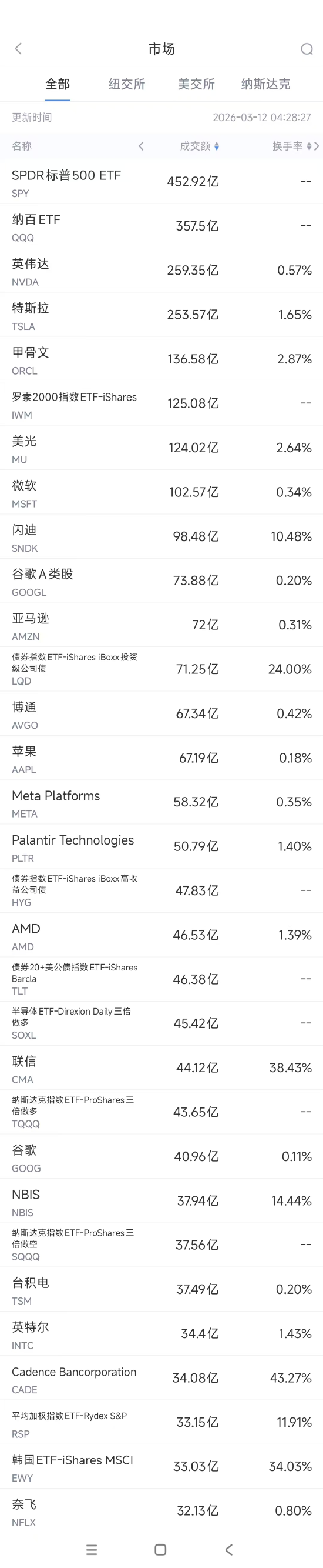
3月12日美股成交额前20:英伟达推出开源模型Nemotron 3 Super
Xin Lang Cai Jing· 2026-03-11 20:57
Group 1: Nvidia - Nvidia's stock rose by 0.66% with a trading volume of $25.935 billion, following the launch of the Nemotron 3 Super, an open-source model with 120 billion parameters [1][10] - The Nemotron 3 Super model is optimized for the Blackwell architecture, achieving throughput up to five times that of its predecessor and doubling accuracy [1][10] - The model aims to address high costs associated with "Long Thinking" and "Context Explosion," which have previously hindered the workflow speed of Autonomous Agents [1][10] - Currently, the model supports Google Cloud and Oracle, with upcoming support for Amazon AWS and Microsoft Azure [1][10] Group 2: Tesla - Tesla's stock increased by 2.15% with a trading volume of $25.357 billion, reporting a significant increase in electric vehicle sales in China [1][11] - In February, Tesla sold 58,600 Model 3 and Model Y vehicles produced at its Shanghai factory, marking a 91% year-over-year increase [2][11] - Despite the year-over-year growth, February sales decreased by 15.2% compared to January, influenced by seasonal factors and production disruptions during the Lunar New Year [2][11] Group 3: Oracle - Oracle's stock rose by 9.18% with a trading volume of $13.658 billion, exceeding analyst expectations with $17.2 billion in revenue for Q3 of fiscal year 2026, a 22% year-over-year increase [3][12] - The adjusted earnings per share for Oracle were reported at $1.79, surpassing the expected $1.23 [3][12] - Oracle's remaining performance obligations reached $553 billion, a 325% increase year-over-year, driven by growing demand for AI computing [3][12] Group 4: Micron Technology - Micron's stock increased by 3.86% with a trading volume of $12.402 billion, as Applied Materials announced a partnership to develop next-generation chips critical for AI and high-performance computing [4][13] - The partnership will focus on advancing DRAM, high-bandwidth memory, and NAND technologies, with an investment of $5 billion planned for semiconductor equipment research and development [4][13] Group 5: Nebius - Nebius's stock surged by 16.14% with a trading volume of $3.794 billion, following Nvidia's announcement of a $2 billion investment to develop AI data centers [5][14] - The partnership aims to deploy over 5 gigawatts of Nvidia systems by the end of 2030, sufficient to power approximately 3.8 million households [5][14] - The collaboration will enhance Nebius's existing infrastructure and support the adoption of the latest generation of chips [5][14] Group 6: SanDisk - SanDisk's stock rose by 5.90% with a trading volume of $9.848 billion, as the storage sector continues to thrive amid a "storage super-cycle" [4][13] - Recent supply chain research indicates minimal impact from geopolitical conflicts on the storage industry, with a bullish outlook from fund managers [4][13]


AI 财报大考来了:美光与甲骨文,谁能点燃科技股反弹?
美股研究社· 2026-03-10 10:42
Core Viewpoint - The article emphasizes that the current AI market's sustainability hinges on financial performance validation, moving beyond mere narratives to actual revenue generation [1][19]. Group 1: AI Market Dynamics - The AI market is at a critical juncture where investor focus has shifted from future potential to scrutinizing financial statements and return on investment [3][19]. - Nvidia is under scrutiny, but Micron and Oracle are viewed as key "stress test" companies due to their positions in the AI value chain [3][5]. Group 2: Micron's Role - Micron is positioned in the hardware layer of AI, where DRAM and NAND are essential for GPU servers, indicating the real demand for computing power [7][8]. - The storage chip sector is becoming increasingly undervalued, with predictions of significant price increases for DRAM (171% by 2026) and NAND (127% by 2026), suggesting a potential supercycle similar to the 1990s [11][12]. - If Micron's financial results are strong, it would indicate robust AI hardware demand; weak results could suggest a slowdown in AI hardware investment [12][20]. Group 3: Oracle's Challenges - Oracle faces the challenge of converting AI orders into cash flow amidst aggressive capital expenditure, which has led to negative free cash flow [14][15]. - The company has seen substantial revenue growth in its OCI cloud business, but the sustainability of this growth is contingent on the speed of revenue realization from AI orders [15][16]. - If Oracle can maintain high growth while improving order fulfillment speed, it may validate its heavy investments in AI infrastructure [16][20]. Group 4: Conclusion on Tech Stocks - The future of tech stocks is tied to the strength of AI demand and the ability to convert that demand into cash flow, with Micron and Oracle's financial results serving as critical indicators [19][20]. - A continued rise in storage prices coupled with accelerated AI cloud order fulfillment could lead to a rebound in tech stocks, while disappointing results may prompt a reevaluation of valuations in the AI sector [20][22].

存储超级周期还是最后狂欢?2 月天量数据背后的危险信号
美股研究社· 2026-03-09 11:12
Core Viewpoint - The storage chip industry is entering a "super cycle," with predictions of DRAM profit margins potentially exceeding 60% and NAND flash surpassing 30%, driven by AI and cloud computing demand [1][2][4] Group 1: Industry Demand and Performance - Current industry demand significantly exceeds production capacity, primarily driven by AI servers, cloud computing, and high-end smart devices [2] - South Korea's semiconductor exports surged by 161% year-on-year in February, marking one of the most extreme growth records in recent years, indicating strong industry health [3] - Taiwan's Nanya Technology reported a staggering 587% year-on-year sales increase in February, a rare occurrence in mature industry cycles [3] Group 2: Profitability and Market Dynamics - Historically, DRAM profit margins have fluctuated between 30% and 40%, but current expectations suggest margins could exceed 60%, indicating a peak in profitability [4][5] - The high profit margins are attributed to operational leverage, where increased production leads to minimal marginal costs, resulting in exponential profit growth [4] Group 3: Market Risks and Signals - The South Korean stock market has experienced significant volatility, triggering three circuit breakers in one week, reflecting investor concerns about the semiconductor sector's health [7][11] - Rising global energy costs, exacerbated by geopolitical tensions, pose a risk to the semiconductor industry's profitability, as energy costs constitute 10% to 15% of manufacturing expenses [9] - The potential for demand elasticity in storage products raises concerns; if prices rise too quickly, downstream manufacturers may delay purchases or reduce configurations, leading to inventory buildup [10][18] Group 4: Historical Context and Future Outlook - Historical patterns indicate that record sales and prices often occur at the peak of a cycle, suggesting that current market conditions may signal an impending downturn [12][20] - The semiconductor industry has previously experienced rapid price increases followed by sharp declines, as seen in 2018 and 2021, when demand quickly fell after initial surges [13][14] - The current market environment presents a "three-way game" with AI demand, sluggish consumer electronics recovery, and rising energy prices, potentially leading to a precarious situation for the industry [16][18] Group 5: Investment Considerations - Divergence in market sentiment regarding the storage industry indicates underlying risks; while some believe in a structural demand surge due to AI, others caution against extreme price and profit levels [19][21] - Investors should focus on inventory metrics, such as "inventory turnover days" and "channel inventory levels," as these indicators may reveal shifts in market dynamics before profit figures do [21]

佰维存储20260308
2026-03-09 05:18
Summary of Bawei Storage Conference Call Industry Overview - The storage industry is entering an AI-driven super cycle, with DRAM and NAND demand experiencing exponential growth due to multimodal large models and AI Agents, expected to continue until the end of 2026 [2][5] - Supply-demand imbalance is anticipated to persist, driven by rapid growth in enterprise-level storage needs due to AI [4][5] Company Performance and Financials - Bawei Storage's performance in Q4 2025 and the first two months of 2026 exceeded expectations, primarily due to the release of profits from low-cost inventory as storage prices increased [2][5] - The company has substantial low-cost inventory remaining, which is expected to further enhance profit margins as storage prices continue to rise [5] - Profit outlook for 2026 has been revised upwards to over 6 billion [2][9] Competitive Positioning - Bawei Storage holds a unique position in the supply chain for Meta AI glasses, maintaining a stable supply unless annual shipments exceed 50 million units [2][6] - The company has established a strong differentiation in the market through partnerships with major North American clients, which provide demand certainty [3][4] - Key competitive advantages include expertise in customized delivery, procurement channels, and integrated R&D and packaging capabilities [3][4] Market Dynamics - The storage module industry is experiencing structural changes, with Micron exiting the mobile NAND market and Samsung/Hynix reducing production, leading to tighter supply for embedded storage products [6] - The demand for embedded storage is expected to grow as Bawei captures market share due to its innovative solutions and integrated capabilities [6] Advanced Packaging and Testing - Bawei's advanced wafer-level packaging business is progressing well, with expected monthly capacity reaching 5,000 pieces by the end of 2026 and 10,000 pieces by the end of 2027 [7] - This segment is anticipated to provide a new source of revenue and help smooth out cyclical fluctuations in the core storage business [7] Supply Chain Management - The key to sustaining profit iteration for module manufacturers is securing stable wafer supply, especially during the AI-driven storage super cycle [8] - Bawei has established long-term supply agreements (LTA) with major wafer manufacturers to ensure a steady supply of critical components [8] Conclusion - Bawei Storage is well-positioned to capitalize on the ongoing super cycle in the storage industry, with strong financial performance, unique market positioning, and effective supply chain management strategies [2][5][8]

DRAM与NAND携手狂飙! 存储芯片成AI时代最硬通货 美光与闪迪迎接“AI超级红利”!
美股IPO· 2026-03-05 04:40
Core Viewpoint - The demand for AI data centers is driving a significant increase in DRAM and NAND storage prices, with major companies like Micron Technology (MU.US) and SanDisk (SNDK.US) becoming focal points for global investors as their stock prices surged nearly 6% in a single day [1][4]. Group 1: Price Predictions and Market Dynamics - BNP Paribas forecasts a 90% quarter-over-quarter increase in DRAM contract prices in Q1 2026, while NAND prices are expected to rise by 55% [3]. - TrendForce has revised its Q1 2026 DRAM contract price forecast from a 55%-60% increase to 90%-95%, and NAND prices are expected to increase by 55%-60% [3]. - The rapid price increases are attributed to a growing demand for enterprise SSDs from North American cloud computing companies, indicating a supply-demand imbalance in the storage chip market [3][4]. Group 2: Current Market Trends - February's spot prices showed a significant increase, with consumer-grade DDR4 spot prices rising 11% month-over-month to $21.93/GB, while contract prices increased by 7% to $12.17/GB, indicating an 80% premium for spot prices over contract prices [5]. - Samsung has reportedly raised DRAM prices by over 100% after negotiations with major clients, reflecting a tightening supply and increasing demand [5]. Group 3: Storage's Role in AI Infrastructure - Storage chips are positioned as critical components in the AI wave, benefiting from both training and inference expansions, and are essential for the performance of AI systems like Google’s TPU and NVIDIA’s GPU clusters [7][8]. - The storage market is experiencing a shift from annual to quarterly contracts, and even monthly adjustments, due to the severe supply-demand imbalance [6]. Group 4: Future Price Outlook - Citigroup analysts predict a dramatic increase in storage prices by 2026, with DRAM prices expected to rise by 88% and NAND prices by 74%, driven by the demand from AI applications [10][11]. - The average selling price (ASP) for server DRAM is projected to increase by 144% year-over-year, with specific products like the 64GB DDR5 RDIMM expected to reach $620 in Q1 2026 [11].