
Duquesne Family Office

Search documents
Billionaire Investor Stanley Druckenmiller Eliminated His Fund's Position in Meta Platforms and Piled into Another "Magnificent Seven" Stock That's Been Getting Crushed by the Broader Market
Yahoo Finance· 2026-02-24 16:39
There aren't many better investors, if any at all, than billionaire Stanley Druckenmiller. As a hedge fund manager, Druckenmiller averaged a 30% annual return for three decades and has supposedly never had a year in the red. Today, Druckenmiller manages much of his personal wealth through his family office, the Duquesne Family Office, which had close to $4.5 billion in assets at the end of 2025. During the fourth quarter of the year, Druckenmiller's fund eliminated its position in Meta Platforms (NASDAQ: ...


Global Market | Global cash is fuelling LatAm stock rally
The Economic Times· 2026-02-23 00:32
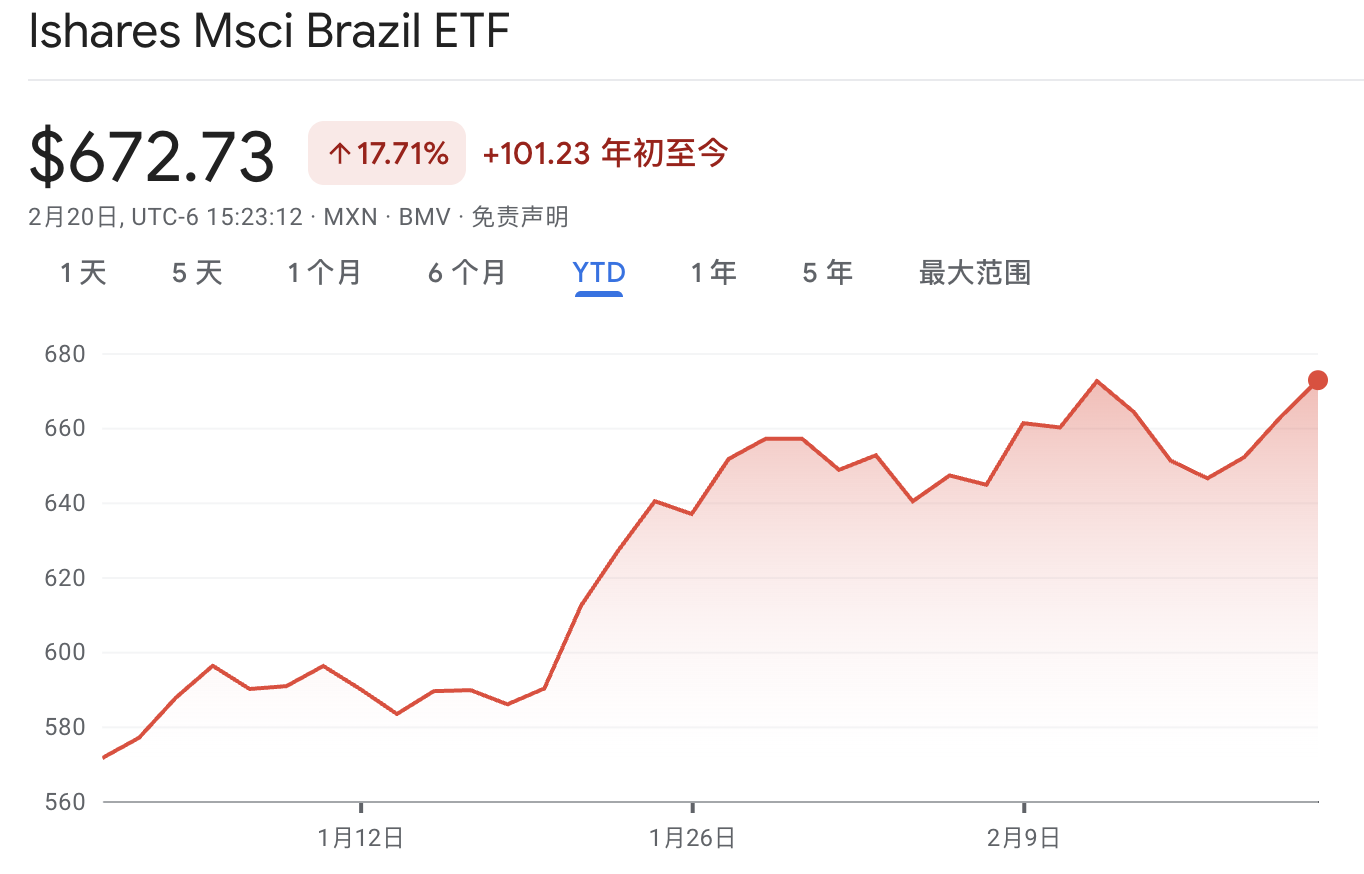
Market Overview - Latin American equity markets are experiencing significant inflows, marking the strongest start to the year since 1991, with the MSCI EM Latin America Index reaching an eleven-year high and increasing over 20% in 2026 [1][17] - Investors are recalibrating their focus on Latin America ahead of presidential elections in Brazil and Colombia, anticipating potential local policy shifts and lower interest rates [1][17] Investment Trends - The buying spree is evident in US-listed exchange-traded funds (ETFs), with BlackRock's iShares Latin America 40 ETF attracting over $1 billion in January, raising total assets to approximately $4.3 billion [6][17] - The iShares MSCI Brazil ETF (EWZ) saw its strongest monthly inflows in over a decade in January, becoming a preferred tool for exposure to Brazilian equities [7][17] Political Landscape - In Brazil, the potential for a political shift in the upcoming October election is influencing investment decisions, with some investors betting on the opposition's victory over President Luiz Inacio Lula da Silva [8][17] - In Colombia, political divisions among candidates are creating uncertainty ahead of the May presidential election, with the leading leftist contender raising concerns about asset price stability [12][17] Foreign vs. Local Investment - Foreign investors are increasingly purchasing directly in local markets, with January seeing the highest foreign buying in at least four years across Brazilian, Mexican, and Colombian markets [13][17] - Local investors remain cautious due to political uncertainties, contrasting with foreign investors who are more focused on potential returns [14][17] Central Bank Policies - Expectations are building for Brazil's central bank to lower the benchmark Selic rate from 15%, its highest in nearly two decades, starting in March [15][17] - In Mexico, the central bank maintained its benchmark interest rate at 7%, pausing an easing cycle that began nearly two years ago [15][17] Overall Sentiment - The overall sentiment towards Latin America remains positive, driven by potential rate cuts, favorable political changes, and commodity tailwinds [16][17]


巴西股市被热捧:1月大涨17%、外资流入超去年全年、投资大佬重仓
Hua Er Jie Jian Wen· 2026-02-22 08:26
Core Insights - Brazil's stock market has become a hotspot for global capital, driven by improving fundamentals and a shift in global asset allocation, with significant inflows from top hedge funds [1][4][7] - Billionaire investor Stanley Druckenmiller's Duquesne Family Office made a substantial investment in Brazil, buying approximately 3.5 million shares of the iShares MSCI Brazil ETF and bullish options, anticipating a market surge [1][5] - The iShares MSCI Brazil ETF saw a 17% increase in January, marking its best monthly performance since 2020, largely due to a weaker dollar and rising commodity prices [1][6] Investment Trends - Foreign investors have injected over 34 billion Brazilian Reais (BRL) into the Brazilian stock market this year, indicating a strong demand for Brazilian equities [4][7] - Global fund managers are shifting from an "underweight" position in Latin America to seeking diversification in emerging markets, particularly in Brazil [4][8] - Institutional optimism remains high, with about 64% of surveyed Latin American fund managers expecting the Ibovespa index to rise above 190,000 points by the end of 2026, suggesting further upside potential [8] Market Dynamics - The recent rally in the Brazilian stock market is led by large-cap stocks favored by foreign investors, supported by a favorable macroeconomic environment [6] - A weaker dollar has alleviated currency pressures on emerging markets, while strong commodity prices have boosted valuations of Brazil's core resource assets [6] - Expectations of an interest rate cut in Brazil are enhancing the attractiveness of equity assets, contributing to overall market valuation recovery [6][9]
Billionaire Stanley Druckenmiller Is Betting Big on These 2 Stocks
The Motley Fool· 2026-02-22 00:30
Group 1: Natera - Natera represents 13.2% of the Duquesne Family Office holdings, with a market cap of $28.8 billion, specializing in genetic testing for women's health, oncology, and organ health [4] - The company is currently loss-making but is projected to have revenue growth at a high-teens percentage rate over the next couple of years, with a gross profit margin increasing from 61.8% in Q3 2024 to 64.9% in Q3 2025 [4] - Natera's oncology tests grew by 54% in Q3, making up 24% of total tests, and the bullish case for the stock is supported by its Signatera personalized blood test for detecting molecular residual disease in cancer patients [5][6] Group 2: Taiwan Semiconductor Manufacturing - Taiwan Semiconductor Manufacturing represents 5.4% of the portfolio and has seen an 80% increase over the last year, driven by AI spending [8] - The company reported robust AI-related demand in 2025, while non-AI markets showed only a mild recovery, indicating a dependency on AI spending for future prospects [9] - Capital spending is projected to exceed $101 billion over the next three years due to rising costs and growth support needs, which may limit free cash flow margin expansion opportunities [10][12]



Famous Hedge Fund Duquesne Is Buying Up This 1 Big Bank Stock. Should You?
Yahoo Finance· 2026-02-19 15:14
Goldman Sachs (GS) stock has been in a steady uptrend with returns of 38% in the last 52 weeks. This rally has been supported by healthy quarterly results, with Goldman dominating the dealmaking market in 2025. As a matter of fact, the investment bank has advised on more than 50% of deals exceeding $10 billion in 2025. While merger and acquisition deals increased by 10% in 2025, they're likely to rise by another 3% in 2026. Further, with the likelihood of larger deals, the deal value is expected to surpa ...

为德雷肯米勒工作,沃什学到了什么?
Hua Er Jie Jian Wen· 2026-02-03 00:09
Core Viewpoint - Trump's nomination of Warsh as Federal Reserve Chair brings attention to billionaire investor Druckenmiller, who has significantly influenced Warsh's economic thinking through their long-term collaboration [1][2]. Group 1: Warsh's Background and Influence - Warsh worked with Druckenmiller for over a decade at Duquesne Family Office, where he learned to prioritize data-driven decision-making over reliance on Federal Reserve forecasts [1]. - Despite being viewed as an inflation "hawk," Warsh has recently adopted a more moderate stance, which is seen as a way to maintain the Federal Reserve's independence amid Trump's pressure for rate cuts [1][3]. - Druckenmiller supports Warsh's nomination, stating that labeling Warsh as always hawkish is inaccurate, as he has demonstrated flexibility in his positions [1]. Group 2: Druckenmiller's Investment Philosophy - Druckenmiller is known for one of the best investment records on Wall Street, with an average annual return of approximately 30% and no annual losses throughout his career [2]. - His notable achievements include a significant profit of over $1 billion from shorting the British pound in 1992 while working with Soros [2]. - Druckenmiller's investment strategy is enhanced by insights from influential corporate executives, as he regularly consults them on current business conditions [2]. Group 3: Expectations for Warsh's Leadership - Investors expect Warsh to rely on insights and intelligence gained from his experience with Druckenmiller, which is viewed as a valuable education [3]. - Druckenmiller has long criticized excessive government borrowing and has warned about the U.S. fiscal deficit, labeling it a "debt bomb" [3]. - There is uncertainty regarding the extent of Druckenmiller's influence on Warsh's policies if he becomes Federal Reserve Chair, as the Fed typically maintains a cautious approach to avoid conflicts of interest [5]. Group 4: Balancing Independence and Influence - Critics of Warsh argue that his cautious response during the 2008-09 financial crisis reflects a disconnect between his previous hawkish stance and his current views on deregulation and AI's potential to curb inflation [5]. - Despite concerns about the risks of direct connections between active investors and the Federal Reserve, there is optimism on Wall Street that Warsh can uphold the Fed's tradition of independence while embracing Druckenmiller's data-driven approach [5].
Billionaire Stanley Druckenmiller Sold Nvidia and Palantir and Piled Into One of Wall Street's Hottest Drug Stocks Ahead of 2026
The Motley Fool· 2025-12-24 08:51
Core Viewpoint - Stanley Druckenmiller, the billionaire head of Duquesne Family Office, has shifted his investment focus from AI stocks like Nvidia and Palantir to Teva Pharmaceutical Industries, which has seen a 191% increase in share price since the start of 2024 [1][18]. Group 1: Artificial Intelligence Stocks - Nvidia and Palantir have been significant holdings for many fund managers, with Nvidia reaching a market cap of $5 trillion and Palantir's shares increasing by over 2,900% [7][10]. - Despite their success, Druckenmiller sold his remaining shares in Nvidia (214,060 shares) during the September-ended quarter of 2024 and exited Palantir (769,965 shares) between July 1, 2024, and March 31, 2025 [10][11]. - Concerns exist regarding the sustainability of Nvidia and Palantir's valuations, with Palantir's price-to-sales (P/S) ratio at 127, which is considered unsustainable [16]. Group 2: Teva Pharmaceutical Industries - Teva's shares have surged by 191% since early 2024, and Druckenmiller has been accumulating shares consistently since the second half of 2024, making it the third-largest holding in his fund [18][19]. - The resolution of legal issues related to the opioid crisis has alleviated financial concerns for Teva, allowing a renewed focus on its innovative capabilities [19]. - Teva is shifting towards novel drug development, which is expected to improve pricing power and margins, with the tardive dyskinesia drug Austedo projected to generate over $2 billion in global sales in 2025 [20][21]. - Teva has significantly improved its balance sheet, reducing net debt from over $35 billion to $14.6 billion by the end of Q3 2025 [21][22].




X @Forbes
Forbes· 2025-09-26 20:34
Stanley Druckenmiller, Chairman and CEO of the Duquesne Family Office, spoke about the power of education at the 2025 #ForbesImpactSummit during a conversation with Forbes chairman and editor-in-chief Steve Forbes. https://t.co/qob47nvvGM (Photo: Jamel Toppin for Forbes) https://t.co/Qq3DoZq5Z7 ...
Billionaire Stanley Druckenmiller Jettisoned His Fund's Entire Stake in Palantir and Loaded Up on His Favorite Artificial Intelligence (AI) Stock for a 4th Straight Quarter
The Motley Fool· 2025-09-24 07:51
Core Insights - Stanley Druckenmiller, the billionaire head of Duquesne Family Office, has exited his position in Palantir Technologies while significantly increasing his stake in Taiwan Semiconductor Manufacturing Company (TSMC), indicating a strategic shift in investment focus towards companies critical to the AI revolution [1][5][14] Group 1: Palantir Technologies - Palantir's stock has surged over 2,400% since the beginning of 2023, making it one of the hottest AI stocks on Wall Street [6] - The company provides AI and machine learning solutions through its Gotham and Foundry platforms, which are used by governments and businesses for data analysis and operational efficiency [7][8] - Druckenmiller sold nearly 770,000 shares of Palantir by March 31, 2025, after holding them for a short period, reflecting a quick profit-taking strategy [8][9] - Palantir's price-to-sales (P/S) ratio is currently around 121, significantly higher than historical norms for megacap companies, raising concerns about its valuation sustainability [10][11] Group 2: Taiwan Semiconductor Manufacturing Company (TSMC) - TSMC has become Druckenmiller's top AI stock and fifth-largest holding, with a current stake of 765,085 shares, marking his largest investment in the company to date [14][19] - The company plays a crucial role in the production of AI-graphics processing units (GPUs), which are essential for AI applications in data centers [15] - TSMC is experiencing high demand for AI-GPUs, leading to a backlog of orders and a robust growth rate [16] - The company has a diversified business model, supplying chips to major clients like Apple, which helps mitigate risks associated with potential AI market fluctuations [17] - Druckenmiller's purchases of TSMC shares occurred at price points ranging from $140 to $210, with a forward price-to-earnings (P/E) ratio of 12 to 19, making it relatively inexpensive compared to Palantir [18]