Hexagon AB

Search documents
[Latest] Global Precision Forestry Market Size/Share Worth USD 12.66 Billion by 2034 at a 7.57% CAGR: Custom Market Insights (Analysis, Outlook, Leaders, Report, Trends, Forecast, Segmentation, Growth Rate, Value, SWOT Analysis)
Globenewswire· 2026-01-15 08:30
Core Insights - The global Precision Forestry Market is projected to grow from approximately USD 6.12 billion in 2024 to USD 12.66 billion by 2034, with a compound annual growth rate (CAGR) of about 7.57% from 2025 to 2034 [2][6]. Market Overview - The Precision Forestry Market is driven by the adoption of advanced technologies such as drones, GPS, and LiDAR, which enhance sustainability and efficiency in forest management [3][4]. - Key growth factors include increased mechanization, demand for sustainable forest products, and government support for conservation efforts [3][5]. Key Trends & Drivers - Technological advancements, including the integration of IoT sensors and GIS, are facilitating more accurate forest management and improving productivity [4]. - Government initiatives promoting sustainable land management and increased awareness among forest managers regarding data-driven practices are catalyzing market growth [5]. Market Segmentation - The market is segmented by technology (e.g., Remote Sensing, LiDAR, Drones), application (e.g., Forest Management, Timber Harvesting), and end-use (e.g., Government Agencies, Forestry Contractors) [20][29]. - Regional analysis indicates North America currently dominates the market, while the Asia Pacific is expected to witness the highest CAGR due to rising timber demand and government-backed afforestation programs [14][15]. Competitive Landscape - Major players in the Precision Forestry Market include John Deere, Trimble Inc., Hexagon AB, and others, focusing on technological innovations and strategic partnerships to enhance their market position [23][24].


Cadence's Free Cash Flow Continues to Power M&A, Buybacks
ZACKS· 2025-12-26 18:16
Core Insights - Cadence Design Systems Inc. (CDNS) is positioned to benefit from increasing demand for its AI-driven solutions amid strong design activity and customer spending on AI initiatives [1] Financial Performance - In Q3, CDNS reported revenues of $1.339 billion, reflecting a year-over-year increase of 10.2% [2][8] - The company generated operating cash flow of $311 million and free cash flow of $277 million [2] - As of September 30, 2025, CDNS had cash and cash equivalents of $2.753 billion and long-term debt of $2.479 billion [2] Growth Strategy - CDNS is pursuing a disciplined inorganic growth strategy, acquiring technologies that enhance organic growth [3] - Recent acquisitions include the Design & Engineering division of Hexagon AB, Artisan foundation IP from Arm Holdings, and Secure-IC [3] Shareholder Returns - CDNS repurchased shares worth $200 million in Q3 and plans to repurchase another $200 million in Q4 [4] - The company intends to use at least 50% of its free cash flow for share buybacks in 2025 [6][8] Future Outlook - The company expects revenues for 2025 to be between $5.262 billion and $5.292 billion, with operating cash flow projected between $1.65 billion and $1.75 billion [6][8] - Trends such as 5G, hyperscale computing, and autonomous driving are anticipated to drive design activity and sustain top-line growth [5]


Cadence Q3 Earnings & Revenues Surpass Estimates, Both Rise Y/Y
ZACKS· 2025-10-28 15:02
Core Insights - Cadence Design Systems (CDNS) reported Q3 2025 non-GAAP EPS of $1.93, exceeding estimates by 7.8% and up 17.7% year over year, surpassing management's guidance of $1.75-$1.81 [1][8] - Revenues reached $1.339 billion, beating estimates by 0.9% and increasing 10.2% year over year, driven by strong demand for AI-driven solutions [2][8] - Management raised the 2025 revenue outlook to $5.262-$5.292 billion, up from $5.21-$5.27 billion, indicating a growth of 13.1% from the previous year [3][8] Financial Performance - Non-GAAP EPS for 2025 is now expected to be between $7.02 and $7.08, an increase from the previous guidance of $6.85-$6.95, reflecting a 15.8% rise from last year [4] - Total revenues for Q3 included $1.208 billion from Product & Maintenance (90.2% of total revenues), up 9.8% year over year, and $131 million from Services (9.8%), which increased 13.9% year over year [6][8] - Non-GAAP gross margin contracted by 60 basis points to 88%, while non-GAAP operating margin expanded by 280 basis points to 47.6% year over year [14] Strategic Developments - CDNS ended the quarter with a backlog of $7 billion and current remaining performance obligations of $3.5 billion, indicating strong future revenue potential [3] - The company announced the acquisition of the Design & Engineering division of Hexagon AB, which includes MSC Software, to enhance its capabilities in automotive, aerospace, and AI sectors [11] - CDNS completed the acquisition of Arm's Artisan foundation IP business, strengthening its design IP portfolio and leadership in advanced process nodes [13] Market Position - CDNS stock is down 2.2% in pre-market trading but has gained 23.5% over the past year, outperforming the Computer Software industry's growth of 20.4% [5] - The company is expected to utilize at least 50% of its free cash flow for share repurchases in 2025, indicating a commitment to returning value to shareholders [16] Outlook - For Q4 2025, revenues are estimated to be between $1.405 billion and $1.435 billion, with non-GAAP EPS anticipated to be between $1.88 and $1.94 [17][18] - Non-GAAP operating margin for 2025 is forecasted to be in the range of 43.9% to 44.9%, compared to 42.5% reported in 2024 [16]

Will Cadence's M&A Strategy Reinforce Its Position in the EDA Space?
ZACKS· 2025-10-20 14:31
Core Insights - Cadence Design Systems, Inc. (CDNS) is enhancing its business through strategic acquisitions in the electronic design automation (EDA) space [1] Inorganic Growth Strategy - Inorganic expansion provides valuable tools, technologies, and market access that accelerate organic growth, allowing companies to increase product offerings without starting from scratch [2] - Acquiring firms with strong R&D capabilities speeds up innovation processes and helps achieve synergies, leading to cost reductions and improved operational efficiency [2] Market Demand and Strategic Response - CDNS's M&A strategy is a response to the growing demand for AI-driven custom chips and the convergence of electronic, mechanical, and physical domains in next-generation designs [3] - The transformation in semiconductor and system design driven by AI is integral to CDNS's strategy, supported by secular growth drivers such as 5G, hyperscale computing, and autonomous vehicles [4] Recent Acquisitions - In September 2025, CDNS agreed to acquire the Design & Engineering division of Hexagon AB for €2.7 billion, which includes the MSC Software business [5] - The Hexagon acquisition will enhance Cadence's System Design & Analysis portfolio and expand its presence in the structural analysis market, building on the earlier acquisition of Beta CAE in 2024 [6] - Hexagon's D&E division generated approximately $280 million in 2024 revenues and employs over 1,100 experts in R&D, sales, and support [6] - The acquisition will allow Cadence to reach top-tier aerospace and automotive clients, including Boeing, Lockheed Martin, and Toyota, as industries shift towards electric vehicles and advanced materials [7] Additional Strategic Acquisitions - In April 2025, Cadence signed an agreement to acquire Arm Holdings' Artisan foundation IP business, and in January 2025, it agreed to acquire Secure-IC, enhancing its security solutions capabilities [8] - The acquisition of BETA CAE has broadened Cadence's multiphysics system analysis offerings, while the purchase of OpenEye Scientific Software opened a new vertical in drug discovery [9][10] - Other significant acquisitions include Future Facilities, Pointwise, and NUMECA, which have increased the system analysis portfolio with more CFD solutions [12] Competitive Landscape - Cadence's acquisition strategy is aimed at solidifying its position in the EDA space amid increasing competition from Siemens EDA, Synopsys, Keysight Technologies, and CEVA Inc [14] - The acquisition of ANSYS by Synopsys is expected to intensify competition in the EDA space [15]
Cadence (CDNS) Stock Jumps 4.8%: Will It Continue to Soar?
ZACKS· 2025-09-12 08:36
Core Viewpoint - Cadence Design Systems (CDNS) is experiencing a positive stock performance driven by its growing influence in the EDA space amid the AI boom and strategic collaborations with major tech companies [2][3]. Group 1: Stock Performance - CDNS shares increased by 4.8% to close at $354.7, following a notable trading volume compared to typical sessions, despite a 3% loss over the past four weeks [1]. - The consensus EPS estimate for the upcoming quarter is $1.79, reflecting a year-over-year increase of 9.2%, with expected revenues of $1.32 billion, up 9% from the previous year [6]. Group 2: Market Trends and Opportunities - The company's product portfolio is gaining traction due to trends such as 5G, hyperscale computing, and autonomous driving, which are driving demand for semiconductor innovation [2]. - The focus on Generative AI, Agentic AI, and Physical AI is leading to an exponential rise in computing demand, positively impacting Cadence's growth prospects [2]. Group 3: Strategic Collaborations and Acquisitions - CDNS is collaborating with tech giants like Qualcomm and NVIDIA, recently expanding its Cadence Reality Digital Twin Platform to include a digital twin of NVIDIA's DGX SuperPOD [3]. - In September 2025, CDNS signed an agreement to acquire Hexagon AB's Design & Engineering division for €2.7 billion, which will enhance its System Design & Analysis portfolio and expand its presence in the structural analysis market [4][5]. Group 4: Financial Outlook - Management has upgraded its revenue outlook for 2025 to a range of $5.21-$5.27 billion, compared to the previous guidance of $5.15-$5.23 billion, driven by strong results and a healthy pipeline [5]. - A positive trend in earnings estimate revisions for CDNS suggests potential price appreciation, indicating a favorable outlook for the stock [8].
Cadence Strengthens Analysis Portfolio With Hexagon D&E Unit Buyout
ZACKS· 2025-09-05 14:10
Core Insights - Cadence Design Systems, Inc. has signed a definitive agreement to acquire Hexagon AB's Design & Engineering division, including MSC Software, for €2.7 billion, structured as 70% cash and 30% common stock, expected to close in Q1 2026 [1][9] Group 1: Acquisition Details - The acquisition will enhance Cadence's System Design & Analysis portfolio and expand its presence in the structural analysis market, building on the previous acquisition of Beta CAE in 2024 [2][3] - Hexagon's D&E division generated approximately $280 million in revenue in 2024 and employs over 1,100 experts globally [2][3] Group 2: Strategic Importance - This deal positions Cadence to offer a comprehensive platform for multiphysics simulations, which are increasingly critical in industries such as aerospace and automotive [3][4] - The acquisition will allow Cadence to serve top-tier clients like Boeing, Lockheed Martin, and Volkswagen, who depend on Hexagon's solutions for mission-critical workflows [4][5] Group 3: Broader Acquisition Strategy - Cadence's acquisition strategy has been pivotal in its growth, with previous acquisitions including Arm Holdings' Artisan foundation IP business and Secure-IC, aimed at strengthening its IP portfolio [6][7] - The acquisition of BETA CAE Systems in June 2024 is expected to further enhance Cadence's capabilities in multiphysics system analysis [7]
刚刚,Cadence又宣布一桩收购
半导体行业观察· 2025-09-05 01:07
Core Viewpoint - Cadence has announced the acquisition of Hexagon AB's Design & Engineering (D&E) business, including its MSC software, to enhance its "Intelligent System Design™" strategy and expand its system design and analysis product portfolio [2][4]. Group 1: Acquisition Details - The acquisition involves a payment of approximately €2.7 billion, with 70% in cash and 30% in Cadence common stock [2]. - The deal is expected to close in the first quarter of 2026, pending regulatory approvals and customary closing conditions [5]. Group 2: Strategic Implications - The integration of Hexagon's D&E technology will strengthen Cadence's position in the multi-billion dollar structural analysis market, following its 2024 acquisition of Beta CAE [2][5]. - The acquisition will enable Cadence to provide a comprehensive, unified, end-to-end multiphysics platform, addressing the growing demand for early-stage multiphysics simulations in design cycles [3][4]. Group 3: Market Impact - The combined business is projected to generate approximately $280 million in revenue in 2024 and will employ over 1,100 staff globally [5]. - The acquisition will broaden Cadence's customer base, including major aerospace and automotive OEMs such as Volkswagen, BMW, Toyota, Lockheed Martin, BAE, and Boeing, who rely on Hexagon's D&E solutions for critical simulation workflows [4][5].

Cadence收购Hexagon业务,作价31.6亿美元
美股IPO· 2025-09-04 23:25
Core Viewpoint - Cadence has announced the acquisition of Hexagon's Design and Engineering (D&E) business, which will enhance its capabilities in simulation and analysis solutions, particularly in the aerospace and automotive sectors [3][4]. Group 1: Acquisition Details - The acquisition involves a payment of approximately €2.7 billion, with 70% in cash and 30% through the issuance of Cadence common stock [3]. - The deal is expected to be completed in the first quarter of 2026, pending regulatory approvals and customary closing conditions [4]. - If the transaction does not close, Cadence may incur a reverse termination fee of up to €175 million [3]. Group 2: Strategic Implications - This acquisition is part of Cadence's strategy to expand its "Intelligent System Design™" and significantly enhance its system design and analysis product portfolio [3]. - The integration of Hexagon's D&E technology is anticipated to strengthen Cadence's position in the multi-billion euro structural analysis market [3]. - The combined business is projected to generate approximately $280 million in revenue in 2024, leveraging a workforce of over 1,100 employees globally [3]. Group 3: Market Position and Client Base - Cadence's client base will broaden to include major aerospace and automotive OEMs such as Volkswagen, BMW, and Lockheed Martin, who utilize Hexagon's D&E solutions for critical simulation workflows [3]. - Hexagon's D&E business is recognized for its flagship products MSC Nastran and Adams, which are industry standards in structural and multibody dynamics simulation [3]. - The acquisition is expected to address the increasing demand for multi-physics simulation in early design cycles, particularly in the context of electric vehicles and autonomous systems [3].

全球与中国消防指挥调度系统市场现状及未来发展趋势
QYResearch· 2025-08-20 09:16
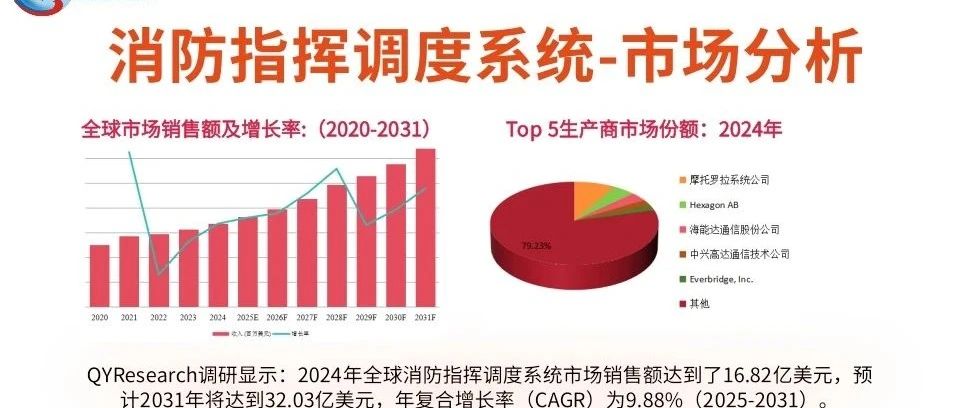
Core Viewpoint - The article emphasizes the importance of fire command and dispatch systems as integrated emergency management platforms that enhance response efficiency and resource coordination during fire incidents and other emergencies [2]. Global Market Size and Trends - The global fire command and dispatch system market is projected to reach $1.682 billion in sales by 2024 and $3.203 billion by 2031, with a compound annual growth rate (CAGR) of 9.88% from 2025 to 2031 [5]. - The Chinese market is expected to grow from $311 million in 2024, accounting for 18.51% of the global market, to $646 million by 2031, increasing its share to 20.16% [5]. - The Asia-Pacific region is the largest market, holding 43.58% of the market share in 2024, followed by North America and Europe with 25.39% and 22.88%, respectively [5]. Product Types and Applications - The market includes terminal devices, communication network equipment, and command dispatch software, with terminal devices representing 48.62% of the global market share in 2024 [5]. - Fire command and dispatch systems are typically deployed in emergency command centers, fire stations, industrial parks, commercial centers, and other scenarios, with fire station deployments accounting for 47.25% of the global market share in 2024 [6]. Major Players and Market Concentration - Key global manufacturers include Motorola Solutions, Hexagon AB, Hytera Communications, ZTE Corporation, and Everbridge, Inc., with the top five companies holding a combined market share of 20.77%, indicating a low market concentration [8]. Industry Drivers - The increasing frequency of extreme disasters, such as wildfires and floods, necessitates the upgrade of emergency response systems to improve efficiency and resource allocation [10]. - National policies are promoting the rapid deployment of fire dispatch systems, with initiatives like the EU's "NG112" action plan and the U.S. FEMA's funding programs supporting local fire agencies [10]. Technological Integration - AI and big data technologies are becoming central to dispatch decision-making, enabling automatic identification of alarm intents and real-time tracking of incidents [11]. - Upgrades in communication architecture and the introduction of edge computing enhance system resilience and flexibility, allowing for better performance in emergency scenarios [11]. Interdepartmental Collaboration - Fire dispatch systems are evolving towards interdepartmental connectivity, integrating police, medical, and municipal services into unified platforms [12]. Domestic and International Market Dynamics - The push for domestic alternatives to imported systems is accelerating, driven by data security concerns, while Chinese companies are expanding into emerging markets through comprehensive fire safety solutions [12].
Natural Disaster Management Company Benchmark Report 2024-2025 | NEC, Hexagon, and Nokia Pioneering Disaster Management Solutions
GlobeNewswire News Room· 2025-07-18 14:22
Core Insights - The report titled "Natural Disaster Management - Company Evaluation Report, 2024" provides a comprehensive analysis of the global market for natural disaster management, evaluating over 100 companies and identifying the top 14 as quadrant leaders [1][2]. Industry Overview - Natural disaster management has shifted from reactive to proactive, technology-driven strategies due to increasing climate-related events and urbanization, integrating technologies such as IoT, AI, GIS, and remote sensing [3][4]. - The approach to disaster management encompasses four phases: preparedness, response, recovery, and mitigation, focusing on planning, immediate actions, restoration, and long-term risk reduction [3][4]. Technological Advancements - Data-driven technologies are crucial for enhancing preparedness and response, with real-time monitoring improving situational awareness and AI supporting predictive analytics [4]. - Key trends include integrated multi-hazard early warning systems, personalized risk assessments, and resilient infrastructure development [4]. Competitive Landscape - The 360 Quadrant evaluates companies based on revenue, geographic presence, growth strategies, and sales strategies, with criteria including product footprint by component, application, end user, and communication system [5]. - Key players in the market include NEC, Hexagon, Nokia, Xylem, Esri, and others, each contributing unique technologies and solutions to disaster management [6][7][8][10]. Market Dynamics - The market is driven by the escalating frequency of climate-related disasters, technological advancements in IoT and AI, and increased government initiatives [12]. - Opportunities exist in the expansion of remote sensing technologies and the development of AI-powered predictive analytics [12]. Company Profiles - NEC Corporation is recognized for integrating AI and IoT in disaster management solutions, enhancing collaboration between governments and enterprises [7]. - Hexagon AB excels in geospatial solutions, supporting effective risk assessment and resource allocation [8][9]. - Nokia provides critical communication infrastructure and drone-based solutions for damage assessment, reinforcing its role in advanced disaster management systems [10].