Realtek

Search documents
Xiaomi MiMo 大模型落地应用,小米“人车家全生态”合作伙伴大会介绍IoT平台生态新进展
Sou Hu Wang· 2025-12-18 10:06
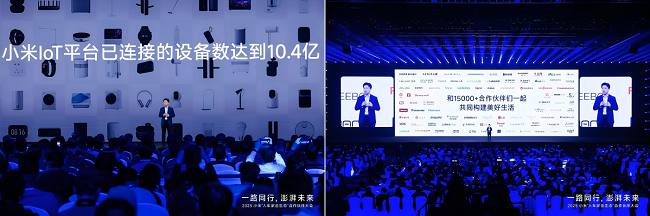
Core Insights - Xiaomi successfully held the "Human-Vehicle-Home Ecosystem" Partner Conference in Beijing, showcasing its latest IoT platform capabilities and user experience innovations [1][3] Group 1: IoT Platform Progress - As of Q3, Xiaomi's IoT platform has surpassed 1 billion connected devices, reaching 1.04 billion units, with the Mi Home app achieving over 110 million monthly active users [3] - The annual shipment of Xiaomi IoT modules has exceeded 10 million units for the first time, solidifying its position as a leading global smart ecosystem platform [3] - Xiaomi has partnered with over 15,000 companies globally, including renowned brands like Miele, Bosch, Siemens, and LG, while also focusing on social responsibility initiatives [3] Group 2: Future Innovations - Xiaomi introduced the Xiaomi Miloco smart home exploration plan, which integrates visual perception into smart home systems, allowing users to create smart rules through natural language [3] - The company is collaborating with leading brain-computer interface firms to enhance interaction possibilities for individuals with mobility impairments [4] Group 3: AI and Ecosystem Integration - The IoT Future Summit 2026 highlighted the role of AI in driving innovation across the entire ecosystem, moving beyond isolated breakthroughs to a comprehensive approach [6] - Various partners presented advancements in smart solutions, emphasizing user experience improvements and seamless integration of devices [6][7] - Xiaomi's IoT platform is transitioning towards "spatial intelligence," focusing on proactive decision-making through multi-modal perception and distributed computing technologies [7][11] Group 4: User Experience Enhancements - The IoT Ecosystem Access and Experience Innovation Forum focused on the new capabilities of the Mi Home 11.0 experience, addressing user demands for comfort, safety, and energy efficiency [9] - Xiaomi upgraded its scene capabilities and 3D central control interactions, enhancing user experience for over 110 million monthly active users [9] Group 5: Technical Developments - The IoT Platform Technology Forum showcased a full-stack upgrade of Xiaomi's IoT capabilities, including the launch of the IoT-BLE 2.0 module matrix and advancements in AI-driven device interactions [11] - The forum discussed strategies for AIoT developers in the context of global trends in security and privacy compliance [11] Group 6: Exhibition Highlights - The conference featured an IoT exhibition area displaying various smart home solutions, IoT connection technologies, and the overall capabilities of Xiaomi's IoT platform [13]


GC Tech_iPhone 17、Watch Ultra 3、AirPods Pro 3 全新发布;卫星功能;延伸至供应链和股票思路-_ iPhone 17, Watch Ultra 3, AirPods Pro 3 newly launched; Satellite functions; read across to supply chain and stock ideas
2025-09-10 14:38
Summary of Key Points from the Conference Call Industry and Company Overview - The report focuses on the technology sector, specifically highlighting Apple's newly launched products including the iPhone 17 series, Apple Watch Ultra 3, and AirPods Pro 3 [1][2][3]. Core Insights and Arguments iPhone 17 Specifications - The iPhone 17 series features significant upgrades: - Rear cameras upgraded from 12MP to 48MP Fusion cameras for Pro/Pro Max models [2] - Front cameras upgraded from 12MP to 18MP with enhanced software [2] - Thickness of the Air model is reduced to 5.6mm [2] - Display refresh rate increased to 120Hz from 60Hz [2] - Starting prices: iPhone 17 at US$799, iPhone 17 Pro at US$1,099 (10% increase), and iPhone 17 Pro Max at US$1,199 [2]. Apple Watch Ultra 3 Specifications - Key upgrades include: - Adoption of satellite network for emergency calls [3] - Display area increased to 1,245 sqmm with a resolution of 422x514 pixels [3] - Battery life extended to 42 hours [3] - Starting price remains at US$799 [3]. AirPods Pro 3 Specifications - New features include: - Active noise cancellation and heart rate monitoring [8] - Live translation capabilities [8]. Supply Chain and Stock Recommendations - Positive outlook on companies benefiting from Apple's supply chain: - **Buy Recommendations**: Largan, AAC, FII, Hon Hai, BYDE, TSMC, ASE, Realtek, EMC, NYPCB, Delta [1]. - **Neutral Recommendations**: Sunny Optical, JCET, BOE, Quanta, ASMPT, Vanguard, Novatek, Unimicron, Kinsus [1]. Additional Important Information - The report includes a detailed analysis of revenue exposure for various companies in the Greater China tech supply chain related to Apple products, indicating significant dependencies on Apple for revenue generation [9]. - The report emphasizes the potential for increased shipment volumes due to the new product features, which may drive replacement demand [1]. This summary encapsulates the critical aspects of the conference call, focusing on product specifications, market implications, and investment recommendations within the technology sector related to Apple.




戴伟立的芯片版图
半导体行业观察· 2025-07-06 02:49
Core Insights - Weili Dai, co-founder of Marvell Technology Group, has played a significant role in the semiconductor industry, transitioning from entrepreneur to a key investor in Silicon Valley [1][3] - Marvell, founded in 1995, grew from a startup with $1 million in initial funding to a semiconductor giant with a market value exceeding $20 billion at its peak [7][12] - After leaving Marvell, Dai focused on supporting the next generation of tech innovators through investments and mentorship, establishing FLC Technology Group and DreamBig Semiconductor [14][15] Group 1: Marvell's Growth and Challenges - Marvell started as a fabless semiconductor company, focusing on storage device controllers and network communication chips, achieving over $100 million in revenue by 1999 [8] - The company expanded into various markets, including Ethernet and Wi-Fi, and acquired Intel's XScale mobile processor business for $600 million in 2006 [9][11] - Governance issues arose, leading to SEC investigations and the eventual departure of Dai and her husband from executive roles in 2016 [12][13] Group 2: Investment Ventures - After Marvell, Dai co-founded FLC Technology Group in 2017, aiming to support tech entrepreneurs with a focus on AI, semiconductors, and advanced packaging [14] - In 2019, she launched DreamBig Semiconductor, which focuses on next-generation chiplet technology and has raised over $93 million in funding [15][18] - DreamBig's MARS platform addresses challenges in AI server and accelerator hardware development, emphasizing modular and efficient solutions [17][19] Group 3: Diverse Investment Portfolio - Dai's investment strategy includes a range of companies across the semiconductor and AI sectors, such as Nuvia, which was acquired by Qualcomm for $1.4 billion [24] - Other notable investments include Nubis, Next Input, and Aviva Links, showcasing her focus on innovative technologies in various applications [25][28] - The investment philosophy emphasizes technology-driven companies, ecosystem thinking, and foresight in market trends [33] Group 4: Ongoing Influence and Legacy - Dai's journey from Marvell to becoming a prominent investor reflects her deep understanding of the semiconductor industry and its evolving landscape [34] - She continues to be active in emerging fields like AI, quantum computing, and biotechnology, indicating her commitment to driving technological progress [34]

进入人工智能交易下半场,上行空间仍在
2025-06-30 01:02
Summary of Key Points from the Conference Call Industry Overview - **Industry**: Asian Technology Sector - **Current Trends**: Asian Tech stocks have rebounded significantly from the tariff-related sell-off in April, primarily driven by the AI sector [3][5] Core Insights and Arguments - **Earnings Revisions**: Overall Asian Tech earnings have seen an 18% upward revision year-to-date, mainly led by large-cap AI-related technology companies [3][5] - **Future Projections**: Continued upward revisions in tech earnings are expected through 2025, supported by the resolution of AI supply chain issues and well-flagged foreign exchange (FX) challenges [3][5] - **Market Growth**: Despite macroeconomic concerns, Asian Tech stocks are projected to increase by another 15-20% by the end of the year [3][5] - **AI Sector Leadership**: The AI complex is anticipated to lead the upcycle, with growth in datacenter capital expenditures (capex) expected in 2025 and increased confidence in growth for 2026 [3][5] - **Non-AI Sector Caution**: Selectivity is advised in the non-AI space due to a deceleration in year-over-year growth in most consumer tech segments in the second half of 2025, as the effects of China consumption subsidies and tariff pull-in fade [3][5] - **Emerging Themes**: Towards the end of 2025, new themes such as the Foldable iPhone product cycle and smart glasses may gain market support within the non-AI sector [3][5] Positive Catalysts for Asian Tech Stocks 1. Reinforcement of 2026 datacenter AI capex growth [3][5] 2. Potential US approval for China-specific NVIDIA AI GPU models [3][5] 3. Better-than-seasonal non-AI demand in the second half of 2025, as expectations have been reset to sub-seasonal levels [3][5] Stock Recommendations - **Preferred Stocks**: TSMC, SK Hynix, Advantest, and Delta among large-cap tech [3][5] - **Cautious Outlook**: More guarded on SEC, Xiaomi, and Mediatek in the near term, but maintain an overweight (OW) position on SEC due to improving progress in High Bandwidth Memory (HBM) [3][5] - **Top Picks**: Quanta is highlighted as a top pick among NVIDIA-related server Original Design Manufacturers (ODMs) [3][5] - **Smaller Cap Recommendations**: Asmedia, ASPEED, Chroma, AMEC, and ACMR are recommended, while SMIC, VIS, UMC, GUC, Realtek, Parade, GlobalWafers, USI, Transsion, and Nikon are advised to be avoided [3][5] Additional Important Insights - **Market Sentiment**: The overall sentiment remains positive for the AI sector, with expectations of revenue momentum picking up in the second half of 2025 [3][5]
摩根士丹利:Investor Presentation-中国人工智能与存储市场展望
摩根· 2025-06-11 02:16
Investment Rating - Industry view is cautious [1] Core Insights - The report highlights a cautious outlook for the semiconductor industry, particularly in the context of AI and memory sectors, with a focus on potential recovery in the second half of 2025 impacted by tariff costs [7] - Long-term demand drivers include the reacceleration of AI semiconductor demand due to generative AI, which is expected to proliferate across various verticals outside the semiconductor industry [7] - The report indicates that the global semiconductor revenue peaked in the third quarter of 2024, with a forecasted decline in semiconductor exports from Korea since February 2025 [12][19] Summary by Sections Semiconductor Market Dynamics - The cyclical downturn is characterized by a shift from euphoria to pessimism, as indicated by the SOX Index performance [8] - Historical data shows that declines in semiconductor inventory days have historically signaled positive stock price appreciation [41] - The report notes that the domestic GPU supply chain may face dilution due to shipments of NVIDIA B30, impacting inferencing AI demand [7] Memory and Logic Cycles - Memory stock prices are seen as leading indicators for logic semiconductors, with the report suggesting that memory share price peaks lead logic semis [42][43] - The report forecasts a significant increase in HBM (High Bandwidth Memory) market size, projecting it to reach US$64 billion by 2027, with a CAGR of 107% from 2023 to 2027 [67] AI and Technology Trends - The report emphasizes the shift in value from hardware to application in the AI investment stack, indicating a growing focus on software and application development [73] - It is projected that local GPU revenue in China could grow to RMB 287 billion by 2027, driven by advancements in local manufacturing capabilities [90]
花旗:台湾电子与半导体_ 台湾科技行业月度追踪 - 4 月销售基本符合预期,人工智能供应链持续表现强劲
花旗· 2025-05-14 03:09
Investment Rating - The report maintains a positive outlook on the Taiwan Electronics and Semiconductors sector, particularly favoring TSMC as the most preferred stock in the semiconductor space [1][2]. Core Insights - April sales in the technology sector were robust, with TSMC reporting NT$349.6 billion in revenue, reflecting a 48% year-over-year increase and a 22% month-over-month increase [2][10]. - The semiconductor supply chain is expected to face challenges in the second half of 2025 due to early order pull-ins and tariff uncertainties, although supply constraints are easing [1][2]. - Companies like Gold Circuit and Quanta are highlighted for their strong sales momentum and improving product mix and margins, particularly in the AI ASIC and server supply chain segments [1][3]. Summary by Sections Semiconductor - TSMC's April revenue was significantly above expectations, driven by solid AI demand and a healthy order flow, with a year-over-year growth of 48% [2][10]. - UMC and other fabless companies are also showing steady recovery, with April revenues tracking positively [2]. Server and ODMs - Server sales in April increased by 167% year-over-year, with companies like Wiwynn and Accton outperforming expectations due to strong ASIC server demand [3][14]. - ODMs reported a 1% month-over-month increase and a 33% year-over-year increase in sales, indicating a positive trend in the server supply chain [3]. Component and PCB - Largan is noted for its 28% year-over-year growth, attributed to market share gains and resilient ASP trends [5]. - Gold Circuit is expected to benefit from rising AI ASIC demand, while Unimicron is projected to capture a significant market share in AI GPU applications [6][10]. Overall Market Trends - The overall revenue trend for the Taiwan technology supply chain shows a 24% year-over-year increase, with significant contributions from the semiconductor and server sectors [14]. - The report anticipates a decline in sales for May due to NTD appreciation, but the long-term outlook remains positive as demand for AI-related products continues to grow [2][3].
TrendForce:英伟达已成IC设计霸主
半导体芯闻· 2025-03-17 10:42
Core Insights - The article highlights the significant growth in the semiconductor industry driven by the AI boom, with the top ten IC design companies projected to generate a combined revenue of approximately $249.8 billion in 2024, marking a 49% year-over-year increase [1][5]. Group 1: Market Overview - The AI trend is leading to a monopolistic situation in the semiconductor IC industry, as high-end chips require substantial capital and advanced technology, creating high entry barriers for new players [2]. - NVIDIA is expected to dominate the market with a projected revenue of $124.4 billion in 2024, reflecting a staggering 125% growth, capturing 50% of the top ten companies' revenue [5]. Group 2: Key Players and Performance - Broadcom is anticipated to achieve a semiconductor revenue of $30.6 billion in 2024, an 8% increase, with over 30% of its semiconductor solutions coming from AI chips [2]. - AMD's revenue is projected to reach $25.8 billion in 2024, a 14% increase, driven by significant growth in its server CPU business, which is expected to grow by 94% [3]. - Qualcomm's revenue is expected to be $34.9 billion in 2024, a 13% increase, as it focuses on AI PC and edge computing devices [3]. - MediaTek is projected to generate $16.5 billion in revenue in 2024, a 19% increase, with expectations of a 65% penetration rate in the 5G smartphone market by 2025 [3]. Group 3: Rankings and Revenue Changes - Realtek is expected to achieve a revenue of approximately $3.5 billion in 2024, a 16% increase, with growth driven by PC and automotive-related shipments [4]. - Will Semiconductor's revenue is projected to reach $3.0 billion in 2024, a 21% increase, benefiting from the rising demand for high-end CIS in Android smartphones and electric vehicle applications [4]. - MPS is anticipated to generate $2.2 billion in revenue in 2024, a 21% increase, due to its PMIC products entering the AI server supply chain [4].