Star Bulk Carriers

Search documents
Danaos(DAC) - 2025 Q3 - Earnings Call Transcript
2025-11-18 15:02
Financial Data and Key Metrics Changes - The company reported adjusted EPS for Q3 2025 of $6.75 per share, compared to $6.5 per share in Q3 2024, indicating a slight increase in profitability [9] - Adjusted net income decreased by $2.7 million to $124.1 million in Q3 2025 from $126.8 million in Q3 2024, primarily due to increased operating costs and lower dividend income [10] - Adjusted EBITDA increased by 1.5% to $181.6 million in Q3 2025 from $178.9 million in Q3 2024 [13] Business Line Data and Key Metrics Changes - Vessel operating expenses increased by $2.4 million to $52.3 million in Q3 2025, attributed to a higher average number of vessels in the fleet [11] - Daily operating costs slightly increased to $6,927 per vessel per day in Q3 2025 from $6,860 in Q3 2024 [11] - The container segment experienced a $4.3 million decrease in revenues due to lower contracted charter rates [10] Market Data and Key Metrics Changes - The charter market remains robust with an all-time low idle fleet, and demand for mid-size and larger vessels continues unabated [4][5] - The company has secured new charters for vessels extending as far out as early 2028, indicating strong future demand [5] Company Strategy and Development Direction - The company is selectively extending its new building program at below-market prices and has secured multi-year employment for new orders, enhancing its contracted revenue backlog [5] - The company is also investing in the dry bulk cape-sized market segment, expecting outsized returns due to supply constraints [8] Management's Comments on Operating Environment and Future Outlook - The management noted that the war in Ukraine and Middle East tensions continue to impact operations, but trade has resumed unhindered between the U.S. and China [4] - The management expressed optimism about the demand for mid-sized ships and the overall market dynamics, although predicting the strength of 2026 remains challenging [22][23] Other Important Information - The company completed a $500 million unsecured seven-year bond offering with a 6.85% coupon, enhancing its financial flexibility [6] - The quarterly dividend was increased to $0.90 per share, reflecting a commitment to returning value to shareholders [8][14] Q&A Session Summary Question: Insights on container shipping chartering activity and future demand - Management noted that despite lower trade and tariffs, demand for charters remains high due to global production capacity and market dynamics outside traditional Western areas [20][22] Question: Update on Cape-sized vessel investment and future plans - The company aims to grow its investment in the dry bulk market selectively, focusing on high-quality second-hand vessels rather than new builds [25] Question: Share repurchase program activity - Management confirmed that the share buyback program continues, albeit at a smaller pace, as they believe the stock is undervalued [26][27]

Danaos(DAC) - 2025 Q3 - Earnings Call Transcript
2025-11-18 15:00
Financial Data and Key Metrics Changes - Adjusted EPS for Q3 2025 was $6.75 per share, compared to $6.50 per share in Q3 2024, reflecting a slight increase [9] - Adjusted net income decreased by $2.7 million to $124.1 million in Q3 2025 from $126.8 million in Q3 2024, primarily due to increased operating costs and decreased dividend income [10] - Adjusted EBITDA increased by 1.5% to $181.6 million in Q3 2025 from $178.9 million in Q3 2024 [13] Business Line Data and Key Metrics Changes - Vessel operating expenses increased by $2.4 million to $52.3 million in Q3 2025, attributed to a higher average number of vessels in the fleet [11] - Daily operating cost slightly increased to $6,927 per vessel per day in Q3 2025 from $6,860 in Q3 2024 [11] - Revenues from the container segment decreased by $4.3 million due to lower contracted charter rates [10] Market Data and Key Metrics Changes - Demand for mid-size and larger vessels remains strong, with new charters secured as far out as 2028 [5] - The charter market is robust, with the idle fleet at an all-time low [4] - Contracted charter backlog improved to $4.1 billion, with a 4.3-year average charter duration [13] Company Strategy and Development Direction - The company is selectively extending its new building program at below-market prices and has secured multi-year employment for new orders [5] - The company is also investing in the dry bulk cape-sized market segment, expecting outsized returns due to supply constraints [7] - A quarterly dividend increase to $0.90 per share was announced, consistent with the policy of yearly increases [7] Management's Comments on Operating Environment and Future Outlook - The ongoing war in Ukraine and the situation in the Middle East continue to impact operations, but trade tensions between the U.S. and China have eased, allowing trade to resume [4] - The company anticipates that conventional fuels will remain prevalent in the medium term despite long-term decarbonization goals [5] - Management expressed uncertainty about the strength of the market in 2026, noting that the opening of the canal will be a crucial factor [23] Other Important Information - The company completed a $500 million unsecured bond offering with a 6.85% coupon, enhancing its financial flexibility [6] - As of September 30, 2025, cash stood at $596 million, with total liquidity at $971 million [14] Q&A Session Questions and Answers Question: What is driving the strong demand for charters despite lower trade and tariffs? - Management noted that while tariffs have not changed overall production capacity, goods have been redirected, leading to increased demand for mid-sized ships outside traditional markets [22] Question: What triggered the investment in the Cape-sized vessel? - The company aims to grow its investment in the dry bulk market, which currently represents less than 5% of overall assets, and is focusing on selectively expanding in the second-hand market [25] Question: What is the outlook for the share repurchase program? - Management confirmed that the share buyback program continues, albeit at a smaller pace, as they believe the stock is undervalued [27]
Capital Clean Energy Carriers Corp. (CCEC) Q3 Earnings Top Estimates
ZACKS· 2025-10-30 14:42
Core Insights - Capital Clean Energy Carriers Corp. (CCEC) reported quarterly earnings of $0.39 per share, exceeding the Zacks Consensus Estimate of $0.38 per share, and showing an increase from $0.28 per share a year ago, resulting in an earnings surprise of +2.63% [1] - The company posted revenues of $97.18 million for the quarter ended September 2025, which was 5.11% below the Zacks Consensus Estimate and a decrease from $103.12 million in the same quarter last year [2] - CCEC shares have increased approximately 18.1% year-to-date, outperforming the S&P 500's gain of 17.2% [3] Earnings Outlook - The company's earnings outlook is crucial for investors, as it includes current consensus earnings expectations for upcoming quarters and any recent changes to these expectations [4] - The current consensus EPS estimate for the next quarter is $0.42 on revenues of $109.21 million, and for the current fiscal year, it is $2.11 on revenues of $427.75 million [7] Industry Context - The Transportation - Shipping industry, to which CCEC belongs, is currently ranked in the top 33% of over 250 Zacks industries, indicating a favorable outlook compared to the bottom 50% [8] - Empirical research suggests a strong correlation between near-term stock movements and trends in earnings estimate revisions, which can be tracked by investors or through tools like the Zacks Rank [5][6]


国金交运:中国对美船舶收取特别港务费,关注油运干散及港口板块
Ge Long Hui· 2025-10-17 01:36
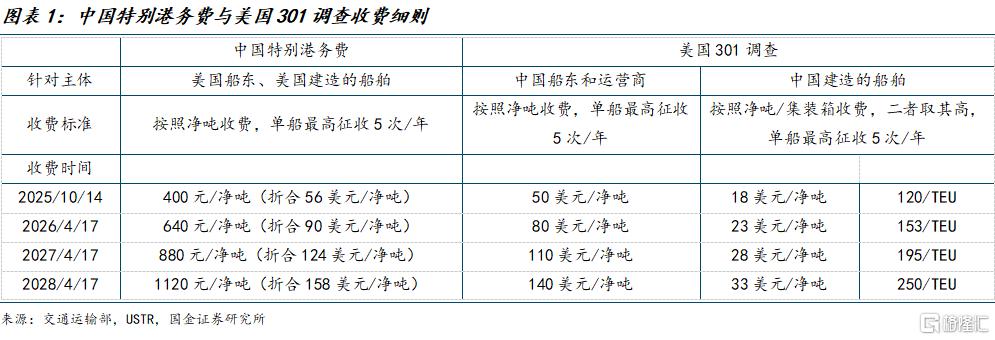
Investment Logic - China will impose a special port fee on U.S. vessels starting October 14, 2025, targeting U.S.-owned, operated, and flagged ships, as well as those built in the U.S. [1][7] - The fee will be collected by local maritime authorities, with a standard charge of 400 RMB (approximately 56 USD) per net ton, increasing annually [1][8]. Affected Capacity - The affected capacity includes U.S.-owned and flagged vessels, with container ships totaling 352,500 TEU (1.1% of global capacity), oil tankers at 20.418 million dwt (1.9%), and dry bulk carriers at 14.907 million dwt (2.1%) [2][12]. - The actual impact on U.S. capacity is reduced due to exemptions for Chinese-built vessels, resulting in effective percentages of 0.86% for container ships, 1.64% for oil tankers, and 0.95% for dry bulk carriers [13][14]. Economic Impact on Shipping Rates - The special port fee significantly affects oil and dry bulk shipping rates, with the fee accounting for approximately 89% of the current rate for VLCCs on the U.S. Gulf to Far East route and 123% on the Middle East to Far East route [25][26]. - For dry bulk carriers, the fee represents 76% of the rate for the Brazil to China route and 133% for the Australia to China route, indicating a loss of economic viability [28][29]. Short-term Effects on Shipping Companies - The imposition of the fee is expected to lead to a short-term supply shortage, driving up shipping rates as U.S. operators may cancel voyages or switch to transshipment routes [29][30]. - The efficiency loss from these changes will likely result in increased shipping costs and a reconfiguration of shipping routes, particularly affecting U.S. oil and dry bulk shipping to China [29][30]. Impact on Port Operations - The special port fee will not directly benefit port companies, as the fee is collected by maritime authorities rather than port operators [30]. - However, the reduction in U.S. shipping activity may lead to decreased throughput at affected ports, although this could be mitigated by other international operators filling the gap [30][33]. Investment Recommendations - Companies in the oil and dry bulk shipping sectors are recommended for investment due to potential rate increases stemming from supply disruptions [34]. - Ports with key transshipment hubs, particularly those oriented towards Southeast Asia, are also expected to benefit from shifts in trade flows [34].
Trade Tracker: Jenny Harrington sells Star Bulk Carriers
CNBC Television· 2025-09-29 17:19
Jenny has a move to tell you about. Star Bulk Carriers. You sold it.Yes. Why'd you do that. Oh my gosh.This was such a home run of an investment. So, we bought it in 2021 and we bought it around like 18 and change initially. We just sold it around 19 and change in like at the exit price.But here's the awesome part on this. We actually had 117% total return in those four years because they were paying out huge huge huge dividends. So when we bought it, um, dry bulk shipping rates were high and the inventory ...

西方上市干散货船东批量处置老旧船!
Sou Hu Cai Jing· 2025-08-13 10:33
Core Viewpoint - The dry bulk shipping industry is witnessing a trend of fleet optimization and capacity upgrades as several companies listed on the NYSE report their Q2 earnings, indicating a strategic shift towards modernizing their fleets and divesting older vessels [1][3]. Group 1: Star Bulk Carriers - Star Bulk Carriers, led by Petros Pappas, has sold 9 vessels that do not align with the company's commercial strategy, including the "Puffin Bulker" and "Star Canary" [1]. - The company has also agreed to sell an additional 6 vessels built between 2006 and 2011, expecting total proceeds of approximately $104 million, with plans to use about $19 million for early debt repayment by Q3 2025 [3]. - Star Bulk is modernizing its fleet with 5 new Kamsarmax vessels currently under construction in China, expected to be delivered in 2026, and operates a total of 142 vessels with a deadweight tonnage of 14.2 million tons [3]. Group 2: Genco Shipping and Trading - Genco Shipping and Trading is also updating its fleet, having announced the acquisition of a 2020-built Capesize bulk carrier, which is expected to be delivered between September and October [3]. - The company has invested approximately $200 million in modern, energy-efficient Capesize vessels since October 2023, with the latest acquisition believed to be related to the sale of the "Bulk Ginza" [5]. - Genco's CEO, John C Wobensmith, emphasized the strategy of selling older, less efficient vessels to invest in environmentally friendly ships, supported by a favorable supply-demand outlook for the Capesize market [6]. Group 3: Safe Bulkers and United Maritime - Safe Bulkers, led by Polys V Hajioannou, has sold the 2007-built Kamsarmax vessel "Pedhoulas Leader" for approximately $13 million as part of its fleet renewal strategy [8]. - The company has invested heavily in newbuilds, with 12 out of 18 vessels ordered delivered as of July 18, and currently operates 47 vessels with a deadweight tonnage of about 4.7 million tons [8]. - United Maritime, led by Stamatis Tsantanis, has confirmed the sale of the 2004-built Capesize vessel "Gloriuship" for about $15 million and is also selling the 2006-built "Tradership" for a net price of approximately $18 million [9]. - These transactions are expected to enhance United Maritime's financial position and enable the company to seize new growth opportunities, managing a fleet of 7 bulk carriers with a total deadweight tonnage of around 750,000 tons [9].