
Tencent Holdings Ltd.

Search documents
Puma to metals, China snapping up overseas assets again
The Economic Times· 2026-02-13 03:58
Core Insights - The volume of outbound mergers and acquisitions (M&A) from Greater China reached approximately $12 billion in January, marking the highest figure for the first month of a year since 2017 [1] - The increase in outbound M&A activity is attributed to heightened competition, fewer domestic opportunities, and renewed confidence among local brands, supported by Beijing's approval for strategic asset acquisitions [1][12] - Chinese companies are particularly interested in markets with lower regulatory hurdles, including consumer and retail sectors, as well as critical metals and technology [1][8][12] Outbound M&A Activity - Notable acquisitions include Luckin Coffee's potential bids for Blue Bottle Coffee and Costa Coffee, and HSG's interest in Leica Camera AG [5][11] - The Aluminum Corporation of China is acquiring a controlling interest in Cia. Brasileira de Alumínio, while CMOC Group and Jiangxi Copper Co. are making significant acquisitions in Brazil [8][11] - The strong performance of stock markets, such as Hong Kong's Hang Seng Index, has bolstered corporate confidence, facilitating increased M&A activity [6][11] Market Dynamics - The competitive landscape in China is driving innovation and positioning companies favorably for international expansion, particularly in Europe and Southeast Asia [9][12] - Private companies in China are often sector leaders, having developed the necessary scale and capabilities to compete globally [12] - The fast-growing data center sector is attracting investment, with companies like DayOne Data Centers planning expansions and IPOs [10][12] Strategic Considerations - The appetite for overseas expansion includes sensitive sectors, which may lead to complications in negotiations, as seen in the case of CK Hutchison Holdings Ltd. [7][11] - Companies are proactively advancing strategic priorities in a constructive M&A environment, supported by a dynamic global backdrop [11]



中国互联网:暂未发现增值税影响的证据-China Internet-No Evidence of VAT Impact
2026-02-04 02:32
Summary of Key Points from the Conference Call Industry Overview - **Industry**: China Internet and Other Services - **Key Focus**: Impact of the new Value Added Tax (VAT) regulation on the Internet industry, particularly gaming and advertising sectors [1][2][3] Core Insights - **Market Reaction**: On February 3, 2026, the Hang Seng Tech Index fell over 3%, with Tencent down 6% and Alibaba (BABA) down 5%, primarily due to concerns over the new VAT regulation affecting the Internet industry [2] - **VAT Regulation Details**: The new VAT law was passed in December 2024 and became effective on January 1, 2026. It reclassified certain telecom services, leading to an estimated EPS dilution of 8-15% for telecom operators [3][4] - **Internet Services VAT**: There is no evidence of any VAT change for Internet-related services, which remain at a 6% rate. The likelihood of future changes is considered low due to the complexity of the legislative process [5] Company-Specific Insights - **Tencent**: Identified as a top pick due to its resilient core businesses and strong positioning in consumer-facing AI applications [6][11] - **Alibaba (BABA)**: Viewed as a leading AI enabler with cloud services as a key growth catalyst [6][11] Additional Considerations - **AI Industry Outlook**: The outlook for China's AI sector is positive for 2026, driven by advancements in both supply (US and domestic chips) and demand (improvements in model coding and agentic capabilities) [6] - **Risks**: Potential risks include regulatory uncertainties in the gaming industry, intensified competition in social networks and advertising, and economic factors such as slower post-COVID recovery and consumption [16] VAT Rate Overview - **VAT Rates for Major Categories**: - 13%: Sale of goods, processing services, etc. - 9%: Basic telecommunications services - 6%: Sale of services and intangible assets [8] Analyst Ratings - **Stock Ratings**: Morgan Stanley uses a relative rating system, with Tencent rated as Overweight and Alibaba also rated positively [34][39] This summary encapsulates the critical points discussed in the conference call, focusing on the implications of the new VAT regulation on the Internet industry and the positioning of key companies like Tencent and Alibaba within this context.

中国股票策略:焦点清单调整-中港及 A 股主题-China Equity Strategy-Focus List Changes – ChinaHK and China A-share Thematic
2026-02-04 02:32
February 3, 2026 08:30 AM GMT China Equity Strategy | Asia Pacific Focus List Changes – China/HK and China A-share Thematic We add Chalco (601600.SS) and remove China Yangtze Power (600900.SS) in our China/HK Focus List and A-share Thematic List. We add Chalco (601600.SS) and remove China Yangtze Power (600900.SS) in our China/HK Focus List and A-share Thematic Focus List: Morgan Stanley Materials analyst Rachel Zhang believes the positive outlook for Chalco stems from the following: For more details on Cha ...
Chinese Tech Stocks Near Bear Market as Tax Concerns Mount
Yahoo Finance· 2026-02-03 09:39
An abrupt selloff in Chinese technology shares pushed a key index to the brink of a bear market, amid growing concerns that authorities may impose a tax on Internet firms. The Hang Seng Tech Index reversed an earlier gain to fall as much as 3.4% on Tuesday, briefly extending its drop to 20% from an October peak. Losses narrowed at the close, with the gauge ending down 1.1%. Kuaishou Technology, Baidu Inc. and Tencent Holdings Ltd. were among the biggest decliners. Most Read from Bloomberg The sudden dr ...
Looking to Expand Your Portfolio's Global Diversity? These ETFs May Help
The Motley Fool· 2026-01-25 07:32
Core Insights - The article compares two international ETFs: Vanguard FTSE Emerging Markets ETF (VWO) and iShares MSCI ACWI ex U.S. ETF (ACWX), highlighting their differing focuses on emerging markets versus a broader global diversification strategy [2] Cost and Size Comparison - VWO has a significantly lower expense ratio of 0.07% compared to ACWX's 0.32% [3][4] - As of January 25, 2026, VWO's one-year return is 28.53%, while ACWX's is 31.86% [3] - Both ETFs offer similar dividend yields, with VWO at 2.64% and ACWX at 2.7% [3] - VWO has assets under management (AUM) of $112.62 billion, significantly larger than ACWX's $8.53 billion [3] Performance and Risk Comparison - Over the past five years, VWO experienced a maximum drawdown of -34.31%, while ACWX had a drawdown of -30.06% [5] - An investment of $1,000 in VWO would have grown to $1,069 over five years, compared to $1,267 for ACWX [5] Portfolio Composition - ACWX, launched nearly 18 years ago, holds 1,796 companies across developed and emerging markets, with a focus on financial services, industrials, and technology [6] - The largest positions in ACWX include Taiwan Semiconductor Manufacturing Co., Tencent Holdings Ltd., and ASML Holding N.V. [6] - VWO is concentrated in emerging markets, with significant investments in technology, financial services, and consumer cyclical sectors, including major stakes in Taiwan Semiconductor, Tencent, and Alibaba Group [7] - TSMC alone constitutes over 10% of VWO's assets, indicating a higher concentration and potential volatility compared to ACWX [7] Dividend Payment Structure - ACWX pays dividends semi-annually, while VWO pays dividends quarterly, which may influence investor preferences regarding cash flow [10]
These Global ETFs Offer International Exposure but One Spans Further
Yahoo Finance· 2026-01-24 23:30
Core Insights - The SPDR Portfolio Developed World ex-US ETF (SPDW) and Vanguard Total International Stock ETF (VXUS) provide broad international exposure, with SPDW focusing on developed markets and VXUS including both developed and emerging markets [2] Cost & Size Comparison - VXUS has an expense ratio of 0.05% and AUM of $573.72 billion, while SPDW has a lower expense ratio of 0.03% and AUM of $35.07 billion [3] - The 1-year return for VXUS is 31.69% compared to SPDW's 32.6%, and the dividend yield for VXUS is 3.02% versus SPDW's 3.14% [3][4] Performance & Risk Metrics - Over five years, VXUS has a max drawdown of -29.43% and a growth of $1,000 to $1,256, while SPDW has a max drawdown of -30.20% and a growth of $1,000 to $1,321 [5] Holdings Overview - SPDW holds 2,413 stocks with a sector tilt towards financials, industrials, and consumer cyclical, featuring top holdings like ASML Holding N.V., Samsung Electronics, and Roche Holding AG [6] - VXUS is broader with 8,673 holdings, including top positions such as Taiwan Semiconductor Manufacturing Company Ltd., Tencent Holdings Ltd., and ASML Holding N.V. [7] Investor Considerations - International stocks in these ETFs may exhibit different price movements compared to U.S. stocks, influenced by the economic and political conditions of the respective countries [8] - SPDW's top holdings are primarily European, while VXUS has a significant presence in Asian companies, indicating different regional exposures [10]
VWO vs. SPDW: How Does a Emerging Markets ETF Fair Against a Developed World Fund?
The Motley Fool· 2026-01-24 20:29
Core Insights - The Vanguard FTSE Emerging Markets ETF (VWO) and SPDR Portfolio Developed World ex-US ETF (SPDW) are both international equity ETFs with different regional focuses, catering to diverse investment strategies [1] Cost & Size Comparison - VWO has an expense ratio of 0.07% and assets under management (AUM) of $111.14 billion, while SPDW has a lower expense ratio of 0.03% and AUM of $35.1 billion [2] - The one-year return for VWO is 28.53%, compared to SPDW's 35.3%, and the dividend yield for VWO is 2.64%, while SPDW offers a higher yield of 3.2% [2] Performance & Risk Analysis - Over the past five years, VWO experienced a maximum drawdown of -34.31%, while SPDW had a lower drawdown of -30.20% [4] - A $1,000 investment in VWO would have grown to $1,069 over five years, whereas the same investment in SPDW would have grown to $1,321 [4] Portfolio Composition - SPDW provides exposure to 2,413 companies in developed international markets, with significant holdings in financial services, industrials, and technology [5] - VWO focuses on emerging markets, with major investments in technology, financial services, and consumer cyclical sectors, including a substantial stake in Taiwan Semiconductor Manufacturing Company, which constitutes over 10% of its assets [6] Investor Considerations - Both ETFs have minimal exposure to U.S. stocks, which may present unique risks for U.S. investors due to differing market behaviors influenced by local economic and political factors [7] - SPDW's top holdings are primarily European companies, while VWO's are mainly Asian, indicating a geographical investment strategy difference [8] - For investors seeking technology-focused exposure, VWO is preferable, while SPDW is characterized as a more balanced option with a higher dividend yield [9]

China Tech Boom Leaves Economic Malaise Behind
ZeroHedge· 2026-01-19 04:55
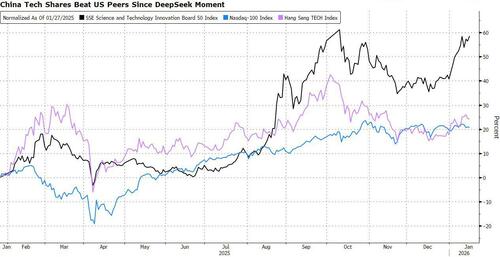
Core Viewpoint - China's technological advancements are driving a stock rally, despite a fragile economy, with significant enthusiasm for homegrown technologies leading the market [1][3]. Group 1: Market Performance - Chinese tech shares have surged nearly 13% this month, with Hong Kong-listed tech firms climbing almost 6%, outperforming the Nasdaq 100 [2]. - A basket of 33 Chinese AI stocks has seen their combined market value increase by approximately $732 billion over the past year, with further upside expected as their market capitalization is only 6.5% of the US's [8]. Group 2: Technological Developments - Progress in various sectors, including commercial rockets, robotics, and flying cars, is contributing to the bullish sentiment in Chinese equities [2]. - The adoption of generative AI has surged among major Chinese internet companies, such as Alibaba and Tencent, following DeepSeek's AI breakthrough [6]. Group 3: Future Outlook - Anticipation of DeepSeek's new AI model release and China's upcoming five-year economic plan focusing on technological self-reliance may further bolster market confidence [3][14]. - Analysts predict that the next major AI breakthrough will occur at the application layer, with China well-positioned to lead due to its diverse user cases [10]. Group 4: Investment Sentiment - Some investors remain optimistic about the technology sector's prospects, citing advantages like a low-cost base and strong state support [12]. - The expected release of DeepSeek's R2 model may act as a catalyst for further disruption in the sector, reinforcing China's competitive stance against US AI dominance [13]. Group 5: Valuation Concerns - The recent stock rally has raised concerns about stretched valuations, with some companies trading at significantly higher multiples compared to the Nasdaq 100 [12].

腾讯-2025 年第四季度前瞻:宏观放缓背景下表现稳健
2026-01-19 02:32
Tencent Holdings Ltd. 4Q25 Earnings Call Summary Company Overview - **Company**: Tencent Holdings Ltd. - **Industry**: Internet and Other Services in Asia Pacific - **Date of Call**: January 18, 2026 Key Financial Metrics - **Revenue Growth**: Projected revenue increase of 12% YoY, with non-IFRS operating profit (OP) up 14% [1][9] - **Value-Added Services (VAS)**: Revenue expected to rise by 12.0% YoY, with online games growing by 16.7% [2][9] - **Marketing Services**: Anticipated growth of 18.5% YoY, driven by AI ad-tech upgrades [3][9] - **FinTech and Business Services (FBS)**: Expected to grow by 7.5% YoY, impacted by weaker commercial payments [4][9] Revenue Breakdown - **VAS Revenue**: Estimated at Rmb 88.469 billion for 4Q25, with online games contributing Rmb 57.433 billion [12] - **Domestic Games**: Expected to grow by 12.5% YoY - **International Games**: Expected to grow by 25.4% YoY - **Marketing Services Revenue**: Projected at Rmb 41.488 billion, reflecting an 18.5% increase [12] - **FBS Revenue**: Expected at Rmb 60.336 billion, a 7.5% increase YoY [12] Profitability Metrics - **Gross Profit**: Expected to be Rmb 105.653 billion, with a gross margin of 54.8% [12] - **Operating Profit (Non-IFRS)**: Projected at Rmb 67.790 billion, with a non-IFRS operating margin of 35.2% [12] - **Net Profit (Non-IFRS)**: Expected to be Rmb 61.160 billion, reflecting a 10.6% increase YoY [12] Market Position and Strategy - **Price Target**: Maintained at HK$735, implying a 19% upside from the current price of HK$617.50 [5][7] - **Valuation Approach**: Price target derived from a discounted cash flow (DCF) model, with a 10% discount rate and 3% terminal growth rate [16][19] - **Competitive Position**: Tencent is viewed as a leading player in China's online consumer market, with strong revenue growth and earnings visibility [26][27] Risks and Considerations - **Macro Environment**: The company is navigating a macroeconomic slowdown, but remains resilient compared to peers [1][5] - **Regulatory Risks**: Rising competitive and regulatory risks in the industry are acknowledged [5][26] - **Investment in AI**: Initial investments in AI are expected to narrow operating leverage, leading to a slight reduction in non-IFRS OP estimates for 2025-27 by 1-2% [5][9] Future Outlook - **Growth Projections**: Total revenue is expected to grow at a CAGR of 9.1% from 2025 to 2030 [25] - **Earnings Visibility**: Continued focus on monetization across all products and services, particularly in mobile games and fintech [24][26] Conclusion - Tencent Holdings Ltd. is positioned to maintain growth despite macroeconomic challenges, with a strong focus on AI and digital services. The company’s strategic investments and market leadership in various segments provide a solid foundation for future performance.
China's tech stock boom pushes past economic malaise
The Economic Times· 2026-01-19 00:33
Core Viewpoint - Chinese tech shares are experiencing significant growth driven by advancements in various sectors, including AI, robotics, and flying cars, with notable performance in January 2026 [1][18]. Group 1: Market Performance - An onshore Nasdaq-like tech gauge has increased by almost 13% this month, while Hong Kong-listed Chinese tech firms have risen nearly 6%, both outperforming the Nasdaq 100 [1][18]. - The combined market value of 33 Chinese AI stocks tracked by Jefferies Financial Group has expanded by approximately $732 billion over the past year, with China's AI market capitalization representing only 6.5% of the US's [9][18]. Group 2: Technological Advancements - Enthusiasm for homegrown technologies has been the primary driver of China's equities bull run since April, despite challenges in the housing market and weak consumption [2][18]. - The rollout of a new AI model by DeepSeek and the unveiling of a five-year economic blueprint focusing on technological self-reliance are expected to further support market momentum [2][15][18]. - Chinese firms are accelerating efforts to develop AI models following DeepSeek's success, with generative AI adoption surging among major internet companies like Alibaba and Tencent [5][6][18]. Group 3: Investment Sentiment - Investors are optimistic about the technology sector's prospects due to China's low-cost base and strong state support, with expectations that the release of DeepSeek's R2 model could disrupt the sector again [14][18]. - Recent listing debuts of Chinese AI-related companies have shown significant gains, encouraging more firms to enter public markets [10][18]. - Analysts predict that the next major breakthrough in AI will occur at the application layer, with China well-positioned to lead this evolution due to its diverse user cases [11][18]. Group 4: Valuation Concerns - The rapid rally in tech stocks has raised concerns about stretched valuations, with some companies trading at high multiples, such as Cambricon Technologies at about 120 times forward earnings [13][18]. - Beijing's decision to tighten margin financing indicates growing unease with speculative excess in the technology sector [13][18].